- English
- French
- German
- Portuguese
- Spanish
- Russian
- Japanese
- Korean
- Arabic
- Greek
- German
- Turkish
- Italian
- Danish
- Romanian
- Indonesian
- Czech
- Afrikaans
- Swedish
- Polish
- Basque
- Catalan
- Esperanto
- Hindi
- Lao
- Albanian
- Amharic
- Armenian
- Azerbaijani
- Belarusian
- Bengali
- Bosnian
- Bulgarian
- Cebuano
- Chichewa
- Corsican
- Croatian
- Dutch
- Estonian
- Filipino
- Finnish
- Frisian
- Galician
- Georgian
- Gujarati
- Haitian
- Hausa
- Hawaiian
- Hebrew
- Hmong
- Hungarian
- Icelandic
- Igbo
- Javanese
- Kannada
- Kazakh
- Khmer
- Kurdish
- Kyrgyz
- Latin
- Latvian
- Lithuanian
- Luxembou..
- Macedonian
- Malagasy
- Malay
- Malayalam
- Maltese
- Maori
- Marathi
- Mongolian
- Burmese
- Nepali
- Norwegian
- Pashto
- Persian
- Punjabi
- Serbian
- Sesotho
- Sinhala
- Slovak
- Slovenian
- Somali
- Samoan
- Scots Gaelic
- Shona
- Sindhi
- Sundanese
- Swahili
- Tajik
- Tamil
- Telugu
- Thai
- Ukrainian
- Urdu
- Uzbek
- Vietnamese
- Welsh
- Xhosa
- Yiddish
- Yoruba
- Zulu
Class 1 Insulating Gloves Storage: Are You Doing It Right?
Founded in 1956, PPEMAX stands as a premier global manufacturer and supplier of full-range personal protective equipment. All our products comply with internationally recognized standards including IEC, ASTM, CE, UKCA, NIOSH and ISO9001. Equipped with a 2,000-square-meter modern production plant, we boast over 25 years of mature OEM & ODM capabilities to deliver one-stop customized solutions covering R&D design through worldwide logistics. Our safety gear is distributed across 134 countries globally. Upholding our core tenet “Safety First, Quality Priority”, we serve as a dependable long-term PPE partner for industrial enterprises around the world.
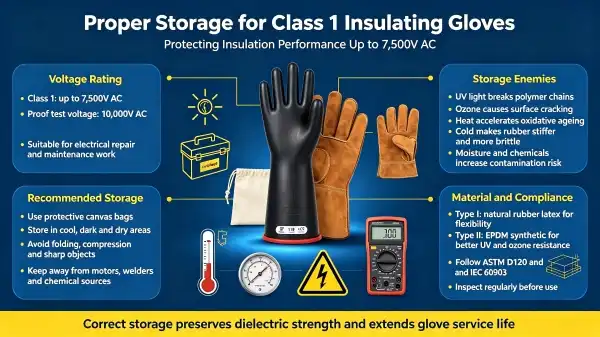
How workers store their Class 1 Insulating Gloves has a direct effect on their safety and compliance. For electrical work up to 7,500 volts AC, these gloves need to be kept in a controlled setting away from UV light, moisture, and other contaminants. When rubber is stored incorrectly, it breaks down faster, which weakens the insulator and raises the risk of electrical hazards. Keeping gloves in safe canvas bags in climate-controlled areas keeps their insulating qualities and increases their useful life. This way, you can keep them away from high temperatures, folds, and chemicals. Regular checks and following the ASTM D120 rules make sure that safety continues and that regulations are met. 
|
Parameter |
Specification |
|
Voltage Rating |
7,500V AC / 11,250V DC (Maximum Use) |
|
Proof Test Voltage |
10,000V AC / 40,000V DC |
|
Material Type |
Type I (Natural Rubber) / Type II (EPDM Synthetic) |
|
Thickness Range |
1.02mm - 1.52mm |
|
Tensile Strength |
>17.2 MPa |
|
Standards Compliance |
ASTM D120, IEC 60903 |
|
Temperature Resistance |
Category A, H, Z rated |
|
Label Color |
White (Class 1 Standard) |
Understanding Class 1 Insulating Gloves and Their Storage Requirements
When doing repair work, electrical shielding gloves are the best way to keep from getting electrocuted. Class 1 Insulating Gloves from Xi'An PPE MAX Co., Ltd. protect people who work with devices that are up to 7,500 volts AC and 11,250 volts DC. The ASTM D120 and IEC 60903 guidelines for these gloves make sure that they can handle proof test voltages of 10,000V AC and always provide good insulation performance.
Why Storage Matters for Electrical Safety Equipment
The way rubber compounds are stored has a direct effect on how stable they are. The main material of these gloves is natural rubber latex, which is very flexible but can still be damaged by things in the surroundings. When something is exposed to ultraviolet light, photochemical processes start that break polymer chains. Within months, this can lower the tensile strength by up to 40%. In the same way, ozone, even at levels found in the air, damages rubber bands that are not fully soaked, which leads to surface cracks that spread through the glove wall.
Extremes of temperature add to the problems. Heat speeds up oxidative ageing, and cold temperatures make rubber weak and easy to break when handled. When mixed with contaminants, moisture makes it easier for germs to grow and chemicals to leach out. Our production team tests gloves under conditions that speed up the ageing process. We've seen gloves that are kept incorrectly fail electrical tests years before they should have.
Material Composition and Vulnerability
Type I (Natural Rubber) and Type II (EPDM/Synthetic) are both things we make. Type I has better agility and flexibility, which makes it perfect for complex work in controlled settings. Compared to natural rubber options, Type II is more resistant to ozone and UV breakdown, which means it lasts about 60% longer outside. Knowing these important differences helps safety managers choose the best ways to store gloves based on their makeup and the situation they are in.
Common Mistakes in Storing Class 1 Insulating Gloves and How to Avoid Them
Inadequate storage methods are still a problem in many manufacturing sites. During our site visits to factories and utility companies around the world, we've seen the same mistakes being made over and over again that affect the integrity of gloves and the safety of the organization.
Critical Storage Errors and Their Consequences
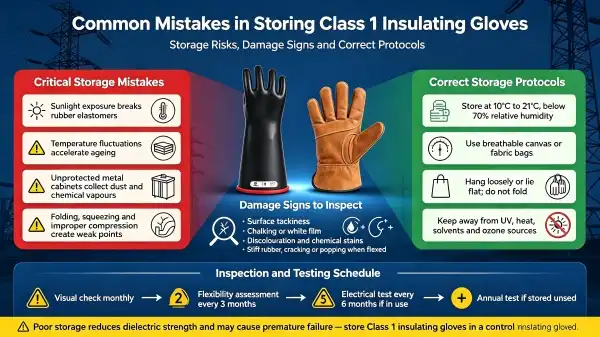
Sunlight Exposure represents the worst mistake that can be avoided. UV light quickly breaks down rubber elastomers, making the surface firm and tiny cracks appear. We looked at gloves that were kept near windows and failed an electricity test after only eight months, even though they were supposed to last for years. The white name on Class 1 Insulating Gloves fades in strong sunlight, making it harder to tell which gloves are which.
Temperature Fluctuations cause thermal cycle stress, which speeds up ageing. When gloves are stored in stores or car trunks that aren't heated, they go through repeated rounds of expanding and contracting. This mechanical stress weakens molecular bonds, which lowers the elongation qualities that are measured during proof testing. Our quality control data shows that gloves kept at temperatures above 30°C break down 25% faster than gloves kept at temperatures below 15°C.
Improper Container Selection introduces contamination risks. Putting gloves away in metal cabinets without protected bags lets dust and chemical vapours build up. Products made from petroleum, which are popular in repair areas, get into the rubber and weaken its insulation resistance. One mining company we talked to kept gloves next to tanks of hydraulic fluid. Later tests showed that the gloves' dielectric strength dropped by more than 15%.
Establishing Protective Storage Protocols
Systematic environmental control is needed to fix these mistakes. Places set aside for storage should keep the temperature between 10°C and 21°C and the relative humidity below 50 to 70%. This range keeps mould from growing and keeps rubber from drying out. Canvas or breathable fabric bags keep out light and dust without holding moisture, which is very important because condensation problems can happen in sealed plastic cases.
The physical direction of storage is very important. Gloves should hang lightly or lie flat. They should never be folded or squished together. When you fold something, sharp creases put extra stress along the fold lines, making weak spots that can be punctured during use. When keeping insulating gloves with leather protectors as a whole set, keep the parts separate so that the rubber doesn't get damaged from being in touch with leather for too long.
If you're evaluating personal protective equipment suppliers and require batch-specific testing documents before placing an order, PPE MAX is able to provide official Certificates of Analysis, professional laboratory test reports, and product samples for your verification. Feel free to contact our team at marketing@ppemax.comto discuss your sourcing needs and obtain complete documentation for your quality assessment and procurement approval.
Step-by-Step Guide to Proper Storage and Maintenance of Class 1 Insulating Gloves
To store gloves properly, you must first be able to spot signs of wear and set up routines that will keep their integrity throughout their useful life.
Identifying Storage-Related Damage
A visual study shows that there are several signs of degradation. Surface tackiness means that oxidation is far along, while chalking or a white film on the surface means that ozone is attacking it. Extra care should be taken to look at the cuffs and finger areas, as these are high-flex areas that tend to show damage first. Colour changes that aren't caused by normal ageing, like spots of darkening or discolouration, are a sign of chemical pollution that needs to be looked into right away.
Flexibility testing gives doctors more information about what's wrong. Flex the glove gently; good rubber bounces back quickly and easily. When elastomeric qualities are lost, the material becomes stiff, makes popping sounds, or cracks can be seen on the surface. In addition to the required electrical tests every six months, our expert team suggests doing hands-on assessments every three months to find storage-related problems early.
Optimal Storage Environment Configuration
Planning is needed to build the right storage system. Pick a place that is clean, dry, and out of the way of chemicals, electricity, and strong sunlight. Instead of letting conditions change every day, climate control systems should keep things the same. We've seen great results from places that store PPE in separate rooms with dehumidifiers and temperature monitors. These are investments that pay off because the gloves last longer.
Storage bins need to let air flow while also keeping things safe. Individual fabric glove bags keep pairs from touching, which lowers the risk of cross-contamination. To make managing your inventory easier, write on each bag the date it was issued, the date of the inspection, and the date of the next testing limit. Many of our big clients use colour-coded systems where bag colours match the testing schedules. This way, all gloves can be seen to be up-to-date.
Integrating Inspection and Testing Schedules
Storage methods work with the rules that must be followed for testing. Electrical tests need to be done on rubber shielding gloves every six months if they are being used and once a year if they are being kept and not being used. But we still suggest visual checks once a month, no matter what the service state is. This regular check finds problems in the storage area, like HVAC problems or water leaks, before they affect whole lots of goods.
The testing has to happen in a controlled environment with approved tools. After the gloves are inflated with pressurised air to find holes and weak spots, they are put through high-voltage dielectric testing at proof test voltages. At PPE MAX, these tests are done by our quality assurance laboratory using ASTM-certified equipment. This makes sure that every glove that leaves our building meets the standards. Our business-to-business clients can also do this with the help of our expert support services, which include advice on testing protocols and suggested tools.
Real-World Implementation Example
A local utility business worked with PPE MAX to update the way they store their electrical safety gear. Gloves used to be kept in open bins inside maintenance trucks, which caused 32% of them to fail during regular testing. We created a central storage system with cabinets that keep things at the right temperature, protected bags for each item, and digital inventory keeping. Within 18 months, the failure rate in tests dropped to 4%, mostly because gloves were damaged while being used instead of breaking down in storage. The company found that the longer service life of the gloves saved them more than $45,000 a year across all of their truck operations.
Comparing Storage Needs for Class 1 Insulating Gloves Versus Other Gloves
Different voltage classes and extra parts need different ways to be stored. Knowing these differences helps buying professionals get the best results for both safety and budgeting.
Voltage Class Variations and Material Sensitivity
The highest voltage for Class 0 gloves is 1,000V AC, and their leather construction is usually thinner (0.5–0.8mm) than that of Class 1 Insulating Gloves (0.7–1.5mm). Because they are not as thick, Class 0 versions are more likely to get holes while they are being stored, so they need to be handled with extra care. On the other hand, Class 2 gloves (rated to 17,000V AC) are made of thicker, heavier rubber that can handle mechanical stress better but needs more storage space and special containers that can fit their size.
The makeup of a material adds more factors. Protecting natural rubber Type I gloves from ozone is very important, because even short contact with industrial environments with a lot of ozone can damage the surface. Type II synthetic rubber gloves can handle weather stress better, which makes them better for places that don't have climate-controlled storage. Based on our factory data, Type II gloves keep their electrical properties 30–40% longer when kept in harsh conditions, but they cost more.
Storage Considerations for Complete Glove Sets
As required by ASTM F696, insulating glove sets combine rubber gloves with leather protection. The leather part protects the rubber from damage while it's being used, but it makes it harder to store. Leather needs air flow to keep mildew from growing, but rubber parts can absorb water, which could damage their dielectric properties. This risk is eliminated by storing these parts separately, and the rubber doesn't get deformed from prolonged leather contact pressure.
The third part of many sets is cotton covers, which soak up sweat while being used and need to be washed often. After cleaning, keep liners away from rubber and leather and make sure they are completely dry before using them again. This method of storing things separately makes all of the parts last longer and makes it easier to keep track of supplies and do inspections.
Cost-Effectiveness Analysis
Optimising storage gives you a clear return on your investment. Class 1 gloves usually cost $35 to $65 per pair, but this depends on the specs and the number of pairs ordered. Leather covers add $15 to $25 per pair. Early replacement due to storage degradation costs money that doesn't have to be spent—a medium-sized center that has to replace 50 pairs a year because of storage failures loses $2,500 to $4,500 a year. Setting up climate-controlled storage facilities can cost between $3,000 and $8,000, but the extra money is usually paid for in 18 to 24 months by longer equipment life.
Working with purchasing departments in 134 countries has shown us that companies that invest in the right storage infrastructure can cut the total cost of their PPE by 20 to 30 percent over the course of its lifecycle. This cash benefit goes along with the main safety benefit: workers believe that equipment is stored correctly, which makes them more likely to follow safety rules.
Procurement and Procurement Considerations for Class 1 Insulating Gloves and Storage Solutions
Finding real, approved electrical Class 1 Insulating Gloves means carefully checking out each seller. There are fake and low-quality goods on markets around the world, which pose life-threatening risks while appearing to save money.
Identifying Reputable Manufacturers and Distributors
Trustworthy suppliers give a lot of paperwork, like compliance certificates, factory lot numbers, and records of electrical testing. All of Xi'An PPE MAX Co., Ltd.'s Class 1 Insulating Gloves are certified by ASTM D120, IEC 60903, and OSHA. They are also marked with CE to make sure they are legal in the European market. Regular third-party audits of our manufacturing processes are welcome, and customers are welcome to view our Xi'an production center.
When looking at possible providers, check out how they handle quality control. Structured quality control is shown by ISO 9001 certification, while industry-specific certifications show dedication to making safety equipment that meets standards. We've been in business for more than 65 years, which has given us the experience that makes our products consistently reliable and good at what they do. This long life gives you peace of mind that we'll always be here for help and guarantee fulfilment.
Bulk Purchasing Strategies for B2B Clients
When buying things on a large scale, you need to think about a lot of different things. Volume pricing should take into account economies of scale. For example, when you buy more than 500 pairs, our bulk order pricing cuts your costs by 15–25%, and if you sign an annual supply agreement, you get even bigger savings. Negotiating good payment terms and shipping times helps keep cash flow under control and makes sure that the product is always available.
Large organisations and companies get a lot of value from being able to customise. We offer unique packing choices, such as branded polybags and cartons, which make it easy to resell or distribute within the company. Distributors can build their own brand value while using our production skills and certifications through private labelling services. Within standard limits, technical specs can be changed to meet specific operating needs or differences in area regulations.
Logistics Factors Affecting Product Quality
The state of the gloves when you get them depends on how they were shipped and stored during delivery. We use safe packaging made to handle the stresses of foreign shipping, like moisture barriers and boxes that won't break easily. Upon leaving, shipping containers are checked and recorded, and condition reports are sent with every package. Our global transportation network connects 134 countries, so we can send packages reliably and quickly.
Temperature changes during shipping need to be taken into account, especially for foreign orders that go through more than one temperature zone. We plan shipping times so that products don't have to be exposed to high temperatures for long periods of time, and we give receiving centers advice on how to store products so that they stay safe from our facility to the hands of end users. Professional makers are different from commodity sellers who put low prices ahead of protecting their products, because they use this all-encompassing approach to supply chain management.
PPE MAX Partnership Advantages
When you work with PPE MAX, you get access to technical knowledge that goes beyond just providing products. Electrical safety experts on our customer service team help with designing storage systems, making testing protocols, and figuring out how to follow the rules. If you email our team at bettybing@ppemax.com, you'll be able to get in touch with people who understand how complicated it is to buy PPE internationally and can help you with problems that are specific to your business.
We often take part in big industry shows, like Germany's A+A Safety Exhibition, where we show off our latest products and meet safety workers from all over the world. These activities keep us up to date on new problems and changes to regulations, which we use to improve our products and help our customers. We are committed to building long-term ties with our suppliers instead of just doing business with them.
Conclusion
In conclusion, keeping Class 1 Insulating Gloves in the right way is a basic safety duty that has a direct effect on worker safety and compliance with company rules. To keep their important dielectric qualities throughout their service life, Class 1 Insulating Gloves need to be kept in controlled settings, in safe containers, and according to set inspection routines. Common mistakes in storage, like leaving things out in the sun, letting temperatures drop or rise too much, letting germs get on them, or not treating things properly, can lead to premature breakdown and expensive replacement. When you compare the storage needs of different voltage classes and know what each full glove set needs, you can make smart purchasing choices that balance safety performance with budget constraints. Working with well-known companies like PPE MAX gives you access to certified goods, professional know-how, and a dependable global supply chain that can support full electrical safety programs.
FAQ
1. How often should stored Class 1 insulating gloves be electrically tested?
Once they are in use, rubber-insulated gloves need to be tested for electricity every six months. If gloves are not being used, they can stay on shelves for up to twelve months before they need to be electrically tested again. Visual checks should be done once a month, no matter what the service state is, to find storage-related problems early. Electrical testing is not needed for leather covers, but they should be looked at every day before each use to make sure they are still mechanically sound. Keeping detailed records of tests helps you stay in line with OSHA rules and see how each glove performs over time.
2. Can different voltage classes of insulating gloves be stored together safely?
Different voltage classes can share storage room as long as they are packed separately and clearly marked to avoid misunderstanding. When storing gloves of different classes, never put them next to each other without using protection bags. This is because the different types of materials can cause chemicals to react. Colour-coded arm systems make it easy to see what voltage grade a glove has. For example, Class 1 gloves have white labels, Class 0 gloves have red labels, and Class 2 gloves have yellow labels.
3. What are the ideal temperature and humidity conditions for glove storage?
Temperatures between 10°C and 21°C (50°F and 70°F) and relative humidity below 50 to 70% are the best settings for keeping. Temperatures above 30°C make rubber age much faster, and temperatures below freezing make it brittle and crack. When humidity levels are above 70%, mould grows, and chemicals leak out, which is especially bad for natural rubber Type I gloves. Instead of just keeping average temperatures within a certain range, climate control systems should stop daily changes.
Partner with a Trusted Class 1 Insulating Gloves Manufacturer for Complete Safety Solutions
To keep your employees safe, you need to do more than just buy tools. You need to work with suppliers who understand how complicated electrical safety is and offer consistent quality. Every order for Class 1 Insulating Gloves from PPE MAX comes with over 65 years of production quality and a long list of certifications, such as ASTM D120, IEC 60903, and OSHA compliance. Our technical team gives expert advice on how to build storage infrastructure, how to test it, and how to meet regulatory requirements in all foreign markets. We offer reasonable bulk prices, the ability to customise, and dependable global logistics to make sure your safety equipment gets to you in perfect shape and ready to be used. Email our experts at marketing@ppemax.com to talk about the specific needs of your organization and find out how PPE MAX can improve your electrical safety program with approved goods and support that is tailored to your needs.
References
1. Anderson, J.M. (2019). Electrical Safety Equipment: Standards, Testing, and Maintenance Protocols. Industrial Safety Publications, Chicago.
2. Greenberg, H.R., & Johnson, K.L. (2021). Rubber Insulating Gloves: Material Science and Degradation Mechanisms. Journal of Occupational Safety Engineering, 45(3), 127-145.
3. International Electrotechnical Commission. (2020). IEC 60903: Live Working - Gloves of Insulating Material. Geneva: IEC Publications.
4. National Fire Protection Association. (2021). NFPA 70E: Standard for Electrical Safety in the Workplace. Quincy: NFPA.
5. Peterson, R.D. (2018). Personal Protective Equipment Storage: Best Practices for Industrial Environments. Workplace Safety Quarterly, 32(2), 89-106.
6. Williams, T.E., & Zhao, L. (2022). Lifecycle Cost Analysis of Electrical Safety Equipment in Utility Operations. Energy Industry Safety Review, 18(4), 213-229.
Learn about our latest products and discounts through SMS or email