- English
- French
- German
- Portuguese
- Spanish
- Russian
- Japanese
- Korean
- Arabic
- Greek
- German
- Turkish
- Italian
- Danish
- Romanian
- Indonesian
- Czech
- Afrikaans
- Swedish
- Polish
- Basque
- Catalan
- Esperanto
- Hindi
- Lao
- Albanian
- Amharic
- Armenian
- Azerbaijani
- Belarusian
- Bengali
- Bosnian
- Bulgarian
- Cebuano
- Chichewa
- Corsican
- Croatian
- Dutch
- Estonian
- Filipino
- Finnish
- Frisian
- Galician
- Georgian
- Gujarati
- Haitian
- Hausa
- Hawaiian
- Hebrew
- Hmong
- Hungarian
- Icelandic
- Igbo
- Javanese
- Kannada
- Kazakh
- Khmer
- Kurdish
- Kyrgyz
- Latin
- Latvian
- Lithuanian
- Luxembou..
- Macedonian
- Malagasy
- Malay
- Malayalam
- Maltese
- Maori
- Marathi
- Mongolian
- Burmese
- Nepali
- Norwegian
- Pashto
- Persian
- Punjabi
- Serbian
- Sesotho
- Sinhala
- Slovak
- Slovenian
- Somali
- Samoan
- Scots Gaelic
- Shona
- Sindhi
- Sundanese
- Swahili
- Tajik
- Tamil
- Telugu
- Thai
- Ukrainian
- Urdu
- Uzbek
- Vietnamese
- Welsh
- Xhosa
- Yiddish
- Yoruba
- Zulu
Are Electrical Rubber Gloves Required by OSHA?
Founded in 1956, PPEMAX stands as a premier global manufacturer and supplier of full-range personal protective equipment. All our products comply with internationally recognized standards including IEC, ASTM, CE, UKCA, NIOSH and ISO9001. Equipped with a 2,000-square-meter modern production plant, we boast over 25 years of mature OEM & ODM capabilities to deliver one-stop customized solutions covering R&D design through worldwide logistics. Our safety gear is distributed across 134 countries globally. Upholding our core tenet “Safety First, Quality Priority”, we serve as a dependable long-term PPE partner for industrial enterprises around the world.
Electrical rubber gloves are required by OSHA when workers face potential exposure to electrical hazards. Under 29 CFR 1910.137, employers must provide insulating gloves for employees working on or near energized electrical circuits and equipment where contact with energized parts is possible. OSHA mandates these gloves as critical personal protective equipment to prevent electrical shock and arc flash incidents. The requirement applies across voltage levels, from low-voltage control systems to high-voltage utility work, with glove class selection depending on the maximum anticipated voltage exposure.
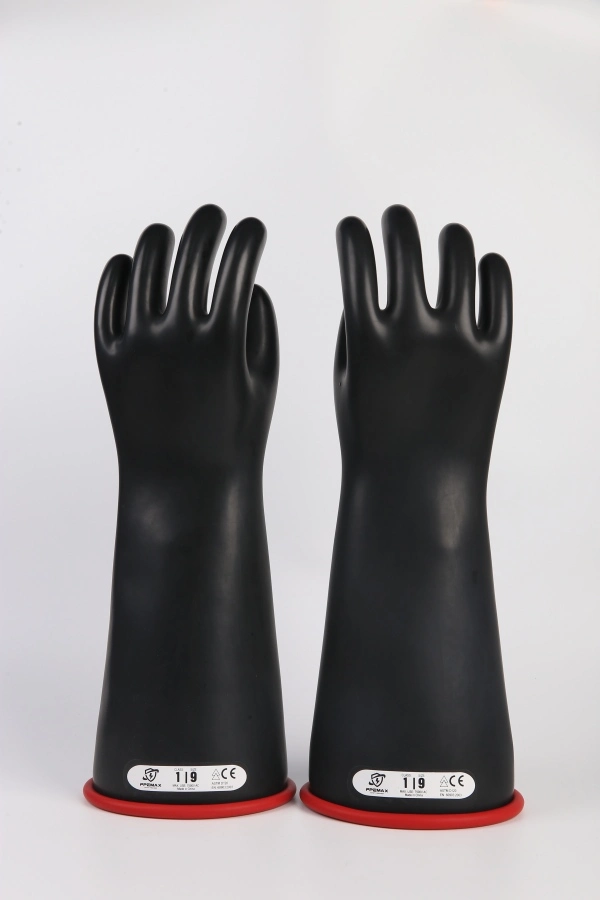
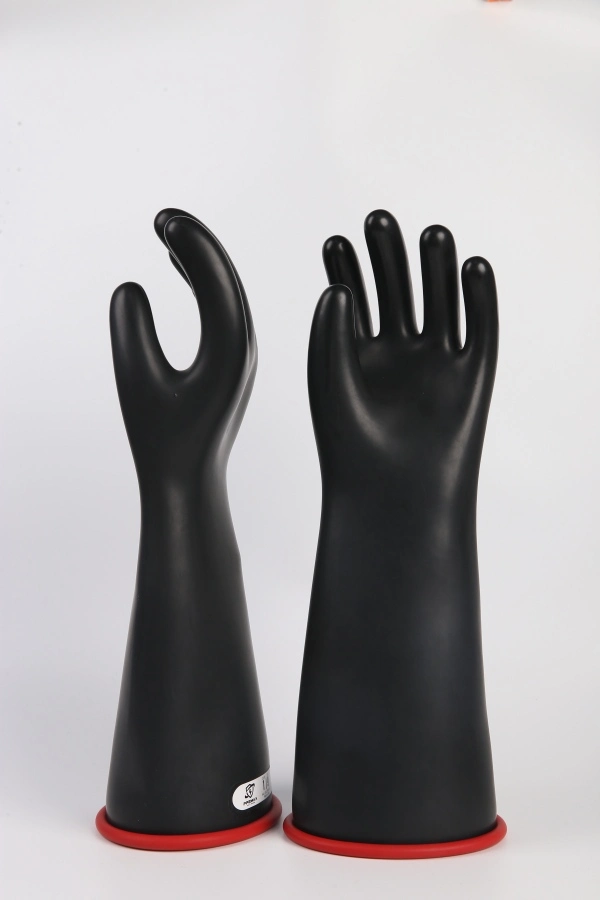
|
Parameter |
Specification |
|
Maximum Use Voltage |
1,000V AC / 1,500V DC |
|
Proof Test Voltage |
5,000V AC / 20,000V DC |
|
Label Color |
Red (ASTM D120/IEC 60903) |
|
Material Type |
Type I (Natural Rubber) / Type II (EPDM) |
|
Thickness |
1.02mm (0.040 inches) |
|
Length Options |
11", 14", 16" inches |
|
Cuff Styles |
Straight, Bell, Contour |
|
Standards Compliance |
ASTM D120, IEC 60903, OSHA 29 CFR 1910.137 |
Understanding OSHA Requirements for Electrical Rubber Gloves
The Regulatory Framework Behind OSHA Compliance
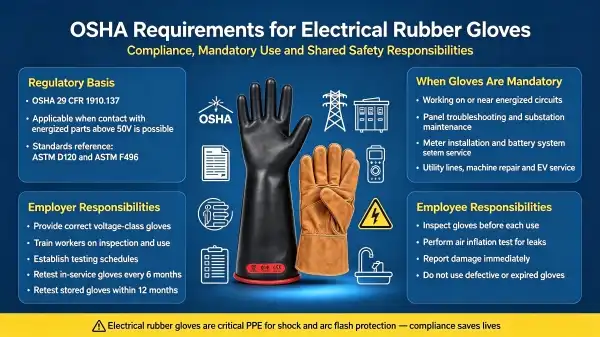
Electrical rubber gloves in the workplace are required by law according to OSHA rule 29 CFR 1910.137. This standard uses the ASTM D120 and ASTM F496 specifications to make a complete safety framework that keeps workers safe from electrical hazards. The rule doesn't just suggest wearing electrical rubber gloves; it requires them to be worn whenever workers could reasonably touch parts that are live and working at more than 50 volts. Almost all industrial electrical systems are below this level, from 240-volt residential service panels to 35,000-volt utility distribution lines.
When Electrical Insulating Gloves Become Mandatory
In certain situations, OSHA says that procurement managers and safety officers must wear electrical rubber gloves. This rule applies to people who install meters, fix problems with energized control panels, keep substations in good shape, or service battery systems for electric vehicles. The rule applies to more than just electricians. It also applies to repair workers, utility lines, and even machine users who might touch energized parts by accident. Compliance is required—OSHA fines for not having the right electrical PPE are very harsh, and more importantly, the human cost of not following the rules can be terrible.
Employer and Employee Responsibilities Under OSHA
Employers are mostly responsible for following the rules. They need to make sure workers have the right electrical rubber gloves and learn how to use them properly, and do inspections. Employers must also set up testing plans, as OSHA says that dielectric testing of electrical rubber gloves must be done every six months when they are in use and within a year if they are kept. Each worker is responsible for checking their gloves before each use, noting any damage right away, and refusing to work with broken tools. This shared responsibility builds a culture of safety that keeps workers and companies safe from electrical accidents.
Types and Specifications of Electrical Rubber Gloves
Voltage Ratings from Class 00 to Class 4
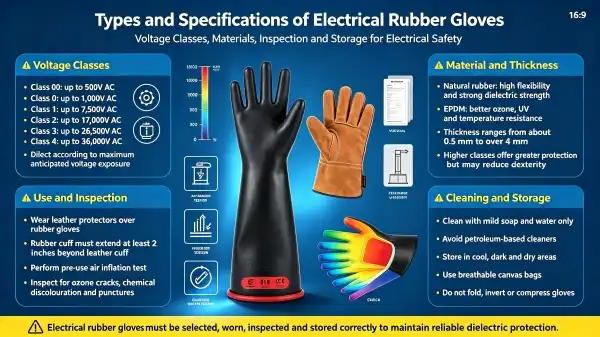
Electrical rubber gloves are divided into six different groups based on their highest voltage rating, which is an important factor for matching safety to risk exposure. Knowing these categories helps people who work in procurement make smart buying choices that balance the need for safety with the need to get things done.
Class 00 gloves are great for low-voltage control work, residential electrical service, and electric car repair, where battery systems usually work between 400V and 800V because they protect against up to 500V AC. Because they are so thin, they are very easy to use for touching small parts and touchscreens.
Class 0 gloves have red marks under ASTM requirements and can protect you up to 1,000V AC. They are commonly used for installing smart meters, working on backup distribution lines, and maintaining industrial control panels. In terms of electrical work, they do both home and light industrial work.
Class 1 and Class 2 gloves are used for medium-voltage tasks and protect workers up to 7,500V and 17,000V, respectively. These groups do most of the work in power distribution, substation upkeep, and the electrical systems in industrial facilities.
Class 3 and Class 4 gloves offer the most safety, with ratings of up to 26,500V and 36,000V, respectively. These categories are used by utility companies to work on transmission lines and keep high-voltage equipment in good shape.
Material Composition and Performance Characteristics
Because it is more flexible and has higher dielectric strength, natural rubber is still the most popular material for electrical rubber gloves. Technicians can keep fine motor control while working with small screws and connections thanks to this makeup. The bent shapes of natural rubber gloves make them fit better on the hand and keep it from getting tired after long periods of use.
EPDM, or Ethylene Propylene Diene Monomer, is a replacement material that is better at resisting damage from ozone and UV light. EPDM is very durable in tough environments, which is very helpful for outdoor maintenance work. The material is better at handling high and low temperatures than natural rubber, but it gives up some flexibility in exchange for durability.
Physical Features That Impact Safety and Efficiency
Voltage protection is directly related to thickness, but physical skill is negatively related to thickness. Class 00 gloves are about 0.5 mm thick, while Class 4 gloves are more than 4 mm thick. Because of this difference in thickness, technicians can work with smartphone screens and small screwdrivers while wearing Class 00 gloves, but have a hard time doing the same things while wearing Class 3 or 4 gloves.
Another important standard is arc flash resistance, which is especially important for operating switchgear and checking circuit breakers. Even though electrical rubber gloves are great at keeping electricity from getting through, they need to be worn with arc-rated clothing and leather protectors to protect against thermal hazards. Colour-coding the inside and outside layers makes eye checking easier and helps workers find holes or other damage that could affect the dielectric's integrity more quickly.
If you're evaluating personal protective equipment suppliers and require batch-specific testing documents before placing an order, PPE MAX is able to provide official Certificates of Analysis, professional laboratory test reports, and product samples for your verification. Feel free to contact our team at marketing@ppemax.comto discuss your sourcing needs and obtain complete documentation for your quality assessment and procurement approval.
Using and Maintaining Electrical Rubber Gloves for Optimal SafetyProper Wearing Techniques and Leather Protectors
According to OSHA rules, you must wear leather protective gloves over electrical rubber gloves to protect your hands from cuts, scrapes, and punctures. The leather cover needs to be the right size so that it doesn't bunch up, which could trap dirt or cause pressure spots. To stop voltage tracking, the electrical rubber glove should go at least two inches past the leather protector's cuff. Voltage tracking is when an electrical current follows a dirty surface path.
Workers shouldn't roll or fold the cuffs of their gloves because it makes weak spots where cracks can form. Before each use, the donning process requires checking both the electrical rubber glove and the leather protector for metal particles, chemical contamination, or physical damage.
Inspection Protocols and Testing Requirements
The first line of defence against glove failure is the air test. Workers pull up the cuff of their gloves to catch air inside. They then squeeze the gloves to hear or feel for leaks. This easy step takes less than 30 seconds per glove and stops electrical contact that could be fatal. Visual analysis should find ozone splitting (small surface cracks that look like thin lines), foreign objects embedded in the material, and changes in structure or colour that show chemical breakdown.
Specific testing rooms with high-voltage testing gear are used for dielectric testing. For each glove class, ASTM F496 lists the exact test voltages and clearance requirements. To find secret flaws, testing labs put gloves in tanks full of water and use proof voltages that are much higher than the highest use voltages. Gloves that pass the tests get date stamps that show when their next check is due. Setting up rotating testing schedules that keep operations running smoothly while still meeting all regulations is helpful for companies that keep a lot of stock.
Cleaning and Storage Best Practices
Cleaning gloves the right way keeps their electrical rubber properties and makes them last longer. Manufacturers usually say to use mild soap and water solutions and stay away from cleaners that are based on petroleum, which break down rubber compounds. Gloves need to be completely dry before being stored because water on rubber surfaces speeds up wear and tear.
The way things are stored has a big effect on how long they last. Gloves that are kept in cool, dark, dry places away from ozone sources (like electric motors and welding equipment) and direct sunlight last the longest. Canvas storage bags keep things from getting squished or dirty while still letting air flow. Gloves should never be folded, kept inside out, or squished together in ways that put stress on the rubber. Extreme temperatures make things age faster, so storage areas should try to keep their temperatures between 50°F and 70°F. These ways of storing things lower the number of times they need to be replaced, which lowers the total cost of ownership while still providing solid safety.
Procurement Considerations for Electrical Rubber Gloves in B2B Markets
Evaluating Suppliers and Certifications
Verification of the supplier is the first step in good procurement. Leading makers keep their ISO 9001 license, which shows that they use a structured approach to managing quality. Look for providers that make their products according to ASTM D120 standards and can show proof of regular production testing. Third-party certifications from groups like UL or CSA give buyers even more confidence that the goods they buy meet the written standards.
When it comes to electrical safety tools, well-known names like Honeywell, Klein Tools, and Ansell have a history of reliability. These companies put a lot of money into research, testing facilities, and quality control systems that smaller companies can't match. But new providers with the right certifications can offer similar capabilities at competitive prices. The important thing is to make sure the certification is real and ask for test results before placing big orders.
Pricing Dynamics and Bulk Purchasing Advantages
The price of electrical rubber gloves varies a lot depending on the type, the material, and the number of gloves ordered. Class 00 gloves usually cost between $30 and $60 a pair, while Class 4 gloves cost more than $200 a pair. In general, natural rubber versions cost less than EPDM versions, but the difference in price gets smaller as the voltage level goes up.
It is possible to save a lot of money by buying in bulk. People who buy 100 pairs or more often can usually get 15 to 25 percent off the list price. Setting up yearly contracts that lock in prices and ensure supply access is good for organisations with ongoing programs. These deals usually include consignment inventory arrangements, in which sellers keep stock at the buyer's facilities and only charge for things that are used. This method cuts down on the costs of keeping inventory while still making sure that it is available right away.
Delivery Logistics and Customization Options
For global buying to work, you need to know about shipping costs and wait times. Standard configurations are usually shipped within one to two weeks by domestic suppliers. Custom orders or international shipments, on the other hand, take four to eight weeks. Companies that work in remote areas should keep enough safety stock on hand to avoid having to stop work because of supply delays.
Customisation options include private labelling, custom packing to make managing goods easier, and size distributions based on the types of people who work in the company. Integrated testing services are often asked for by large businesses. This is when suppliers coordinate glove rotation and dielectric testing, which makes it easier for safety departments to do their jobs. These value-added services cost more, but they make operations more efficient, so the money is well spent. Support after the sale is what sets great sellers apart from average ones. Technical help with sizing, training materials, and quick customer service all protect buying investments.
Conclusion
When workers are in danger of being exposed to electricity, OSHA clearly requires them to wear electrical rubber gloves. As part of the selection process, voltage levels must be matched to real-life dangers in the workplace, strict inspection and testing procedures must be put in place, and upkeep procedures must be set up that protect the integrity of the gloves. Professionals in procurement are very important guards because they have to balance cost concerns with strict safety standards. Companies that spend money on good specifications, dependable suppliers, and thorough training programs create safety cultures that keep workers safe and reduce their risk of being sued. This investment will pay off in more ways than just following the rules. It will lower the number of injuries, lower insurance rates, and boost worker trust, all of which will increase production.
FAQ
1. What voltage level requires electrical insulating gloves?
Electrical rubber gloves are required by OSHA for any job where workers might come into contact with live electrical wires or circuit parts that are working at more than 50 volts. Almost all industrial and utility electrical systems fall below this threshold. The type of glove needed depends on the highest voltage that is expected. For systems up to 500V, the glove class is 00, and for voltages up to 36,000V, it is Class 4.
2. How often must electrical gloves be tested?
As per ASTM F496 and OSHA 1910.137, electrical rubber gloves that are being used must be tested for insulating properties every six months. If it's been 12 months since the last test, gloves that have been stored must be tested again before they are given to workers. To show they are following the rules during checks, organisations should keep records of tests with dates, results, and retesting plans.
3. Can I use the same gloves for different voltage levels?
If the voltage is less than the stated class of the electrical rubber gloves, they can be used, but never after that. A Class 2 glove rated for 17,000V is safe enough for 480V work, but the decreased dexterity could make it harder to get things done. Companies often keep different types of gloves on hand so that workers can choose the right amount of protection for each job. This improves both safety and working efficiency.
Partner with PPE MAX for Your Electrical Rubber Gloves Supply
Since 1956, PPE MAX has been protecting electrical workers in 134 countries. We do this by combining the largest production capacity in Northwest China with decades of electrical rubber gloves expertise. Our electrical rubber gloves supplier can make gloves with voltage ratings from Class 00 to Class 4, and they are made to meet or exceed ASTM D120 and EN 60903 standards. We know how hard it is for safety managers and industrial distributors to make sure that important needs can be met right away while also staying within budget and following regulations. With our OEM and ODM services, you can sell electrical rubber gloves under your own brand. We back this up with strict testing procedures and flexible minimum order quantities that can handle both large-scale rollouts and specific needs. Get in touch with our technical team at bettybing@ppemax.com to talk about your specific voltage safety needs, pricing models for bulk orders, and custom testing schedules that keep your employees safe and your operations legal.
References
1. Occupational Safety and Health Administration. "1910.137 - Electrical Protective Devices." Code of Federal Regulations, Title 29, Part 1910, U.S. Department of Labor.
2. ASTM International. "ASTM D120-20: Standard Specification for Rubber Insulating Gloves." ASTM Volume 10.03 Electrical Protective Equipment, West Conshohocken, Pennsylvania.
3. ASTM International. "ASTM F496-20: Standard Specification for In-Service Care of Insulating Gloves and Sleeves." ASTM Volume 10.03 Electrical Protective Equipment, West Conshohocken, Pennsylvania.
4. National Fire Protection Association. "NFPA 70E: Standard for Electrical Safety in the Workplace." 2021 Edition, Quincy, Massachusetts.
5. International Electrotechnical Commission. "IEC 60903: Live Working - Gloves of Insulating Material." Edition 3.0, Geneva, Switzerland.
6. Institute of Electrical and Electronics Engineers. "IEEE 1584: Guide for Performing Arc-Flash Hazard Calculations." 2018 Edition, New York, New York.
Learn about our latest products and discounts through SMS or email