- English
- French
- German
- Portuguese
- Spanish
- Russian
- Japanese
- Korean
- Arabic
- Greek
- German
- Turkish
- Italian
- Danish
- Romanian
- Indonesian
- Czech
- Afrikaans
- Swedish
- Polish
- Basque
- Catalan
- Esperanto
- Hindi
- Lao
- Albanian
- Amharic
- Armenian
- Azerbaijani
- Belarusian
- Bengali
- Bosnian
- Bulgarian
- Cebuano
- Chichewa
- Corsican
- Croatian
- Dutch
- Estonian
- Filipino
- Finnish
- Frisian
- Galician
- Georgian
- Gujarati
- Haitian
- Hausa
- Hawaiian
- Hebrew
- Hmong
- Hungarian
- Icelandic
- Igbo
- Javanese
- Kannada
- Kazakh
- Khmer
- Kurdish
- Kyrgyz
- Latin
- Latvian
- Lithuanian
- Luxembou..
- Macedonian
- Malagasy
- Malay
- Malayalam
- Maltese
- Maori
- Marathi
- Mongolian
- Burmese
- Nepali
- Norwegian
- Pashto
- Persian
- Punjabi
- Serbian
- Sesotho
- Sinhala
- Slovak
- Slovenian
- Somali
- Samoan
- Scots Gaelic
- Shona
- Sindhi
- Sundanese
- Swahili
- Tajik
- Tamil
- Telugu
- Thai
- Ukrainian
- Urdu
- Uzbek
- Vietnamese
- Welsh
- Xhosa
- Yiddish
- Yoruba
- Zulu
Insulating Gloves: Can They Be Repaired After Damage?
Founded in 1956, PPEMAX stands as a premier global manufacturer and supplier of full-range personal protective equipment. All our products comply with internationally recognized standards including IEC, ASTM, CE, UKCA, NIOSH and ISO9001. Equipped with a 2,000-square-meter modern production plant, we boast over 25 years of mature OEM & ODM capabilities to deliver one-stop customized solutions covering R&D design through worldwide logistics. Our safety gear is distributed across 134 countries globally. Upholding our core tenet “Safety First, Quality Priority”, we serve as a dependable long-term PPE partner for industrial enterprises around the world.
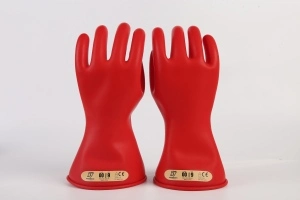
Can insulating gloves that are broken be fixed? The short answer is no, because it is against industry standards to repair damaged electrical insulating gloves. Both ASTM D120 and IEC 60903 say that you should not do any kind of fix on the glove because even small harm can make it less dielectric, which can lead to deadly shocks. Electrical shielding tools, on the other hand, need to be completely reliable. If the glove gets damaged, cut, or chemically broken down, it can't protect against voltage exposure anymore. This means that workers are at risk of electrical contact and arc flash injuries that could be fatal.
|
Parameter |
Type I (Natural Rubber) |
Type II (Synthetic/EPDM) |
|
Maximum Use Voltage |
500V AC / 750V DC |
500V AC / 750V DC |
|
Proof Test Voltage |
2,500V AC / 10,000V DC |
2,500V AC / 10,000V DC |
|
Maximum Thickness |
0.75mm (30 mils) |
0.75mm (30 mils) |
|
Length Options |
11-14 inches |
11-14 inches |
|
Color Code |
Beige Label |
Beige Label |
|
Temperature Range |
Standard |
Extended (-25°C to +55°C) |
|
UV/Ozone Resistance |
Standard |
Enhanced |
Understanding Insulating Gloves and Their Critical Role in Electrical Safety
The Engineering Behind Electrical Protection
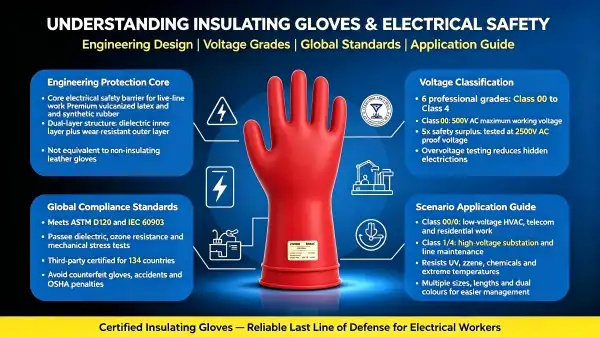
Electrical insulating gloves are the main thing that keeps live flesh from touching live electrical wires. These are not like leather work gloves, which only protect against wear and tear. They are made from high-quality natural rubber latex or manmade materials that are designed to stop the flow of electricity. The rubber goes through vulcanisation processes that cross-link its molecules, making it stronger and more flexible. A lot of designs use a two-layer construction: an insulated layer on the inside that stops current flow and a layer on the outside that can't be punctured or damaged by the environment.
Insulating gloves are divided into six classes by the voltage classification system, starting with Class 00 (rated for 500V AC maximum use) and continuing through Class 4. To make sure there are no safety gaps, each group goes through proof testing at voltages that are much higher than the working levels. At PPE MAX, our Class 00 insulating gloves are put through strict AC proof testing at 2,500V, even though their maximum use rate is only 500V. This five-fold safety cushion shows our dedication to worker protection since 1956.
Compliance Standards Shape Safety Parameters
Every part of how electrical gloves work is regulated by international norms. The international standard IEC 60903 and the North American standard ASTM D120 spell out how to test, how much power a device can handle, its physical qualities, and how it must be marked. These requirements aren't just paperwork; they come from decades of working in the field, investigating accidents, and studying materials science. Gloves with these approvals have been through tough dielectric breakdown tests, ozone protection tests, and mechanical stress tests.
Before agreeing to large orders, purchasing managers should check the approval marks. In some markets, there are a lot of fake or non-compliant goods that look like they'll save you money at first, but those savings are quickly lost when accidents happen and cause OSHA fines, insurance disputes, or even death on the job. As a result, our factory always follows the rules set by ASTM D120 and IEC 60903. For every batch of products we send to partners in 134 countries, we have proof that it was tested by a third party.
Application Environments Demand Specialized Protection
Electrical dangers are different in each workplace setting. Class 00 or Class 0 protection is usually needed for low-voltage tasks like home service work, telecommunications installs, and HVAC fixes. For medium-voltage distribution work, you need gloves that are Class 1 or Class 2, and for high-voltage gearbox repair, you need tools that are Class 3 or Class 4. In addition to voltage grade, environmental factors are important. For example, working outside subjects gloves to UV rays and ozone, which speed up the breakdown of rubber. When chemicals are present in factories, they can damage the insulator. Extreme temperatures can change how flexible and insulating something is.
Knowing about these application factors helps procurement teams choose the right security. Our Class 00 insulating gloves come in lengths of 11 inches and 14 inches and sizes 8 through 11. They can fit a wide range of hand sizes and reach needs. The two colour choices (red and black) make it easier to keep track of goods across multiple work sites, and the 170-gram weight keeps your hands from getting tired after long periods of use.
Can Insulating Gloves Be Repaired? Understanding Damage and Repair Limitations
Common Damage Mechanisms That Compromise Protection
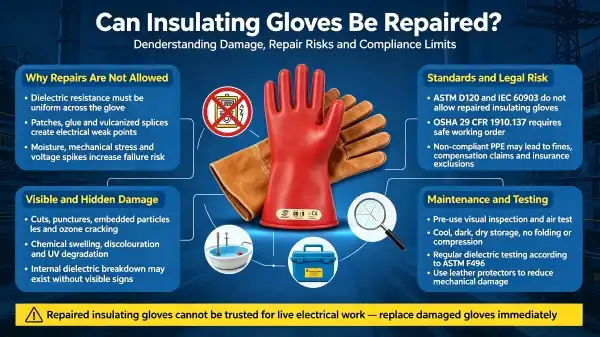
During normal use, electrical insulating gloves can break down in a number of ways. Physical damage includes cuts from sharp edges, holes from wires sticking out, and wear and tear from surfaces that are too rough. Chemicals like gasoline products, acids, and some cleaning products can damage the molecular structure of rubber, making it weak in ways that can't be seen. Ozone, which is made by corona discharge around high-voltage equipment, puts stress on the environment and causes cracks in the surface. Polymer chains are broken up by UV light. Material wears out when temperatures change quickly from very cold to very hot.
A close look shows some damage, including cuts, foreign objects stuck inside, surface cracks, swelling from chemical absorption, and colour changes. But the most dangerous breakdown happens on the inside, where chemical breakdown and stress concentrations are hard to find without expensive testing tools. Even if the glove looks like it's in good shape, the insulation may have been compromised enough to let a fatal current through.
Why Repair Attempts Create Unacceptable Risk
Electrical science is at the heart of the problem with repair methods. Insulating gloves work by having the same amount of dielectric resistance all over their surface. Any kind of fix, like glue patches, rubber cement applications, or vulcanised splices, leaves gaps in the material. These connections create areas of high stress where electrical breakdown is more likely to happen. If a patch passes low-voltage tests, it might fail completely in real life, where moisture, mechanical stress, or voltage spikes make things more difficult.
Because of these problems, ASTM D120 and IEC 60903 guidelines make it clear that broken insulating gloves can't be fixed. The standards take into account that the costs of repairs are small compared to the problems that could happen, such as workers being electrocuted, lawsuits, OSHA tickets with fines of up to $145,027 per wilful violation, workers' compensation claims, and lost work time. Most insurance plans don't cover accidents involving electrical PPE that isn't up to code or has been fixed, so companies are directly responsible for paying for them.
Legal and Compliance Implications for B2B Buyers
Buying choices have legal weight that goes beyond the cost of the buy itself. Safety officers and buying managers can be held personally responsible if people get hurt or die because they didn't have the right PPE. Documented choices to fix broken insulation equipment instead of replacing it show a deliberate disregard for known dangers, which is what the law calls "wilful negligence." In the worst cases, where cutting costs meant putting electricity safety at risk, people have been charged with crimes.
During regulatory checks, the state of electrical PPE and testing records is specifically looked at. According to OSHA's electrical safety guidelines (29 CFR 1910.137), companies must keep insulating equipment in safe, working order. Using gloves that have been fixed goes against this rule and will get you a ticket even if there is no accident. Local occupational health laws in Europe, Asia, and other places look closely at international businesses in the same way.
If you're evaluating personal protective equipment suppliers and require batch-specific testing documents before placing an order, PPE MAX is able to provide official Certificates of Analysis, professional laboratory test reports, and product samples for your verification. Feel free to contact our team at marketing@ppemax.com
to discuss your sourcing needs and obtain complete documentation for your quality assessment and procurement approval.
Best Practices for Maintaining and Testing Insulating Gloves to Avoid Damage
Pre-Use Inspection Protocols
Every shift starts with a good check of the gloves. In well-lit places, workers should do both visual and physical checks. Cuts, tears, punctures, embedded particles, ozone cracking, swelling, and discolouration are all clear flaws that are found during the eye check. The physical check, which is sometimes called the "air test," involves putting pressure on the glove and keeping air inside it to listen for leaks through soft hissing sounds or felt air movement. By rolling the glove tightly from the wrist to the tips of the fingers, air is forced toward any possible flaws, making them visible.
The people in charge of buying things should make clear rules about inspections and train everyone on them. Workers should be able to take suspected gloves off the job right away, without having to go through a lot of red tape that makes them less likely to report problems. Replacement gloves need to be easy to get—not getting rid of old, potentially dangerous equipment often happens because new stock isn't available. This dangerous deal can be avoided by keeping enough product buffers.
Storage Conditions That Extend Service Life
How you store your gloves has a huge effect on how long they last. Insulating tools should be kept in cool, dark, dry places that are out of direct sunlight, away from ozone sources like electric motors and welding equipment, and away from temperature changes. A lot of places use climate-controlled PPE storage boxes that are just for that purpose. If you don't want stress spots, your gloves should hang loosely or sit flat. Never fold or compress them. Keeping things away from solvents, chemicals, and fuel products keeps them from getting contaminated.
Class 00 insulating gloves from PPE MAX come in individual boxes with one pair per box and twenty pairs per carton. Each carton is 54.5cm x 35cm x 42.5cm and weighs 6.5 kg. This makes keeping them easier and protects the gloves from the elements. Our utility, telecom, and industrial clients around the world use this packaging method for both central warehouse delivery and storage on job sites spread out.
Dielectric Testing Requirements and Frequency
Visual analysis is not enough to confirm the electrical stability. Gloves are put through normal high-voltage stress in a controlled lab setting during regular dielectric testing. ASTM F496 spells out how to test things and what the standards for acceptance are. How often gloves are tested depends on how often they are used. OSHA suggests testing them every six months, but makers may suggest different plans depending on how often they are used.
Inflating gloves and putting them in conductive water while giving proof test voltage is part of the test. Technicians keep an eye on leaking current; too much flow means the dielectric is breaking down. Gloves that pass the tests are marked with a date, and gloves that fail are taken out of service for good. Laboratories that are not part of the company doing the tests provide important records for compliance checks. Some big companies do their own testing, but they have to spend a lot of money on things like training technicians and calibrating their tools.
Leather Protector Integration
As a top layer, leather guard gloves must be worn over insulating gloves. Protectors keep soft rubber from getting damaged by mechanical forces, which is the main reason why it fails before it should. Good leather guards don't wear down easily, don't get holes, and keep your feet dry when it's wet. Compared to bare rubber, the mix makes it less flexible, but this trade-off stops the damage that requires an expensive repair.
The requirements for buying should include the right protection for the type of insulating glove and the job. Our Class 00 gloves work well with different types of leather protectors, and customers who buy in bulk can customise their orders by adding their logo to the package. This unified method makes keeping track of supplies easier and makes sure that field teams only use full, compatible PPE systems, not pieces that don't work together and put people at risk.
When to Replace Insulating Gloves: Decision Factors for B2B Buyers
Cost-Benefit Analysis Beyond Initial Purchase Price
Electrical insulating gloves aren't the most expensive safety item in the world, but if they break, the damage they cause is much worse than the cost of replacing them. Employers lose an average of $1.45 million for every fatal electrocution accident. This includes OSHA fines, lawsuits, workers' compensation, lost output, and damage to their image. The direct and secondary costs of serious accidents that need hospitalisation are about $500,000. Compared to these numbers, the cost of even high-end insulating gloves shipped in bulk is very small.
The time between replacements should never be pushed back to make gloves last longer at the cost of safety. It makes economic sense to have conservative retirement rules, like taking off gloves as soon as they get damaged, sticking to strict testing plans, and changing gloves that are getting close to their manufacturer's expiration dates. Companies that put off repair will have to pay more in the long run because of accidents, fines from regulators, or parts that break down faster and need to be bought quickly at higher prices without any volume savings.
Observable Indicators Requiring Immediate Replacement
In some situations, gloves must be thrown away right away, no matter when they are due for testing or how long they still have left to serve. Any cuts that can be seen going through the thickness of the rubber ruin the dielectric stability totally. Current paths are made when conductors or sharp items make holes in the wires. Swelling means that chemicals are being absorbed, which weakens the structure of molecules. Cracks on the surface caused by ozone or UV light show that the degradation is advanced and is probably affecting the inner layers. Discolouration, especially thickening or blotching, is often a sign of damage from chemicals or heat. Loss of flexibility or stiffness is a sign that the polymer has broken down.
Not passing the dielectric test means that the gloves can't be used anymore. When maker expiration dates, which are usually written on each glove, are passed, the gloves need to be replaced, even if they look brand new. No matter how often they are used, rubber compounds break down over time; age alone finally makes security less effective. To keep goods from going bad in storage, procurement teams should use first-in, first-out inventory movement.
Establishing Reliable Supply Partnerships
Electrical safety programs depend on having constant access to insulation equipment that is approved and follows the rules. When there are problems in the supply chain, like shipping delays, production bottlenecks, or poor quality, there are dangerous gaps where workers are exposed to power without enough safety. Instead of looking for small price savings from sellers who haven't been around for a while, procurement workers should build relationships with well-known companies that have been reliable for decades.
PPE MAX has been meeting the needs of electrical safety professionals around the world since 1956. Our manufacturing operations in Northwest China are the biggest PPE production facility in the area. Our global distribution network covers 134 countries and is made possible by the fact that we can ship in bulk, offer custom packing, and speed up delivery for urgent needs. We keep a large stock of common sizes in both 11-inch and 14-inch lengths, which lets us quickly fill big orders without having to wait for long lead times that put safety programs at risk.
Volume Purchasing Strategies for Large Organizations
Strategic buying methods help companies that are in charge of many job sites and hundreds of electrical workers. Budget planning is more stable when there are annual contracts with guaranteed prices that promise priority production times and delivery plans. When you order in bulk, you can save money on shipping costs. Our carton packaging (20 pairs per carton) works well for market distribution, while individual box packing makes it easier to handle inventory at the site level. With consignment agreements, you can put your goods in smart places without having to pay for them right away. This can help your cash flow while keeping your stock available.
At a certain point, it becomes cost-effective to offer custom specs like private labelling, specialised sizes, or better features. Our OEM/ODM services help partners who want branded insulation equipment made exactly the way they want it. Early on in the vendor evaluation process, procurement teams should talk about the possibility of customisation. This is especially important when standardisation across foreign operations requires features that aren't available in the catalogue.
Conclusion
When electrical insulating gloves get damaged, they can't be safely fixed because the risks to worker safety, following the rules, and the company's responsibility are too high to be worth the short-term cost savings. Industry standards make it clear that you can't try to fix something because a damaged dielectric causes a fatal shock risk that can't be reliably found through inspection or testing. Instead, smart purchasing strategies focus on keeping things in good shape through storage, upkeep, and the use of leather protectors. They also have strict replacement policies that only allow items to be replaced when they are clearly damaged, fail tests, or reach their expiration dates. Working with well-known companies that offer certified goods in large quantities and are backed by global delivery networks ensures that you can always get compliant safety.
FAQ
1. Can minor tears or small punctures be patched?
Attempts to patch insulating gloves pose an unacceptable risk, no matter how small the damage is. Even tiny holes can weaken the uniform dielectric resistance, causing stress spots where electricity breaks down. When you put on adhesive patches, they create gaps in the material that break when exposed to power, moisture, or mechanical stress. Both the ASTM D120 and IEC 60903 standards make it clear that no repairs are allowed. This is because most people in the industry agree that fixing costs are never worth the terrible results of security failing during energised work.
2. How often should industrial gloves undergo dielectric testing?
How often you test relies on how important the application is and what the rules say. As a general rule, OSHA suggests that inspections happen every six months. However, manufacturers may mention different times based on voltage class and usage trends. Gloves that are used every day in tough settings should be tested every three months, while equipment that is only used once a year may be tested once a year.
3. Do specialized gloves exist for heavy-duty electrical applications?
For gearbox work and heavy industrial uses, higher voltage classes—especially Class 2, Class 3, and Class 4—have better construction. These have bigger layers of rubber, stronger fingers, and new compound formulas that balance the need for flexibility with dielectric strength. The Type II materials (synthetic/EPDM rubber) are better at resisting ozone and UV damage than the Type I materials (natural rubber), so they can be used in high-voltage outdoor settings.
Partner with PPE MAX for Certified, Bulk-Available Electrical Protection
You can't just buy electrical safety equipment from a catalogue to keep your employees safe. You need to work with makers of proven electrical safety equipment. Every Class 00 insulating glove that PPE MAX makes is the result of 68 years of specialized experience. Our gloves meet strict ASTM D120 and IEC 60903 standards and have useful design features that electrical workers like. Our two-color choices, eight, nine, ten, and eleven-inch sizes, and eleven-inch and fourteen-inch lengths meet the needs of a wide range of teams. We are the biggest PPE maker in Northwest China and a trusted provider of insulating gloves to 134 countries. We offer low bulk prices, the ability to make changes, and fast shipping around the world. Email our technical team at marketing@ppemax.com to talk about your safety program needs across multiple sites, OEM specs, or urgent delivery needs.
References
1. American Society for Testing and Materials. "ASTM D120-20: Standard Specification for Rubber Insulating Gloves." ASTM International, West Conshohocken, Pennsylvania, 2020.
2. International Electrotechnical Commission. "IEC 60903:2019 - Live Working - Electrical Insulating Gloves." International Electrotechnical Commission, Geneva, Switzerland, 2019.
3. Occupational Safety and Health Administration. "1910.137 - Electrical Protective Equipment." Code of Federal Regulations, Title 29, U.S. Department of Labor, Washington D.C., 2023.
4. National Fire Protection Association. "NFPA 70E: Standard for Electrical Safety in the Workplace, 2024 Edition." National Fire Protection Association, Quincy, Massachusetts, 2023.
5. Institute of Electrical and Electronics Engineers. "IEEE Guide for the In-Service Maintenance and Electrical Testing of Electrical Protective Equipment." IEEE Std 1048-2016, Institute of Electrical and Electronics Engineers, New York, 2016.
6. Canadian Standards Association. "CSA Z462:2021 - Workplace Electrical Safety Standard." Canadian Standards Association, Toronto, Ontario, Canada, 2021.
Learn about our latest products and discounts through SMS or email