- English
- French
- German
- Portuguese
- Spanish
- Russian
- Japanese
- Korean
- Arabic
- Greek
- German
- Turkish
- Italian
- Danish
- Romanian
- Indonesian
- Czech
- Afrikaans
- Swedish
- Polish
- Basque
- Catalan
- Esperanto
- Hindi
- Lao
- Albanian
- Amharic
- Armenian
- Azerbaijani
- Belarusian
- Bengali
- Bosnian
- Bulgarian
- Cebuano
- Chichewa
- Corsican
- Croatian
- Dutch
- Estonian
- Filipino
- Finnish
- Frisian
- Galician
- Georgian
- Gujarati
- Haitian
- Hausa
- Hawaiian
- Hebrew
- Hmong
- Hungarian
- Icelandic
- Igbo
- Javanese
- Kannada
- Kazakh
- Khmer
- Kurdish
- Kyrgyz
- Latin
- Latvian
- Lithuanian
- Luxembou..
- Macedonian
- Malagasy
- Malay
- Malayalam
- Maltese
- Maori
- Marathi
- Mongolian
- Burmese
- Nepali
- Norwegian
- Pashto
- Persian
- Punjabi
- Serbian
- Sesotho
- Sinhala
- Slovak
- Slovenian
- Somali
- Samoan
- Scots Gaelic
- Shona
- Sindhi
- Sundanese
- Swahili
- Tajik
- Tamil
- Telugu
- Thai
- Ukrainian
- Urdu
- Uzbek
- Vietnamese
- Welsh
- Xhosa
- Yiddish
- Yoruba
- Zulu
Can Electrical Rubber Gloves Fail Under Ozone or Chemical Exposure?
Founded in 1956, PPEMAX stands as a premier global manufacturer and supplier of full-range personal protective equipment. All our products comply with internationally recognized standards including IEC, ASTM, CE, UKCA, NIOSH and ISO9001. Equipped with a 2,000-square-meter modern production plant, we boast over 25 years of mature OEM & ODM capabilities to deliver one-stop customized solutions covering R&D design through worldwide logistics. Our safety gear is distributed across 134 countries globally. Upholding our core tenet “Safety First, Quality Priority”, we serve as a dependable long-term PPE partner for industrial enterprises around the world.
Yes, electrical rubber gloves can fail when exposed to ozone or harsh chemicals. These environmental factors attack the rubber material at a molecular level, causing surface cracking, loss of elasticity, and ultimately compromising dielectric strength. Ozone-induced degradation appears as fine surface cracks, while chemical exposure leads to swelling, softening, or embrittlement depending on the contaminant. Procurement managers and safety engineers must recognize that even certified gloves lose protective integrity when subjected to prolonged environmental stressors without proper material selection, routine testing, and maintenance protocols.
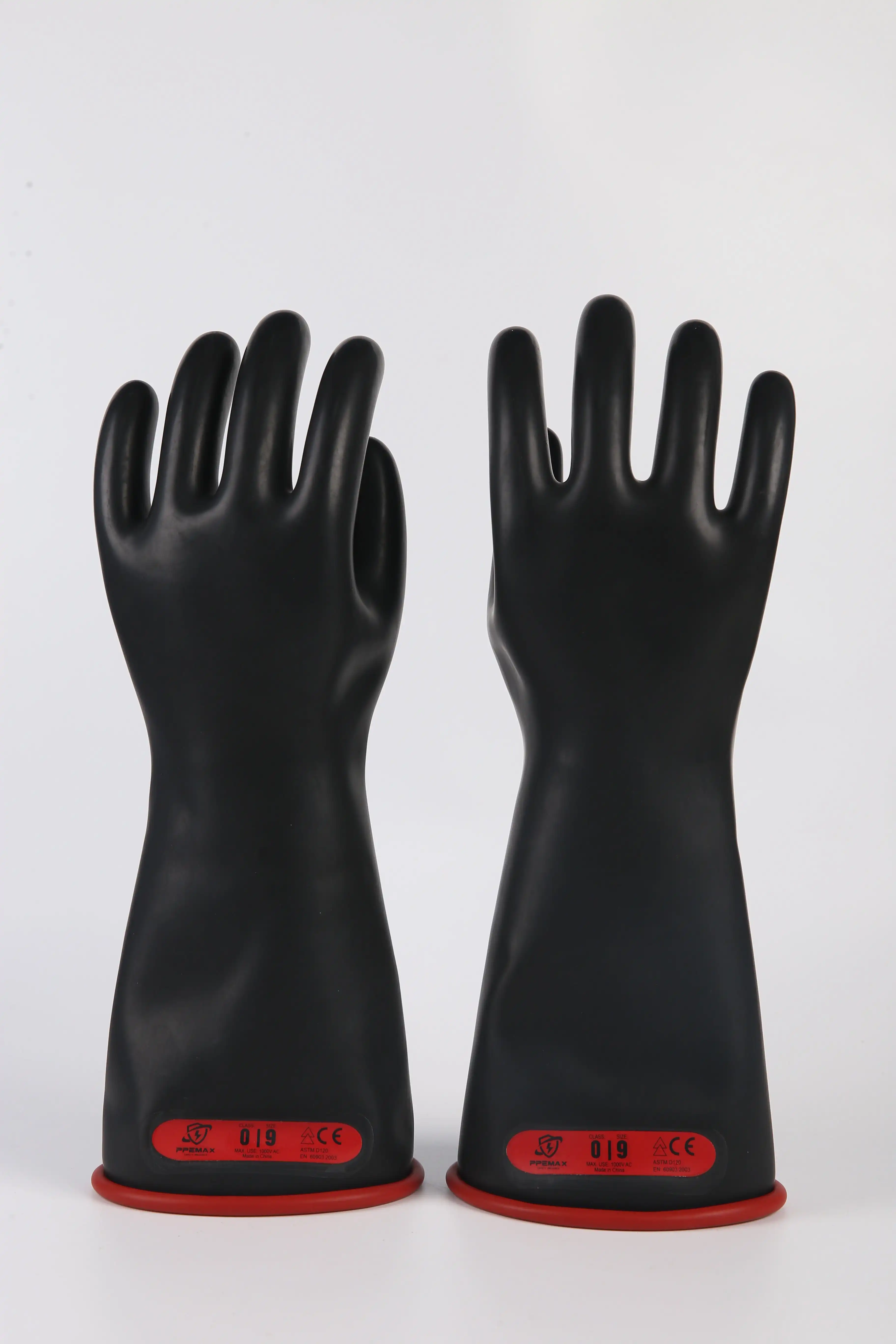
|
Parameter |
Specification |
|
Maximum Use Voltage |
1,000V AC / 1,500V DC |
|
Proof Test Voltage |
5,000V AC / 20,000V DC |
|
Label Color |
Red (ASTM D120/IEC 60903) |
|
Material Type |
Type I (Natural Rubber) / Type II (EPDM) |
|
Thickness |
1.02mm (0.040 inches) |
|
Length Options |
11", 14", 16" inches |
|
Cuff Styles |
Straight, Bell, Contour |
|
Standards Compliance |
ASTM D120, IEC 60903, OSHA 29 CFR 1910.137 |
Understanding Electrical Rubber Gloves and Their Insulation Properties
Electrical shielding gloves are the best way for people who work with live wires to avoid getting shocked. Our company, PPE MAX, tests these items ourselves because we know that each voltage grade and material standard could mean the difference between life and death.
The Core Function of Insulating Rubber Gloves
These gloves put up a physical wall between the worker's hands and the wires, which stops the flow of electricity through the body. Rubber materials can prevent electrical discharge up to certain voltage levels because they are dielectric. Insulating rubber gloves are not like regular work gloves; they are put through a lot of electrical tests to make sure they can protect against both AC and DC charges.
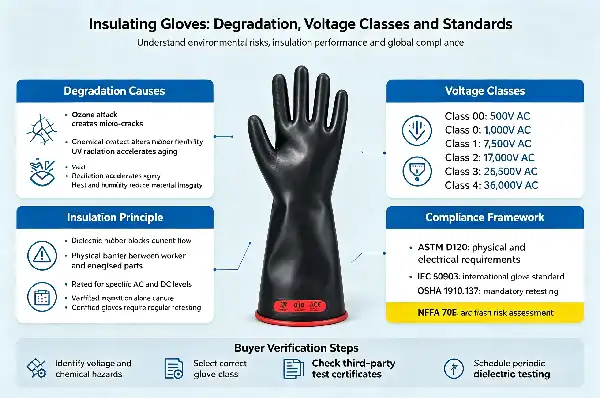
Voltage Classification Systems Explained
Based on the highest voltage that can be used, the industry divides insulating gloves into six classes. Class 00 gloves protect workers from up to 500 volts AC and can be used for work with household utilities and servicing EV batteries, where techs have to work with small terminals in tight areas. Class 0 gloves cover up to 1,000 volts AC, which makes them useful for both low-voltage control work and upkeep on power distribution systems. As you move up the scale, Class 3 gloves rated for 26,500 volts AC are used by utility workers on high-voltage transmission lines. These gloves must have leather covers to keep the rubber from getting damaged mechanically.
Regulatory Standards Governing Glove Performance
In the United States, OSHA requires that ASTM D120 standards be followed. For foreign activities, IEC 60903 standards are used. These standards spell out the physical property needs, proof test voltages, and leakage current limits. Based on an analysis of the arc flash risk, NFPA 70E also says when and where certain types of gloves must be used. When buying gloves for international companies, procurement teams should make sure that suppliers show proof of compliance in all important countries.
Effects of Ozone and Chemical Exposure on Electrical Rubber Gloves
Environmental factors can damage gloves in ways that buyers don't see, and this is something that many buyers miss when they are first choosing gloves. After sixty years of making things, we know that knowing how things break down is just as important as knowing power rates.
How Ozone Attacks Rubber Materials
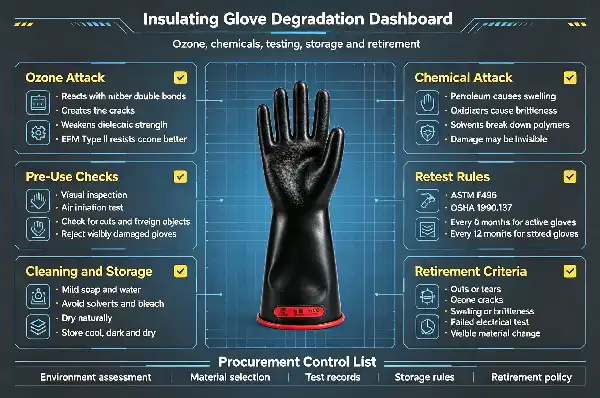
It is very strong and reacts with the carbon-carbon double bonds that are found in natural rubber and some synthetic elastomers. Ozone cracking is the process by which this chemical reaction makes surface cracks that run perpendicular to stress lines. When workers store their gloves near electrical equipment that makes ozone, like motors, generators, and high-voltage switches, they speed up the breakdown without realizing it. At first, the cracks are very small, but they spread through the material, making ways for electricity to flow. Type II gloves made from EPDM rubber are better at resisting ozone than Type I gloves made from natural rubber. This is why material choice is so important for outdoor use and places with a lot of ozone.
Chemical Degradation Pathways
Gloves used in factories are often exposed to many chemical hazards, such as acid mists, transformer oils, hydraulic fluids, and cleaning solvents. Each chemical has a different effect on rubber compounds. Things made from petroleum make natural rubber grow and get softer, which lowers its tensile strength. Strong oxidizers, such as chlorine bleach, break down polymer chains, making them hard and brittle. Aromatic molecules break down parts of rubber, which lowers its mechanical and electrical qualities. Degradation often starts without any damage that can be seen on the outside. This is why regular testing procedures are important for finding secret problems before they cause accidents at work.
Real-World Failure Case Studies
A mining utility company had glove failures during routine maintenance, even though the right voltage classification was chosen. An investigation showed that workers often touched electrical rubber gloves after using hand cleaners with petroleum-based ingredients, which slowly broke down the rubber. In a different case, gloves were kept in a repair van that was sitting outside in full sunlight. High temperatures sped up the ozone cracking in the natural rubber, which meant that the dielectric tests failed after only three months of use, instead of the expected shelf life of six months. These examples show why, along with voltage ratings and dexterity standards, environmental compatibility studies must be used to make buying choices.
If you're evaluating personal protective equipment suppliers and require batch-specific testing documents before placing an order, PPE MAX is able to provide official Certificates of Analysis, professional laboratory test reports, and product samples for your verification. Feel free to contact our team at marketing@ppemax.com to discuss your sourcing needs and obtain complete documentation for your quality assessment and procurement approval.
How to Test and Maintain Electrical Rubber Gloves to Prevent Failure
Setting up thorough testing and upkeep procedures saves workers, extends the life of gloves, and lowers the total cost of ownership. We came up with these suggestions after helping safety programs in 134 countries for many years.
Pre-Use Inspection and Air Testing
Workers should visually check each piece before each use for any embedded foreign objects, holes, tears, or signs of ozone cracking. The most useful test for finding leaks in the field is still the air inflation test, which involves squeezing the glove while squeezing air inside it to hear hissing or pressure loss. This easy step-by-step process finds mechanical damage that would otherwise cause shock paths to form during live work.
Electrical Testing Requirements and Intervals
According to ASTM F496 and OSHA 1910.137, gloves that are being used must be retested for electricity every six months. Gloves that are being stored must be tested within twelve months of being stored before they can be given to workers. During the dielectric test, a proof voltage that is much higher than the glove's stated maximum use voltage is used, and leaking current is monitored. Gloves that have current levels higher than what is allowed fail testing, even if there is no damage that can be seen. This shows degradation that can't be seen. When purchasing gloves for big groups of people, procurement managers should build relationships with certified testing laboratories or buy portable testing tools to use in-house.
Proper Cleaning Methods to Preserve Material Integrity
Sticking contaminants to glove surfaces speeds up chemical breakdown and makes electrical tests less accurate. To clean gloves, use water and light soap. Do not use cleaners that are based on petroleum, as these can damage rubber materials. Rinse the gloves well to get rid of any soap residue, and then let them dry naturally, away from direct heat sources. Don't use bleach, acids, or rough cleaners that can damage the structure of polymers. To get a good idea of how good something is, it should be cleaned before it is stored and tested.
Storage Strategies to Minimize Environmental Damage
Keep gloves in cool, dark, dry places that are out of the sun, out of the ozone-making equipment, and away from temperature extremes. Canvas storage bags keep gloves safe from damage while still letting air flow. Do not fold or squeeze gloves because this causes stress points that can crack from ozone. Avoid putting gloves away inside out or while they are still wet from being cleaned. Facilities that work in tough environments should set aside climate-controlled storage areas that are different from the production floors. Using the right storage methods can increase the shelf life of gloves and slow down the aging process that happens because of exposure to the environment.
Identifying Retirement Criteria
When gloves have cuts, tears, attached objects, ozone cracks, or changes in material that show chemical attack, they must be taken out of service. Electrical tests that fail require immediate retirement, no matter how things look. Many businesses set limits on how long something can last based on how often it is used and how harshly it is exposed to the environment. Writing down the criteria for retirement in safety procedures makes sure that they are applied the same way at all workplaces and shifts.
Comparison of Electrical Rubber Gloves Based on Resistance to Ozone and Chemicals
Differences in performance are caused by material science and have a direct effect on how long gloves last in certain industrial settings. By knowing these differences, procurement teams can match the specifications of gloves with the needs of operations.
Natural Rubber: Traditional Performance with Limitations
Because it is very flexible and has high insulating strength, natural rubber is the best material for complicated electrical work that needs fine motor control. The thin profile and flexibility make it easier for workers to install meters, work with small terminals, or use touch-screen interfaces. The material is vulnerable to splitting from ozone and being exposed to petroleum products. When working inside, where the environment is controlled, natural rubber gloves are better than when working outside, where you are constantly exposed to ozone from tools and lines above you.
EPDM Synthetic Rubber: Enhanced Environmental Resistance
Ethylene propylene diene monomer rubber, which is called Type II in the industry, is much more resistant to ozone, weathering, and many chemicals than natural rubber. The polymer structure doesn't have any unsaturated links that ozone can damage. EPDM electrical rubber gloves stay flexible over a bigger range of temperatures and can be stored outside for a long time without getting cracks on the surface. As a trade-off, they are a little less flexible and sensitive to touch than natural rubber alternatives. When buying things for outdoor service crews, mining operations, or places with a lot of ozone, procurement managers should put EPDM material specs at the top of their list.
Specialized Compounds for Chemical Environments
For industrial uses that involve regular contact with hydraulic fluids, oils, or solvents, manufacturers create their own rubber mixtures with specific chemical resistance ratings in mind. Chemical-resistant polymers and safe additives are used in these specialized materials. Nitrile-blended formulations offer better protection to oil while still having good dielectric qualities. Facilities that use harsh chemicals for electrical maintenance should work with suppliers who can suggest materials that are compatible with the contaminants present at the site and make sure they are.
Leading Manufacturer Performance Characteristics
Well-known companies in the industry, like Honeywell, Ansell, and Salisbury, put a lot of money into building up facilities for material science study and testing. Honeywell's Electrosoft line focuses on ergonomic design, with fingers that are shaped to make them easier on the hands after long periods of use. Ansell's Class 0 and Class 00 products have thin walls that make them ideal for precise work on electronics and battery systems that are already charged. When an industrial customer buys voltage-rated rubber goods from Salisbury, they offer full technical support and testing services. When procurement teams look at different providers, they should compare prices and look at things like performance paperwork, warranty policies, and technical support skills.
Critical Selection Criteria for Procurement
To match glove specs to practical needs, you have to look at a lot of things at once. With enough safety margin, the voltage rating must be higher than the highest level of exposure that is expected. When choosing materials, you should think about things like ozone levels, chemical exposure profiles, temperature extremes, and UV exposure. The required thickness and length depend on the voltage class and the intensity of the mechanical danger. Material and thickness choices are based on dexterity needs, which are a balance between protection and task performance. Companies that have to deal with complicated safety rules at many locations can save time and money by sticking with suppliers that offer a wide range of products, uniform quality control systems, and global delivery networks.
Procurement Strategies for Electrical Rubber Gloves Resistant to Ozone and Chemical Exposure
To find high-quality electrical safety tools, you need to think about more than just the unit price. You need to think about the total cost of ownership, the stability of the supply chain, and making sure that you are following the rules.
Benefits of Partnering with Certified Manufacturers
Getting in touch with makers who have the right quality standards makes sure that the products are consistent and can be tracked. ISO 9001 quality management systems show a dedication to controlling processes and always making them better. Facilities that make gloves that meet ASTM and IEC standards keep their equipment calibrated and their procedures written down so that they can be checked by a third party. Direct relationships with manufacturers give you access to technical experts who can make suggestions based on your specific needs and help you get what you need quickly when supplies run out. Volume price structures and specialized account support are helpful for businesses with a lot of employees.
Conducting Supplier Verification and Audits
Procurement teams should set up ways for suppliers to be qualified that check their ability to make things, their quality control methods, and the validity of their certifications. Ask for proof that the product meets all the necessary standards, as well as material test reports and electrical test data. Site visits to factories show how advanced the equipment is, how clean the floors are, and how well the workers are trained, all of which affect the quality of the products made. Audit processes should look at where the raw materials come from, how they are tested during production, and how they are inspected at the end. When buying important safety tools, it's safer to buy from suppliers who have complete quality systems and clear business practices.
Bulk Purchasing Considerations and Inventory Management
It's important to look at usage patterns, lead times, and storage space in order to find the best balance between the costs of keeping inventory and the benefits of buying in bulk. Gloves have set shelf lives that need to be tested before they go bad, so having too much inventory is useless. When you set up vendor-managed inventory programs, you give suppliers control over your stock while still making sure you have enough for operations. Just-in-time supply plans cut down on the need for storage space and capital that is stuck in inventory, but they do need suppliers with reliable transportation skills. Companies that have more than one location can benefit from centralized sourcing with spread shipping, which helps them standardize specs and get savings for buying in bulk.
Pricing Analysis and Total Cost of Ownership
The unit price is only one part of the total cost of ownership. Lifecycle costs and how often gloves need to be replaced are affected by how long they last in certain circumstances. Products that are better at resisting ozone and chemicals may cost more at first, but they end up costing less in the long run because they last longer and fail tests less often. The expert help that suppliers offer cuts down on the amount of internal resources that are needed to choose products and fix problems. Services provided after the sale, like testing, training, and emergency repair, add value beyond the buy itself. A full cost analysis should look at how long the product lasts, how often it needs to be tested, how it affects worker productivity, and the possible incident costs that come with using poor products.
Logistics and Global Distribution Capabilities
Companies that do business around the world need providers that can support their operations by always having products in stock, paperwork that meets local regulations, and quick customer service that works in all time zones. When compared to international shipments that come from a single source, lead times and shipping costs are cut when suppliers maintain regional distribution networks. Check to see if the seller can provide material safety data sheets, product certificates, and technical documents in the languages that are needed. Cross-border transactions are made easier by customs classification knowledge and established import relationships. Companies that want to grow into new markets should work with providers that already have a transportation system in place and know how to deal with the rules and regulations in those new markets.
Conclusion
It is true that ozone and chemicals can damage electrical rubber gloves, which is why environmental compatibility assessments must be done before buying them. Choosing between natural rubber and manufactured materials like EPDM has a direct effect on how long something will last in certain working conditions. Using strict testing standards, proper maintenance techniques, and smart storage methods can increase the service life of gloves and protect workers from damage that might not be obvious. Instead of just looking at unit prices, procurement teams should judge sellers based on their manufacturing quality systems, expert support, and global distribution infrastructure. When companies combine their knowledge of material science with full lifecycle management programs, they improve safety and lower the total cost of ownership for all of their electrical safety equipment.
FAQ
1. What causes electrical insulating gloves to fail prematurely?
Natural rubber materials get surface cracks when they are exposed to ozone, and based on the substance, chemical pollution can cause them to swell, soften, or break down. When things are stored incorrectly in hot places or in direct sunlight, they age faster. Insulation is less effective when it is punctured, cut, or has foreign objects stuck in it. When regular electricity tests are skipped, worn-out gloves can be used for longer than is safe.
2. How often should insulating rubber gloves undergo electrical testing?
ASTM F496 and OSHA rules say that gloves that are being used must be tested every six months. Gloves that are being stored must be tested within twelve months of being given to workers. Based on how often something is used and how bad the situation is, some organizations do testing processes more often.
3. Can Type II gloves be used in all applications where Type I gloves are specified?
Type II EPDM gloves are better at protecting you from the elements, but they may be a little less flexible than Type I natural rubber gloves. No matter what kind of material it is, the voltage rating and class must match the needs of the application. When replacing materials, check the application's specific needs and think about how precise the job needs to be.
Partner with PPE MAX for Reliable Electrical Rubber Gloves
By buying electrical rubber gloves from a reputable company, you can be sure that your workers will be safe in all kinds of real-world situations. Since 1956, PPE MAX has been making insulated rubber goods that help with electrical safety programs in 134 countries. Their products have been tested to meet international standards. Our EPDM and natural rubber glove lines go through strict quality control checks, such as electrostatic testing, ozone protection testing, and chemical compatibility testing. We test our own products because we know that the safety of your workers depends on how well they work in tough conditions. Our technical team gives you advice based on their knowledge of material science, whether you need Class 00 gloves for maintaining electric vehicles or Class 3 gear for utility work. Get in touch with our team at marketing@ppemax.com to talk about your electrical safety needs and find out why companies that run complicated safety programs trust our complete solutions.
References
1. American Society for Testing and Materials. (2019). Standard Specification for Rubber Insulating Gloves. ASTM D120-14a.
2. Occupational Safety and Health Administration. (2021). Electrical Protective Equipment. 29 CFR 1910.137.
3. International Electrotechnical Commission. (2018). Live Working – Gloves of Insulating Material. IEC 60903:2014.
4. National Fire Protection Association. (2021). Standard for Electrical Safety in the Workplace. NFPA 70E-2021 Edition.
5. Institute of Electrical and Electronics Engineers. (2017). Guide for the In-Service Use, Care, Maintenance, and Testing of Electrical Protective Equipment. IEEE Standard 1589-2017.
6. American Society for Testing and Materials. (2020). Standard Specification for In-Service Care of Insulating Gloves and Sleeves. ASTM F496-14a.
Learn about our latest products and discounts through SMS or email