- English
- French
- German
- Portuguese
- Spanish
- Russian
- Japanese
- Korean
- Arabic
- Greek
- German
- Turkish
- Italian
- Danish
- Romanian
- Indonesian
- Czech
- Afrikaans
- Swedish
- Polish
- Basque
- Catalan
- Esperanto
- Hindi
- Lao
- Albanian
- Amharic
- Armenian
- Azerbaijani
- Belarusian
- Bengali
- Bosnian
- Bulgarian
- Cebuano
- Chichewa
- Corsican
- Croatian
- Dutch
- Estonian
- Filipino
- Finnish
- Frisian
- Galician
- Georgian
- Gujarati
- Haitian
- Hausa
- Hawaiian
- Hebrew
- Hmong
- Hungarian
- Icelandic
- Igbo
- Javanese
- Kannada
- Kazakh
- Khmer
- Kurdish
- Kyrgyz
- Latin
- Latvian
- Lithuanian
- Luxembou..
- Macedonian
- Malagasy
- Malay
- Malayalam
- Maltese
- Maori
- Marathi
- Mongolian
- Burmese
- Nepali
- Norwegian
- Pashto
- Persian
- Punjabi
- Serbian
- Sesotho
- Sinhala
- Slovak
- Slovenian
- Somali
- Samoan
- Scots Gaelic
- Shona
- Sindhi
- Sundanese
- Swahili
- Tajik
- Tamil
- Telugu
- Thai
- Ukrainian
- Urdu
- Uzbek
- Vietnamese
- Welsh
- Xhosa
- Yiddish
- Yoruba
- Zulu
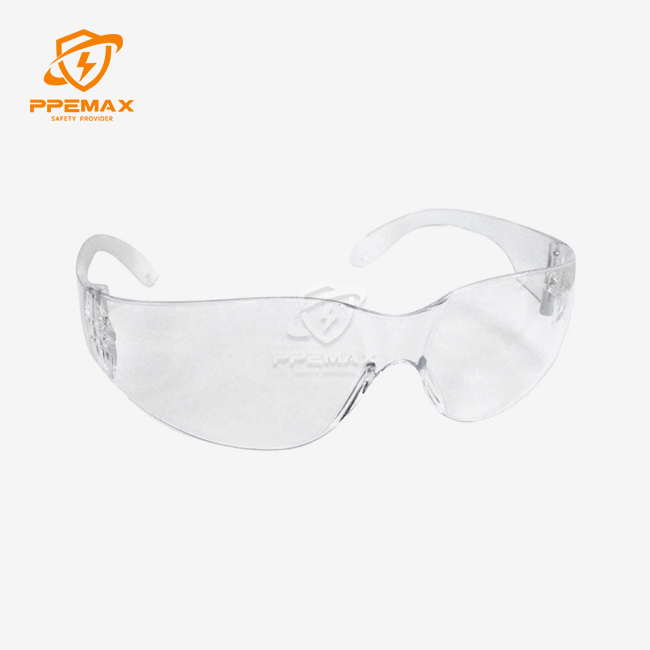
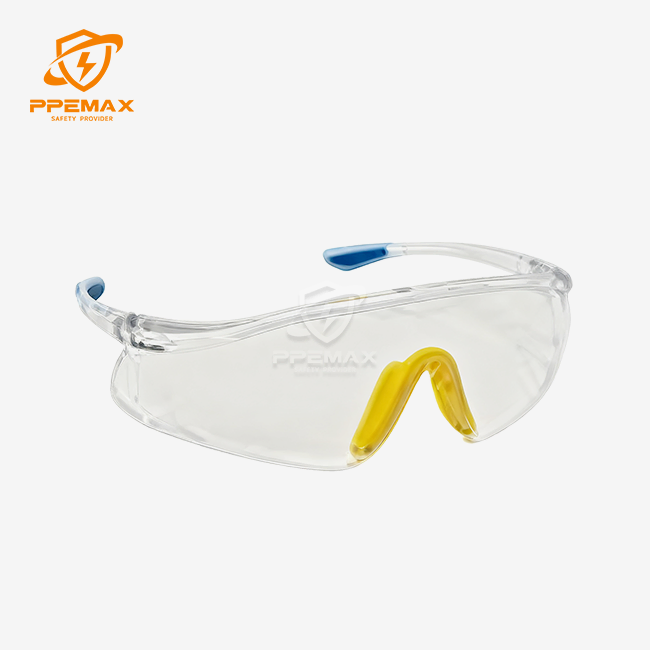
Protective Safety Goggles
Material: PC lens
Packaging: 1 pair/opp bag, 12 pairs/inner box, 120 pairs/outer box
Function: anti-fog, anti-impact
Standard: ANSI Z87.1
Protective Safety Goggles with Anti-Fog & Anti-Impact PC Lens | ANSI Z87.1 Certified
Guarding eyes at work has been the single focus of Xi'An PPE MAX Co., Ltd since 1956. That works out to more than sixty years. Our Protective Safety Goggles come straight out of that history. Inside model SG-6001 sits a polycarbonate (PC) lens built to resist fog and impact, and the model carries ANSI Z87.1 certification. Construction sites buy it. Chemical handling crews and medical teams buy it as well. A standard outer box ships 120 pairs. Nothing leaves the plant untested. Each batch goes through our own lab first, where optics, impact, fogging and flammability are checked before dispatch.

About Xi'An PPE MAX Co., Ltd
PPE MAX was established in 1956 with a single focus: manufacturing personal protective equipment that holds up under real working conditions. Over the following decades, we expanded our testing capabilities and product range while keeping eye protection at the core of what we do.
Our in-house QC team runs optical refraction testing, high-mass and high-velocity impact testing, anti-fog testing, scratch resistance testing, flammability testing, and liquid splash verification on every production batch. We do not outsource these checks. That discipline is what we consider our main differentiator after 60-plus years in this industry.

What Are This Product?
Goggles count as PPE. The whole orbital area sits under them, and the seal against the face stays unbroken. Safety glasses take a different approach. At the sides and over the top, gaps stay open. A flexible frame, PVC or TPR for instance, lets goggles follow the facial contours of each wearer.
That sealed fit lifts the level of protection a long way. Four hazard categories exist that safety glasses cannot handle with any reliability:
- Orbital seal failure: particles get in past the sides or the top of glasses; goggles shut that opening completely
- Chemical splash: acid or alkali liquids cannot reach the eye, because the frame is sealed
- Fogging in humid environments: air keeps moving through indirect ventilation channels. Nothing liquid gets inside
- Prescription eyewear compatibility: OTG (Over-The-Glass) designs go over prescription frames. The seal around the face stays unbroken

Standard Specifications
|
Parameter |
Specification |
|
Lens Material |
Polycarbonate (PC) / Acetate |
|
Frame Material |
PVC / TPR (Flexible Seal) |
|
Impact Rating |
ANSI Z87+ High Impact |
|
Optical Class |
Class 1 (Continuous Work) |
|
UV Protection |
99.9% UV Radiation Blocking |
|
Mechanical Strength |
EN 166 Rating B/A |
|
Ventilation Options |
Direct / Indirect / Non-Vented |
|
Anti-Fog Rating |
N Rating (EN 166) |
|
Anti-Scratch Rating |
K Rating (EN 166) |
|
Temperature Range |
-5°C to +55°C |
|
Chemical Resistance |
D3 (Splash/Droplet) Rating |
Product Features
PC Lens: Impact Resistance
Polycarbonate lenses carry a medium to high energy impact rating. A steel ball travelling at 120 m/s will not get through the SG-6001 lens (EN 166 'B' rating). UV radiation gets blocked at 99.9%.
Anti-Fog Coating
Humid jobs and hard work both fog up a lens fast. A coating bonded to the lens keeps your vision clear through it. That coating passes the EN 168 fog test. Hold the lens in direct steam and it has to stay clear for 8 seconds or longer.
Anti-Scratch Hard Coat
Sand-fall abrasion testing verifies the 'K' rated surface coating. The test measures light scattering once the surface has been contacted. Fine particles in the air then cause less degradation over long periods of use.
Indirect Ventilation System
Angled vents let heat escape and cut fogging. They also block liquid splash from entering the goggle body. That makes SG-6001 a good fit for sites with impact and liquid splash.
Flexible Protective Safety Goggles Seal Frame
The PVC/TPR frame adjusts to different face shapes and maintains a consistent seal during extended wear. The material does not ignite when a 650°C steel rod is applied — verified through standard flammability testing.
Optical Class 1 Lens
The lens bends light only a little. With Class 1 optical quality, that bending is not enough to cause noticeable distortion. A full shift is no problem for the SG-6001. Lower-grade lenses often bring eye strain. This one does not.

Applications
Petrochemical and Industrial Laboratories
Workers in these environments face risks from corrosive liquids and airborne vapors. The SG-6001's indirect ventilation and sealed frame help prevent liquid ingress at the points where standard glasses typically fail — the sides and lower edge of the lens.
Heavy Construction and Demolition
Debris flies fast when you sand. Chipping and grinding throw it too. Fine silicate dust also gets stirred up. The PC lens carries an ANSI Z87.1 rating. That rating covers the impacts these jobs create. When the work gets physical, the anti-fog coating keeps the view clear.
Medical and Research Settings
Some settings call for splash protection against biological fluids or chemical agents. The sealed frame blocks those splashes. Open safety glasses cannot. The goggle frame is built to fit with respiratory protection. Facial contact stays intact on both devices.

In-House QC Testing for Protective Safety Goggles
Each production batch of SG-6001 goggles goes through the following checks before shipment:
- Optical refraction testing using a focimeter (±0.06 diopter tolerance)
- High-mass impact test: 500 g pointed projectile dropped from 127 cm (ANSI Z87.1)
- High-velocity impact test: steel ball at 120 m/s (EN 166 'B')
- EN 168 anti-fog test: lens clarity maintained for minimum 8 seconds under steam
- Sand-fall abrasion test for scratch resistance ('K' rating)
- 650°C flammability test on frame material
- Liquid splash dye-transfer test on indirect vents
These tests are conducted by our own QC team, not a third-party lab. Results are recorded per batch and available for review on request.
Certifications
- ANSI/ISEA Z87.1-2020 (USA)
Packaging
Every pair gets its own OPP bag. That way the lens does not get scratched in transit. One inner box takes 12 pairs. An outer carton takes 120 pairs. With this setup, bulk orders are easy to palletize and count.
Custom labeling and packaging setups can be discussed. Send us your Protective Safety Goggles requirements and order volume. We can then give you accurate options.

After-Sales Policy
Goods that arrive damaged or fail to match the agreed spec get checked by our team. After that, we work with you on a fix. A replacement, a refund, or credit may be the answer. The case decides which one. Messages sent to after-sales get a reply within 24 business hours.
Factory Visits and Trade Exhibitions
Buyers can visit the PPE MAX factory. You get a direct look at our production lines and the QC process. Our team also goes to safety and industrial trade shows abroad. Want to plan a visit? Get in touch. You can also ask which exhibitions we have coming up.

FAQ
Q: How does the ANSI Z87 mark differ from the Z87+ mark?
A: Basic impact rules are what the Z87 mark stands for. Add a plus sign to it and the pair has cleared two tests. One is high-mass impact. The other is high-velocity impact. For grinding jobs, go with Z87+. Machining and demolition work need that same rating. Look for this spec.
Q: Are alcohol wipes or solvent wipes safe for cleaning these goggles?
A: No. Anti-fog coatings get worn down by alcohol and strong solvents. Anti-scratch coatings suffer the same way. Stress can then make PC lenses crack from that damage too. Use mild soap and lukewarm water to wash them instead. Pat the lens dry with a microfiber cloth.
Q: What should I look at when I pick vented or non-vented goggles?
A: For toxic vapors, gases, or very fine dust, choose non-vented goggles. Dealing with liquid splashes and impact? If fogging also bothers you, indirect-vented goggles work (the SG-6001 is one). Direct-vented models handle impact only. Liquids and dust will get past them.
Q: How often should you replace safety goggles?
A: Across the industry, most quotes put active use at 2 to 3 years. Swap them sooner if pits or scratches show up on the lens. Frames that UV light has made brittle or yellow need replacing too. Once either problem shows up, the facial seal suffers.
Q: Will prescription glasses fit under the SG-6001?
A: The SG-6001 has deeper frames than most. Extra room often helps. It leaves space for prescription eyewear. Want us to confirm OTG (Over-The-Glass) compatibility? Reach out with your prescription frame dimensions.
Q: Which paperwork comes with each order?
A: Batch QC records are available. So are test reports from our own lab and product certifications. Get in touch and we will confirm which documents your region or procurement process asks for.
Contact Us
Have sourcing questions or want to request a Protective Safety Goggles sample? Email bettybing@ppemax.com and our team will respond within 24 business hours.
Learn about our latest products and discounts through SMS or email