- English
- French
- German
- Portuguese
- Spanish
- Russian
- Japanese
- Korean
- Arabic
- Greek
- German
- Turkish
- Italian
- Danish
- Romanian
- Indonesian
- Czech
- Afrikaans
- Swedish
- Polish
- Basque
- Catalan
- Esperanto
- Hindi
- Lao
- Albanian
- Amharic
- Armenian
- Azerbaijani
- Belarusian
- Bengali
- Bosnian
- Bulgarian
- Cebuano
- Chichewa
- Corsican
- Croatian
- Dutch
- Estonian
- Filipino
- Finnish
- Frisian
- Galician
- Georgian
- Gujarati
- Haitian
- Hausa
- Hawaiian
- Hebrew
- Hmong
- Hungarian
- Icelandic
- Igbo
- Javanese
- Kannada
- Kazakh
- Khmer
- Kurdish
- Kyrgyz
- Latin
- Latvian
- Lithuanian
- Luxembou..
- Macedonian
- Malagasy
- Malay
- Malayalam
- Maltese
- Maori
- Marathi
- Mongolian
- Burmese
- Nepali
- Norwegian
- Pashto
- Persian
- Punjabi
- Serbian
- Sesotho
- Sinhala
- Slovak
- Slovenian
- Somali
- Samoan
- Scots Gaelic
- Shona
- Sindhi
- Sundanese
- Swahili
- Tajik
- Tamil
- Telugu
- Thai
- Ukrainian
- Urdu
- Uzbek
- Vietnamese
- Welsh
- Xhosa
- Yiddish
- Yoruba
- Zulu
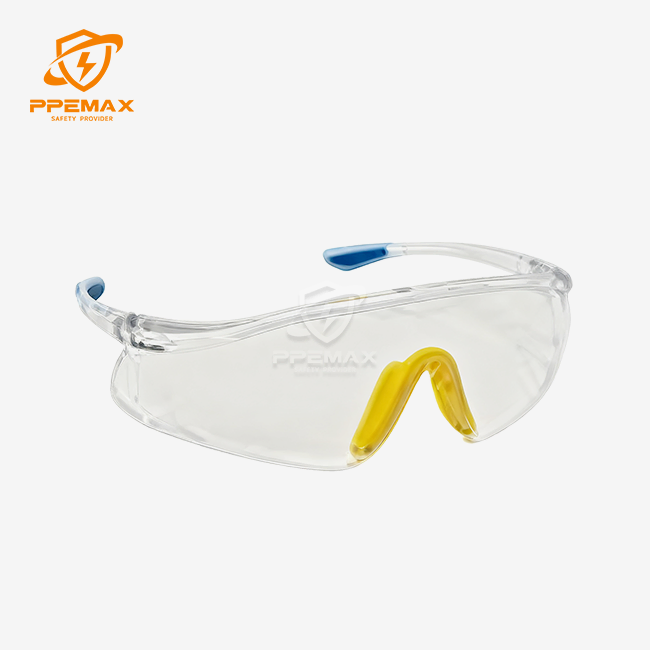
Construction Safety Glasses
Material: PC lens
Packaging: 1 pair/opp bag, 12 pairs/inner box, 300 pairs/outer box
Function: anti-fog, anti-impact
Standard: ANSI Z87.1,EN166
Construction Safety Glasses with Anti-Fog & Anti-Impact PC Lens | Built for Job Site Protection
Personal protective equipment has come out of Xi'An PPE MAX Co., Ltd since 1956. Every pair of our construction safety glasses (Model: SG-71006-G) uses virgin polycarbonate lenses. Certification covers the anti-fog and anti-impact performance of each pair. This model meets ANSI Z87.1 and EN166, so it satisfies North American and European compliance rules. One outer carton holds 300 pairs. Distributors, contractors, and site safety buyers get a packing format that suits bulk B2B orders.

What Are This Product?
One kind of Personal Protective Equipment (PPE) is this product. Site workers wear them to keep their eyes safe. Mechanical damage is one threat they face. Chemical splash and optical risks are two more.
That bar does not apply to plain sunglasses or to prescription eyewear. Industrial testing here is strict, and these glasses have to pass it. Two examples are ANSI/ISEA Z87.1+ (USA) and EN166 (Europe). Either mark proves a lens can stop high-velocity projectiles. Nails, metal shards or wood chips are the kind of thing it takes.
UVA and UVB rays that cause harm are blocked as well. Damp air or shifting weather will not fog up the lens. Side shields come with the wraparound shape, and they cover the sides of the face. That zone stays open with ordinary eyewear. Debris can then reach the eyes from the edge of vision.

Standard Specifications
| Parameter | Details |
|---|---|
| Model | SG-71006-G |
| Lens Material | Polycarbonate (PC) |
| Function | Anti-fog, Anti-impact |
| Standards | ANSI Z87.1, EN166 |
| UV Protection | Up to 380nm–400nm absorption |
| Optical Class | Class 1 (no prismatic distortion) |
| Packaging | 1 pair/OPP bag, 12 pairs/inner box, 300 pairs/outer box |
For bulk pricing or custom packaging inquiries, contact us at bettybing@ppemax.com.
Features
PC Lens with Natural UV Filtering
Virgin polycarbonate makes up the lens. UV radiation up to 400nm gets absorbed by it. This material takes roughly 10 times more impact than standard glass or plastic. That is why certified protective eyewear so often relies on it.
Anti-Fog Coating
This anti-fog coating meets EN166 N. Vision stays clear in damp rooms and tight spaces. Temperatures swing too, and the same holds. Think of walking out of an air-conditioned room onto a hot rooftop.
Anti-Impact Resistance
High-velocity impact is what these lenses are built to take. Part of the ANSI Z87.1 test protocol is a 0.25-inch steel ball fired at 150 ft/s. Snapping under physical stress is less likely, because the frame uses flexible polymer construction.
Optical Class 1 Clarity
Eye strain over long shifts drops when lenses hold zero prismatic distortion (0 diopters). Visual accuracy plays a direct part in safety for crew running precision tools, and for anyone working at height.
Advantages
Job sites where compliance and optical performance both have to hold are what the Construction Safety Glasses SG-71006-G is specified for.
- Two certifications (ANSI Z87.1 + EN166) help buyers meet compliance rules in the US and the EU
- UV absorption up to 400nm comes from the PC lenses themselves, so no extra coating is needed
- Anti-fog performance is EN166 N rated
- The frame wraps around the face. This gives side coverage against impacts coming from the side
- Flexible polymer frame reduces breakage risk on active job sites
- Optical Class 1 rating prevents visual distortion during extended wear
- Each outer carton holds 300 pairs. Big orders are easier to manage with bulk packing like this.
Applications of Construction Safety Glasses
Heavy Infrastructure & Demolition
Jackhammer operators and concrete cutters run into silica dust. Heavy debris flies around too. Anti-impact lenses and a wraparound frame guard the eyes in places full of particles. There, the exposure risk does not let up.
Electrical & HVAC Installation
Tight spaces put electricians and HVAC techs through quick temperature swings. Heat and cold move fast in attics, on rooftops, and inside cooled rooms. When the air changes that quickly, the EN166 N anti-fog rating keeps the lenses clear.
Exterior Framing & Roofing
The wraparound lens shape blocks light from the sides. Precision cutting jobs benefit from this. On those jobs, good eyesight has a direct effect on safety.
General Construction & Site Management
Class 1 optics come standard on the clear PC lenses. Everyday use in mixed indoor and outdoor settings works well with them, such as framing, drywall, and site inspection.

Why Choose Us?
PPE MAX was established in 1956 and has manufactured safety equipment for workers in demanding industries for over six decades. Our manufacturing process for construction safety glasses includes ballistic drop ball testing, focimeter-verified lens power checks, cross-cut tape adhesion tests for coatings, and VLT (Visible Light Transmission) verification.
Product compliance documents for ANSI Z87.1 and EN166 go out with every order. Your procurement stays compliant in North America or Europe, thanks to this dual certification. Order quantities, private-label development, or custom specs on your mind? Get in touch with us directly.


Certifications
| Standard | Region | Scope |
|---|---|---|
| ANSI Z87.1 | USA | High-velocity impact, optical clarity |
| EN166 | Europe | Impact, anti-fog (N), anti-scratch (K) |
Packing
| Level | Quantity |
|---|---|
| Retail unit | 1 pair / OPP bag |
| Inner box | 12 pairs |
| Outer carton | 300 pairs |
A protective OPP bag holds each pair. Inner boxes and outer cartons hold up through shipping and warehouse handling. Custom labels needed? Get in touch and tell us what you need.

After-Sales Service
- Pre-shipment QC inspection reports available on request
- Every order includes compliance documents for ANSI Z87.1 and EN166
- Dedicated account support for ongoing B2B orders
- Custom specification and private-label development supported
FAQ
Q: What's the difference between the Z87 and Z87+ markings?
A: Z87 covers the basics of impact protection. The glasses earn a Z87+ rating once they pass the high-velocity test and the high-mass test. That Z87+ rating is the standard you need on active construction sites.
Q: Can I wear prescription glasses under these safety glasses?
A: Over-The-Glass (OTG) models are the only ones that fit prescription frames. The SG-71006-G gives you a standard fit. Need your crew to wear prescription glasses on the job? Get in touch and we will walk you through the options that suit.
Q: How do I choose the right lens tint?
A: Pick clear lenses for indoor work or low light. Smoke or gray cuts the glare outdoors. When the sky turns overcast, amber or yellow gives you better contrast. The SG-71006-G clear lens is built for general job site and indoor use.
Q: What kind of lifespan does the anti-fog coating have?
A: The coating on the SG-71006-G meets EN166 N standards. To keep that coating working, rinse the lenses with water or wipe them with a microfiber cloth. Alcohol-based cleaners are best avoided. They can break down anti-fog layers.
Q: When should safety glasses be replaced?
A: Swap them out right away after any impact, even when you can't see damage. Lenses with pits or scratches that blur your vision need replacing too.
Q: Can I use these glasses for electrical work?
A: Anti-fog lenses work well in HVAC and electrical settings where temperatures swing fast. In arc flash risk zones, check that the frame has no metal parts. Those applications call for dielectric properties.
Contact Us
Have a bulk order inquiry or need a custom quote? Email bettybing@ppemax.com about Construction Safety Glasses and our team will get back to you.
Learn about our latest products and discounts through SMS or email