- English
- French
- German
- Portuguese
- Spanish
- Russian
- Japanese
- Korean
- Arabic
- Greek
- German
- Turkish
- Italian
- Danish
- Romanian
- Indonesian
- Czech
- Afrikaans
- Swedish
- Polish
- Basque
- Catalan
- Esperanto
- Hindi
- Lao
- Albanian
- Amharic
- Armenian
- Azerbaijani
- Belarusian
- Bengali
- Bosnian
- Bulgarian
- Cebuano
- Chichewa
- Corsican
- Croatian
- Dutch
- Estonian
- Filipino
- Finnish
- Frisian
- Galician
- Georgian
- Gujarati
- Haitian
- Hausa
- Hawaiian
- Hebrew
- Hmong
- Hungarian
- Icelandic
- Igbo
- Javanese
- Kannada
- Kazakh
- Khmer
- Kurdish
- Kyrgyz
- Latin
- Latvian
- Lithuanian
- Luxembou..
- Macedonian
- Malagasy
- Malay
- Malayalam
- Maltese
- Maori
- Marathi
- Mongolian
- Burmese
- Nepali
- Norwegian
- Pashto
- Persian
- Punjabi
- Serbian
- Sesotho
- Sinhala
- Slovak
- Slovenian
- Somali
- Samoan
- Scots Gaelic
- Shona
- Sindhi
- Sundanese
- Swahili
- Tajik
- Tamil
- Telugu
- Thai
- Ukrainian
- Urdu
- Uzbek
- Vietnamese
- Welsh
- Xhosa
- Yiddish
- Yoruba
- Zulu
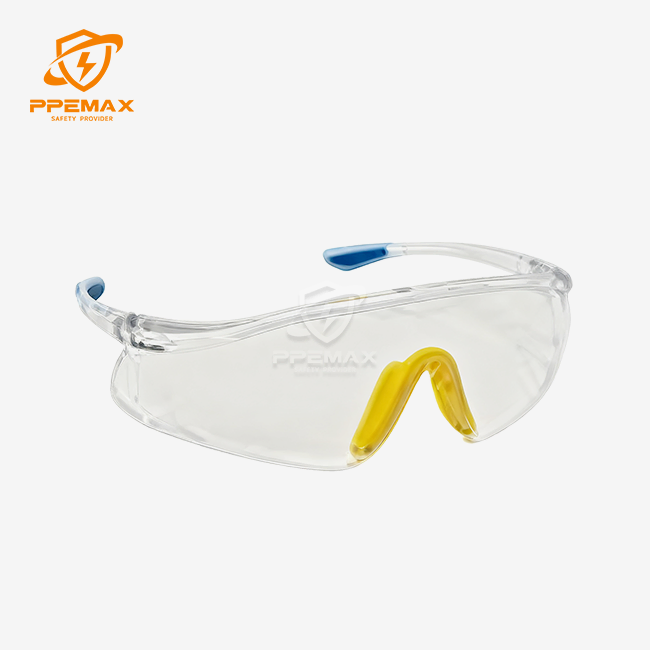
Cycling Safety Glasses
Material: PC lens
Packaging: 1 pair/opp bag, 12 pairs/inner box, 300 pairs/outer box
Function: anti-fog, anti-impact
Cycling Safety Glasses for High-Performance Riding — SG-71045C | PPE MAX
Cycling Safety Glasses for B2B buyers need proof, not just a label. Buyers want materials checked. They want standards written down. Packaging has to grow with the order too. The SG-71045C from Xi'An PPE MAX Co., Ltd. uses a polycarbonate (PC) lens. An anti-fog coating goes on at the factory. The frame has a wraparound shape with a base curve from 7 to 9. UV400 protection comes standard. Each unit ships in an OPP bag. Inner boxes hold 12 pairs. Outer boxes hold 300 pairs. That makes the product ready for bulk distribution or retail fulfillment.

Xi'An PPE MAX Co., Ltd: This Product Manufacturer & Supplier
Xi'An PPE MAX Co., Ltd. has manufactured protective eyewear since 1956. Our output includes industrial eye protection. Sports eye protection is part of it too. The SG-71045C sits in our cycling line. We made that line for road use. It works on trails. Commuters use it too.
Our factory runs quality control steps that follow ANSI Z87.1 and EN166/EN168. Full QC documentation comes with every order. B2B buyers get help from sample request to bulk shipment.

What Are This Product?
Personal Protective Equipment (PPE) includes this product. Fast sports and road riding are what they are made for. Fashion sunglasses are a different product, so do not mix the two up.
CR-39 or glass lenses are used in most everyday sunglasses. A hard hit can break them. Polycarbonate (PC) and Trivex are used in this product instead. Those two materials absorb impact energy and will not splinter. The gap matters once you ride above 40 km/h. At that speed, road debris and particles in the air become a real hazard.
Impact protection is just one job. Cycling eyewear must also handle wind that makes eyes water. UV radiation is another concern. Fogging can come from body heat. A lens with a high curve can cause optical distortion too.


Standard Specifications
|
Component |
Specification |
Performance Standard |
|
Lens Material |
Injection-Molded Polycarbonate/NXT |
Impact Resistance: ANSI Z87.1 |
|
Frame Material |
TR90 (Grilamid) Thermoplastic |
Chemical Resistance, Memory Retention |
|
Base Curve |
7-9 Curve |
Wraparound Aerodynamic Fit |
|
Light Transmission |
Variable 15%-85% (Photochromic) |
UV Intensity Adaptive |
|
Optical Power |
Zero Refractive (Planar) |
Distortion-Free Vision |
|
Weight |
25-35 grams |
Ultra-Lightweight Design |
|
Coating System |
Multi-layer (Hydrophobic/Oleophobic) |
Anti-Fog, Water-Repelling |
Features
PC Lens with High-Impact Resistance
The SG-71045C uses a polycarbonate lens that soaks up impact energy. Bending is what happens. Breakage is not. Testing runs to ANSI Z87.1 high-velocity impact requirements, the same standard industrial safety eyewear must meet.
Factory-Applied Anti-Fog Coating
A hydrophilic anti-fog coating is bonded to the inside of the lens. During slow climbs and stops, that layer deals with condensation. Temperature swings are covered too. Stick to microfiber and water when you clean it. Solvents will break the coating down. Durability testing follows EN168 humidity cycle standards.
Wraparound Frame Geometry
With its base curve 7–9 shape, the lens wraps around the face. Wind turbulence behind the lens drops as a result. Fast descents and the open road both bring less wind-induced tearing.
UV400 Full Spectrum Cycling Safety Glasses Blocking
Every lens blocks 100% of UVA and UVB rays. That means UV cover through an entire shift. For commuters and couriers who ride for long hours each day, it counts.
Frame Venting
Vents in the frame pull air over the inside of the lens. Warm, damp air gets carried away. Fog builds up less on slow climbs or at rest stops. Structural protection stays the same.
Applications
Road Cycling & Competitive Racing
Once you go past 40 km/h, the wraparound shape of the lens and the PC build shield you from tarmac debris and particles in the air. That counts in peloton conditions.
Mountain Biking & Trail Riding
In the woods, light shifts fast. Gravel gets kicked up. Branches hang low. The anti-fog coating and the full-rim frame design guard against both. Your vision stays clear as the light changes.
Urban Commuting & Cycle Couriers
Commuters deal with road grit. Long hours of UV and stop-start traffic come with the ride. Clear or tinted PC lenses with UV400 protection cover a whole shift. Against road grit, PC lasts better than standard CR-39 or glass lenses.
Certifications for Cycling Safety Glasses
The SG-71045C is tested against:
- ANSI Z87.1: impact from fast objects and heavy objects is resisted
- EN166 / EN168: the European standard that covers personal eye protection, plus how well anti-fog coatings hold up
Packing
| Level | Detail |
|---|---|
| Unit | 1 pair per OPP bag |
| Inner Box | 12 pairs |
| Outer Box | 300 pairs |
Standard export carton packing. Custom labeling is available for private label orders.

Why Choose PPE MAX
Protective eyewear has been made by Xi'An PPE MAX Co., Ltd. since 1956. Every SG-71045C passes a set of QC checks. Impact resistance of Cycling Safety Glasses is tested two ways, with a drop ball and at high velocity. A lensometer handles the optical calibration and flags any prism imbalance. Hinges go through fatigue testing. Metal components get a salt spray test.
Full B2B paperwork goes out with every shipment. Order quantities stay flexible. Packaging runs from OPP bag to outer box, so it suits retail or warehouse distribution. Any defect reported within 30 days can be replaced or refunded. Our technical team helps with coating care. The same team answers questions about Rx insert compatibility and about picking the right lens.

FAQ
Q: How well do this product hold up on impact, compared with regular sunglasses?
A: Fashion sunglasses take CR-39 or glass. Sharp pieces can fly off if you hit them hard. For the SG-71045C, PC lenses are used instead. On impact they bend. The force gets soaked up. No splinters. At riding speed, flying debris stays away from your eyes.
Q: Do polarized lenses always work better for cycling?
A: No, they do not. Polarized lenses cut glare off the road. They can hide oil slicks, wet manholes, and LCD screens on bike computers too. Plenty of riders therefore pick high-contrast lenses with no polarization. Road safety drives that choice.
Q: How long can the anti-fog coating keep working?
A: Factory-applied, the coating comes already on the lens. It pulls water across the surface, and each batch gets checked against EN168 humidity cycle standards. Cleaning takes microfiber and water. Nothing else. Solvents and abrasive cloths will strip the coating off. After that, performance drops.
Q: What do the frame vents do?
A: Vents let air in, and that airflow travels across the inside of the lens. Moisture and warmth get pulled out with it. On slow climbs, or whenever you stop, breath and body heat would otherwise fog the lens. With the vents working, less condensation forms.
Q: Can prescription lenses be fitted to these glasses?
A: You can go two ways. One is a clip-in Rx optical insert that sits behind the main shield. The other is direct digital surfacing of the Rx into the high-curve PC lens. Cost-wise, the insert wins. Optics-wise, direct surfacing gives the better result.
Q: Which impact testing standards does the SG-71045C meet?
A: ANSI Z87.1 and EN166 are the two standards the SG-71045C is tested to. A steel ball gets dropped on the lens. The same happens to the frame. Both parts have to come through with no shattering and nothing coming loose.
Contact Us
Need pricing, samples, or to place an order? Send a message about Cycling Safety Glasses to bettybing@ppemax.com. Distributors can write to us too. So can retailers and private label buyers.
Learn about our latest products and discounts through SMS or email