- English
- French
- German
- Portuguese
- Spanish
- Russian
- Japanese
- Korean
- Arabic
- Greek
- German
- Turkish
- Italian
- Danish
- Romanian
- Indonesian
- Czech
- Afrikaans
- Swedish
- Polish
- Basque
- Catalan
- Esperanto
- Hindi
- Lao
- Albanian
- Amharic
- Armenian
- Azerbaijani
- Belarusian
- Bengali
- Bosnian
- Bulgarian
- Cebuano
- Chichewa
- Corsican
- Croatian
- Dutch
- Estonian
- Filipino
- Finnish
- Frisian
- Galician
- Georgian
- Gujarati
- Haitian
- Hausa
- Hawaiian
- Hebrew
- Hmong
- Hungarian
- Icelandic
- Igbo
- Javanese
- Kannada
- Kazakh
- Khmer
- Kurdish
- Kyrgyz
- Latin
- Latvian
- Lithuanian
- Luxembou..
- Macedonian
- Malagasy
- Malay
- Malayalam
- Maltese
- Maori
- Marathi
- Mongolian
- Burmese
- Nepali
- Norwegian
- Pashto
- Persian
- Punjabi
- Serbian
- Sesotho
- Sinhala
- Slovak
- Slovenian
- Somali
- Samoan
- Scots Gaelic
- Shona
- Sindhi
- Sundanese
- Swahili
- Tajik
- Tamil
- Telugu
- Thai
- Ukrainian
- Urdu
- Uzbek
- Vietnamese
- Welsh
- Xhosa
- Yiddish
- Yoruba
- Zulu
Class 3 Insulating Gloves Set
1 pair cotton gloves
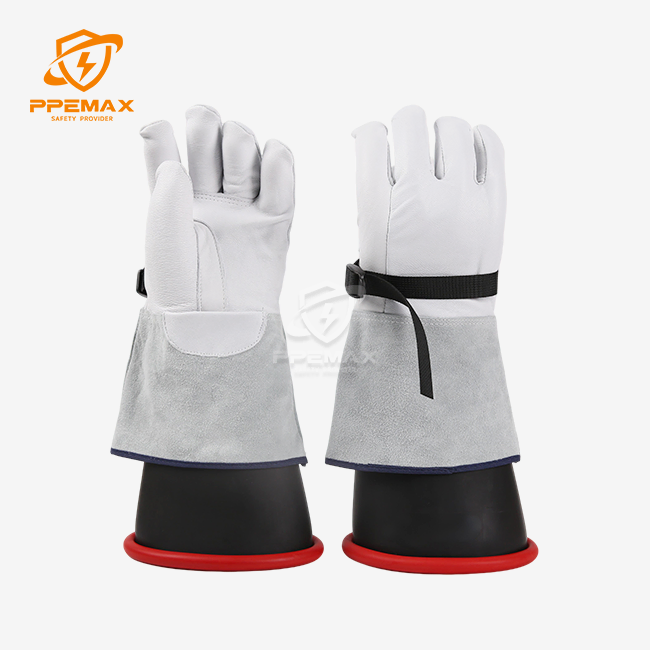
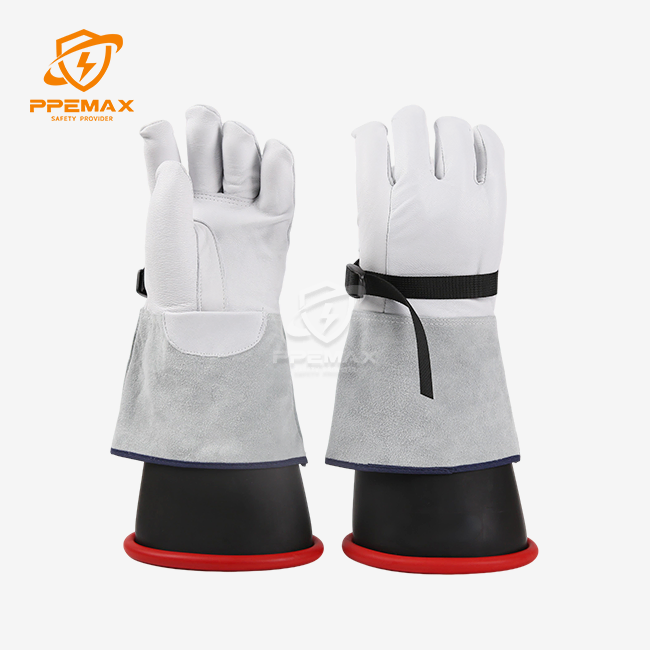
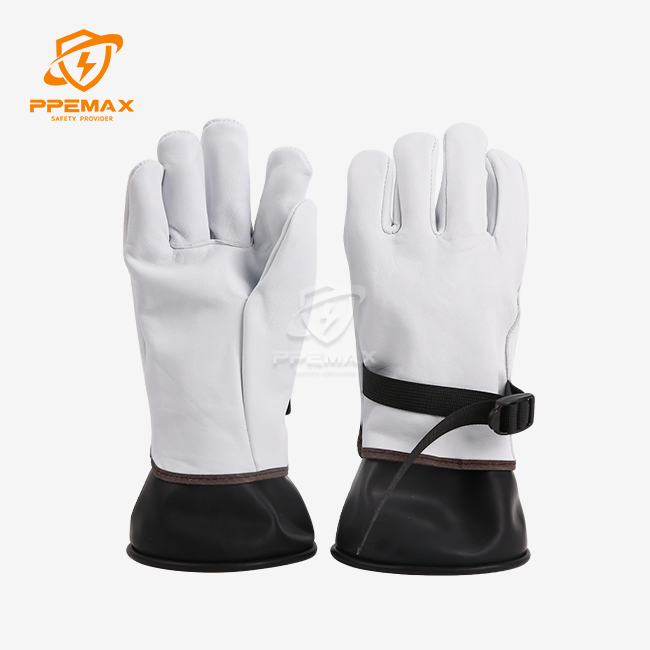
1 pair class 3 insulating gloves
1 pair leather gloves
1pcs Canvas bag
Class 3 Insulating Gloves Set – High-Voltage Electrical Protection for Linemen & Industrial Technicians
Xi'An PPE MAX Co., Ltd has been manufacturing workplace safety equipment since 1956. The Class 3 Insulating Gloves Set is engineered for electrical workers operating at voltages up to 26,500V AC. Each set includes one pair of cotton liner gloves, one pair of Class 3 rubber insulating gloves, one pair of leather protector gloves, and one canvas storage bag — a four-component system built to meet ASTM D120, ASTM F496, ASTM F696, and IEC 60903 standards.

What Is This Product?
This this product is a PPE system built for one job: keeping electrical workers safe from voltages up to 26,500V AC. Each set must pass a proof test at 30,000V AC.
Rubber gloves on their own do give dielectric protection. Cuts, wire strands, and sharp tool edges can still ruin them. That is why the set format exists. Mechanical trauma hits the leather protector first, before it ever reaches the rubber layer. Moisture gets handled by the cotton liner, and comfort holds up through long shifts. Between jobs, the canvas bag keeps the whole set clean, dry, and stored the right way.

Standard Specifications
| Parameter | Details |
|---|---|
| Voltage Class | Class 3 |
| Max Use Voltage | 26,500V AC |
| Proof Test Voltage | 30,000V AC |
| Label Color | Green |
| Rubber Glove Standard | ASTM D120 / IEC 60903 |
| Leather Protector Standard | ASTM F696 |
| In-Service Retest Standard | ASTM F496 |
| Nominal Thickness | 2.3mm – 2.9mm |
| Material Type I | Natural Rubber (strong elasticity) |
| Material Type II | Salcor / EPDM (ozone & UV resistant) |
| Set Contents | Cotton liner + Rubber glove + Leather protector + Canvas bag |

FeaturesGreen Label Identification
The green label is the ASTM and IEC designation for Class 3. It confirms the glove is rated for 26,500V AC — distinct from Class 2 (orange, 17kV) and Class 4 (red, 36kV). Confirming label color before every use is a basic safety step, not an optional one.
Dual Material Options
For close, detailed work, Type I natural rubber gives you better flexibility and tactile sensitivity. Ozone and UV degradation are the weakness of plain rubber, and Type II EPDM/Salcor resists both. That makes it a fit for outdoor utility lines and substation environments, where corona discharge produces ozone. Which material you pick comes down to the work environment itself.
Chemically Treated Leather Protector
The leather protectors are chemically processed to reduce water absorption. They are sized to maintain the required cuff gap between the leather and rubber cuff — a gap that prevents electrical flashover along the glove surface.
Wall Thickness for Dielectric Integrity
At 2.3mm to 2.9mm, the rubber glove wall sustains the dielectric strength required at Class 3 voltages while still allowing enough hand movement for tool operation.

How Each Component Works Together
The main electrical barrier comes from the rubber glove. Punctures and scrapes can ruin that insulation. A leather protector guards against them. Hands stay dry thanks to the Class 3 Insulating Gloves Set cotton liner. Dry hands mean better grip and more comfort over a long shift.
Storing the full set in the included canvas bag — fingers pointing up, hung in a cool dry location — helps extend glove service life and protects the rubber from UV and thermal degradation between uses.
Applications
Utility Grid Transmission and Distribution
Linemen use this set for maintenance on distribution lines where voltages exceed the Class 2 limit of 17kV but remain within the 26.5kV Class 3 range. It is suited for bucket truck and pole-climbing operations.
Substation Switchgear Operations
Some techs work on high-voltage switchgear, transformers, and capacitor banks. For them, Type II versions make sense. Corona discharges are common in substations. These gloves hold up against the ozone those discharges give off.
Industrial High-Voltage Maintenance
Steel mills, mining sites, and big data centers often run their own step-down substations. This set lets them keep workers safe. It gets used during fault testing and for routine checks of the infrastructure.

Certifications and Standards Compliance for Class 3 Insulating Gloves Set
We make these Class 3 rubber insulating gloves to meet ASTM D120 and IEC 60903. The leather protectors comply with ASTM F696. For testing, we follow ASTM F496. That standard covers the electrical retest you must do every 6 months while the gloves are in service.

Packing
Each Class 3 Insulating Gloves Set ships with:
- 1 pair cotton liner gloves
- 1 pair Class 3 rubber insulating gloves
- 1 pair leather protector gloves
- 1 canvas storage bag
Packing is done so the rubber gloves cannot be squashed or folded in transit. That keeps their dielectric integrity intact before the first use.
After-Sales Support
Documentation comes with the product, along with compliance certificates. We also give technical guidance on storage intervals and electrical retesting schedules. Not sure whether Type I or Type II rubber suits you? Or need a leather protector size that matches a specific rubber cuff dimension? Get in touch with our team.
About Xi'An PPE MAX Co., Ltd
Protective equipment has come out of Xi'An PPE MAX Co., Ltd since 1956. Utility operators, substation technicians, and industrial maintenance teams all count on us for high-voltage PPE. Buyers are welcome to visit the factory. You can review our production and quality control processes in person.

FAQ
Q: What is the electrical test interval for this products?
A: OSHA and ASTM F496 say rubber insulating gloves in service get an electrical test every 6 months. Gloves kept in storage need it every 12 months. Whatever the testing status, check the gloves by eye before each use.
Q: Can the rubber glove be used without the leather protector?
A: No. ASTM F496 requires that leather protectors be worn over rubber insulating gloves to prevent mechanical damage. Using the rubber glove without the leather protector is not permitted under the standard's safety requirements.
Q: What does the green label indicate?
A: Green identifies Class 3: a maximum use voltage of 26,500V AC. Orange identifies Class 2 (17kV). Red identifies Class 4 (36kV). Always verify the label color before beginning work.
Q: What is the practical difference between Type I and Type II gloves?
A: Type I is natural rubber. It bends more, but ozone resistance is lower. Type II is EPDM/Salcor. It works for outdoor utility jobs and substations, where ozone and UV exposure are constant. The choice comes down to where the gloves are used.
Q: Between uses, how should the set be kept?
A: Put the whole set in the canvas bag that comes with it. Point the fingers up. Hang it or store it in a cool spot. That spot should also be dark and dry. Keep the set out of sunlight. Heat sources and steam also break down rubber, so keep it away from those too.
Q: Is the set's electrical rating changed by the cotton liner?
A: No. Inside the rubber glove sits the cotton liner. The dielectric rating is not affected at all. Its only jobs are to handle moisture and keep the wearer comfortable during extended shifts.
Contact Us
Have questions or need technical guidance on the Class 3 Insulating Gloves Set? Reach our team at bettybing@ppemax.com: we're ready to help.
Learn about our latest products and discounts through SMS or email



_1759025742504.webp)