- English
- French
- German
- Portuguese
- Spanish
- Russian
- Japanese
- Korean
- Arabic
- Greek
- German
- Turkish
- Italian
- Danish
- Romanian
- Indonesian
- Czech
- Afrikaans
- Swedish
- Polish
- Basque
- Catalan
- Esperanto
- Hindi
- Lao
- Albanian
- Amharic
- Armenian
- Azerbaijani
- Belarusian
- Bengali
- Bosnian
- Bulgarian
- Cebuano
- Chichewa
- Corsican
- Croatian
- Dutch
- Estonian
- Filipino
- Finnish
- Frisian
- Galician
- Georgian
- Gujarati
- Haitian
- Hausa
- Hawaiian
- Hebrew
- Hmong
- Hungarian
- Icelandic
- Igbo
- Javanese
- Kannada
- Kazakh
- Khmer
- Kurdish
- Kyrgyz
- Latin
- Latvian
- Lithuanian
- Luxembou..
- Macedonian
- Malagasy
- Malay
- Malayalam
- Maltese
- Maori
- Marathi
- Mongolian
- Burmese
- Nepali
- Norwegian
- Pashto
- Persian
- Punjabi
- Serbian
- Sesotho
- Sinhala
- Slovak
- Slovenian
- Somali
- Samoan
- Scots Gaelic
- Shona
- Sindhi
- Sundanese
- Swahili
- Tajik
- Tamil
- Telugu
- Thai
- Ukrainian
- Urdu
- Uzbek
- Vietnamese
- Welsh
- Xhosa
- Yiddish
- Yoruba
- Zulu
Class 4 Insulating Gloves Set
1 pair cotton gloves
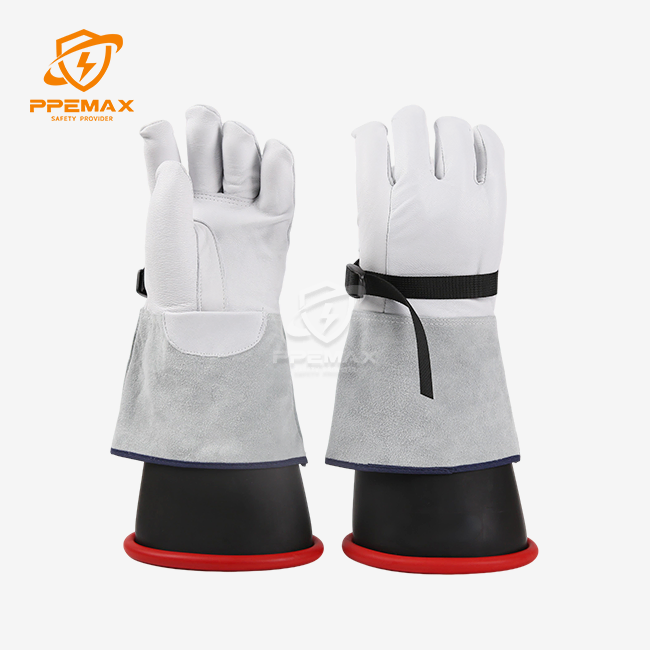
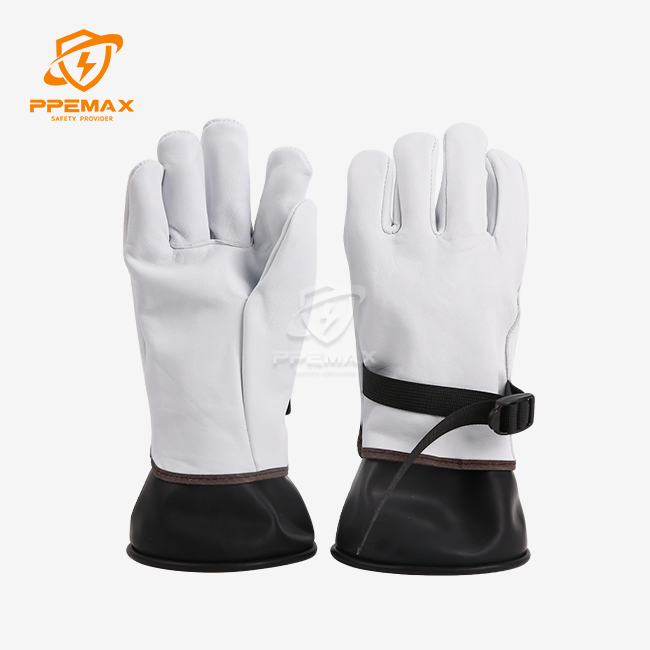
1 pair class 4 insulating gloves
1 pair leather gloves
1pcs Canvas bag
Class 4 Insulating Gloves Set for High-Voltage Protection — 36kV Rated Safety Solution
Xi'An PPE MAX Co., Ltd has built electrical safety PPE since 1956. Maximum use voltage for our Class 4 Insulating Gloves Set is 36,000V AC and 54,000V DC. That covers both ASTM D120 and IEC 60903. Inside each set you get one pair of cotton liner gloves and one pair of Class 4 dielectric rubber gloves. One pair of leather protector gloves sits in there too, along with one canvas storage bag. Electrical workers at transmission-level voltages get all four components in one box.

Xi'An PPE MAX Co., Ltd: This Product Manufacturer & Supplier
For more than six decades PPE MAX has kept its focus on occupational electrical safety PPE. Quality controls on our production floor follow ASTM F496 and OSHA 1910.137 compliance requirements. Utilities buy from us, and so do industrial contractors and safety distributors in international markets.
What Is This Product?
High-voltage work calls for serious gear, and This product is the top-rated PPE ensemble for it. Contact with systems up to 36kV AC and 54kV DC is what it guards against. Class 3 (26.5kV) equipment cannot reach that far.
You are not dealing with one glove here. The setup is a system with four parts:
- Cotton liner glove: takes up sweat and keeps the hand warm over long periods of wear
- Class 4 dielectric rubber glove: this is the main insulating barrier. Natural latex (Type I) or EPDM synthetic rubber (Type II) is what it gets made from
- Leather protector glove: meets ASTM F696. During live-line work it keeps the rubber safe from cuts and punctures, and from abrasion too
- Canvas storage bag: guards the set while you carry it and while it sits in storage. Gloves stay fingertips-up inside, so the rubber does not crease
Two problems come up for electrical workers every day. One is keeping the dielectric layer intact. The other is holding on to enough dexterity to use tools safely. This combination handles both.

Standard Specifications
| Parameter | Value |
|---|---|
| Voltage Class | Class 4 |
| Maximum Use Voltage (AC) | 36,000V AC |
| Maximum Use Voltage (DC) | 54,000V DC |
| Proof Test Voltage | 40,000V AC |
| Glove Thickness | 2.0mm – 2.5mm |
| Elongation at Break | ≥ 600% |
| Applicable Standards | ASTM D120, IEC 60903, ASTM F696, ASTM F496 |
| Rubber Type I Material | Natural Latex (Non-Ozone Resistant) |
| Rubber Type II Material | EPDM Synthetic Rubber (Ozone Resistant) |
| Leather Protector Clearance | Min. 1 inch (25mm) from cuff of rubber glove |
| Set Contents | Cotton gloves + Class 4 rubber gloves + Leather gloves + Canvas bag |

Features
Dual-color dipping construction: Two colors that contrast go into this glove (black over orange, for instance). Scuff it or cut it and the color underneath shows up. A quick look during your pre-use check then warns you right away.
Type I and Type II options: Detailed work calls for Type I natural rubber, which brings flexibility and dexterity. On outdoor sites, or sites with heavy pollution, go with Type II EPDM rubber. Ozone cracking and UV damage do not get through it.
Full leather mechanical protection: Tearing strength and puncture resistance both meet ASTM F696 on the leather outer glove. Rough line work still leaves the rubber layer intact.
Clearance that is planned, not guessed: Every leather protector gets cut so it sits at least 1 inch (25mm) under the rubber glove cuff. That gap gives the creepage distance the job calls for. At 36kV, flashover will not happen.
Elongation at break ≥ 600%: Your hands still move the usual way. The rubber layer keeps handing out that same insulating protection the whole time.

Applications
Some sites run at voltage levels where lower-class protection is simply not enough. That is the work the Class 4 Insulating Gloves Set is built for.
Utility transmission and substation maintenance: This set was built for live-line work on transmission lines and busbars rated up to 34.5kV. Linemen wear it for hot-stick jobs. They also wear it for tasks where they touch the line directly.
Renewable energy high-voltage systems: A turbine nacelle leaves little room to move, and the chance of arc flash goes up in there. This set is standard PPE for wind farm technicians who work on step-up transformers and collector grid switching gear.
Emergency response and disaster recovery: Storms bring down power lines and wreck infrastructure. That means wet ground and heavy debris. Rubber gloves alone will not hold up against those mechanical hazards. So utility crews and first responders do need the leather protectors.
Working at transmission-level voltages? Get in touch and we can go over configuration and availability.

Certifications for Class 4 Insulating Gloves Set
Every pair of our insulating gloves is made and tested against these requirements:
- ASTM D120: Rubber Insulating Gloves
- IEC 60903: Live Working Electrical Insulating Gloves
- ASTM F696: Leather Protectors
- ASTM F496: In-Service Care of Rubber Insulating Gloves and Sleeves
- OSHA 1910.137: we follow this rule for Electrical Protective Equipment

Packing
| Item | Detail |
|---|---|
| Set Contents | 1 pair cotton gloves, 1 pair Class 4 rubber gloves, 1 pair leather gloves, 1 canvas bag |
| Storage Bag | Canvas bag, fingertips-up orientation |
| Storage Conditions | Away from sunlight, heat above 35°C, ozone, oils, and solvents |
After-Sales Service
- ASTM F496 sets out the re-testing guide: every 6 months while in service, and every 12 months if the item is unissued
- Technical documentation support for compliance and safety audits
- Replacement and repair inquiry support available through our sales team
- Account support available for ongoing supply arrangements
Why Choose PPE MAX?
PPE MAX has built safety equipment since 1956. Our production process follows the test protocols in ASTM D120, IEC 60903, ASTM F696, and ASTM F496.
Electrical safety buyers buy from us direct. Utility procurement teams and regional distributors do too. Bulk orders can include Class 4 Insulating Gloves Set with custom sizes. Custom labels and product configurations are possible as well. Reach out. We will talk through your needs.


FAQ
Q: How often does This product need an electrical test?
A: Rubber insulating gloves in service must be electrically tested every 6 months. That comes from OSHA 1910.137 and ASTM F496. Gloves that were issued but never used still need re-testing once 12 months have passed since the last test. Before each use, a daily air inflation inspection is required.
Q: Can I use the Class 4 rubber gloves without the leather protectors?
A: No. That rubber glove only insulates against electricity. Take away the leather protector and the rubber sits exposed during line work. Cuts and punctures happen there. Once the rubber layer is damaged, its dielectric strength is gone. That is a serious safety hazard.
Q: What separates Type I gloves from Type II?
A: Type I starts with natural rubber. More dexterity and flexibility come from that. Ozone exposure can crack it, though. Type II uses EPDM synthetic rubber. Neither ozone nor UV radiation attacks it. Work outdoors or in high-pollution areas? Type II is the better fit.
Q: How should the set be stored?
A: Slide the rubber gloves back into the canvas bag supplied with them. Point the fingertips upward. That way they will not crease. Do not leave them in direct sunlight. Heat above 35°C (95°F) causes problems as well. The same goes for humidity, ozone sources, and chemicals such as oils or solvents.
Q: What tells me the leather protector sits on the rubber glove correctly?
A: The leather protector must be shorter than the rubber glove. Leave a gap of at least 1 inch (25mm) between its top and the top cuff of the rubber glove. That gap holds the creepage distance. Without it, flashover at 36kV can happen.
Q: What makes this set different from a Class 3 insulating gloves set?
A: Class 4 is rated for 36,000V AC: significantly higher than the Class 3 maximum of 26,500V AC. The rubber is also thicker (2.0–2.5mm vs. thinner Class 3 profiles), and proof testing is conducted at 40,000V AC, making this set the appropriate choice for transmission-level voltage environments.
Contact Us
For product specifications or order inquiries regarding the Class 4 Insulating Gloves Set, contact our team at bettybing@ppemax.com. We will get back to you as soon as possible.
Learn about our latest products and discounts through SMS or email



_1759025742504.webp)