- English
- French
- German
- Portuguese
- Spanish
- Russian
- Japanese
- Korean
- Arabic
- Greek
- German
- Turkish
- Italian
- Danish
- Romanian
- Indonesian
- Czech
- Afrikaans
- Swedish
- Polish
- Basque
- Catalan
- Esperanto
- Hindi
- Lao
- Albanian
- Amharic
- Armenian
- Azerbaijani
- Belarusian
- Bengali
- Bosnian
- Bulgarian
- Cebuano
- Chichewa
- Corsican
- Croatian
- Dutch
- Estonian
- Filipino
- Finnish
- Frisian
- Galician
- Georgian
- Gujarati
- Haitian
- Hausa
- Hawaiian
- Hebrew
- Hmong
- Hungarian
- Icelandic
- Igbo
- Javanese
- Kannada
- Kazakh
- Khmer
- Kurdish
- Kyrgyz
- Latin
- Latvian
- Lithuanian
- Luxembou..
- Macedonian
- Malagasy
- Malay
- Malayalam
- Maltese
- Maori
- Marathi
- Mongolian
- Burmese
- Nepali
- Norwegian
- Pashto
- Persian
- Punjabi
- Serbian
- Sesotho
- Sinhala
- Slovak
- Slovenian
- Somali
- Samoan
- Scots Gaelic
- Shona
- Sindhi
- Sundanese
- Swahili
- Tajik
- Tamil
- Telugu
- Thai
- Ukrainian
- Urdu
- Uzbek
- Vietnamese
- Welsh
- Xhosa
- Yiddish
- Yoruba
- Zulu
Chemical Respirator
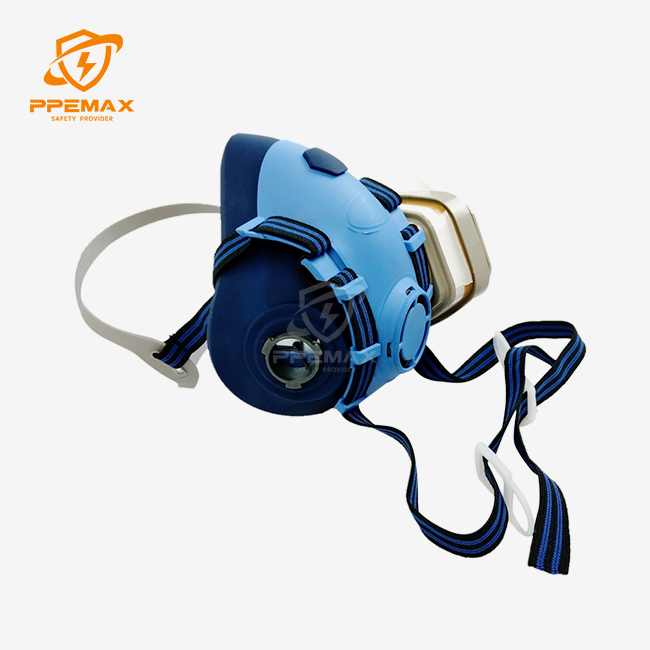
Head belt & neck belt: Size adjustable
Connector: Bayonet dust filters/gas filters
Size: S, M, L
Certified: CE EN: 140: 1998
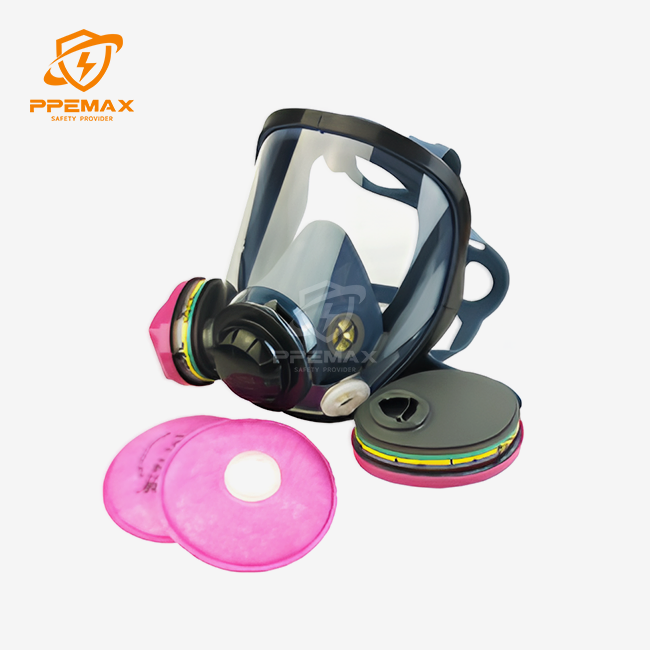
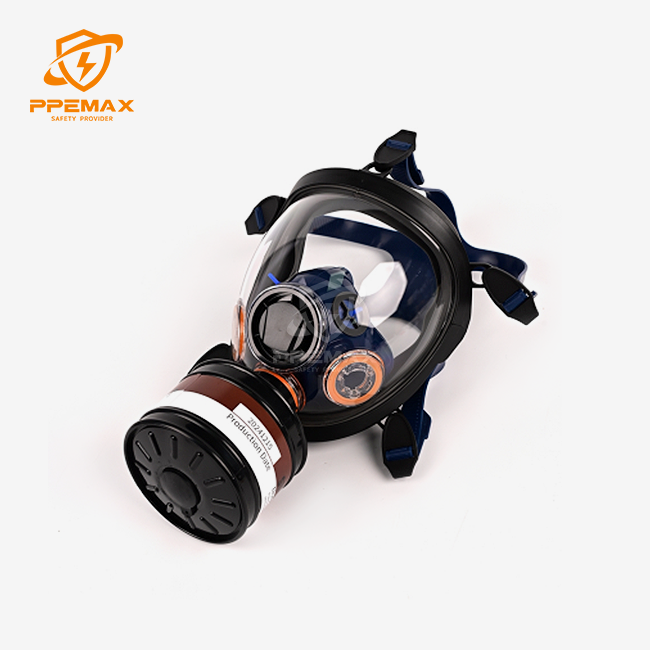
Chemical Respirator Half-Face Mask | TPE Facepiece with Bayonet Filter System for Industrial Protection
Safety gear has come out of Xi'An PPE MAX Co., Ltd since 1956. The Chemical Respirator uses a facepiece made of medical-grade TPE. Changing a filter takes very little time. A bayonet connector holds the dust and gas cartridges in place. The seal on the face stays put, because a head belt and a neck belt both adjust. Sizes S, M, and L are available. CE EN 140:1998 certification covers the unit. Industrial sites are where it fits. Toxic gases and vapors are present there. Airborne particles pose a risk as well.
What Are This Products?
This product is a half-face air-purifying respirator. It keeps harmful substances out of a worker's lungs. Toxic gases count among them. So do vapors. Particulate matter belongs on that list too, and so do some biological aerosols. Its working principle differs from a single-use dust mask. This device seals against the lower face and holds a negative pressure there. Filter cartridges snap in and out. Media like activated carbon sit inside those cartridges and clean the surrounding air. Cleaning happens before the air reaches the lungs.
Use this respirator only where contaminant levels stay below Immediately Dangerous to Life or Health (IDLH) levels. Ambient oxygen also has to be at least 19.5%. Sites get help meeting occupational health rules from the design. OSHA 29 CFR 1910.134 is one example. Under that rule, a written respiratory protection program is required. Before use, fit testing and a medical evaluation are needed too.

Standard Specifications
| Parameter | Details |
|---|---|
| Facepiece Material | TPE (Thermoplastic Elastomer) |
| Mask Type | Half-face respirator |
| Size | S, M, L |
| Head Strap System | Adjustable head belt & neck belt |
| Connector Type | Bayonet (compatible with dust filters & gas filters) |
| Certification | CE EN 140:1998 |
| Filter Compatibility | Dust filter cartridges / Gas filter cartridges |
Features
TPE Facepiece Construction
TPE bends easily and stands up to chemicals. Skin reactions are rare with it. Soft is how the contact surface feels. A full shift of wear gets less tiring because of that. Harder facepiece materials turn stiff. This one never does.
Bayonet Filter Connector System
No tools are needed to change a cartridge, thanks to the bayonet interface. Dust filters or gas filter cartridges, whichever the hazard calls for, can be swapped out by the user. Shift transitions then take less changeover time.
Adjustable Head Belt & Neck Belt
Each strap tightens on its own. With this two-strap design, the load spreads over the head and neck. Holding that steady negative-pressure seal gets easier while the wearer moves around.
Three Size Options (S / M / L)
Fit plays a big part in how well a respirator works. More air leaks in when the fit is poor. You get three sizes. Each size covers a different range of face shapes. A bad fit drives Total Inward Leakage up. This helps bring it back down.


Performance Characteristics
- Facial Seal: The TPE facepiece flexes to follow the shape of the face. That keeps the seal in place. Under normal use, Total Inward Leakage stays inside the EN 140:1998 limits.
- Inhalation and Exhalation Valves: Valve shape cuts down the effort needed to breathe. CO₂ can collect in the dead space. It still stays inside the limits set by EN 140:1998.
- Exhalation Valve: When the wearer breathes in, the valve closes. Contaminants cannot pass back through. Under the test conditions set by EN 140:1998, leakage stays within limits.
- Filter Compatibility: Particulate cartridges attach to the bayonet fitting. Gas and vapor cartridges use that same fitting. You can pair them, and that helps when more than one hazard is present.
Applications
Petrochemical & Chemical Respirator for Oil Refining
Maintenance and sampling work can put people near VOCs, hydrogen sulfide (H₂S), and benzene. The TPE facepiece holds up when hydrocarbons touch it. If vapor filtration is needed, use gas cartridges.
Automotive & Aerospace Painting
Isocyanates and solvent-based coatings can build up in spray booth air. Filters made for combination use fit the bayonet system. They trap organic vapors. They also catch particulates. So one setup covers more than one exposure type in the same work area.
Agrochemical Application & Pharmaceutical Manufacturing
Fine powders and toxic aerosols get released during mixing, during loading, and during spraying. That risk is real. The same goes for operators who handle organophosphate pesticides or potent active pharmaceutical ingredients (APIs). A practical barrier comes from the half-face design here.

Chemical Respirator Quality Control
Each this product is inspected before shipment. Checks include:
- Total Inward Leakage (TIL) Test: The seal gets checked here. Can the mask meet what EN 140:1998 asks for? This test gives that answer.
- Exhalation Valve Leakage Test: Here the valve leakage rate gets measured against the limit the standard sets.
- CO₂ Accumulation Check: CO₂ build-up in the dead space gets measured. Those numbers are then compared with the limits set in EN 140:1998.
- Field of view check: The usable field of view is checked against the requirements of the EN standard that applies.
- Strap strength check: We test the pull strength of the head harness and neck belt. We also check how well they keep their elasticity.
Why Choose Xi'An PPE MAX Co., Ltd?
PPE MAX has been making safety gear since 1956. Sizes come in S/M/L. Export packaging is standard. Order in volume and you can ask for custom labels or bulk packaging. Production runs under the CE rules of EN 140:1998. Every order ships with product documentation. That paperwork makes audits and compliance checks easier.
You talk to the maker. No middleman gets in the way. Questions about specs or technical details go right to the team that runs production.

Certifications
| Certification | Standard |
|---|---|
| CE | EN 140:1998 |

Packing
Orders ship in standard export packaging. Larger volumes can get custom labels and bulk packing, just ask. Before you place the order, tell us what you need.
After-Sales Service
- Product documentation ships with every order. CE compliance certificates are included too.
- Which filter type fits your setup? When should the cartridge be changed? Ask us for technical advice if you are unsure.
- You can buy spare parts on their own. Each strap ships separately. So do the valves and the cartridges.
- Need to follow up on an order or get help after delivery? Talk to our team directly.
Exhibition & Customer Visits
PPE MAX attends safety and occupational health trade fairs around the world. Visitors are welcome at the factory. Once you arrive, the team can walk you along the Chemical Respirator production line. They will also explain how quality control works.


FAQ
Q: What tells me a chemical cartridge is used up and needs to be replaced?
Q: A nose cannot act as a gauge. Smell by itself will not give you a warning. Olfactory fatigue sets in. Once that happens, the nose is no longer a guide you can trust. Where End-of-Service-Life Indicators (ESLI) exist, rely on them. Got none? Then build a change-out schedule from the guidance the cartridge manufacturer provides. Use humidity as one input and temperature as another. Factor in the contaminant concentration. Work rate also belongs in the math.
Q: Can I wear this respirator in places where the oxygen level is low?
A: No. These respirators filter the air. They add no oxygen at all. Before you put one on, the air around you must hold at least 19.5% oxygen. Where oxygen is low, a Self-Contained Breathing Apparatus (SCBA) is the only choice.
Q: What separates N-series particulate filters from P-series filters?
A: NIOSH classifies N-series filters, N95 among them, as not oil-resistant. Areas with oil-based aerosols are not the place for them. P-series filters are oil-proof. P100 is one example. Oil mists do not harm them. Cutting fluids and hydraulic aerosols are fine too. The hazards in your own application decide which filter you need.
Q: How should the mask be cleaned and stored?
A: Take the cartridges off first. Next, wash the facepiece with warm water and a mild detergent. Rinse it well. Let it air dry. Store it in a sealed container. Keep direct sunlight away from it. Reactive chemicals and extreme temperatures can damage it too. All of these can break down the TPE material.
Q: Can facial hair break the seal?
A: Yes. Stubble or a beard that crosses the seal line will break the negative-pressure seal. Total Inward Leakage then goes up. OSHA rules generally ban tight-fitting respirators when facial hair sits at the seal line. In those cases, a Powered Air-Purifying Respirator (PAPR) with a loose-fitting hood or helmet is a suitable alternative.
Q: What sizes do you offer, and how can I pick the right one?
A: This this product is available in S, M, and L. A fit test — either qualitative or quantitative — is the recommended method for selecting the correct size. Proper sizing directly reduces Total Inward Leakage and ensures the respirator performs within its certified specification.
Contact Us
For product inquiries, quotes, or Chemical Respirator compliance documentation requests, contact our team directly at bettybing@ppemax.com. We respond to all inquiries.
Learn about our latest products and discounts through SMS or email