- English
- French
- German
- Portuguese
- Spanish
- Russian
- Japanese
- Korean
- Arabic
- Greek
- German
- Turkish
- Italian
- Danish
- Romanian
- Indonesian
- Czech
- Afrikaans
- Swedish
- Polish
- Basque
- Catalan
- Esperanto
- Hindi
- Lao
- Albanian
- Amharic
- Armenian
- Azerbaijani
- Belarusian
- Bengali
- Bosnian
- Bulgarian
- Cebuano
- Chichewa
- Corsican
- Croatian
- Dutch
- Estonian
- Filipino
- Finnish
- Frisian
- Galician
- Georgian
- Gujarati
- Haitian
- Hausa
- Hawaiian
- Hebrew
- Hmong
- Hungarian
- Icelandic
- Igbo
- Javanese
- Kannada
- Kazakh
- Khmer
- Kurdish
- Kyrgyz
- Latin
- Latvian
- Lithuanian
- Luxembou..
- Macedonian
- Malagasy
- Malay
- Malayalam
- Maltese
- Maori
- Marathi
- Mongolian
- Burmese
- Nepali
- Norwegian
- Pashto
- Persian
- Punjabi
- Serbian
- Sesotho
- Sinhala
- Slovak
- Slovenian
- Somali
- Samoan
- Scots Gaelic
- Shona
- Sindhi
- Sundanese
- Swahili
- Tajik
- Tamil
- Telugu
- Thai
- Ukrainian
- Urdu
- Uzbek
- Vietnamese
- Welsh
- Xhosa
- Yiddish
- Yoruba
- Zulu
Why Class 1 Insulating Gloves Matter in Arc-Flash Environments?
Class 1 Insulating Gloves represent the critical first line of defense against electrical hazards in arc-flash environments, providing essential protection for workers exposed to voltages up to 7,500 volts AC. These specialized protective gloves serve as indispensable safety equipment in medium-voltage electrical systems, where the risk of arc-flash incidents poses serious threats to worker safety. The unique electrical insulation properties of these gloves, combined with their durability and flexibility, make them fundamental components in comprehensive electrical safety programs across industrial sectors.
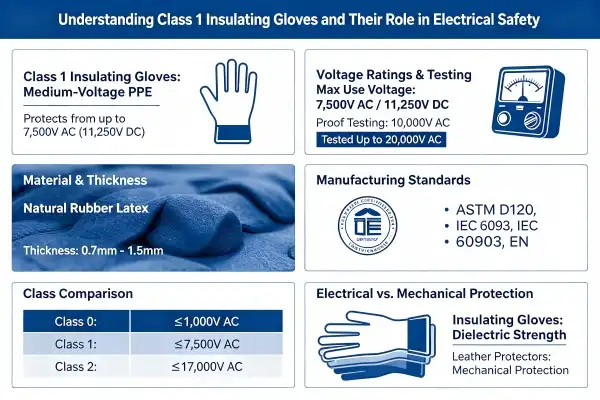
Understanding Class 1 Insulating Gloves and Their Role in Electrical Safety
Electrical insulating gloves classified as Class 1 serve as specialized personal protective equipment engineered to safeguard workers from electrical hazards in medium-voltage environments. These gloves undergo rigorous testing to ensure they can withstand electrical exposure up to 7,500 volts AC under normal operating conditions.
Voltage Ratings and Technical Specifications
The electrical security capabilities of Class 1 Insulating Gloves follow strict voltage parameters set by worldwide security benchmarks. The greatest utilized voltage comes to 7,500V AC or 11,250V DC, whereas confirmation testing happens at 10,000V AC to confirm the voltage. Beneath extraordinary conditions, these gloves can withstand up to 20,000V AC amid standardized testing procedures. Thickness determinations run from 0.7mm to 1.5mm, giving ideal adjustment between assurance and smoothness. This carefully built thickness guarantees satisfactory electrical separator whereas keeping up the adaptability fundamental for exact manual tasks in electrical environments.
Material Construction and Manufacturing Standards
High-quality characteristic elastic latex shapes the establishment of dependable electrical protection gloves. This fabric choice conveys predominant electrical separator properties while keeping up adaptability over different temperature ranges. The elastic compound experiences specialized treatment forms to upgrade resistance against ozone degradation and UV introduction, amplifying the operational life expectancy in challenging mechanical environments. International fabricating benchmarks, including ASTM D120, IEC 60903, and EN details, govern the generation of these security gadgets. These guidelines guarantee steady quality and execution over different producers, giving procurement experts with certainty in item quality and compliance with workplace safety regulations.
Comparing Class 1 Insulating Gloves to Other Protective Gloves
Understanding the distinctions between different classes of electrical insulating gloves enables informed procurement decisions for specific workplace applications. Each classification serves distinct voltage ranges and operational requirements within electrical safety protocols.
Class 0 vs. Class 1 vs. Class 2 Comparison
Class 1 Insulating Gloves give assurance up to 1,000 volts AC, making them appropriate for low-voltage electrical work in private and light commercial applications. Lesson 1 gloves expand security to 7,500 volts AC, tending to medium-voltage mechanical necessities. Lesson 2 gloves offer assurance up to 17,000 volts AC for high-voltage utility and mechanical applications. The choice between these classifications depends on the particular voltage presentation dangers displayed in each work environment. Course 1 gloves possess the center ground, giving upgraded security past Lesson 0 capabilities, while keeping up more noteworthy adaptability and consolation compared to the heavier Lesson 2 alternatives.
Electrical Insulation vs. Mechanical Protection
Traditional calfskin work gloves exceed expectations in mechanical security against cuts, scraped spots, and punctures but offer no electrical cover capabilities. Electrical protection gloves prioritize dielectric quality and voltage resistance over mechanical toughness. Numerous security conventions prescribe utilizing calfskin defender gloves over protection gloves to combine both electrical and mechanical protection. This layered approach maximizes specialist security by tending to numerous danger types at the same time. The calfskin defenders shield the protection gloves from physical harm, whereas the elastic protection layer maintains electrical security judgment throughout the work period.
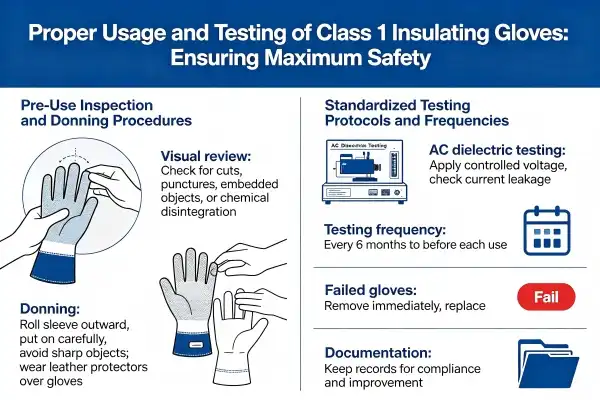
Proper Usage and Testing of Class 1 Insulating Gloves: Ensuring Maximum Safety
Effective implementation of electrical insulating gloves requires adherence to established safety protocols covering inspection, testing, and maintenance procedures. These practices ensure optimal protection performance throughout the gloves' service life.
Pre-Use Inspection and Donning Procedures
Visual review some time recently, each user recognizes potential harm that may compromise electrical security. Specialists ought to look at the whole glove surface for cuts, punctures, inserted remote objects, or signs of chemical disintegration. Any unmistakable harm requires quick glove removal from the benefit until appropriate testing can confirm proceeded security performance. Proper wearing procedures incorporate rolling the glove sleeve outward to check for gaps, at that point carefully putting on the glove whereas maintaining a strategic distance from sharp objects or gems that might cause harm. When calfskin defenders are required, they ought to be worn over the protection gloves to give mechanical security without interfering with electrical cover properties.
Standardized Testing Protocols and Frequencies
Regular electrical testing confirms the proper separator integrity of Course 1 gloves throughout their service life. AC dielectric testing applies a controlled electrical push to distinguish any degradation in the cover execution. Testing frequencies ordinarily extend from every six months to some time recently each utilization, depending on organizational security arrangements and administrative requirements. Professional testing gear applies the verification test voltage while checking for current spillage that would demonstrate separator breakdown. Gloves that fall flat during electrical testing must be quickly removed from the benefit and replaced to keep up laborer safety standards. Testing documentation gives traceability for security compliance and makes a difference in recognizing designs that might show capacity or dealing with issues influencing glove execution. Appropriate record-keeping bolsters both administrative compliance and nonstop enhancement in security protocols.
Procurement Strategies for Class 1 Insulating Gloves in B2B Settings
Strategic procurement of electrical insulating gloves balances safety performance, cost efficiency, and supplier reliability. Effective procurement practices ensure the consistent availability of compliant safety equipment while optimizing organizational resources.
Supplier Evaluation and Certification Verification
A thorough provider assessment looks at fabricating capabilities, Class 1 Insulating Gloves, and certification compliance. Trustworthy providers keep up current certifications from recognized testing research facilities and give documentation supporting item compliance with appropriate security standards. Verification of ASTM D120, IEC 60903, and OSHA prerequisites guarantees the acquisition of compliant security gear. European markets, moreover, require CE checking compliance, whereas other territorial markets may have particular certification necessities that must be addressed in acquisition specifications. Quality control documentation from providers ought to incorporate clump testing records, fabric certifications, and manufacturing process controls that guarantee reliable product performance. These records back due constancy necessities and give certainty in long-term supply reliability.
Volume Purchasing and Logistics Considerations
Bulk acquiring procedures can accomplish noteworthy fetched reserve funds while guaranteeing satisfactory stock levels for continuous security requirements. Volume rebate arrangements ought to consider add up to fetched of possession counting testing, upkeep, and replacement costs throughout the life of the gloves. Delivery planning must account for testing necessities and stock turnover to keep up new stock whereas dodging superfluous carrying costs. Appropriate capacity conditions during shipment and warehousing anticipate untimely maturing that may influence security performance. Global supply chain contemplations incorporate shipping strategies, traditions documentation, and territorial dispersion capabilities. Solid providers keep a stock situated to support fast conveyance when security gear needs arise unexpectedly.
Xi'An PPE MAX: Your Trusted Partner for Class 1 Insulating Gloves
PPE MAX brings over 65 years of experience in manufacturing high-quality electrical safety equipment to serve industrial customers worldwide. Our comprehensive approach to electrical insulating glove production combines traditional craftsmanship with modern quality control systems.
Product Excellence and Technical Specifications
Our Lesson 1 Protection Gloves meet thorough execution benchmarks with greatest utilize voltage ratings of 7,500V AC and 11,250V DC. The confirmation test voltage of 10,000V AC and withstand voltage of 20,000V AC surpass the least necessities, giving extra security edges for demanding applications. Key item highlights incorporate ergonomic plan for upgraded dexterity, color-coded sleeves for simple recognizable proof, and prevalent resistance to ozone and UV corruption. The high-quality normal elastic latex development guarantees solid electrical cover properties while keeping up adaptability over different working conditions. Material thickness ranges from 0.7mm to 1.5mm to suit distinctive application prerequisites while maintaining reliable electrical assurance execution. This detail permits clients to select the ideal thickness for their particular operational needs without compromising security standards.
Manufacturing Capabilities and Quality Assurance
Our state-of-the-art fabricating offices in Xi'an, China, keep up comprehensive quality control frameworks throughout the production process. Each clump experiences thorough testing to confirm compliance with ASTM D120, IEC 60903, OSHA necessities, and CE stamping guidelines for European markets. Customization capabilities address particular client necessities counting measuring varieties, bundling choices, and private labeling for wholesaler associations. Our OEM fabricating administrations back clients create their own branded security gear lines whereas keeping up our quality standards. Technical bolster administrations incorporate item preparation, legitimate utilization direction, and progressive meeting to optimize security program viability. Our experienced group gives mastery in electrical security applications over the utility, manufacturing, development, and broadcast communications industries.
Conclusion
Class 1 Insulating Gloves serve as essential protective equipment in arc-flash environments, providing reliable electrical insulation for workers exposed to medium-voltage hazards. The combination of proper selection, testing, and maintenance ensures optimal safety performance throughout the gloves' service life. Strategic procurement practices that emphasize supplier reliability, certification compliance, and total cost considerations support effective safety program implementation while managing organizational resources efficiently.
FAQ
What voltage levels can Class 1 insulating gloves safely handle?
Class 1 insulating gloves protect maximum use voltages up to 7,500 volts AC or 11,250 volts DC. These gloves undergo proof testing at 10,000 volts AC and can withstand up to 20,000 volts AC during standardized testing procedures.
How often should these gloves be tested for electrical integrity?
Testing frequency varies based on organizational policies and regulatory requirements, typically ranging from every six months to before each use. High-use environments may require more frequent testing to ensure continued electrical protection performance.
Can Class 1 gloves be used alone, or should they be paired with other protective equipment?
While Class 1 insulating gloves can function independently for electrical protection, safety protocols often recommend using leather protector gloves over the insulating gloves to provide mechanical protection against cuts and punctures that could compromise electrical safety.
Partner with PPE MAX for Superior Class 1 Insulating Gloves
PPE MAX stands ready to support your electrical safety requirements with our comprehensive range of certified Class 1 Insulating Gloves. As a trusted manufacturer with over six decades of experience, we deliver reliable protection solutions backed by rigorous quality control and international certifications. Contact our team at marketing@ppemax.com to discuss bulk procurement opportunities, technical specifications, and customization options that meet your specific safety requirements.
References
1. Institute of Electrical and Electronics Engineers. "IEEE Standard for Electrical Safety Practices in Industrial and Commercial Power Systems." IEEE Standards Association, 2019.
2. National Institute for Occupational Safety and Health. "Electrical Safety Guidelines for Industrial Facilities." NIOSH Publication Series, 2021.
3. American Society for Testing and Materials. "Standard Specification for Rubber Insulating Gloves for Electrical Workers." ASTM International Standards, 2020.
4. Occupational Safety and Health Administration. "Electrical Protective Equipment Requirements in Industrial Settings." OSHA Technical Manual, 2022.
5. International Electrotechnical Commission. "Live Working - Gloves of Insulating Material Performance Standards." IEC Publications, 2021.
6. European Committee for Standardization. "Personal Protective Equipment Against Electrical Hazards in Professional Environments." EN Standards Documentation, 2020.
Learn about our latest products and discounts through SMS or email