- English
- French
- German
- Portuguese
- Spanish
- Russian
- Japanese
- Korean
- Arabic
- Greek
- German
- Turkish
- Italian
- Danish
- Romanian
- Indonesian
- Czech
- Afrikaans
- Swedish
- Polish
- Basque
- Catalan
- Esperanto
- Hindi
- Lao
- Albanian
- Amharic
- Armenian
- Azerbaijani
- Belarusian
- Bengali
- Bosnian
- Bulgarian
- Cebuano
- Chichewa
- Corsican
- Croatian
- Dutch
- Estonian
- Filipino
- Finnish
- Frisian
- Galician
- Georgian
- Gujarati
- Haitian
- Hausa
- Hawaiian
- Hebrew
- Hmong
- Hungarian
- Icelandic
- Igbo
- Javanese
- Kannada
- Kazakh
- Khmer
- Kurdish
- Kyrgyz
- Latin
- Latvian
- Lithuanian
- Luxembou..
- Macedonian
- Malagasy
- Malay
- Malayalam
- Maltese
- Maori
- Marathi
- Mongolian
- Burmese
- Nepali
- Norwegian
- Pashto
- Persian
- Punjabi
- Serbian
- Sesotho
- Sinhala
- Slovak
- Slovenian
- Somali
- Samoan
- Scots Gaelic
- Shona
- Sindhi
- Sundanese
- Swahili
- Tajik
- Tamil
- Telugu
- Thai
- Ukrainian
- Urdu
- Uzbek
- Vietnamese
- Welsh
- Xhosa
- Yiddish
- Yoruba
- Zulu
Which Full Mask Respirator Fits Your Hazard Level?
Founded in 1956, PPEMAX stands as a premier global manufacturer and supplier of full-range personal protective equipment. All our products comply with internationally recognized standards including IEC, ASTM, CE, UKCA, NIOSH and ISO9001. Equipped with a 2,000-square-meter modern production plant, we boast over 25 years of mature OEM & ODM capabilities to deliver one-stop customized solutions covering R&D design through worldwide logistics. Our safety gear is distributed across 134 countries globally. Upholding our core tenet “Safety First, Quality Priority”, we serve as a dependable long-term PPE partner for industrial enterprises around the world.
Selecting the right full-face respirator protection equipment directly impacts worker safety and operational compliance in hazardous environments. The correct full-face respirator for your workplace depends on identifying the specific contaminants present, their concentration levels, and the physical demands of the job. Unlike partial-coverage devices, a properly matched full-face respiratory system creates a completely sealed barrier over the face, integrating both a full-face respirator and ocular protection to address exposure scenarios where half-mask designs fall short—such as environments with splash hazards, irritating vapors, or elevated particulate levels that could compromise eye safety.
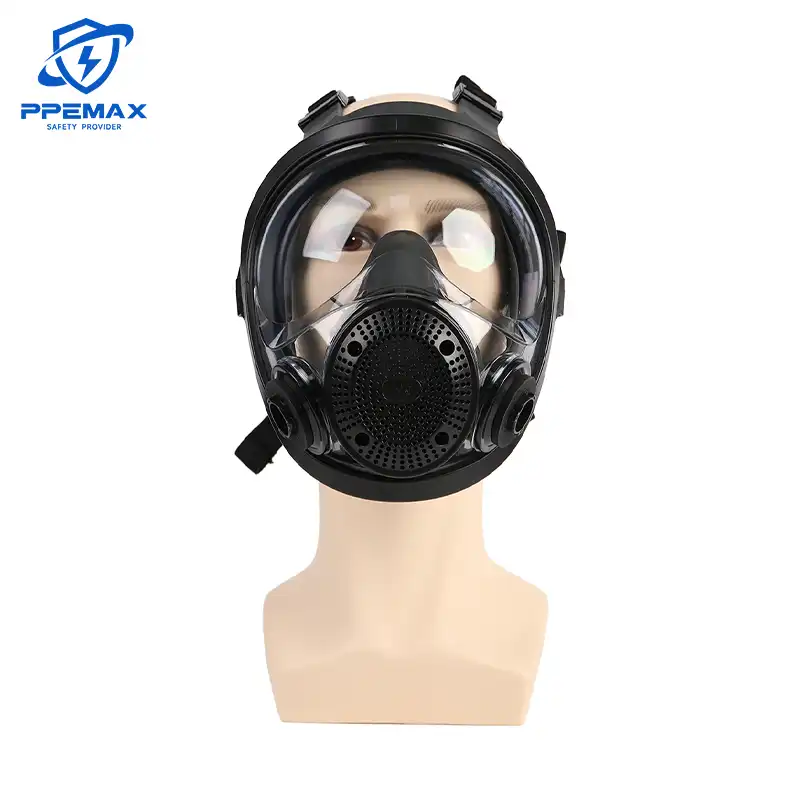
| Parameter | Details |
|---|---|
| Mask Style | Full-Face Gas Mask |
| Connector Type | 3-Point Bayonet System |
| Compatible Filters | A1/B1/E1/K1/A1B1E1K1P3 Cartridges |
| Certification Standard | CE EN 136:1998 |
| Dimensions (L×W×H) | 17cm × 22cm × 15cm |
| Weight | 1000g |
| Face Seal Material | Food-Grade Silicone |
| Lens Type | Panoramic Anti-Scratch Visor |
| Packing | 1pc/bag, 12pcs/carton |
Understanding Full Mask Respirators and Their Role in Hazard Protection
In workplace areas, a respirator that covers the whole face is the best way to protect against all airborne dangers. These gadgets use filtration technology along with structural design elements that make a complete seal from the forehead to the chin. They also have clear glasses that protect the eyes while still letting you see.
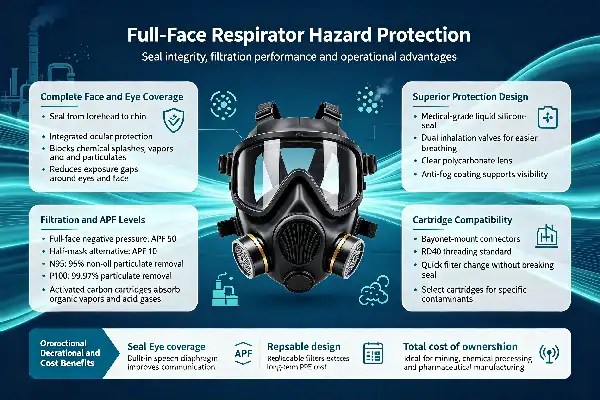
How Full-Face Respirators Deliver Superior Protection
The engineering behind these breathing apparatuses fixes a major problem with partial-face options: they cover multiple entry points at the same time. When workers are in places with chemical vapors, biological aerosols, or high-speed particles, their eyes are an easy way for contaminants to get into their bodies. This gap is gone thanks to the combined lens design, and the outer seal stops leaks from happening during inhalation cycles.
At PPE MAX, our devices are made with medical-grade liquid silicone rubber that molds perfectly to different face shapes and keeps the seal intact even when you're working out hard. The face seal works with two inhalation valves to make breathing easier. This solves the common problem of users getting tired after long periods of wear. This two-valve design spreads gas out evenly, making it less noticeable that you're breathing hard, which can make workers less likely to follow safety rules.
Filtration Mechanisms and Protection Factors
To measure how well respiratory protection works, Assigned Protection Factors (APF) are used. These show how much contamination is removed when the device works properly. Standard full-face negative-pressure respirators usually have an APF of 50, which means that the person wearing them breathes air with a concentration of contaminants that is one-fiftieth of what it is outside. This amount of protection is much higher than the APF of 10 that half-mask options offer.
The ability to filter comes from cartridge and canister devices that join using standard threaded holes. Our types have bayonet-mount connectors that meet RD40 threading standards. This lets you change filters quickly without affecting the seal. Particulate filters range from N95, which removes 95% of non-oil-based particles, to P100, which removes 99.97% of all particulate matter. Chemical capsules have activated carbon beds that soak up organic vapors, acid gases, and other gaseous toxins depending on how they are made.
Advantages Over Half-Mask Alternatives
In addition to the obvious benefit of protecting your eyes, full-face models have other useful benefits in operational situations. When you wear polycarbonate glasses with anti-fog coatings, you can see more clearly, which helps you stay aware of your surroundings. This is especially helpful in emergency situations where your peripheral vision is important. The speech diaphragm built into high-quality designs makes it easier to communicate clearly without taking the device off. This solves a safety issue where workers have to give up protection in order to be heard.
For workplace settings, reusable full-face respirators offer strong total cost of ownership benefits. The initial cost is higher than disposable options, but the replaceable filter system and long-lasting elastomer construction make it last for many years with regular maintenance. This durability is especially helpful for companies that have to manage big teams in industries like mining, chemical processing, or pharmaceutical manufacturing, where ongoing PPE costs add up quickly.
Identifying Your Hazard Level: How to Match Respirator Types to Risk
Correctly assessing the risks is the first step to effective lung protection. Because there are so many types of pollution in the workplace, it's important to be methodical about describing risks before choosing tools.
Chemical Hazard Classification
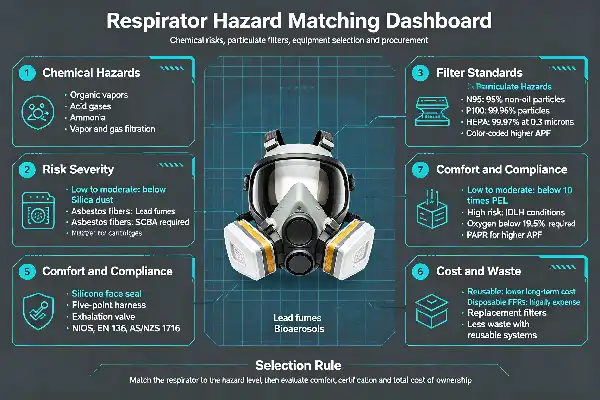
Chemical exposures are very different in terms of how toxic they are, how they look, and how they get into the body. One type is organic vapors, which come from solvents, paints, and petroleum products. These need tubes with activated carbon that are rated to absorb organic fumes. Different types of sorbents are needed for acidic gases like chlorine, hydrogen chloride, and sulfur dioxide, while ammonia and methylamine need alkaline media to neutralize them.
The NIOSH certification guidelines make it possible to match different kinds of cartridges to different chemicals. The color-coding method makes it easy to find things when they are being distributed. For example, organic vapor cartridges are marked in black, acid gas cartridges are marked in white, and combo units are marked in more than one color. Knowing the difference between Permissible Exposure Limits (PEL) and Immediately Dangerous to Life or Health (IDLH) concentrations helps procurement managers set the right levels of protection.
Particulate and Biological Contaminants
Particulate dangers include dust, fumes, mists, and biological droplets. These hazards vary in the size and toxicity of the particles. Basic particulate filters are needed for nuisance dusts like those from processing wood or grains. However, P100-rated filters are needed for silica dust from cutting stones, asbestos fibers during cleanup work, or lead fumes from soldering because they are very dangerous to your health even at low exposure levels.
Biohazards like bacteria, viruses, and fungal spores are hard to get rid of because their particles are usually smaller than one micron. People often face these risks in healthcare, lab, and farming settings. When installed correctly, HEPA filtration (which is basically the same as the P100 rating) can catch particles as small as 0.3 microns with 99.97% success, giving you enough safety.
Matching Equipment to Risk Severity
Standard negative-pressure full-face respirators with the right cartridges can usually be used in low- to moderate-risk areas where contaminant levels stay below ten times the PEL and conditions don't become IDLH. Some examples of these are routine maintenance work in chemical plants, spray painting with enough airflow, and controlled asbestos removal projects.
In high-risk situations with IDLH air, oxygen levels below 19.5%, or very dangerous chemicals, supplied-air respirators or self-contained breathing apparatus are needed. Powered air-purifying respirators (PAPRs) are in the middle. They use battery-powered fans to push air through filters and into the facepiece while maintaining positive pressure. This setup gets APFs up to 1,000 and lowers breathing resistance, which is good for workers who wear protection for whole shifts.
Customized solutions are needed for specialized applications. For welding jobs that release metal fumes and bright light, you need full-face respirators that fit over welding helmets and filter out both particles and ozone/nitrogen dioxide. Emergency reaction teams need systems that can be quickly set up, offer broad safety, and require little time to put on. Each use case has its own unique needs that may not be met by off-the-shelf options without being customized.
If you're evaluating personal protective equipment suppliers and require batch-specific testing documents before placing an order, PPE MAX is able to provide official Certificates of Analysis, professional laboratory test reports, and product samples for your verification. Feel free to contact our team at marketing@ppemax.com to discuss your sourcing needs and obtain complete documentation for your quality assessment and procurement approval.
Comparing Full Mask Respirators: Key Factors for Informed Procurement
Decisions about procurement involve more than just following the rules; they also involve practical factors that affect the long-term success of a program. Results are affected by the total cost of ownership, how well users accept the product, and how reliable the supply chain is.
Protection Levels and Comfort Considerations
Compliance rates are based on how well safety and wearability are balanced. When devices are too painful, people take them off or wear them wrong, which takes away from their protective value. The high-end models, like those made by PPE MAX, use a silicone face seal material that is hypoallergenic and stays flexible at temperatures ranging from -40°C to +60°C, making it suitable for both cold storage areas and hot industrial processes.
The five-point harness system evenly distributes the force of retention across the head. This keeps pressure points from forming that can lead to headaches after long periods of use. Center-mounted exhalation valves effectively let out humid breath and stop heat from building up inside the mask, which addresses the discomfort caused by heat that makes people not follow the rules in warm places. With these design elements, respiratory protection goes from being a necessary evil to an expected part of the job.
Evaluating Leading Manufacturers
There are well-known companies in the lung defense market, each with its own strengths. Knowing these differences helps organizations match goods to their top goals. Manufacturers with decades of experience in materials science and human factors engineering have built brands that are known all over the world for their quality.
When looking at suppliers for large purchases, the warranty coverage and expert help facilities are very important. When a company uses hundreds or thousands of respirators at different locations, they need service networks that can quickly repair parts, help with fitting, and provide maintenance training. Depending on the size of the business and where it is located, authorized dealer networks and direct producer relationships have different benefits.
PPE MAX has been making products in this field for 65 years and is certified to NIOSH, EN 136, and AS/NZS 1716 standards, which means our products meet the needs of customers all over the world. Because we make our products ourselves instead of sending them to distributors, we can offer customization options that distributors don't, such as private labeling, custom filter configurations, and lens treatments that are specific to different environmental conditions.
Reusable Versus Disposable Models
The cost-effectiveness of reuse and disposable choices relies on how often they are used and how dirty they are. Reusable full-face respirators cost a modest to large amount of money to buy at first, and they also have continuing costs for new filters, cleaning tools, and storage systems. Disposable filtering facepiece respirators (FFRs) are cheaper per unit, but they quickly add up in cost when used every day.
When workers wear breathing protection every day or several times a week, the break-even calculation usually favors methods that can be used again. As companies keep track of how much trash they produce, environmental concerns are becoming more and more important in buying choices. If you use one reusable full-face respirator instead of hundreds of disposable ones every year, you'll be putting a lot less trash in landfills and still getting the same or better protection.
Full Mask Respirator Maintenance, Safety Standards and Compliance
The success of a respiratory protection program rests on keeping equipment working by taking care of it properly and following the rules set by the government.
Cleaning and Maintenance Protocols
In the workplace, respirators are subject to dust buildup, chemical residues, and physical wear that weakens their performance over time. Systematic cleaning after each use makes sure that the next wearing is clean and extends the life of the item. To disassemble, you have to take out the filters and cartridges, separate the lens assembly if it's designed to do that, and clean the elastomer parts with mild detergents. Harsh chemicals or rough scrubbing hurt silicone and speed up the breakdown of the material.
Inspections done during cleaning find problems before they get bad enough to break the protection. If you look at the face seal and see any cracks, tears, or permanent deformation, it means it needs to be replaced. Checking the intake and exhaust valves for damage and proper fitting makes sure that airflow patterns are correct. Lenses that are scratched or cracked in a way that makes them hard to see need to be replaced. Our devices have parts that are easy to replace, and spare parts are easy to get through our technical support network, so that downtime is kept to a minimum.
The way things are stored affects how long they last. When respirators are stored in direct sunlight, too much heat, or squished together, the materials wear out more quickly. Dedicated storage boxes that support the shape of the facepiece and keep lenses from getting scratched are a small expense that greatly increases the time between replacements.
Regulatory Certifications and Standards
In most places, respiratory protection at work is closely regulated by the government. In the US, OSHA's Respiratory Protection Standard (29 CFR 1910.134) sets out a lot of rules, such as how to evaluate hazards, choose the right tools, make sure users are medically fit, test their training, and evaluate the program. In Europe, EN 140 and EN 136 are similar standards, and AS/NZS 1715 governs workplaces in Australia and New Zealand.
When respiratory protective equipment is certified by NIOSH, it shows that it meets minimum performance standards for breathing resistance, filter efficiency, and facepiece leakage. A NIOSH approval number is given to each approved type and must be written on the device. Specifications for buying things should clearly say that the equipment must be NIOSH-approved or have a similar international approval to make sure that it is legal and actually protects people.
Our manufacturing methods stay in line with these international standards thanks to quality management systems that are written down and frequent audits by a third party. Performance tests are done on every production batch to make sure that the filter's effectiveness, the seal's integrity, and the resistance to breathing stay within the limits set by the manufacturer. This method of quality assurance makes sure that all big orders are the same.
Fit Testing Importance
If respirators don't fit right, they won't protect you even if they are perfectly made. Different groups of people have very different facial dimensions, so one model can't fit everyone. Quantitative fit testing uses special tools to record actual leakage during standard movements. This gives unbiased information on how well the seal works. Qualitative testing uses test agents that can be found to make sure that the wearer can't feel any leakage.
Fit testing is required by OSHA before the first use, whenever a new model comes out, and every year after that. When a person's face changes because of major weight gain or loss, dental work, or scars, they need to be retested. Companies with a diverse workforce need more than one model option to fit people with different face shapes and sizes.
Our full-face respirator line comes in three different frame sizes. Sizing tips based on facial measurements help safety managers choose the right models before they are officially put through fit tests. This method cuts down on the time needed to set up lung protection programs that are in line with regulations while also increasing the number of first-time fits that work.
Procuring Full Mask Respirators: Best Practices for B2B Clients
When buying respiratory protection equipment strategically, you have to weigh short-term needs against long-term operational needs while also making sure the supply chain is reliable.
Sourcing from Certified Suppliers
Manufacturers, approved wholesalers, and independent resellers with different levels of expertise make up the respiratory protection supply chain. Direct connections with manufacturers give you access to technical know-how, the latest product details, and the ability to make changes to the product. Authorized distributors offer help from the maker, local supplies, and faster shipping for common configurations.
Checking to see if the seller is real protects against fake tools that put workers' safety at risk. By asking for proof of certification, checking the manufacturer's license status, and making sure that certain model numbers are on NIOSH's Certified Equipment List, you can avoid buying devices that don't meet safety standards. Suppliers that have been around for a while keep paperwork methods that make these checks easier.
As a company that makes products and sells them in 134 countries, PPE MAX uses both approved distribution partners and direct sales methods, based on the size of the order and the level of tailoring needed. Our global supply chain helps with last-minute purchases, and our production flexibility lets us meet the specific needs of different industrial applications.
Cost Analysis and Bulk Ordering Benefits
Providing respiratory protection is a high ongoing cost for businesses with a lot of workers or dangerous tasks. When you commit to buying a lot of something, the price per unit usually goes down a lot. This makes buying in bulk appealing when storage space and usage rates allow it. Cost optimization and inventory management can be balanced by negotiating framework deals that set prices for set periods of time and allow flexible call-off amounts.
A total cost analysis looks at more than just the purchase price. It also looks at things like training costs, fit-testing costs, maintenance supplies, and replacement part inventories. When compared to more expensive choices with a longer service life and a full support system, cheaper equipment that needs to be replaced often or that doesn't have as many parts may actually make the program more expensive overall.
Price points are related to the level of risk and the amount of use. Basic types that are only used occasionally in low-risk areas are cheaper than more advanced systems that are made to be worn all the time in IDLH-capable settings. Matching the specifications of equipment to what is actually needed keeps people safe and saves money on things that aren't needed.
Customization and Emergency Stock Management
Standard catalog items work well for most uses, but industries that need specific configurations often find them more useful. Private labeling helps distributors build their own brands, and custom lens tinting cuts down on glare in bright outdoor or industrial settings. End users don't have to deal with as much distribution difficulty when certain filter combinations are pre-installed and sold as full systems.
Emergency scenarios and problems with the supply chain show how important it is to handle your stockpiles strategically. Companies that work in remote areas or have to wait a long time for supplies need to make sure they have enough safety stock to handle sudden increases in demand or delivery delays. Setting up vendor-managed inventory systems lets sellers handle holding costs while making sure that goods are available when they're needed.
Because we have a lot of machines and keep a lot of stock on hand, we can ship standard setups within 48 hours, and we can finish special orders within agreed-upon time frames that depend on how complicated the specifications are. We keep a lot of finished goods in our distribution centers to protect against changes in demand and make sure that clients who are handling big workforce operations always have what they need.
Conclusion
To protect workers from breathing in harmful substances, it is necessary to match the capabilities of the tools to the specific risks in the workplace. This can be done through systematic danger assessment and smart purchasing choices. Full-face respirators offer full protection in places where half-masks aren't enough. They do this by combining respiratory filtration with ocular defense and getting higher protection factors. By knowing the differences between filter types, figuring out when special features are useful, and building relationships with reliable providers, you can make lung protection programs that really protect worker health while keeping operations running smoothly. Investing in well-designed and well-kept equipment pays off in the form of fewer illnesses, following the rules, and the incomparable benefit of workers getting home safely every day.
FAQ
1. What filter type protects against paint fumes and chemical vapors?
Activated carbon in organic vapor cartridges soaks up most paint solvents and toxic organic chemicals. When spray painting with coatings that contain isocyanates, like two-component polyurethanes, combination cartridges that have P100 particulate filtration and organic vapor capacity are needed to protect against both mist overspray and vapor exposure. Always check that the cartridge's approved paperwork lists the drugs that are in it.
2. How often should respirators be cleaned and inspected?
After each use, clean respiratory protective equipment to get rid of dirt and sweat. While the machine is being cleaned, the seals, valves, and lenses are carefully checked for damage. Any part that has cracks, permanent deformation, or loss of functionality should be replaced right away. Putting things away in safe cases between uses keeps them from getting worn out or dirty.
3. Can one respirator model protect against multiple hazard types?
Full-face respirators have standard connection interfaces that let them work with a variety of filter and cartridge types. By switching out the cartridges, users can respond to different dangers. When chemical exposure happens, the same facepiece that is used with P100 filters for particulate protection can also be used with organic vapor cartridges, as long as the specific mixtures of contaminants don't require special tools. Having a variety of cartridges on hand lets you respond to hazards in different ways with just one facepiece platform.
Partner with PPE MAX for Certified Respiratory Protection
PPE MAX has been making full-face respirators for more than sixty years and has a reputation for quality products that meet the strict needs of industrial, construction, and emergency response applications all over the world. Our wide range of products is made with medical-grade materials, goes through strict quality control, and is certified to meet NIOSH, EN 136, and AS/NZS 1716 standards. This will make sure that your workers are properly protected in dangerous places. We help procurement managers, safety directors, and distributors by letting them customize products, giving them discounts when they buy in bulk, and giving them expert advice that helps them find the right tools for their individual risks. Contact our team at marketing@ppemax.com to talk about your needs for full-face respirator protection and find out how our manufacturing skills can help you meet your operational safety goals.
References
1. National Institute for Occupational Safety and Health. (2018). NIOSH Guide to the Selection and Use of Particulate Respirators. DHHS Publication No. 96-101.
2. Occupational Safety and Health Administration. (2020). Respiratory Protection Standard 29 CFR 1910.134: Compliance Guide for Employers.
3. European Committee for Standardization. (2019). EN 136:1998 Respiratory Protective Devices - Full Face Masks - Requirements, Testing, Marking.
4. American National Standards Institute. (2021). ANSI/ISEA 110-2020 American National Standard for Occupational and Educational Eye and Face Protection Devices.
5. Cohen, H.J. and Becker, S.P. (2017). Respiratory Protection Equipment: Design, Selection and Use in Industrial Hygiene Programs. Journal of Occupational and Environmental Hygiene, 14(8), 623-637.
6. International Safety Equipment Association. (2022). ISEA Respiratory Protection White Paper: Best Practices for Workplace Respiratory Protection Program Development and Implementation.
Learn about our latest products and discounts through SMS or email