- English
- French
- German
- Portuguese
- Spanish
- Russian
- Japanese
- Korean
- Arabic
- Greek
- German
- Turkish
- Italian
- Danish
- Romanian
- Indonesian
- Czech
- Afrikaans
- Swedish
- Polish
- Basque
- Catalan
- Esperanto
- Hindi
- Lao
- Albanian
- Amharic
- Armenian
- Azerbaijani
- Belarusian
- Bengali
- Bosnian
- Bulgarian
- Cebuano
- Chichewa
- Corsican
- Croatian
- Dutch
- Estonian
- Filipino
- Finnish
- Frisian
- Galician
- Georgian
- Gujarati
- Haitian
- Hausa
- Hawaiian
- Hebrew
- Hmong
- Hungarian
- Icelandic
- Igbo
- Javanese
- Kannada
- Kazakh
- Khmer
- Kurdish
- Kyrgyz
- Latin
- Latvian
- Lithuanian
- Luxembou..
- Macedonian
- Malagasy
- Malay
- Malayalam
- Maltese
- Maori
- Marathi
- Mongolian
- Burmese
- Nepali
- Norwegian
- Pashto
- Persian
- Punjabi
- Serbian
- Sesotho
- Sinhala
- Slovak
- Slovenian
- Somali
- Samoan
- Scots Gaelic
- Shona
- Sindhi
- Sundanese
- Swahili
- Tajik
- Tamil
- Telugu
- Thai
- Ukrainian
- Urdu
- Uzbek
- Vietnamese
- Welsh
- Xhosa
- Yiddish
- Yoruba
- Zulu
What Defects Force Insulating Gloves Out of Service Immediately?
Founded in 1956, PPEMAX stands as a premier global manufacturer and supplier of full-range personal protective equipment. All our products comply with internationally recognized standards including IEC, ASTM, CE, UKCA, NIOSH and ISO9001. Equipped with a 2,000-square-meter modern production plant, we boast over 25 years of mature OEM & ODM capabilities to deliver one-stop customized solutions covering R&D design through worldwide logistics. Our safety gear is distributed across 134 countries globally. Upholding our core tenet “Safety First, Quality Priority”, we serve as a dependable long-term PPE partner for industrial enterprises around the world.
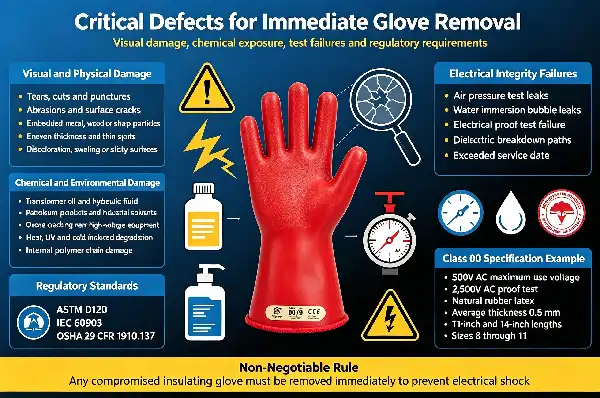
Insulating gloves with tears, punctures, cracks, embedded foreign objects, chemical contamination, ozone damage, failed air or water tests, uneven thickness, or exceeded service dates must be removed from service immediately. These defects compromise dielectric strength and expose workers to potentially fatal electrical shock. Even minor visible damage can create pathways for current leakage during live-line work, making immediate withdrawal non-negotiable. Regulatory standards from ASTM D120, IEC 60903, and OSHA 29 CFR 1910.137 explicitly mandate zero tolerance for compromised electrical protective equipment in any voltage environment.
|
Parameter |
Type I (Natural Rubber) |
Type II (Synthetic/EPDM) |
|
Maximum Use Voltage |
500V AC / 750V DC |
500V AC / 750V DC |
|
Proof Test Voltage |
2,500V AC / 10,000V DC |
2,500V AC / 10,000V DC |
|
Maximum Thickness |
0.75mm (30 mils) |
0.75mm (30 mils) |
|
Length Options |
11-14 inches |
11-14 inches |
|
Color Code |
Beige Label |
Beige Label |
|
Temperature Range |
Standard |
Extended (-25°C to +55°C) |
|
UV/Ozone Resistance |
Standard |
Enhanced |
Critical Defects That Force Immediate Removal of Insulating Gloves
There are clear and present risks from some flaws that need to be fixed right away. Our testing labs have looked at thousands of gloves that didn't work and found trends that purchasing managers and safety engineers need to be able to see right away. Based on the idea of risk fear, the following groups show non-negotiable conditions for removal.
Visual and Physical Damage
The continuous rubber matrix that is needed for dielectric protection can't handle tears, cuts, punctures, and abrasions. Even very small surface cracks, which can happen because of too much bending, bad storage, or normal wear and tear with age, create stress concentration points where electrical breakdown starts when voltage stress is applied. Embedded foreign objects, like metal bits, wood splinters, or sharp particles, get through the insulation and make paths for electricity to flow.
If the rubber polymer structure changes because of a chemical attack, it will swell, stick, or be sticky on the surface. Both mechanical strength and electrical resistance are going down because of these changes. Changes in color, especially darkening or discoloration spots, show that a material is breaking down because it was exposed to heat, UV light, or something that doesn't work well with it. In any of these situations, the insulating gloves must be taken off right away.
Environmental Degradation and Chemical Exposure
Hydraulic fluids, transformer oils, petroleum products, and industrial solvents are all very harsh on rubber materials. Even a short touch can break polymer chains in a way that can't be seen below the surface. If gloves are contaminated with these kinds of chemicals, they can't be cleaned and used again because the damage inside can't be fairly judged from the outside.
Ozone cracking shows up as small surface fissures, usually on the outside of gloves that are near electrical equipment that makes corona discharge. This breakdown happens faster in storage areas that don't have enough airflow or are close to equipment that uses high voltage. Extreme temperatures can also damage integrity. Long-term contact with heat makes rubber harder and less flexible, while extreme cold makes it rigid and causes it to crack when bent.
Electrical Integrity Failures
Standardized tests of air pressure show pinhole leaks and small holes that can't be seen with the naked eye. Gloves are filled and either put in water or closely watched to see if air leaks out during this test. Any leak that is found must be fixed right away. Similarly, electrical proof testing, which is done at voltages much higher than the maximum use voltage, finds dielectric breakdown paths before they lead to field failures.
Manufacturing flaws like thin spots, gaps, or inclusions sometimes get past the first round of quality control. These flaws become clear when the gloves fail too soon or when they are tested again and again. When wall thickness isn't uniform, weak spots form where voltage stress builds up. This makes the effective voltage rating much lower, no matter what class is stated.
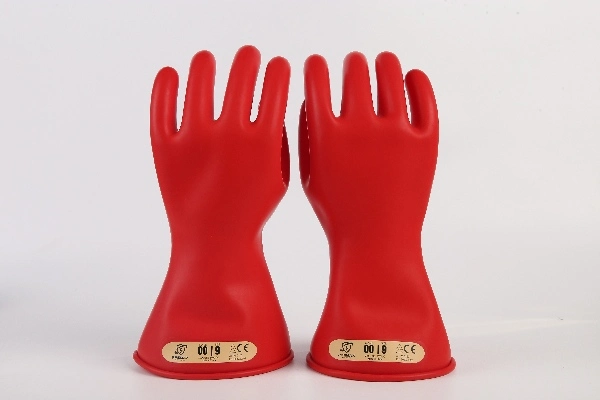
Our Class 00 Insulating gloves, which are tested for quality assurance in accordance with IEC 60903 and ASTM D120 standards and are rated for a maximum use voltage of 500V AC, are proof-tested at 2,500V AC. These gloves come in 11-inch and 14-inch lengths and sizes 8 through 11. They are used for work with electric utilities, installing telecommunications equipment, maintaining industrial electrical systems, and fixing HVAC systems. They are made from high-quality natural rubber latex and have an average thickness of 0.5 mm. They have great electrical insulation qualities and the flexibility and dexterity needed for precise jobs.
How to Identify and Test Defects in Insulating Gloves
Electrical protection programs that work are based on systematic inspection and testing protocols. We help safety teams all over the world by giving them complete advice based on decades of experience in the field and lab studies.
Conducting Thorough Visual Inspections
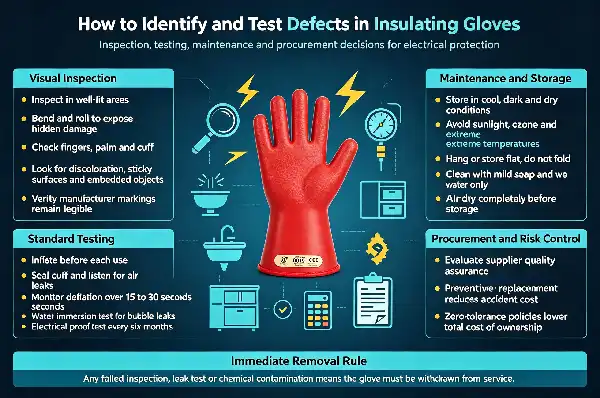
The best way to keep broken tools from getting into service is still to look at them visually. Inspectors should work in well-lit areas and slowly bend and roll their gloves to reach all surfaces. Pay extra attention to the areas of the finger, the palm, and the cuff where mechanical wear is most common.
Holding gloves up against backgrounds that are different from each other will bring out small changes in color or texture. Run your fingers along the inside and outside of the surface to find rough spots, sticky spots, or bits that are attached. Check to see if the manufacturer's markings can be read. Labels that are faded or can't be read may be an indication of age-related wear and tear that needs more attention.
Standardized Electrical Testing Procedures
In many situations, Class 00 through Class 2 gloves should be inflated with air before each use. However, the frequency of testing depends on how often the gloves are used and the elements of the surroundings. Put air into the gloves, close the cuff, and listen for air escaping while keeping an eye out for deflation. Small leaks show up as a steady loss of size over 15 to 30 seconds.
By letting air bubbles rise to the surface, water immersion tests can visually confirm where leaks are happening. This method is more sensitive than air tests alone, and it can help find more than one flaw at the same time. Electrical proof testing must be done every six months on gloves that are regularly used or as required by the manufacturer and the government. This testing must be done in certified labs using specialized high-voltage equipment.
Advanced Testing Technologies and Maintenance Strategies
New diagnostic technologies use automatic visual inspection systems that use machine vision techniques to find problems on the surface that humans can't see. By showing differences in thermal conductivity across glove walls, infrared thermography can find holes or inclusions inside a material. Many businesses still can't afford these high-tech methods, but they are the way of the future for predictive maintenance in important safety programs.
When gloves are stored correctly, they last longer and are less likely to break. Keep gloves in cool, dark, dry places that are out of direct sunlight, ozone sources, and places with extreme temperatures. Don't fold or crease insulating gloves; hang them up or store them flat in cases made just for that purpose. Clean gloves with water and mild soap, then rinse them well and let them dry completely in the air before putting them away. Never use cleaners made from gasoline or strong solvents that break down rubber faster.
If you're evaluating personal protective equipment suppliers and require batch-specific testing documents before placing an order, PPE MAX is able to provide official Certificates of Analysis, professional laboratory test reports, and product samples for your verification. Feel free to contact our team at marketing@ppemax.com to discuss your sourcing needs and obtain complete documentation for your quality assessment and procurement approval.
Comparing Defective vs. Serviceable Gloves – What Procurement Must Know
Knowing the line between normal wear and major flaws helps you make smart purchasing choices that balance the need for safety with the realities of your budget. This information is especially important for businesses that manage long-term source relationships and bulk buying plans.
Performance Degradation from Defects
There are two main ways that defects lower voltage resistance: they reduce the useful thickness and change the qualities of the material. Depending on the type of rubber used, a 0.1 mm drop in wall thickness can lower dielectric strength by 20 to 30 %. Chemical contamination changes the structure of polymer chains, which lowers both their mechanical strength and their electrical resistance.
In difficult field conditions like high humidity, changing temperatures, and mechanical stress from putting on and taking off gloves over and over again, faulty gloves fail without warning. In contrast to useful equipment that slowly stops working with observable signs, seriously damaged gloves may continue to work until they completely stop working under voltage stress. Because of this, zero-tolerance removal policies are the only way to make sense of things.
Financial Impact Analysis
Organizations have to make a basic cost-benefit analysis: the cost of replacing gloves versus the risk of accidents. But when the costs of harming people are properly calculated, this calculation leans heavily toward preventative replacement. A single electrical injury has direct costs like medical care, workers' compensation, and fines from the government. It also has secondary costs like lost work time, investigation time, legal trouble, and damage to one's image. These costs are much higher than any savings that could be made by servicing gloves more often.
We've talked to procurement managers who are in charge of safety programs for thousands of workers. Their data consistently show that strict replacement policies—erring on the side of caution in close calls—lower the total cost of ownership by preventing accidents and boosting worker confidence. It's easier to plan a budget when replacements are based on written procedures instead of reacting to events.
Sourcing High-Quality Equipment from Reputable Suppliers
When buying in bulk, strategies must put supplier quality assurance skills ahead of maximizing unit prices. Leading makers keep their production vertically linked, which means that tests are done in-line, batches can be tracked, and there is a lot of paperwork to support regulatory compliance. They provide technical support, training materials, and helpful customer service that turns business partnerships into long-term partnerships.
Trusted names like Ansell, Honeywell, 3M, and Kelly have become known all over the world thanks to their strong quality control and guaranteed support. These companies put a lot of money into studies, new developments in material science, and keeping their certifications up to date in many places. Since our company's founding in 1956, PPE MAX has worked hard to earn its place among respected suppliers by making similar promises. We now serve customers in 134 countries with goods that meet the strictest international standards.
Best Practices for Procurement and Safety Management to Avoid Defective Gloves
To keep broken equipment from going into use, you need strategies that cover everything from choosing a seller to making sure that contracts are followed, inspecting equipment, and teaching workers. Safety management systems that are well-developed are based on these practices.
Certification Verification and Voltage Rating Alignment
Every glove you buy should have clear markings that show the voltage class, the date of the test, and the name of the manufacturer. In order to be bought, something has to meet certain standards, like ASTM D120, IEC 60903, and any regional licenses that are needed, like the CE mark for European markets. The voltage ratings should be higher than the highest level of risk that can be expected, with enough safety margins to account for voltage changes and system faults.
We suggest that detailed job hazard analyzes be used to match glove classes to specific types of work. Low-voltage control work doesn't usually need Class 2 or higher tools, but upkeep on distribution systems has to have the right voltage ratings. Too much detail wastes budget dollars, and not enough detail leads to disaster. Purchasing managers work closely with electricity experts and safety officers to choose the best equipment that meets the needs of the business.
Supplier Quality Assurance and Contractual Protections
Transparent quality inspection methods let you see how consistently and how often defects are found in the manufacturing process. Suppliers with a good reputation let customers do audits, keep statistical process control data, and use corrective action protocols when quality problems happen. Acceptance criteria, testing duties, return policies for damaged packages, and paperwork that needs to support regulatory compliance should all be spelled out in the contract.
Bulk buying deals benefit from scheduled delivery methods that keep goods from being stored in warehouses for too long and breaking down over time. Labels with clear expiration dates and first-in, first-out inventory management keep gloves that are getting close to the end of their useful life from being used in the field. These seemingly small logistics issues have a big effect on how well the equipment works and how safe the workers are.
Inspection Integration and Workforce Training
Instead of being separate compliance drills, inspection procedures should be built right into the way things are done. During pre-shift training, the state of the gloves should be checked. Supervisors need to be trained to spot signs of defects and have the power to get rid of questionable equipment without having to go through a lot of red tape. Reporting systems should make it easier to find bugs instead of making it harder to do so by making it too much work.
We've put together thorough training programs to help clients all over the world learn how to spot defects, use tools correctly, and do inspections the right way. By giving every worker the power to be a frontline quality assurance agent, these educational programs strengthen the safety culture. If maintenance is a regular habit instead of a one-time thing, it becomes much easier to find problems, and the equipment becomes much more reliable.
Conclusion
Taking off faulty insulating gloves right away is a safety requirement based on regulations, material science, and years of hard-won experience in the field. Chemical pollution, environmental damage, tears, punctures, and electrical integrity failures are all things that put workers at risk and require zero-tolerance reactions. Organizations in charge of electrical safety programs need to set clear criteria for removal, do regular inspections, and build relationships with suppliers that put quality over lowering costs. We at PPE MAX are still committed to supporting these efforts through high-quality manufacturing, clear quality assurance, and responsive customer partnerships that have been going on for 60 years and in 134 countries around the world.
FAQ
1. How often should insulating gloves be inspected and tested?
Before each use, the gloves must be inspected visually, and the number of times they must be tested for electrical safety depends on the type of glove and how it will be used. According to ASTM D120 and OSHA 1910.137, gloves that are used regularly must be tested every six months. However, gloves that are used in high-risk situations must be tested every month. Based on what manufacturers say, what the law says, and practical risk estimates, organizations should write down inspection schedules. When gloves are kept properly and not used, they still need to be tested every so often to make sure they are still ready for use in an emergency.
2. Can damaged gloves be repaired or patched?
Without a doubt, not. Voltage-rated rubber insulating gloves must not be fixed, patched, or changed in any way that is against all safety standards. The dielectric stability depends on the material having the same properties all over and the rubber matrix running through the whole structure of the glove. Any fix adds new material inconsistencies, stress concentration points, and failure modes that can't be tried or proven to be reliable. Damaged gloves must be taken out of service and thrown away so they are never used again by accident.
3. What distinguishes insulating gloves from regular rubber gloves?
Insulating gloves are carefully designed electrical safety gear made from specially mixed materials. They are thoroughly tested to specific voltage levels and approved to ASTM D120 or IEC 60903 standards. They are tested for electrical resistance and have been shown to have high dielectric strength. Normal rubber gloves, even chemical-resistant or all-purpose ones, don't have these electrical grades, aren't tested for voltage, and don't protect against electricity in any way. Anywhere in the world, using gloves that aren't rated for electrical work is considered gross carelessness and is against the law.
Partner with PPE MAX for Certified Electrical Protection Solutions
To protect your employees from electrical dangers, you need to do more than just buy equipment. You need to work with a reputable insulating glove maker that is dedicated to quality, compliance, and customer success. Since 1956, PPE MAX has been protecting workers all over the world. They do this by combining their knowledge of manufacturing with quick technical support that is tailored to your needs. Our Class 00 Insulating gloves are safe for use in utility, telecommunications, and industrial settings because they meet strict IEC 60903 and ASTM D120 standards. We offer competitive pricing, the ability to make changes, and shipping to 134 countries around the world for bulk purchases. Email our team at marketing@ppemax.com to talk about your electrical safety needs, get free samples of our products, or set up a meeting with one of our technical experts who knows the problems your industry faces.
References
1. American Society for Testing and Materials. (2022). ASTM D120-20: Standard Specification for Rubber Insulating Gloves. West Conshohocken, PA: ASTM International.
2. International Electrotechnical Commission. (2023). IEC 60903: Live Working – Gloves of Insulating Material. Geneva, Switzerland: IEC Publications.
3. Occupational Safety and Health Administration. (2021). 29 CFR 1910.137: Electrical Protective Equipment Standards. Washington, DC: U.S. Department of Labor.
4. National Fire Protection Association. (2021). NFPA 70E: Standard for Electrical Safety in the Workplace. Quincy, MA: NFPA Publications.
5. Cadick, J., Capelli-Schellpfeffer, M., & Neitzel, D. (2019). Electrical Safety Handbook, Fourth Edition. New York: McGraw-Hill Education.
6. International Labour Organization. (2020). Guidelines on Occupational Safety and Health Management Systems for Electrical Work. Geneva, Switzerland: ILO Publications.
Learn about our latest products and discounts through SMS or email