- English
- French
- German
- Portuguese
- Spanish
- Russian
- Japanese
- Korean
- Arabic
- Greek
- German
- Turkish
- Italian
- Danish
- Romanian
- Indonesian
- Czech
- Afrikaans
- Swedish
- Polish
- Basque
- Catalan
- Esperanto
- Hindi
- Lao
- Albanian
- Amharic
- Armenian
- Azerbaijani
- Belarusian
- Bengali
- Bosnian
- Bulgarian
- Cebuano
- Chichewa
- Corsican
- Croatian
- Dutch
- Estonian
- Filipino
- Finnish
- Frisian
- Galician
- Georgian
- Gujarati
- Haitian
- Hausa
- Hawaiian
- Hebrew
- Hmong
- Hungarian
- Icelandic
- Igbo
- Javanese
- Kannada
- Kazakh
- Khmer
- Kurdish
- Kyrgyz
- Latin
- Latvian
- Lithuanian
- Luxembou..
- Macedonian
- Malagasy
- Malay
- Malayalam
- Maltese
- Maori
- Marathi
- Mongolian
- Burmese
- Nepali
- Norwegian
- Pashto
- Persian
- Punjabi
- Serbian
- Sesotho
- Sinhala
- Slovak
- Slovenian
- Somali
- Samoan
- Scots Gaelic
- Shona
- Sindhi
- Sundanese
- Swahili
- Tajik
- Tamil
- Telugu
- Thai
- Ukrainian
- Urdu
- Uzbek
- Vietnamese
- Welsh
- Xhosa
- Yiddish
- Yoruba
- Zulu
Are dielectric gloves required for Electrical Safety?
Founded in 1956, stands as a premier global manufacturer and supplier of full-range personal protective equipment. All our products comply with internationally recognized standards including IEC, ASTM, CE, UKCA, NIOSH and ISO9001. Equipped with a 2,000-square-meter modern production plant, we boast over 25 years of mature OEM & ODM capabilities to deliver one-stop customized solutions covering R&D design through worldwide logistics. Our safety gear is distributed across 134 countries globally. Upholding our core tenet “Safety First, Quality Priority”, we serve as a dependable long-term PPE partner for industrial enterprises around the world.
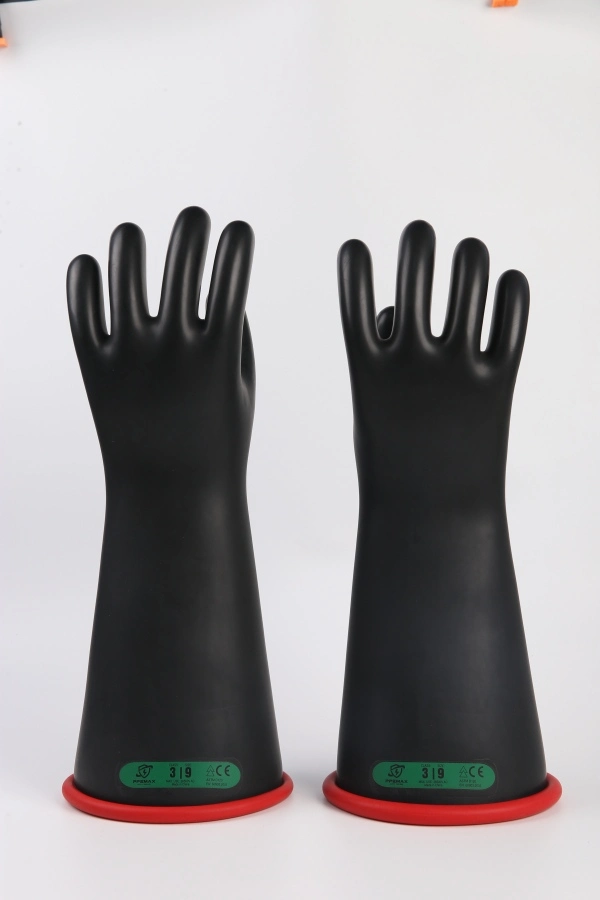
Dielectric gloves are necessary for electrical safety in most professional situations. They must be used when workers touch or approach exposed energized conductors, as required by OSHA 29 CFR 1910.137. These insulating rubber gloves are rated from 500V (Class 00) up to 36,000V (Class 4) and are tested to the ASTM D120 and IEC 60903 standards. Employees risk electrocution, arc flash burns, and regulatory fines without the right electrical insulating gloves. If you’re a procurement team buying PPE at scale, knowing precisely when and why these gloves are required is the first step to developing a compliance safety program.
|
Parameter |
Specification |
Standard |
|
Maximum Use Voltage |
26,500V AC / 39,750V DC |
ASTM D120 / IEC 60903 |
|
Proof Test Voltage |
30,000V AC / 45,000V DC |
ASTM D120 |
|
Material Types |
Type I (Natural Rubber) / Type II (EPDM) |
ASTM D120 |
|
Thickness Range |
2.3mm - 2.9mm |
Industry Standard |
|
Length Options |
14" - 18" inches |
Customizable |
|
Label Color |
Green |
International Standard |
|
Temperature Range |
-25°C to +65°C |
Operating Conditions |
Understanding Dielectric Gloves and Their Role in Electrical SafetyWhat Makes Them Different from Regular Gloves
Dielectric gloves are manufactured from high-grade natural rubber or EPDM (Ethylene Propylene Diene Monomer) and tested to ensure they do not conduct electricity. Normal rubber gloves are not authorized electrical insulating gloves. However, electrical shielding gloves can withstand proof-test voltages up to 40,000V AC. They are color-coded to illustrate the interior and exterior layers. That makes it easy to rapidly and precisely spot holes in them during daily inspections.
Key Voltage Ratings You Need to Know
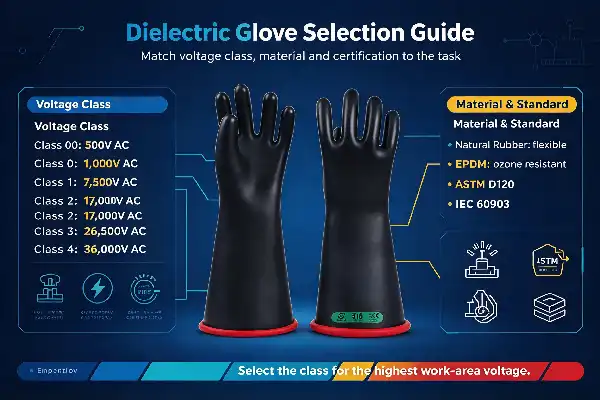
The maximum power available in each class is clearly shown. Class 00 is rated for 500V AC. Class 0 is rated for 1,000V AC. Class 2 is rated for 17,000V AC. Class 4 is rated for 36,000V AC. The choice of the correct class depends on the real voltage of the equipment; this is the foundation of safe work and compliance with regulations.
Governing Standards: ASTM D120 and IEC 60903
International markets are regulated by IEC 60903 (or EN 60903 in Europe), while North American markets use ASTM D120 as the standard. Both standards have to be checked for dielectricity, tensile strength, and frequent re-certification. When procurement staff are purchasing gloves for activities that take place in more than one location, they should make sure the gloves are dual certified to avoid any gaps in compliance across jurisdictions.
Types and Materials of Dielectric Gloves
Voltage Classes: From Class 00 to Class 4
The class system makes it easy for buyers to choose. Class 00 and Class 0 dielectric gloves are good for low-voltage jobs like working on EV batteries and in the phone industry. Gloves in Classes 2 and 3 are required for utility linemen who work on overhead power lines. Class 4 gloves are only worn when they are exposed to voltages at the transmission level. It is very important to match the class to the job; gloves that aren't rated properly will only protect you in a fake way.
Natural Rubber vs. EPDM: Which Material Fits Your Operation?
Natural rubber is the best material for tasks that need fine motor control because it is more flexible and dexterous. On the other hand, EPDM-manufactured materials are better at resisting ozone cracking, UV damage, and some chemical exposures. Type I gloves are made of natural rubber and can't stand up to ozone. Type II gloves are made from man-made materials like EPDM and are rated for ozone resistance, which is important in workplaces with electrical discharge equipment nearby.
When Dielectric Gloves Outperform Standard Alternatives
Standard rubber or nitrile gloves don't protect against electricity at all. If you need to work with live wires, operate switches, test circuit breakers, or service transformers, you need to wear approved insulating gloves. When doing mechanical work, you should always wear leather guard gloves over the rubber layer to keep cuts and scrapes from damaging the insulation layer.
Are Dielectric Gloves Mandatory for Electrical Safety?
U.S. and International Regulatory Requirements
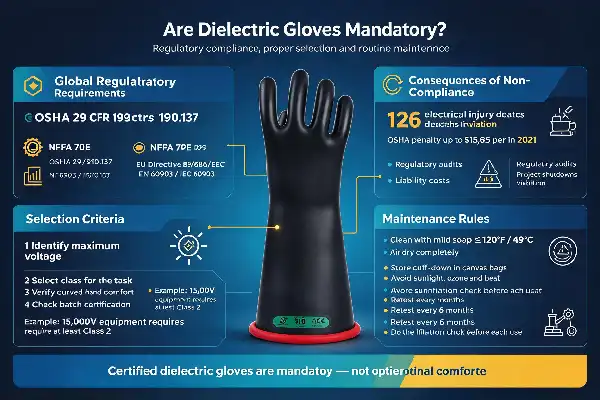
When working on or near live electrical equipment in the United States, OSHA 29 CFR 1910.137 makes it clear that you must wear insulating gloves. In addition, NFPA 70E spells out the standards for arc flash PPE. Directive 89/686/EEC and EN 60903 both set duties that are the same in the EU. In the Middle East, Asia, and Africa, national standards are becoming more and more like ASTM and IEC frameworks. This means that certified insulating gloves are needed everywhere to meet the rules.
Real Consequences of Non-Compliance
In 2021, the Bureau of Labor Statistics found that 126 people died from electrical injuries at work in the United States. In addition to deaths, OSHA can fine people $15,625 per violation for not wearing the right PPE. A single electrical event that can be recorded can lead to regulatory audits, project shutdowns, and big liability costs for big building, energy, and factory companies with hundreds of workers.
Field Evidence from High-Risk Sectors
Utility companies that use Class 2 and Class 3 insulating gloves for overhead line repair report a lot fewer contact accidents than teams that use non-certified substitutes. Class 0 gloves are now standard issue for EV manufacturers who work with 400V–800V DC battery systems. These examples of how warming gloves are used in real life show that they are not just a safety measure that should be taken; they are a must.
If you're evaluating personal protective equipment suppliers and require batch-specific testing documents before placing an order, PPE MAX is able to provide official Certificates of Analysis, professional laboratory test reports, and product samples for your verification. Feel free to contact our team at marketing@ppemax.com to discuss your sourcing needs and obtain complete documentation for your quality assessment and procurement approval.
How to Choose the Right Dielectric Gloves for Your Business Needs
Matching Voltage Class to Job Hazard
“First, do a job risk study. Identify the greatest voltage your workers could be exposed to or even approach, and choose gloves rated one class higher for a comfortable safety margin. A maintenance engineer working on 15,000V equipment at a substation must wear at least Class 2 gloves, not Class 1.
Comfort, Ergonomics, and Extended Wear
Many times, glove design doesn’t enter the procurement team’s mind in terms of its effect on work. Anatomically "curved hand" forms prevent your hands from tiring during extended chores. Pre-curved fingers make it easy to handle objects and make workers less inclined to refuse to wear PPE all the time. In lower-class ratings, thinner glove walls allow for better dexterity, which is vital for EV technicians working in cramped places.
Evaluating Suppliers: What to Look For
If a customer is going to purchase a lot of electrical safety dielectric gloves , they should ask for ASTM D120 or IEC 60903 test certifications for each batch. Suppliers should provide confirmation of tensile strength, stretch, and dielectric glove test results. Names like Salisbury, Honeywell, Ansell, and Klein Tools always meet these requirements. For OEM and bulk orders, the best method to make sure the quality of all huge orders is the same is to deal with a dielectric glove producer with a lot of expertise and in-house testing capabilities.
Maintaining and Extending the Lifespan of Dielectric Gloves
Cleaning Best Practices
Use a moderate soap and water solution not to exceed 120°F (49°C) to clean insulating gloves. Do not use cleansers or solvents based on gasoline since they deteriorate rubber materials. Wipe dry after washing and air dry well before storing. In industry, it is a need that equipment be thoroughly cleaned after each use since even a little quantity of chemical contamination may diminish the dielectric strength but will not create any visible harm.
Correct Storage Conditions
To prevent gloves from becoming wet inside, place them in canvas bags with the sleeves down. Avoid sources of direct sunlight, ozone (electric motors), and heat sources. Store in a cool, dark, dry place. Do not fold or squeeze gloves when storing. Crease lines might become microscopic fractures that degrade the insulation over time.
Inspection Schedules and Retirement Criteria
Gloves in use must be electrically retested every six months as required by OSHA and ASTM D120. Perform the daily air inflation test before each usage. Roll the cuff toward your fingers to capture air and then inspect for any visible leaks or breaks. If gloves contain cuts, punctures, or chemical stains, or if they fail the inflation test, dispose of them immediately. Do not use a glove after the date indicated on the test that shows it is no longer good.
Conclusion
OSHA, ASTM, and IEC regulations confirm that dielectric gloves are a legal requirement and a logical step to save lives while working with electricity. To summarize, the primary duties of any procurement or safety manager for electrical operations are to choose the correct voltage class, verify the material type, and adhere to tight re-testing schedules. If your teams repair utilities, make electric cars, or maintain industrial substations, certified insulator gloves should be in every job site kit. Getting the requirements right from the outset saves your staff and company.
FAQ
1. What is the difference between Type I and Type II gloves?
Type I gloves are made from natural rubber and are not rated for ozone resistance. Type II gloves use synthetic materials like EPDM and resist ozone cracking, making them better suited for environments with high electrical discharge activity.
2. How often must insulating gloves be re-tested?
ASTM D120 and OSHA require electrical re-testing every six months for gloves in use, or sooner if physical integrity is in question after an incident or visual inspection failure.
3. Can dielectric gloves be cleaned and reused?
Yes. Wash with mild soap and water below 120°F, air-dry completely, and store correctly. They are reusable until they fail inspection or exceed their certified test interval.
4. Why must leather protectors be worn over rubber insulating gloves?
Leather protectors shield the thin rubber layer from cuts, abrasions, and punctures during mechanical tasks. Any physical breach of the rubber compromises its insulating properties, regardless of its electrical test rating.
5. How do I select the correct voltage class for my application?
Identify the maximum voltage present in the work environment. Select a glove class rated above that voltage. Consult the ASTM D120 class table for precise maximum use voltage thresholds for each class.
Partner with PPE MAX for Certified Dielectric Gloves Supplier Solutions
Since 1956, PPE MAX has sold approved electrical PPE to businesses in 134 countries. As a reliable provider of dielectric gloves with in-house testing and OEM production experience, we can help you buy in bulk and provide proof that our gloves meet ASTM D120 and IEC 60903 standards. Get in touch with our team to get product details, prices, or a consultation that is tailored to the voltage exposure needs of your employees. You can email us at marketing@ppemax.com.
References
1. American Society for Testing and Materials (ASTM). ASTM D120: Standard Specification for Rubber Insulating Gloves. ASTM International, 2022.
2. International Electrotechnical Commission. IEC 60903: Live Working — Gloves of Insulating Material. IEC, 2022.
3. Occupational Safety and Health Administration (OSHA). 29 CFR 1910.137: Electrical Protective Equipment. U.S. Department of Labor, 2019.
4. National Fire Protection Association. NFPA 70E: Standard for Electrical Safety in the Workplace. NFPA, 2024.
5. Bureau of Labor Statistics. Census of Fatal Occupational Injuries Summary, 2021. U.S. Department of Labor, 2022.
6. European Committee for Electrotechnical Standardization (CENELEC). EN 60903: Live Working — Gloves of Insulating Material. CENELEC, 2023.
Learn about our latest products and discounts through SMS or email