- English
- French
- German
- Portuguese
- Spanish
- Russian
- Japanese
- Korean
- Arabic
- Greek
- German
- Turkish
- Italian
- Danish
- Romanian
- Indonesian
- Czech
- Afrikaans
- Swedish
- Polish
- Basque
- Catalan
- Esperanto
- Hindi
- Lao
- Albanian
- Amharic
- Armenian
- Azerbaijani
- Belarusian
- Bengali
- Bosnian
- Bulgarian
- Cebuano
- Chichewa
- Corsican
- Croatian
- Dutch
- Estonian
- Filipino
- Finnish
- Frisian
- Galician
- Georgian
- Gujarati
- Haitian
- Hausa
- Hawaiian
- Hebrew
- Hmong
- Hungarian
- Icelandic
- Igbo
- Javanese
- Kannada
- Kazakh
- Khmer
- Kurdish
- Kyrgyz
- Latin
- Latvian
- Lithuanian
- Luxembou..
- Macedonian
- Malagasy
- Malay
- Malayalam
- Maltese
- Maori
- Marathi
- Mongolian
- Burmese
- Nepali
- Norwegian
- Pashto
- Persian
- Punjabi
- Serbian
- Sesotho
- Sinhala
- Slovak
- Slovenian
- Somali
- Samoan
- Scots Gaelic
- Shona
- Sindhi
- Sundanese
- Swahili
- Tajik
- Tamil
- Telugu
- Thai
- Ukrainian
- Urdu
- Uzbek
- Vietnamese
- Welsh
- Xhosa
- Yiddish
- Yoruba
- Zulu
What Proof Test Voltage Applies to Dielectric Gloves?
Founded in 1956, PPEMAX stands as a premier global manufacturer and supplier of full-range personal protective equipment. All our products comply with internationally recognized standards including IEC, ASTM, CE, UKCA, NIOSH and ISO9001. Equipped with a 2,000-square-meter modern production plant, we boast over 25 years of mature OEM & ODM capabilities to deliver one-stop customized solutions covering R&D design through worldwide logistics. Our safety gear is distributed across 134 countries globally. Upholding our core tenet “Safety First, Quality Priority”, we serve as a dependable long-term PPE partner for industrial enterprises around the world.
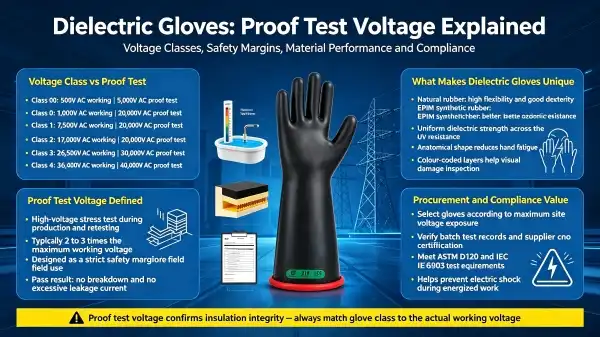
For dielectric gloves, the proof test voltage changes by voltage class, from 5,000V AC for Class 00 gloves to 40,000V AC for Class 4 gloves. This measurement is much higher than the maximum use voltage. It is used as a strict safety margin to make sure that each glove is properly insulated before it goes into the field. Knowing the requirements for the proof test helps procurement professionals choose electrical safety gloves that meet government standards and keep workers from getting shocked by electricity while they work with high voltage.
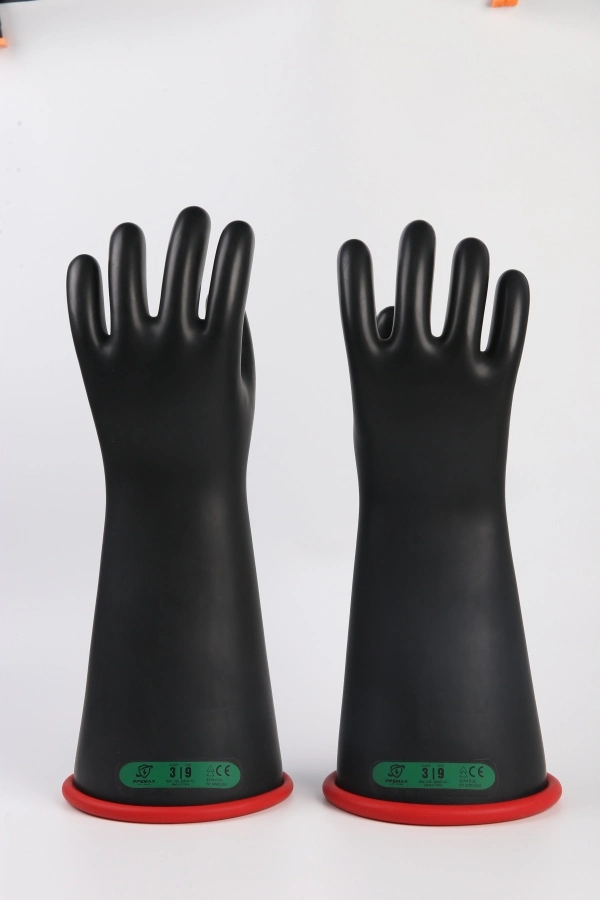
|
Parameter |
Specification |
Standard |
|
Maximum Use Voltage |
26,500V AC / 39,750V DC |
ASTM D120 / IEC 60903 |
|
Proof Test Voltage |
30,000V AC / 45,000V DC |
ASTM D120 |
|
Material Types |
Type I (Natural Rubber) / Type II (EPDM) |
ASTM D120 |
|
Thickness Range |
2.3mm - 2.9mm |
Industry Standard |
|
Length Options |
14" - 18" inches |
Customizable |
|
Label Color |
Green |
International Standard |
|
Temperature Range |
-25°C to +65°C |
Operating Conditions |
Understanding Dielectric Gloves and Their Proof Test Voltage
Dielectric gloves are an important way to protect yourself from electrical dangers in the workplace. These specialised hand protectors are not like regular work gloves made from leather or general-purpose rubber. They are made with exact insulating qualities that stop current flow through the body.
What Makes Dielectric Gloves Different
The main difference is in the materials used and how they are built. Natural rubber is very flexible and easy to work with, which makes it perfect for fine details on moving parts. EPDM synthetic rubber, on the other hand, is better at resisting damage from ozone and UV light, which means it lasts longer in outdoor settings. Both materials go through a lot of steps to make sure that the dielectric strength is the same all over the surface of the glove. The anatomically curved hand design keeps muscles from getting tired after long periods of use, and the colour-coded inner and outer layers make it easier to see any damage before use.
Defining Proof Test Voltage
The proof test voltage shows the electrical stress that is put on each glove during quality control, during production, and regular testing while it is being used. This parameter goes over the highest voltage for use by a large safety margin, usually between two and three times the specified working voltage. When a glove passes its defined proof test without breaking or leaking too much current, it shows that its structure is strong enough to be used safely. When purchasing, teams look at a supplier's skills; they should give more weight to those that keep detailed records of all tests and methods that keep track of each batch of gloves as they are made and certified.
Industry Standards and Safety Guidelines for Proof Test Voltage
Global regulatory frameworks set clear standards for electrical safety dielectric gloves, making sure that everyone is safe in a wide range of industries and markets around the world.
ASTM D120 Requirements
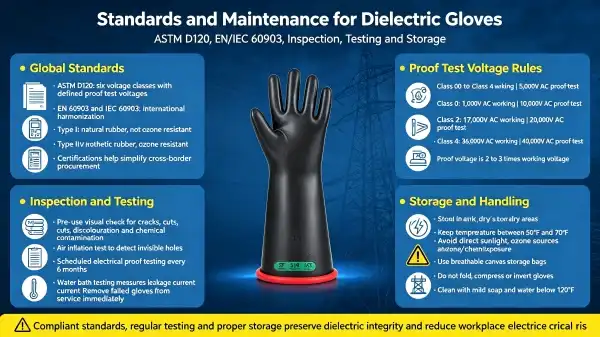
Standard D120 from the American Society for Testing and Materials lists six voltage classes and the proof test rules that go with them. Even though they can only handle 500V at most, Class 00 gloves are tested at 5,000V AC. For 1,000V uses, Class 0 gloves have to pass a 10,000V proof test. As you move up the scale, Class 2 gloves have to pass 20,000V tests to be approved for a maximum 17,000V use. Class 4 gloves, which have the highest grade, have to pass 40,000V AC tests to be approved for a 36,000V working ability. Real-world factors like high temperatures, mechanical stress, and material ageing are taken into account by these large gaps.
European and International Harmonization
The EN 60903 and IEC 60903 standards are similar to the ASTM classifications, with a few small regional changes. This makes it easier to buy things across borders and follow the rules. European rules put more weight on ozone resistance classification, separating gloves into Type I (natural rubber that doesn't resist ozone) and Type II (made chemicals that do resist ozone). This difference is very important for utilities that keep overhead distribution networks, since storing and using things outside for a long time speeds up their degradation. When B2B buyers are looking for gloves for multinational companies, they can choose gloves that are certified under more than one standard system. This makes it easier to keep separate inventory for each regional facility.
Regulatory Compliance and Liability Reduction
Meeting set proof test voltage standards keeps businesses from getting fined by the government and putting themselves at risk of liability after accidents at work. OSHA requires companies to give workers the right safety gear for electrical work and make sure that all of the equipment they use meets agreement standards. A safety record that can be checked for errors and shows that proper care was taken includes proof of regular testing and repair. When purchasing goods for government agencies and public safety groups, procurement departments must make sure that suppliers keep their third-party laboratory accreditation and can provide certification documents that can be linked to specific production lots.
If you're evaluating personal protective equipment suppliers and require batch-specific testing documents before placing an order, PPE MAX is able to provide official Certificates of Analysis, professional laboratory test reports, and product samples for your verification. Feel free to contact our team at bettybing@ppemax.com to discuss your sourcing needs and obtain complete documentation for your quality assessment and procurement approval.
How to Inspect, Test, and Maintain Dielectric Gloves for Safety and Performance
Electrical safety gloves keep the protective features that make them useful for a long time, thanks to routine repair plans.
Daily Visual and Air Inflation Tests
Before each use cycle starts, they should be carefully looked over in good lighting. Inspectors look for cracks on the surface, foreign items buried in the material, chemical pollution, or changes in colour that could mean ozone checking. In the field, the air inflation test is a useful way to find tiny holes or tears that you can't see. Workers blow up the glove by squeezing air into the cuff and then gently pressing on it while listening and feeling for air that is leaving. This easy process, which takes less than two minutes per pair of gloves, finds damage that could cause shocks.
Scheduled Electrical Proof Testing
Electrical testing must be done every six months, no matter how often it is used, according to ASTM D120 and OSHA rules for dielectric gloves. Testing facilities put gloves in water baths that are conductive and then use the right proof test voltage to measure leaking current. Gloves that leak more than a certain amount fail the test and must be taken out of service right away. Companies that keep a lot of gloves should work with approved testing labs that can handle a lot of files quickly, so that equipment doesn't have to be taken out of service too often.
Storage and Handling Best Practices
Environmental factors have a big effect on how long gloves last and how well they work. The temperature in storage places should stay between 50°F and 70°F, and they should be kept cool, dark, and dry. Direct sunlight speeds up the breakdown of rubber, and being close to equipment that makes ozone, like electric motors and welding stations, causes it to crack before it should. Canvas storage bags keep gloves safe from damage and light, and the cuffs are positioned downward to keep dust from building up inside the glove. When you fold or compress gloves, you put a lot of stress on certain areas, which makes them weak and more likely to break an electrical circuit. To keep mould from growing and the material from getting soft, gloves must dry fully after being cleaned with light soap and water below 120°F.
Comparing Dielectric Gloves by Proof Test Voltage and Other Key Factors
To choose the right electrical safety gloves, you have to weigh a lot of technical factors against specific operational needs and work environments.
Voltage Class Selection Logic
The minimum acceptable glove class is based on the maximum use voltage, but smart procurement takes extra room into account for voltage spikes or measurement errors that might happen. Technically, working on 4,160V distribution equipment is within Class 0 capability, but many utilities require Class 1 gloves for this job, which adds an extra safety cushion. Class 2 gloves are most common for utility transfer work with voltages up to 17,000V. Class 3 and Class 4 gloves are used for specific high-voltage tasks in power plants and industrial substations. The required proof test voltages, which range from 10,000V for Class 0 to 40,000V for Class 4, make sure that each glove can safely handle these electrical stresses.
Material Performance Trade-offs
Natural rubber is very flexible and sensitive to touch, which are traits that techs who work carefully on complicated electrical assemblies value. EPDM synthetic materials give up some dexterity in return for better weather protection and longer service life in harsh outdoor conditions. Type I gloves are cheaper at first, but they need to be replaced more often in jobs where they will be exposed to ozone. Type II gloves are more expensive, but they have a lower total cost of ownership for businesses that work in difficult climates or store a lot of gloves for long periods of time.
Evaluating Supplier Quality Indicators
Leading makers of electrical safety dielectric gloves set themselves apart with strict quality systems that go above and beyond meeting base standards. PPE MAX has been around since 1956 and keeps detailed records of all the tests done on each batch, as well as statistical process control data that shows how the properties of the materials stay the same from one production run to the next. Procurement teams can be sure that the products they buy are real and will work well if the suppliers provide thorough technical data sheets, material certifications, and testing lab approval. The warranty terms and replacement policies show how confident the manufacturer is in the durability of the product. Quickly responding technical support teams help safety managers create glove management programs that work for their operations.
Buying Guide: Procuring Dielectric Gloves with Proper Proof Test Voltage
When making strategic choices about what to buy, you have to think about both short-term working needs and long-term safety program goals as well as the total cost.
Aligning Specifications with Actual Field Conditions
Choosing the right voltage class starts with figuring out how much electrical exposure there is. Maintenance teams should write down the highest voltage they come across while doing regular tasks and responding to emergencies. They should then choose gloves that are rated for that maximum voltage plus a safety cushion. Strategic standardisation can help organisations that run a variety of sites with different voltage levels keep track of their goods. Picking one class of gloves that can safely handle the highest voltage application at all sites makes training easier, makes buying gloves easier, and lowers the risk that workers will pick the wrong gloves for the job.
Verifying Supplier Credentials and Documentation
Trustworthy suppliers give a lot of paperwork that shows they follow the rules. When you get a certificate, it should come with proof test results for each batch, reports on the materials used, and production date codes that let you handle the product's shelf life properly. Before making big purchases, buyers should ask for samples of gloves to be tested by a third party to make sure they are what they say they are. This is especially important when making deals with new sellers or buying from places they have never been to before. Traceability systems that connect each glove to the batch it was made in allow for targeted recalls if quality problems arise. This protects both worker safety and the company's liability exposure.
Bulk Purchasing Considerations and After-Sales Support
Buying in bulk can often save you a lot of money, but buyers have to weigh the unit price against the costs of keeping goods and the length of time that materials can be stored. When kept properly, natural rubber gloves usually keep their best qualities for about three years from the date they were made, while EPDM materials may last up to five years. Setting up blanket purchase orders with scheduled delivery releases makes sure that inventory levels are in line with actual consumption rates and takes advantage of volume pricing. Strong relationships with suppliers include technical consulting services that help safety managers set up programs for sizing gloves, make testing plans, and teach workers how to do proper inspections. Respondent customer service teams that quickly replace gloves that break down keep operations running smoothly and show that the provider is committed to long-term relationship success.
Conclusion
Proof test voltage standards for electrical safety gloves set high-quality standards that keep workers safe from shock risks in a wide range of industrial settings. When procurement workers know how voltage classes relate to the proof test parameters that go with them, they can make choices that balance safety performance, legal compliance, and operational needs. Systematic inspection and maintenance protocols keep gloves in good shape for as long as they are used, and strategic partnerships with suppliers make sure that users can get certified products with full technical support. Companies that put worker safety first by choosing the right gloves and managing them well show they care about workplace health while lowering their risk of liability and improving the efficiency of their operations.
FAQ
1. What is the difference between proof test voltage and maximum use voltage?
The biggest electrical potential at which gloves can be used safely during normal activities is called the maximum use voltage. Proof test voltage is a much higher voltage than is used for quality control during production and for regular retesting to make sure that the insulation is still good with a large safety cushion. Class 2 gloves, which can handle up to 17,000V, must pass a 20,000V proof test to make sure they are safe enough to use.
2. How often should dielectric gloves undergo electrical retesting?
Every six months, ASTM D120 and OSHA guidelines say that the gloves that are being used must be tested for electrical resistance. Also, when the integrity of a glove is called into question because of possible damage, chemical exposure, or unusual stress, organisations should do more tests. Keeping written testing schedules with clear dates for the next test stops people from using gloves that are past their due dates by accident.
3. Can suppliers provide proof of pre-shipment electrical testing?
Reputable manufacturers test each batch thoroughly and include certification paperwork with every shipment. These documents should have the date of the test, the proof test voltage that was used, readings of the leakage current, and details about the lab's accreditation. Before putting gloves to use, buyers should make sure that the paperwork is real and that the testing dates are within a reasonable amount of time.
Partner with PPE MAX for Certified Electrical Safety Solutions
PPE MAX sells dielectric gloves that have been through a lot of tests and meet strict proof test voltage standards across all voltage grades. As a reliable company that has been making dielectric gloves for 134 countries since 1956, we offer detailed technical documentation, low bulk prices for large orders, and expert consultation services that are tailored to your specific electrical safety needs. We have a lot of experience in the field, so you can be sure that the products you buy are real and certified. Our quality systems are also reliable, and we offer helpful customer service after the sale. Email our procurement experts at marketing@ppemax.com to talk about your needs for a dielectric glove source and find out how our end-to-end solutions can help you protect your employees and make managing your safety tools easier.
References
1. American Society for Testing and Materials. (2022). ASTM D120-20: Standard Specification for Rubber Insulating Gloves. ASTM International, West Conshohocken, PA.
2. Occupational Safety and Health Administration. (2021). 1910.137 - Electrical Protective Devices. U.S. Department of Labor, Washington, DC.
3. International Electrotechnical Commission. (2020). IEC 60903: Live Working - Gloves of Insulating Material. Edition 4.0, Geneva, Switzerland.
4. European Committee for Electrotechnical Standardization. (2019). EN 60903: Live Working - Electrical Insulating Gloves. CENELEC, Brussels, Belgium.
5. National Institute for Occupational Safety and Health. (2021). Electrical Safety Guidelines for Insulating Gloves and Sleeves. NIOSH Publication No. 2021-118, Cincinnati, OH.
6. Institute of Electrical and Electronics Engineers. (2020). IEEE 1584: Guide for Performing Arc-Flash Hazard Calculations and PPE Selection. IEEE Standards Association, Piscataway, NJ.
Learn about our latest products and discounts through SMS or email