- English
- French
- German
- Portuguese
- Spanish
- Russian
- Japanese
- Korean
- Arabic
- Greek
- German
- Turkish
- Italian
- Danish
- Romanian
- Indonesian
- Czech
- Afrikaans
- Swedish
- Polish
- Basque
- Catalan
- Esperanto
- Hindi
- Lao
- Albanian
- Amharic
- Armenian
- Azerbaijani
- Belarusian
- Bengali
- Bosnian
- Bulgarian
- Cebuano
- Chichewa
- Corsican
- Croatian
- Dutch
- Estonian
- Filipino
- Finnish
- Frisian
- Galician
- Georgian
- Gujarati
- Haitian
- Hausa
- Hawaiian
- Hebrew
- Hmong
- Hungarian
- Icelandic
- Igbo
- Javanese
- Kannada
- Kazakh
- Khmer
- Kurdish
- Kyrgyz
- Latin
- Latvian
- Lithuanian
- Luxembou..
- Macedonian
- Malagasy
- Malay
- Malayalam
- Maltese
- Maori
- Marathi
- Mongolian
- Burmese
- Nepali
- Norwegian
- Pashto
- Persian
- Punjabi
- Serbian
- Sesotho
- Sinhala
- Slovak
- Slovenian
- Somali
- Samoan
- Scots Gaelic
- Shona
- Sindhi
- Sundanese
- Swahili
- Tajik
- Tamil
- Telugu
- Thai
- Ukrainian
- Urdu
- Uzbek
- Vietnamese
- Welsh
- Xhosa
- Yiddish
- Yoruba
- Zulu
What Materials Are Used in Class 1 Insulating Gloves?
Class 1 Insulating Gloves are mostly made of natural rubber latex, which has great insulating qualities that keep workers safe from electrical dangers up to 7,500 volts AC. Additionally, leather protection gloves protect against mechanical damage like cuts, abrasions, and punctures. This special material acts as the main insulation barrier in Class 1 Insulating Gloves. These materials work together to make a complete safety system that stops electrical shocks and lasts a long time. It meets strict international standards for electrical safety tools, such as ASTM D120, IEC 60903, and OSHA 1910.137.
Understanding Class 1 Insulating Gloves and Their Role in Electrical Safety
Electrical workers face life-threatening risks daily when servicing energised equipment. The margin between safety and catastrophe often depends on the quality of their protective gear. The primary purpose of insulating rubber gloves is to protect against electrical shock hazards, and understanding their classification is essential for procurement professionals responsible for worker protection.
What Defines Class 1 Protection Standards
People who work with maximum levels of 7,500 volts AC or 11,250 volts DC can be sure that Class 1 tools will keep them safe. The power can go as high as 10,000 volts AC for the proof test and 20,000 volts AC for the safety test. Not just any numbers were used to come up with these rules; they are the result of decades of research into power safety and a review of real-life events. The teams that are in charge of getting things need to know that these voltage levels set the range of levels where gloves will still keep you safe.
Compliance Framework for Industrial Procurement
Every part of making and testing insulated gloves has to follow international standards. In North America, ASTM D120 sets the standards for materials and testing procedures that are used everywhere. In Europe, Asia, and the developing markets, IEC 60903 is the worldwide system that is used everywhere. EN 60903 makes these standards consistent so they can be followed in the European Union. At PPE MAX, we've made sure that our production methods are in line with all three standards at the same time. This way, we can be sure that our goods meet the strictest requirements, no matter where you work. This agreement with multiple standards makes it easier to buy tools for our 134-country delivery network's foreign activities.
The Critical Safety Function of Material Selection
The qualities of the materials directly affect whether insulated gloves do what they're supposed to do and protect you or fail horribly when electrical stress is applied. Because natural rubber latex is insulating, it stops current from flowing through the glove material. However, the material is still flexible enough for workers to precisely move tools and parts. Finding the right mix between safety and flexibility is the most difficult part of designing insulation gloves. Either safety gaps or worker abilities are compromised when the wrong materials are chosen, and both of these results are unacceptable in high-risk electricity settings.
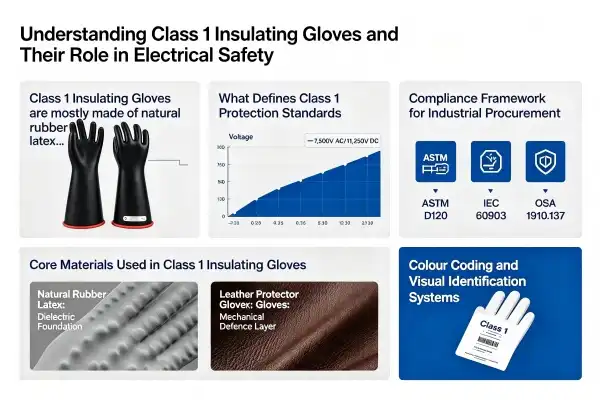
Core Materials Used in Class 1 Insulating Gloves: Properties and Functions
The material science behind Class 1 Insulating Gloves represents sophisticated engineering that balances competing demands. Each component serves specific protective functions, and understanding these relationships helps procurement professionals evaluate Class 1 Insulating Gloves product quality beyond simple price comparisons.
Natural Rubber Latex: The Dielectric Foundation
In Class 1 gloves, natural rubber latex is used as the main insulation barrier because it has qualities that manufactured materials have a hard time matching at the same time. This stretchy material has a high dielectric strength, which is a measure of how well it keeps electricity from breaking down when voltage stress is applied. Natural rubber's chemical structure effectively blocks the flow of electrons while keeping its flexibility across the wide range of temperatures found in industrial settings. Specifications for thicknesses between 0.7 mm and 1.5 mm give the insulation layer needed for voltage class approval while still letting workers use their touch senses for difficult physical jobs. Natural rubber is also very good at recovering its shape after being stretched. This means that gloves can bend and stretch with your hand without permanently changing shape, which could leave weak spots in the protective barrier.
The material's resistance to ozone and UV degradation extends service life in outdoor applications common to utility companies and telecommunications work. This durability characteristic reduces replacement frequency, lowering the total cost of ownership for procurement departments managing large inventories across multiple work sites.
Leather Protector Gloves: Mechanical Defence Layer
Rubber insulating gloves possess excellent electrical properties but remain vulnerable to physical damage that instantly compromises their protective function. A single puncture or cut creates a direct pathway for electrical current, rendering the dielectric barrier worthless. Leather protectors address this vulnerability by absorbing mechanical trauma before it reaches the rubber layer underneath. These protectors are manufactured from heavy-duty leather that withstands abrasion from rough surfaces, resists puncture from sharp edges, and provides cushioning against impact forces.
Wearing rubber gloves without leather protectors violates safety protocols established in ASTM F696 and exposes workers to unacceptable risk. The mechanical protection layer isn't optional—it represents a mandatory component of the complete insulating glove system. Procurement specifications must always include both elements when ordering electrical safety equipment.
Colour Coding and Visual Identification Systems
The distinctive colour scheme applied to insulating gloves serves an immediate safety function beyond simple aesthetics. Class 1 gloves feature white colour labels that enable instant visual verification of voltage rating. This standardised identification system prevents dangerous mismatches where workers might accidentally use lower-rated equipment on higher voltage systems. Colour coding functions as a last line of defence against human error in equipment selection, particularly valuable in facilities where multiple voltage classes operate simultaneously.
Visual inspection protocols rely on these colour standards, allowing safety managers to conduct rapid compliance audits without handling every piece of equipment. The colour distinction becomes especially critical during emergency response situations where personnel must quickly access appropriate protective gear under stress conditions.
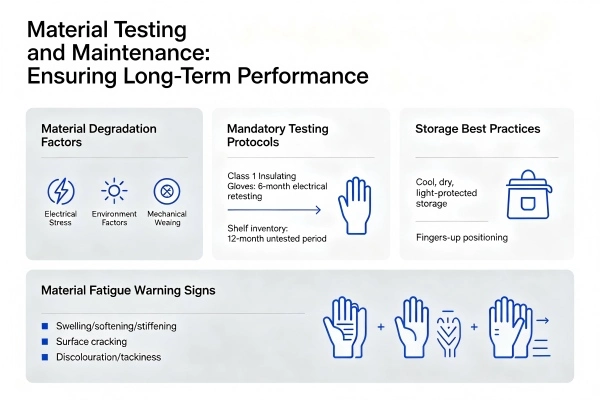
Material Testing and Maintenance: Ensuring Long-Term Performance
Even premium materials degrade over time when exposed to electrical stress, environmental factors, and mechanical wear. Comprehensive testing and maintenance protocols preserve the protective integrity that procurement investments are meant to deliver. These programs represent the operational component of electrical safety that extends beyond initial purchase decisions.
Mandatory Electrical Testing Intervals
OSHA 1910.137 and ASTM F496 establish clear testing requirements that procurement teams must factor into total ownership costs. Class 1 Insulating Gloves require electrical retesting every six months after being placed into active service. This dielectric testing subjects Class 1 Insulating Gloves to proof test voltages that verify the material maintains its insulating properties despite accumulated service exposure. Newly manufactured Class 1 Insulating Gloves stored as shelf inventory can remain untested for up to twelve months before first issue, but the six-month clock begins immediately upon deployment to workers.
Testing protocols include air inflation tests that reveal invisible punctures or weak spots in the rubber, followed by high-voltage dielectric testing using specialised equipment that applies proof test voltage while monitoring for current leakage. Gloves that fail either test must be immediately removed from service—there is no acceptable compromise on electrical safety equipment performance.
Storage Conditions That Preserve Material Properties
When gloves are handled incorrectly between uses, environmental factors speed up the wear and tear on the material. Industrial equipment, like electric motors and other common items in factories, produces ozone that is very harmful to natural rubber. Direct sunlight's UV rays break down rubber compounds, leaving weak spots that break when the rubber is stretched. Heat sources, like steam lines, speed up the breakdown of chemicals in the whole material structure.
For proper storage, gloves need to be kept in bags that keep out light and dirt. Gloves should be kept with the fingers facing up so that stress points don't become permanently creased. Storage places need to stay cool and dry, and chemicals that could damage the materials must be kept out of those areas. These seemingly small storage details have a direct effect on service life and the dependability of protected gear, which can be measured in terms of replacement costs and worker safety.
Recognising Material Fatigue Warning Signs
Proactive replacement strategies depend on recognising early indicators of material degradation before protective failure occurs. Visual inspection protocols train workers to identify swelling, softening, or stiffening of rubber compounds that signal chemical attack or environmental damage. Surface cracking, particularly near stress concentration areas around fingers and the wrist cuff, indicates UV or ozone degradation that compromises dielectric strength. Discolouration or tackiness suggests contamination exposure that may have altered material properties.
These warning signs enable procurement teams to implement condition-based replacement rather than relying solely on time-based schedules. Understanding typical service life under various operational conditions allows more accurate inventory planning and budget forecasting for safety equipment replacement cycles.
Comparing Materials: Class 1 Insulating Gloves vs. Other Electrical Safety Gloves
The electrical safety glove market encompasses multiple voltage classifications and material formulations, each optimised for specific operational requirements. Procurement professionals must navigate these distinctions to match equipment specifications with actual workplace hazards, avoiding both under-protection and unnecessary cost.
Voltage Class Distinctions and Material Implications
Class 1 gloves occupy a specific position in the voltage classification spectrum, protecting against hazards up to 7,500 volts AC. This rating addresses the majority of distribution-level electrical work in utility, construction, and manufacturing environments. Class 0 gloves rated for 1,000 volts AC use thinner material sections that enhance dexterity for lower-voltage tasks, while Class 2 gloves rated for 17,000 volts AC incorporate substantially thicker rubber compounds that sacrifice some flexibility for higher voltage protection.
Material thickness directly correlates with voltage rating—higher protection requires more insulating material between the worker's hand and the electrical hazard. Class 1 represents an engineered balance point where material thickness provides substantial voltage protection while preserving the finger flexibility and tactile sensitivity essential for manipulation tasks. Attempting to use Class 1 equipment on 12kV circuits creates life-threatening exposure—the voltage exceeds the glove's protective capacity. Conversely, specifying Class 2 gloves for consistent 480-volt work imposes unnecessary dexterity penalties on workers.
Material Innovations in Modern Glove Design
New developments in material science have focused on making things lighter and more comfortable to use without affecting electrical safety. Type II EPDM versions are better at resisting ozone cracking than Type I natural rubber, which makes them better for use outside, where contact with the elements speeds up decline. These man-made rubber materials keep their insulating qualities similar to natural latex while making service times longer in difficult situations.
Leading makers have also come up with shaped cuffs and finger shapes that fit the anatomy better, so that your hands don't get tired after long periods of wear of Class 1 Insulating Gloves. These practical changes recognise that worker comfort has a direct effect on safety compliance—uncomfortable equipment is either taken off or used wrongly, which takes away from its protection value. Our engineering team at PPE MAX is always looking at new materials and mechanical research to make sure that we can add proven improvements to our Class 1 Insulating Gloves product lines without lowering the quality of production that our customers have come to expect for over 65 years.
Procurement Considerations: Selecting and Buying the Right Materials for Class 1 Gloves
Making informed procurement decisions about electrical insulating gloves requires evaluating multiple factors beyond unit price. Total cost of ownership, certification verification, supply chain reliability, and vendor support capabilities all influence the value proposition that different suppliers present to industrial buyers.
Certification Verification and Compliance Documentation
Every batch of insulating gloves entering your facility should arrive with complete certification documentation verifying compliance with applicable standards. This documentation includes manufacturing lot numbers, test voltage results, and certification statements confirming ASTM D120, IEC 60903, or EN 60903 compliance as appropriate for your operational jurisdiction. Third-party certification marks, such as CE marking, provide additional verification that products meet European safety directives.
Procurement protocols should require this documentation before accepting delivery, creating an auditable paper trail that demonstrates due diligence in safety equipment selection. This documentation becomes essential during regulatory inspections or incident investigations where equipment certification status comes under scrutiny. Suppliers who cannot provide immediate, complete certification records present unacceptable risk regardless of the pricing advantages they might offer.
Balancing Durability, Comfort, and Budget Constraints
Buying teams are always juggling the costs of tools with the requirements for quality. This balance is more important for life safety when it comes to electrical insulation gloves than just a normal purchase decision. When replacement rates, worker satisfaction, and protection effectiveness under real-world stress situations are all taken into account, the cheapest gloves rarely offer the best value.
Premium materials cost more at first, but they usually last longer and are easier for people to work with. When workers find their gloves nice and useful, they wear them regularly and properly. The protection effect only happens when the equipment is worn as directed. On the other hand, gloves that are too uncomfortable or badly made are taken off too soon or used wrongly, leaving gaps in protection that cancel out any cost savings from the initial purchase discount.
Bulk buying offers economies of scale that make expensive materials easier for procurement teams that are watching their budgets to get. When makers make volume promises, they can plan their production runs more efficiently and pass those savings on to customers by lowering the price per unit. At PPE MAX, our low prices for large orders come from 65 years of manufacturing experience that has helped us become more efficient. This means that organisations of all kinds can access our global delivery network and buy approved, high-quality insulated gloves.
Evaluating Supplier Capabilities and Global Reach
Looking at what suppliers can do and how far they can reach
Supply chain resiliency has become an important thing to think about when buying things, especially for companies that do business in more than one foreign market. Suppliers with well-established global shipping networks can make sure that products are always available, even if there are problems with supplies in some areas or changes in the rules. When handling safety equipment stocks across sites in different countries, each with its own licensing standards and import rules, this feature comes in very handy.
Customisation is another way that a company can set itself apart and add value beyond standard product options. Suppliers who can handle custom manufacturing runs without requiring huge minimum orders or long lead times are helpful for businesses that need specific sizes, private labelling, or application-specific changes. Technical help and training tools are two more things that set providers who are real partners in workplace safety programs apart from those who are just transactional.
Conclusion
When buying, professionals know about the materials used in Class 1 Insulating Gloves; they can make choices that protect workers while also making the best use of budgets and increasing business efficiency. Natural rubber latex is the dielectric base that is needed to avoid electrical shocks, and leather covers give you the mechanical sturdiness you need for real-world industry uses. These material qualities will last as long as the equipment does because of thorough testing methods and good repair practices. It is important to make sure that the equipment standards match the real dangers in the workplace by choosing the right voltage classifications and checking all of the licensing paperwork. When you work with providers who are committed to worker safety, high-quality manufacturing, and global logistics, you can build relationships that are worth a lot more than just comparing unit costs.
FAQ
1. How often must Class 1 Insulating Gloves be electrically retested?
Rubber insulating gloves require electrical testing every six months once placed into active service, per OSHA 1910.137 and ASTM F496 standards. Shelf-stored gloves can remain untested for up to twelve months before first issue without retesting. Leather protectors require daily visual inspection but do not undergo electrical testing.
2. Can I use the rubber insulating glove without the leather protector?
Generally, no. Using rubber gloves without leather protectors exposes them to mechanical damage, including cuts, punctures, and abrasions that immediately compromise their dielectric protection. ASTM D120 gloves are specifically designed to be worn with protectors as part of a complete protective system.
3. What determines the choice between Type I and Type II rubber materials?
Type II EPDM rubber offers superior resistance to ozone cracking, making it preferable for outdoor applications or environments with significant ozone exposure. Type I natural rubber provides maximum dexterity and flexibility in controlled, ozone-free environments where tactile sensitivity takes priority.
4. How should Class 1 Insulating Gloves be stored to prevent material degradation?
Gloves should be stored in protective canvas bags, fingers up, in cool, dry, dark locations away from direct sunlight, heat sources, and ozone-generating equipment. Rubber gloves should be removed from leather protectors during long-term storage to prevent deformation. Avoid folding or unnecessary creasing that creates stress concentration points.
Partner with PPE MAX for Certified Class 1 Insulating Gloves
At PPE MAX, we've spent over 65 years perfecting the manufacturing processes that produce Class 1 Insulating Gloves trusted by organisations across 134 countries. Our commitment to premium natural rubber latex, rigorous quality control, and comprehensive certification compliance ensures that every pair of Class 1 Insulating Gloves leaving our Xi'an facilities meets the exacting standards your workers depend upon. As a leading Class 1 Insulating Gloves manufacturer with proven expertise in large-scale B2B procurement, we offer customizable ordering options, competitive bulk pricing, and technical support that extends throughout your equipment lifecycle. Contact our team at marketing@ppemax.com to discuss how our manufacturing capabilities and global supply chain can support your electrical safety program with reliable, certified protection that never compromises on quality.
References
1. American Society for Testing and Materials. (2021). Standard Specification for Rubber Insulating Gloves (ASTM D120-20). West Conshohocken: ASTM International.
2. International Electrotechnical Commission. (2019). Live working – Gloves of insulating material (IEC 60903:2019). Geneva: IEC Publications.
3. Occupational Safety and Health Administration. (2020). Electrical Protective Equipment, 29 CFR 1910.137. Washington: U.S. Department of Labour.
4. European Committee for Electrotechnical Standardisation. (2018). Live working – Gloves of insulating material (EN 60903:2018). Brussels: CENELEC.
5. American Society for Testing and Materials. (2019). Standard Specification for In-Service Care of Insulating Gloves and Sleeves (ASTM F496-19). West Conshohocken: ASTM International.
6. National Fire Protection Association. (2021). Standard for Electrical Safety in the Workplace (NFPA 70E-2021). Quincy: NFPA Publications.
Learn about our latest products and discounts through SMS or email