- English
- French
- German
- Portuguese
- Spanish
- Russian
- Japanese
- Korean
- Arabic
- Greek
- German
- Turkish
- Italian
- Danish
- Romanian
- Indonesian
- Czech
- Afrikaans
- Swedish
- Polish
- Basque
- Catalan
- Esperanto
- Hindi
- Lao
- Albanian
- Amharic
- Armenian
- Azerbaijani
- Belarusian
- Bengali
- Bosnian
- Bulgarian
- Cebuano
- Chichewa
- Corsican
- Croatian
- Dutch
- Estonian
- Filipino
- Finnish
- Frisian
- Galician
- Georgian
- Gujarati
- Haitian
- Hausa
- Hawaiian
- Hebrew
- Hmong
- Hungarian
- Icelandic
- Igbo
- Javanese
- Kannada
- Kazakh
- Khmer
- Kurdish
- Kyrgyz
- Latin
- Latvian
- Lithuanian
- Luxembou..
- Macedonian
- Malagasy
- Malay
- Malayalam
- Maltese
- Maori
- Marathi
- Mongolian
- Burmese
- Nepali
- Norwegian
- Pashto
- Persian
- Punjabi
- Serbian
- Sesotho
- Sinhala
- Slovak
- Slovenian
- Somali
- Samoan
- Scots Gaelic
- Shona
- Sindhi
- Sundanese
- Swahili
- Tajik
- Tamil
- Telugu
- Thai
- Ukrainian
- Urdu
- Uzbek
- Vietnamese
- Welsh
- Xhosa
- Yiddish
- Yoruba
- Zulu
Welding Face Shield Comfort: Fit, Padding & Adjustment Features
Comfort is not a nice-to-have when choosing protected gear for welding jobs; it's a must that has a direct effect on safety and work efficiency. If a welding face shield rubs against the skin, slips off during important tasks, or bothers workers all the time, they will change, remove, or replace it to feel better. This leaves dangerous exposure gaps. We've spent more than 60 years improving our safety gear at PPE MAX to deal with these very problems. Our welder face shields have fit systems that were carefully thought out, padding that was strategically placed, and easy-to-use change methods that allow for longer wear without sacrificing safety. When you understand these comfort factors, buying choices go from being simple compliance checks to strategic investments in the health and efficiency of your staff.
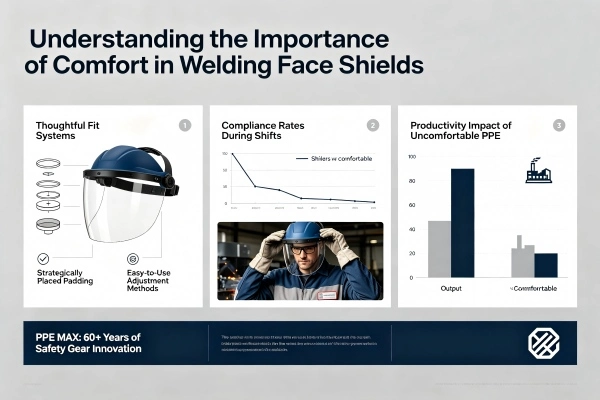
Understanding the Importance of Comfort in Welding Face Shields
Why Comfort Directly Affects Safety Performance
There is a clear link between comfort and following safety rules, and it can be measured. Studies show that compliance rates drop a lot during shifts when welders are uncomfortable because their shields don't fit right. Workers naturally move, tilt, or briefly remove uncomfortable equipment, leaving gaps where UV rays, infrared rays, and moving objects can reach them. Photokeratitis (arc eye) and serious face burns are some of the effects that could have been avoided with the right gear.
The Hidden Costs of Uncomfortable PPE
In addition to the immediate safety risks, welding protection that is awkward causes a chain reaction of operating problems. When workers have to keep adjusting their screens or taking breaks because of pressure headaches and neck pain, they are less productive. When factories keep track of performance data, the difference between PPE that is comfy and uncomfortable can lead to real output losses. Purchasing offices that are in charge of big teams know that the original costs of equipment are small compared to the costs of lower output, higher accident rates, and higher worker loss that are caused by not having the right safety gear.
Comfort as a Competitive Advantage
When companies buy PPE with comfort in mind, they get real benefits in keeping employees and running their businesses well. Skilled welders are judging possible companies more and more by how good their safety gear is. Companies that show they care about their workers' health and safety by providing them with the best protection gear have an advantage in competitive job markets, especially in places where specialised welding skills are highly valued.
In-Depth Analysis of Welding Face Shield Fit and Its Impact
Understanding Fit Variables Across Diverse Workforces
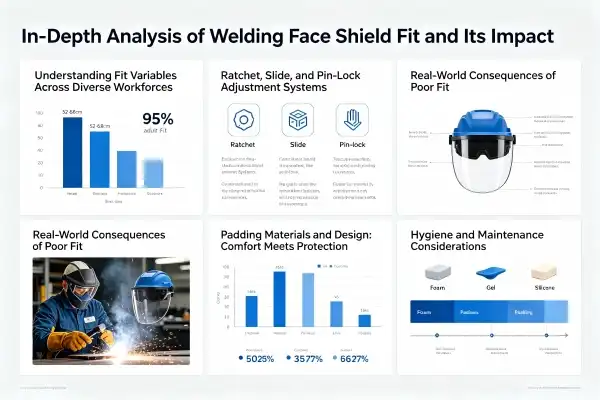
People who work in factories have a wide range of head sizes, face features, and other physical differences. When shields are made with a single fit shape, they always fail for large parts of the workforce. At PPE MAX, our flexible headgear systems can fit head sizes from 52 to 68 centimetres, which means that 95% of adult users will be able to stay in place. This method to inclusive design solves a major buying problem: making sure that everyone gets the same level of safety, no matter what their physical differences are.
Ratchet, Slide, and Pin-Lock Adjustment Systems
There are three main ways to change modern welder shields, and each one has its own benefits. Ratchet systems let users make small changes with clear input, so they can get a perfect fit even when they're wearing gloves. The clicking system makes sure that each change is correct, so there's less room for error. Continuous size along a rail is possible with slide adjustment systems, which let you make small changes to fit small differences. Pin-lock systems offer the safest retention and are perfect for active workplaces where twisting and moving the head are common. Our research team has put these systems through a lot of tests in shipyards, which are tough places to keep equipment in place because of vibrations, tight areas, and odd positions.
Real-World Consequences of Poor Fit
Case studies from pipeline building projects show the real dangers of not fitting right. In one recorded case, a welder's cover slipped while he was welding pipes overhead, letting hot spatter touch his neck. This caused second-degree burns and a fourteen-day leave from work. An investigation showed that the worker's shield's headgear didn't have enough adjusting options for their head size. The direct costs of the event were more than $12,000. This does not include the time it took to complete the job. A proper fit exam and choice of tools would have stopped this accident before it happened.
Padding Materials and Design: Comfort Meets Protection
Comparing Foam, Gel, and Silicone Solutions
The choice of padding for the Welding Face Shield has a big effect on both short-term comfort and long-term usefulness. Traditional foam padding is cheap and provides light support, but it gets smaller over time and soaks up sweat, which raises cleanliness issues. Gel cushion spreads pressure better and keeps its shape longer, but it does add a little weight. Silicone padding is the best choice because it lasts longer, is easier to clean, and is better at keeping out wetness. At PPE MAX, our welder face shields come with high-density foam that has been treated to kill germs. For settings with a lot of use, we offer silicone updates.
It turns out that choosing the right cloth is just as important as where to put the padding. Pressure mapping studies show that padding that isn't placed properly focuses forces on the temporal areas and browline, which can cause headaches after just two hours of continuous wear. Our design team has come up with multi-zone padding that spreads the force across the forehead band and keeps pressure spots to a minimum. The design of the padding has different levels of thickness, with thicker material in the main touch areas and softer padding in sensitive areas.
Hygiene and Maintenance Considerations
When you work long welding shifts, you sweat a lot, especially in hot places like foundries and building sites outside. Padding materials that wick away moisture actively pull sweat away from skin contact points, which stops discomfort and the growth of germs. Antimicrobial treatments that are built into padding materials stop bacteria and fungus that cause bad smells, so they can be used for longer before they need to be replaced. Our care guidelines say that padding parts should be cleaned once a week with light soap solutions and should be replaced every three months in areas that get a lot of use. When comparing providers, procurement teams should add the cost of padding repair to the total cost of ownership.
Adjustment Mechanisms: Enhancing Fit and User Experience
Headgear Customization Features
Modern welding face shields incorporate sophisticated headgear systems that extend far beyond simple size adjustment. Crown strap configurations allow vertical positioning adjustments, ensuring the shield sits at the optimal height relative to the user's eyes. Lateral stabilizers prevent side-to-side movement during head turning, maintaining consistent protection positioning. At PPE MAX, we've integrated textile engineering into our headgear design, using moisture-wicking bands that reduce perspiration accumulation while maintaining grip without excessive tension.
Lens Positioning and Angle Refinement
The ability to adjust lens angle and distance from the face addresses multiple comfort and performance objectives simultaneously. Proper lens positioning maintains the optimal focal distance for clear arc visualization while ensuring adequate ventilation to minimize fogging. Our pivot point systems allow users to tilt the shield backward incrementally, facilitating brief inspections without complete removal. This feature proves particularly valuable during tack welding operations requiring frequent position verification. The lens positioning mechanism in our shields provides five-degree increments across a thirty-degree range, accommodating diverse welding techniques and user preferences.
Integration with Auto-Darkening Technology
Auto-darkening filters revolutionized welding comfort by eliminating the need for repetitive helmet flipping. However, the comfort benefits extend beyond convenience. Our auto-darkening shields feature response times of 1/25,000 second, transitioning from light state (DIN 4) to full shade (DIN 9-13) faster than the human blink reflex. This rapid response prevents eye strain associated with anticipatory squinting that welders unconsciously perform with passive lens shields. The variable shade adjustment allows customization based on welding process, amperage, and personal preference, reducing unnecessary darkness that compromises precision in low-amperage TIG applications.
Choosing the Right Welding Face Shield for Your Workforce: Comfort & Features Checklist
Comprehensive Procurement Evaluation Framework
Selecting welding protection for large workforces requires systematic evaluation across multiple dimensions. We recommend procurement specialists develop assessment criteria that balance immediate comfort features with long-term durability and maintenance requirements. The evaluation should begin with understanding the specific welding processes employed across your operations. FCAW applications in shipbuilding demand different shield characteristics than precision TIG work in aerospace manufacturing. Our product specialists assist buyers in matching shield specifications to operational realities rather than simply comparing specification sheets.
Standards compliance forms the foundation of any procurement decision. Our welding face shields meet ANSI Z87.1-2020, EN 175:1997, CSA Z94.3-2020, and AS/NZS 1338.1:2012 certifications, ensuring regulatory compliance across international jurisdictions. Beyond baseline standards, consider enhanced specifications such as Optical Class ratings. Our premium shields achieve 1/1/1/1 ratings per EN 379 standards, delivering zero optical distortion, uniform shading, and angular dependence that support precise weld bead placement.
Compatibility with Respiratory and Head Protection
Modern industrial safety programs increasingly require integrated PPE systems where welding shields must coexist with respirators, hard hats, and hearing protection. This compatibility extends beyond physical clearance to include functional integration. Our welding face shields feature recessed lower profiles that accommodate half-mask and full-face respirators without creating gaps or pressure points. The headgear design allows installation over standard hard hats using universal mounting adapters, maintaining the hard hat's impact protection integrity. Procurement teams should conduct field trials with representative workers wearing their complete PPE ensemble to identify interference issues before committing to large orders.
Supplier Reliability and After-Sales Support
Equipment quality matters little if replacement parts become unavailable or warranty claims face bureaucratic obstacles. At PPE MAX, our sixty-eight years of continuous operation demonstrate the institutional stability that supports long-term supply relationships. We maintain inventory depth across our product line, ensuring replacement lenses, padding sets, and headgear components ship within forty-eight hours globally. Our technical support team provides application-specific guidance, helping safety managers optimize shield selection for specialized environments like confined space welding or extreme temperature operations in refineries.
Conclusion
Welding face shield comfort encompasses far more than subjective preference—it represents a critical factor in safety compliance, operational efficiency, and workforce satisfaction. Proper fit prevents dangerous exposure gaps while reducing fatigue-related errors. Quality padding materials and strategic placement eliminate pressure points that drive non-compliance. Sophisticated adjustment mechanisms enable personalized customization that accommodates diverse anatomical variations and welding techniques. Procurement professionals who prioritize these comfort features invest in equipment that protects workers effectively throughout entire shifts, not just during initial donning. The result is measurable improvements in safety outcomes, productivity metrics, and employee retention.
FAQ
How often should welding face shield padding be replaced?
Padding replacement frequency depends on usage intensity and environmental conditions. In standard manufacturing environments with eight-hour daily shifts, we recommend quarterly inspection and semi-annual replacement. High-temperature applications or extreme-sweat environments may require quarterly replacement. Visual indicators include compressed padding that no longer rebounds, visible discoloration, or persistent odors despite cleaning. Maintaining a replacement schedule prevents gradual comfort degradation that users might not consciously notice, but that subconsciously affects compliance behaviors.
Can welding face shields accommodate prescription eyewear?
Quality welding shields provide sufficient interior clearance for most prescription safety glasses. Our shields maintain a minimum 40-millimeter distance from the lens to the forehead, accommodating standard eyewear frames. Users with particularly large frames should verify clearance before bulk ordering. Some welders prefer prescription inserts that mount directly to the shield interior, eliminating potential interference. We offer prescription insert compatibility across our product line for buyers supporting workforces with vision correction needs.
What causes auto-darkening filters to malfunction?
ADF failures typically stem from sensor obstruction, battery depletion, or damage to the liquid crystal cells. Spatter accumulation on the lens exterior can block arc sensors, preventing darkening activation. Our shields feature replaceable outer cover lenses that protect the expensive ADF cartridge, reducing this risk. Battery-powered units require periodic replacement, though our solar-assisted models extend battery life significantly. Extreme cold below minus ten degrees Celsius can slow response times; battery-assist features compensate in these conditions.
Partner with PPE MAX: Your Trusted Welding Face Shield Manufacturer
PPE MAX brings over six decades of protective equipment manufacturing expertise to every welding face shield we produce. Our Xi'an facility combines advanced materials engineering with rigorous quality control, delivering shields that meet the demanding requirements of automotive manufacturing, shipbuilding, pipeline construction, and metal fabrication industries worldwide. We understand that procurement decisions for large workforces require more than product specifications—they demand reliable supply chains, consistent batch quality, and responsive technical support. Our team welcomes the opportunity to discuss your specific welding protection requirements and provide customized solutions that address your operational challenges. Contact our B2B specialists at bettybing@ppemax.com to explore how PPE MAX welding face shields can enhance your workforce safety program with superior comfort, proven durability, and comprehensive support.
References
1. American Welding Society. (2021). Safety and Health Fact Sheets: Personal Protective Equipment for Welding. Miami: AWS Publications.
2. Occupational Safety and Health Administration. (2020). Eye and Face Protection eTool: Welding Hazards and Controls. Washington: U.S. Department of Labor.
3. European Committee for Standardization. (2018). Personal Eye Protection Standards for Welding and Related Techniques. Brussels: CEN Technical Publications.
4. Canadian Standards Association. (2019). Eye and Face Protectors: Design, Performance, and Selection Guidelines. Toronto: CSA Group Standards.
5. International Institute of Welding. (2020). Ergonomics in Welding: Reducing Physical Strain Through Equipment Design. Paris: IIW Technical Commission.
6. National Institute for Occupational Safety and Health. (2019). Preventing Eye Injuries in Welding Operations: Engineering and Administrative Controls. Cincinnati: NIOSH Publications Dissemination.
Learn about our latest products and discounts through SMS or email