- English
- French
- German
- Portuguese
- Spanish
- Russian
- Japanese
- Korean
- Arabic
- Greek
- German
- Turkish
- Italian
- Danish
- Romanian
- Indonesian
- Czech
- Afrikaans
- Swedish
- Polish
- Basque
- Catalan
- Esperanto
- Hindi
- Lao
- Albanian
- Amharic
- Armenian
- Azerbaijani
- Belarusian
- Bengali
- Bosnian
- Bulgarian
- Cebuano
- Chichewa
- Corsican
- Croatian
- Dutch
- Estonian
- Filipino
- Finnish
- Frisian
- Galician
- Georgian
- Gujarati
- Haitian
- Hausa
- Hawaiian
- Hebrew
- Hmong
- Hungarian
- Icelandic
- Igbo
- Javanese
- Kannada
- Kazakh
- Khmer
- Kurdish
- Kyrgyz
- Latin
- Latvian
- Lithuanian
- Luxembou..
- Macedonian
- Malagasy
- Malay
- Malayalam
- Maltese
- Maori
- Marathi
- Mongolian
- Burmese
- Nepali
- Norwegian
- Pashto
- Persian
- Punjabi
- Serbian
- Sesotho
- Sinhala
- Slovak
- Slovenian
- Somali
- Samoan
- Scots Gaelic
- Shona
- Sindhi
- Sundanese
- Swahili
- Tajik
- Tamil
- Telugu
- Thai
- Ukrainian
- Urdu
- Uzbek
- Vietnamese
- Welsh
- Xhosa
- Yiddish
- Yoruba
- Zulu
Can Insulating Gloves Reduce Workplace Electrical Accidents?
Of course. Insulating gloves are very important because they keep workers from touching live electrical systems and stop dangerous currents from going through the body. When chosen, kept, and used correctly according to voltage levels and safety standards, these special rubber gloves greatly lower the risk of electrical shocks, burns, and deaths. Industrial safety organisations constantly show that workplaces that follow approved electrical glove practices have measurably fewer major electrical accidents. This means that these insulating gloves must be a part of all electrical safety programs.
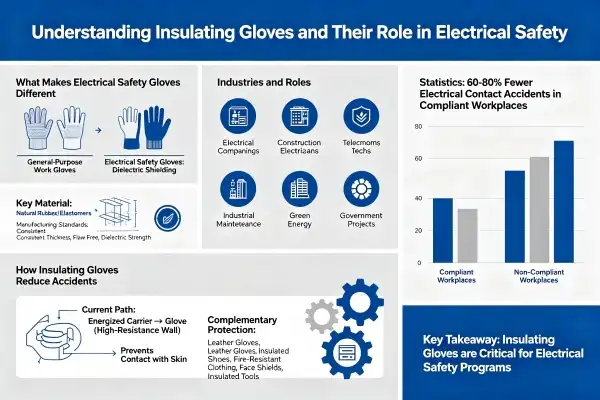
Understanding Insulating Gloves and Their Role in Electrical Safety
What Makes Electrical Safety Gloves Different
Personal protective equipment (PPE) that is specifically designed to protect against electrical dangers includes electrical safety gloves. In contrast to general-purpose work gloves made to resist scratches or cuts, these items offer dielectric shielding, which is what stops electrical current from going through the material and touching the wearer's skin.
The main part is made up of natural rubber latex or manufactured elastomers that are made to not break down under high voltage stress. During the manufacturing process, these materials are closely inspected to make sure they are of consistent thickness, free of flaws, and have the same dielectric strength all over the surface of the glove. International standards set specific voltage values for each product. These numbers show the highest safe working voltage and the matching proof test voltage.
Industries and Roles That Depend on This Protection
The biggest group of users is electrical companies, where workers regularly work on powered transmission and distribution networks using insulating gloves. Every day, construction electricians install business building systems, telecoms techs work with powered equipment, and industrial maintenance teams take care of control screens that are turned on. These safety steps are also needed to keep workers safe in places that use high-voltage machines for manufacturing, install green energy, and work on government building projects with insulating gloves.
It's very important to know the difference between regular rubber gloves and approved electrical safety gloves. For electrical work, regular rubber gloves don't have the right material specs, testing procedures, or voltage rates. Using options that aren't approved puts workers in danger of dying, which is a basic mistake that procurement teams need to clear up through education and strict specification.
How Insulating Gloves Reduce Workplace Electrical Accidents
The Mechanism of Electrical Accident Prevention
When current finds a way through the body, usually from an energised carrier to ground, it can cause electrical damage. How bad it is depends on the voltage, the current, the path it takes through important organs, and how long it stays in touch. When electrical gloves are properly rated, they literally block this path by creating a high-resistance wall that keeps the current in the wire and stops it from going through the worker.
The success depends on keeping the insulating stability of the glove. Even tiny holes, cuts, or wear and tear on the material can create failure points through which current can flow. This fact makes it clear why eye review, regular testing, and proper keeping are essential parts of any electrical safety program.
Complementary Protection Systems
Using multiple layers of safety is the best way to use electrical gloves. When leather protective gloves are worn over the rubber insulation layer, they protect the dielectric material from mechanical damage like punctures, cuts, and scrapes that could happen from sharp edges. Insulated shoes, clothing that won't catch fire, face shields, and insulated tools all work together to make complete protection zones that cover many possible routes of exposure at once.
Statistics from utility companies and factories that have strict electrical personal protective equipment (PPE) programs show that incidents have gone down a lot. 60–80% fewer electrical contact accidents happen at places that require employees to wear approved gloves, test regularly, and include actual training in their safety procedures compared to places that don't always follow the rules. These results directly lead to lower costs for workers' compensation, fewer accidents that cause lost time, and better measures of safety culture.
Selecting the Right Insulating Gloves for Your Workforce
Understanding Voltage Classification Systems
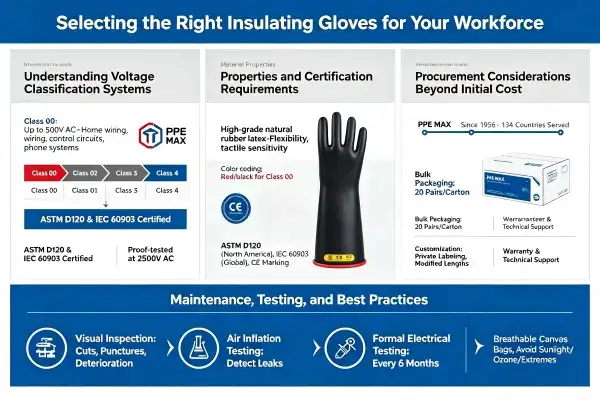
There are four classes of voltage ratings, from Class 00 to Class 4. Each class has its own highest use voltage and proof test standards. Class 00 goods, which can handle up to 500V AC, are used for low-voltage tasks like wiring homes, maintaining control circuits, and setting up phone systems. Our Class 00 products at PPE MAX meet both ASTM D120 and IEC 60903 standards. They are proof-tested at 2500V AC to make sure they provide safe security.
These insulating gloves come in two lengths, 11 inches and 14 inches, so you can get the right amount of covering for your arms based on how close you are working to moving parts. The 11-inch length is good for use in tight spaces where extra material makes it hard to move around. The 14-inch lengths, on the other hand, protect your forearms more when you reach into electrical boxes. With sizes from 8 to 11, the right fit gives you the freedom to move and the security of knowing you're covered without any extra fabric that could get caught on gear.
Material Properties and Certification Requirements
High-grade natural rubber latex delivers superior flexibility and tactile sensitivity, allowing workers to manipulate small components, operate test meters, and handle wiring with precision. The material resists ozone degradation and maintains performance across temperature ranges typical of North American work environments. Color coding—red or black in our Class 00 line—provides immediate visual identification of voltage class, preventing dangerous misapplication of lower-rated gloves on higher-voltage systems.
Certification standards govern every aspect of design and performance. ASTM D120 establishes requirements for North American markets, while IEC 60903 provides the international framework adopted across European, Asian, and other global markets. CE marking indicates European conformity, essential for procurement teams sourcing equipment for multinational operations or export markets. Our manufacturing facility maintains these certifications through continuous quality verification, with each production batch undergoing electrical testing before shipment.
Procurement Considerations Beyond Initial Cost
Supplier reliability directly impacts long-term program success. Since 1956, PPE MAX has served utilities, industrial facilities, and government agencies across 134 countries, building relationships founded on consistent quality and responsive technical support. Bulk packaging—20 pairs per carton with dimensions optimized for warehouse storage—reduces per-unit costs for large procurement orders while simplifying inventory management.
Customization capabilities address specific operational needs, from private labeling for distributor partners to modified lengths for specialized applications. Our OEM manufacturing expertise allows partners to develop proprietary product lines backed by our quality systems and certifications. Warranty provisions, replacement policies, and technical consultation services differentiate commodity suppliers from true manufacturing partners invested in customer success.
Maintenance, Testing, and Best Practices to Maximize Safety
Inspection Protocols That Catch Problems Early
Visual inspection before each use represents the simplest yet most critical safety practice. Workers examine the entire glove surface for cuts, punctures, embedded foreign objects, or obvious signs of deterioration such as cracking or discoloration. Stretching the material reveals small defects that might escape casual observation. Any glove showing visible damage must be immediately removed from service and destroyed to prevent inadvertent reuse.
Air inflation testing provides field-level verification between formal electrical tests. The worker inflates the glove by rolling it from the cuff, trapping air inside, then applies gentle pressure while listening and feeling for air leaks. This simple procedure detects many punctures and tears that compromise protection, adding a crucial verification layer to visual inspection alone.
Formal Electrical Testing Requirements
Regulatory standards mandate periodic electrical testing at intervals no longer than six months for gloves in active service. Testing laboratories subject each glove to proof test voltage levels far exceeding the maximum use rating, verifying that dielectric strength remains within acceptable parameters. Water voltage testing—where the glove is filled with water and subjected to high voltage—reveals any breakdown points with precision.
Proper storage extends service life significantly. Gloves should rest in breathable canvas bags away from direct sunlight, ozone sources such as electric motors, petroleum products, and temperature extremes. Folding creates stress points that accelerate cracking, so gloves should be stored in natural curved positions that avoid sharp bends. Clean gloves using mild soap and water, avoiding solvents or petroleum-based cleaners that attack rubber compounds.
Integration With Comprehensive Safety Programs
Training programs must move beyond simple equipment distribution to build genuine competency. Demonstrations showing correct donning procedures, practice sessions with leather protector placement, and hands-on exercises manipulating tools while wearing gloves develop the muscle memory needed for consistent field use. Refresher training addresses complacency that develops over time, reinforcing why shortcuts create unacceptable risks.
Documentation systems track each glove through its service life—from initial receipt and testing through retest intervals to eventual retirement. Barcode or serial number tracking simplifies compliance verification during safety audits while identifying usage patterns that inform future procurement decisions. Digital management platforms now streamline these record-keeping requirements, automatically flagging gloves approaching retest due dates.
Addressing Common Misconceptions and Challenges
The Dangerous Myth of "Rubber Is Rubber"
A persistent misconception treats any rubber glove as suitable for electrical work. This fundamental misunderstanding places workers at lethal risk. Only gloves manufactured specifically for electrical protection, tested to recognized standards, and properly classified by voltage rating provide reliable safeguarding. General-purpose rubber gloves, chemical-resistant gloves, and examination gloves completely lack the material specifications and dielectric properties necessary for electrical applications.
The confusion sometimes stems from cost pressures that encourage procurement shortcuts. When budget constraints dominate decision-making, some organizations gravitate toward lower-priced alternatives without verifying certifications or understanding voltage ratings for insulating gloves. This represents a false economy—the cost differential between certified and non-certified insulating glove products pales in comparison to the financial and human consequences of a single electrical injury.
Balancing Durability With Protection Requirements
Concerns about how long gloves will last and how often they need to be replaced are valid practical concerns. Natural rubber has great electrical qualities, but it wears down over time from being used a lot, being bent, and being exposed to the environment. Organisations with strong inspection and testing programs get the most out of their replacement schedules by getting rid of gloves based on their real state instead of making up random schedules that either throw away usable equipment too soon or keep broken units for too long.
Leather covers make insulated gloves last a lot longer by keeping the rubber from getting damaged by everyday use. The small extra cost pays off in a big way by cutting down on replacements and boosting worker trust. People often say that rubber gloves feel slippery when doing certain tasks, but protectors make it easier to hold on to tools and materials.
Choosing Manufacturing Partners With Proven Track Records
Choosing a brand affects not only the quality of the product but also the system that supports it. Established makers have decades of experience with a wide range of applications, which helps customers make choices about power ratings, sizes, and accessories. PPE MAX has been around since 1956, and since then, we have been improving our manufacturing processes, material formulas, and quality systems.
Having access to technical help is very important when questions come up during the development of specifications or when problems in the field need to be quickly looked over by an expert. Our team is made up of engineers who know about electricity safety standards in many countries, regulatory experts who keep up with changing compliance requirements, and application experts who have worked directly with utilities and businesses. This knowledge base, which you can access by emailing bettybing@ppemax.com, turns a supply connection into a real partnership that improves customer safety.
Conclusion
There is a lot of clear proof that electrical safety gloves are an important way to keep accidents from happening. Electrical accidents go down a lot when companies make sure they only buy approved goods that meet international standards, when they have strict inspection and testing processes in place, and when workers get a lot of training on how to use equipment correctly. The money that needs to be spent on good tools, repair methods, and ongoing training is a small part of the money and lives that are lost in avoidable electricity accidents. Class 00 products, like those made at PPE MAX, are used in basic low-voltage tasks that make up most of electrical work exposure. This is why making smart choices about which products to use can have a big effect on total workplace safety performance.
FAQ
1. What voltage level requires certified electrical protective gloves?
Any work on energized electrical systems operating above 50 volts requires appropriate voltage-rated protective gloves according to OSHA regulations and industry consensus standards. Class 00 gloves protect workers up to 500V AC, covering residential electrical systems, many industrial control circuits, and low-voltage distribution applications. Higher voltage environments demand correspondingly higher-rated glove classes.
2. How do I determine the correct glove size for my team?
Proper sizing balances secure fit with adequate circulation and comfort during extended wear. Measure hand circumference at the widest point across the palm, excluding the thumb. Compare measurements to manufacturer sizing charts, which typically range from size 8 through size 11 in half-size increments. Gloves should fit snugly without constriction, allowing full finger flexion while preventing excess material that reduces dexterity.
3. Can electrical gloves be repaired if damaged?
Absolutely not. Any glove showing cuts, punctures, tears, embedded foreign objects, or evidence of electrical tracking must be immediately destroyed and replaced. Repair attempts cannot restore dielectric integrity or reliability. The modest cost of replacement gloves is insignificant compared to injury risks from using compromised equipment.
4. What training should accompany glove distribution?
Effective training covers hazard recognition, voltage rating selection, proper donning with leather protectors, pre-use inspection techniques, work practices that minimize mechanical damage, and correct storage procedures. Hands-on practice wearing gloves while performing typical tasks builds the comfort level necessary for consistent compliance. Annual refresher sessions address complacency and reinforce critical safety messages.
Partner With a Trusted Insulating Gloves Manufacturer
Procurement managers and safety directors seeking reliable electrical protective equipment will find a committed ally in PPE MAX. Our Class 00 insulating gloves, certified to ASTM D120 and IEC 60903 standards, provide proven protection for low-voltage applications across industrial, utility, and construction environments. We manufacture these insulating glove products with the same attention to quality and worker protection that has defined our company since 1956. Bulk order pricing, customization capabilities for private label partners, and technical support from experienced safety professionals ensure your PPE program delivers maximum protection and compliance value. Contact our team at marketing@ppemax.com to discuss your specific voltage rating requirements, request product samples, or explore OEM manufacturing partnerships. We serve as your insulating gloves supplier across 134 countries, bringing northwest China's largest PPE manufacturing capacity to your workforce protection needs.
References
1. Bureau of Labor Statistics. (2022). Census of Fatal Occupational Injuries Summary. U.S. Department of Labor.
2. National Fire Protection Association. (2021). NFPA 70E: Standard for Electrical Safety in the Workplace. NFPA Publications.
3. American Society for Testing and Materials. (2020). ASTM D120-20: Standard Specification for Rubber Insulating Gloves. ASTM International.
4. International Electrotechnical Commission. (2019). IEC 60903: Live Working - Gloves of Insulating Material. IEC Publications.
5. Occupational Safety and Health Administration. (2021). 1910.137: Electrical Protective Equipment Standards. U.S. Department of Labor.
6. Institute of Electrical and Electronics Engineers. (2018). IEEE Guide for Maintenance Methods on Energized Power Lines. IEEE Standards Association.
Learn about our latest products and discounts through SMS or email