- English
- French
- German
- Portuguese
- Spanish
- Russian
- Japanese
- Korean
- Arabic
- Greek
- German
- Turkish
- Italian
- Danish
- Romanian
- Indonesian
- Czech
- Afrikaans
- Swedish
- Polish
- Basque
- Catalan
- Esperanto
- Hindi
- Lao
- Albanian
- Amharic
- Armenian
- Azerbaijani
- Belarusian
- Bengali
- Bosnian
- Bulgarian
- Cebuano
- Chichewa
- Corsican
- Croatian
- Dutch
- Estonian
- Filipino
- Finnish
- Frisian
- Galician
- Georgian
- Gujarati
- Haitian
- Hausa
- Hawaiian
- Hebrew
- Hmong
- Hungarian
- Icelandic
- Igbo
- Javanese
- Kannada
- Kazakh
- Khmer
- Kurdish
- Kyrgyz
- Latin
- Latvian
- Lithuanian
- Luxembou..
- Macedonian
- Malagasy
- Malay
- Malayalam
- Maltese
- Maori
- Marathi
- Mongolian
- Burmese
- Nepali
- Norwegian
- Pashto
- Persian
- Punjabi
- Serbian
- Sesotho
- Sinhala
- Slovak
- Slovenian
- Somali
- Samoan
- Scots Gaelic
- Shona
- Sindhi
- Sundanese
- Swahili
- Tajik
- Tamil
- Telugu
- Thai
- Ukrainian
- Urdu
- Uzbek
- Vietnamese
- Welsh
- Xhosa
- Yiddish
- Yoruba
- Zulu
What Makes a Resists Corrosion Chemical Protective Mask OSHA Compliant?
Founded in 1956, PPEMAX stands as a premier global manufacturer and supplier of full-range personal protective equipment. All our products comply with internationally recognized standards including IEC, ASTM, CE, UKCA, NIOSH and ISO9001. Equipped with a 2,000-square-meter modern production plant, we boast over 25 years of mature OEM & ODM capabilities to deliver one-stop customized solutions covering R&D design through worldwide logistics. Our safety gear is distributed across 134 countries globally. Upholding our core tenet “Safety First, Quality Priority”, we serve as a dependable long-term PPE partner for industrial enterprises around the world.
When a Resists Corrosion Chemical Protective Mask meets the strict requirements set out in 29 CFR 1910.134, the Respiratory Protection Standard, it is OSHA-compliant. Compliance depends on having NIOSH certification, the right filter efficiency rates, written fit testing methods, and following the upkeep rules. These respirators need to fit snugly over the eyes, nose, and mouth, protecting the wearer from the dangers in the workplace. They also need to have the right Assigned Protection Factor. Compliance isn't just about buying certified gear; it covers the whole lifecycle, from choosing the gear and making sure it fits right to regular maintenance and training for workers. This makes sure that respiratory protection programs protect workers from airborne contaminants while also meeting federal regulations.
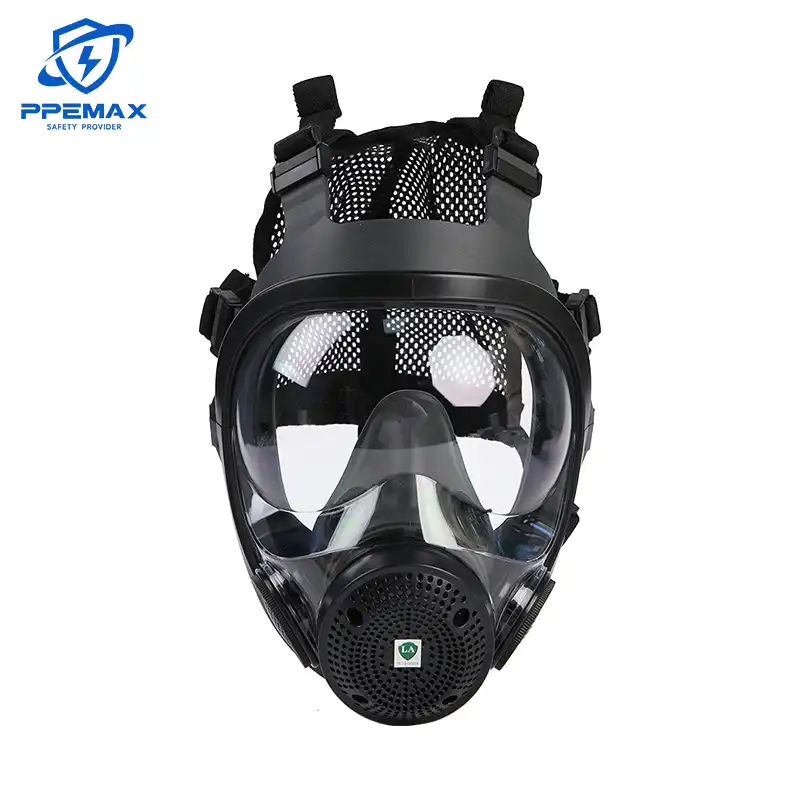
Understanding OSHA Compliance for Full Face Respirators
When your employees are exposed to dangerous airborne contaminants, knowing what legally required breathing protection equipment isn't just a matter of checking a box; it's the difference between a safe workplace and health problems that could be very bad. The rules for respiratory safety have changed over the years based on decades of work experience, data on injuries at work, and science study into respiratory hazards.
The Foundation: 29 CFR 1910.134 Standards
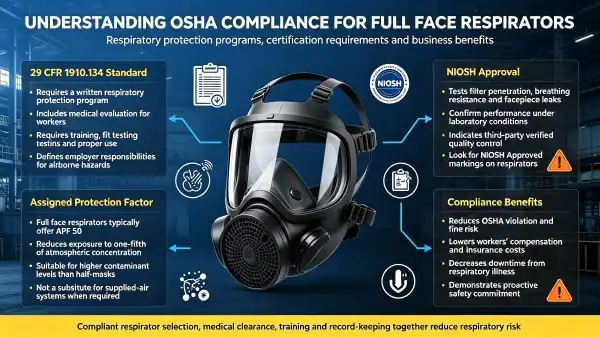
The Respiratory Protection Standard from OSHA tells companies what they need to do when workers need to be protected from dangerous airborne chemicals. This rule says that companies must have a written lung protection program, do medical exams on workers to make sure they are healthy enough to wear respirators, and give them the right training. The standard talks about Resists Corrosion Chemical Protective Masks in particular. These usually have an Assigned Protection Factor of 50, which means that when they are worn correctly and kept up, they lower exposure levels to a fifth of the atmospheric concentration. With this APF grade, these devices can be used in places where the amount of contaminants is higher than what half-masks can handle, but don't need supplied-air systems yet.
Certification Bodies: NIOSH's Very Important Part
Occupational safety and health equipment in the United States is mostly certified by the National Institute for Occupational Safety and Health. The NIOSH testing procedures check respirators for strict performance criteria, such as filter penetration, breathing resistance, and facepiece leaks. When you see "NIOSH Approved" on a Resists Corrosion Chemical Protective Mask, it means that it has been through a lot of lab tests and quality control checks. In addition to NIOSH standards, compliance may also need to meet ANSI standards, which cover specific performance aspects like how resistant face shields and glasses are to impact. At PPE MAX, we make sure that every respirator that leaves our Xi'an facility meets the high standards that safety directors and procurement managers expect. This is because our production processes are in line with these approval requirements.
Legal and Business Advantages of Compliance
Using breathing protection that meets OSHA standards has real benefits that go beyond following the rules. Companies that don't follow OSHA rules can be fined a lot. Fines for major violations can reach $15,625 per violation, and fines for wilful or repeated violations can reach $156,259. In addition to keeping companies out of trouble, programs that follow the rules cut down on workers' compensation claims, insurance costs, and lost work time due to lung illnesses. When mining operations, building companies, or chemical makers include approved respiratory protection in their safety plans, they show that they care about their workers and the organization's bottom line.
Core Features That Define OSHA-Compliant Full Face Respirators
Decades of study into respiratory physiology, filter technology, and human factors engineering have gone into the technical details that set compatible respiratory protection apart from less effective options. When procurement teams know about these features, they can make choices that protect workers and make the best use of safety funds.
Filter Classification and Hazard Matching
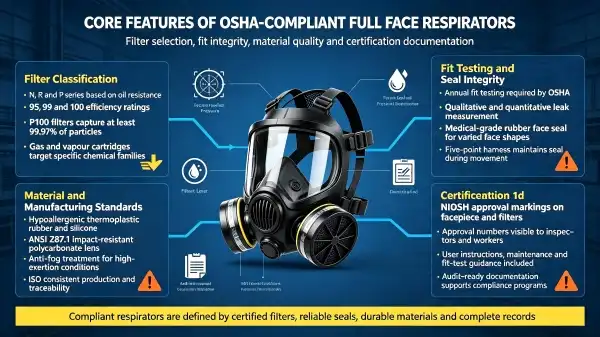
NIOSH divides air-purifying filters into nine groups based on how well they filter air and how resistant they are to degradation. N means it's not resistant to oil, R means it is resistant to oil, and P means it is oilproof. Filters are given a score of 95, 99, or 100 in each area, which means they catch at least 95%, 99%, or 99.97% of particles, respectively. P100 filters are the best at removing small particles from the air. They can catch almost all of them, like asbestos fibres, silica dust, and lead particles. Gas and vapour capsules deal with completely different dangers. They have activated carbon or other sorbents that are made for specific chemical families. At PPE MAX, we make Resists Corrosion Chemical Protective Masks with bayonet connection systems that work with all NIOSH-approved filters and refills. This way, safety managers can tailor protection to specific workplace risks instead of having to settle for solutions that work for everyone.
Fit Testing Requirements and Seal Integrity
If the respirator doesn't close properly against the wearer's face, not even the best screen will protect them. All tight-fitting respirators must be fit tested by OSHA at least once a year and again whenever the wearer's body might change in a way that could affect the seal. For qualitative fit testing, challenge agents like saccharin or bitter solutions are used to find leaks. For quantitative testing, instruments are used to measure the real rates of leaking. Our Resists Corrosion Chemical Protective Masks have medical-grade rubber face seals that can fit a wide range of face shapes. This makes it much more likely that everyone in your workforce will pass the fit test. The five-point changeable harness system spreads pressure out evenly, keeping the seal intact even when the head moves and there are long periods of wear that are typical in industrial settings.
Material Quality and Standards for Manufacturing
Durability, chemical resistance, and user comfort during long shifts are all directly affected by the material of the facepiece. The bodies of our respirators are made from hypoallergenic thermoplastic rubber and silicone materials that don't break down when exposed to cleaning chemicals, UV light, or changes in temperature. The wide-view polycarbonate lens meets ANSI Z87.1 standards for impact protection and has anti-fog treatments that keep you visible in wet situations or while doing hard physical work. These materials take a lot of engineering work, but they provide the dependability that mines, drug companies, and contractors who work with hazardous trash need when workers' lives depend on how well the equipment works. Our factory's production methods are regularly checked to make sure they are in line with the ISO quality management system. This makes sure that the same quality is used in all runs of production and that the products can be tracked all the way through the supply chain.
Certification Marking and Documentation
Genuine NIOSH-approved respirators have approval numbers printed right on the facepiece, and the filter cartridges have labels that show the classification and limits. This clear approval lets safety testers, workers, and management check right away that the rules are being followed. The technical documentation package that comes with each unit is just as important. It has approval certificates, user directions, maintenance procedures, and rules for fit testing. When you work with well-known manufacturers instead of unofficial providers, you get detailed paperwork that meets audit standards and helps you run your respiratory protection program. Because we've been making things for more than 65 years, we know how much paperwork safety pros have to deal with, which is why we include full licensing packages with every order.
If you’re evaluating personal protective equipment suppliers and require batch-specific testing documents before placing an order, PPE MAX is able to provide official Certificates of Analysis, professional laboratory test reports, and product samples for your verification. Feel free to contact our team at marketing@ppemax.comto discuss your sourcing needs and obtain complete documentation for your quality assessment and procurement approval.
Comparing Full Face Respirators Against Alternative Respiratory Solutions
To choose the right breathing protection, you need to know how the different types of devices work, what the consequences are for not following the rules, and how much they cost. The decision matrix includes more than just the original buy price. It also includes the amount of protection, the cost of operations, and the difficulty of running the program.
Protection Levels and Application Scenarios
Half-mask respirators have an APF of 10, so they can be used in places where the quantity of contaminants is low, and eye protection is not needed. These tools are good for jobs that involve annoying dust or light liquid contact. Disposable filtered facepiece respirators, like N95 masks, offer even less protection and don't cover the eyes, so they can only be used in certain low-risk situations. The APF of powered air-purifying respirators is higher—up to 1,000 for full-face powered units—because they use battery-powered fans to push air through filters, causing positive pressure that stops air from leaking inward. Supplied-air respirators offer the best level of protection because they provide breathing air from a clean source, which is necessary in environments that are directly dangerous to life or health. Resists Corrosion Chemical Protective Masks are a good compromise because they offer better protection than half-masks without the complexity, weight, or cost of driven or supplied-air systems.
Cost-Benefit Analysis for Bulk Procurement
The prices of the initial purchase don't tell the whole story when it comes to money. When you think about how often a big workforce needs to change their respirators over months or years, disposable respirators don't seem like a good deal. A construction company that gives disposable masks to 200 workers every day might spend $50,000 a year on them. Reusable Resists Corrosion Chemical Protective Masks with replaceable filters, on the other hand, cost about $8,000 to buy and maybe $12,000 a year to replace the cartridges, which is a 40% savings even before considering the better protection they provide. Reusable respirators don't cost much to maintain as long as they are cleaned properly. This is especially true when compared to powered units that need new batteries and regular upkeep on the fan. Our respirators have parts that can be replaced, like valves, head straps, and lens systems. With proper care, these parts can last longer than ten years. This longevity is especially helpful in places like mines, petrochemical plants, and factories where equipment has to work in difficult conditions and long-term value is needed to save money.
Sustainability Considerations in Respiratory Protection
Environmental duty is becoming more and more important to businesses when they buy things, and respiratory safety offers a lot of options for sustainability. Millions of disposable respirators end up in dumps every year, creating huge amounts of trash. This is a huge problem for the environment, but reusable Resists Corrosion Chemical Protective Masks can help. Over the course of their useful life, each unit could replace thousands of disposables. Because the filter system is changeable, only the dirty media needs to be thrown away, not the whole facepiece assembly. Many big businesses, government agencies, and publicly traded companies have made sustainability promises that are in line with these environmental benefits. This means that safety programs can help organisations reach their larger environmental goals.
Maintenance, Fit Testing, and User Training: Sustaining Compliance
Buying tools that meet OSHA standards is only the beginning. For lung protection programs to work, they need to pay constant attention to maintenance plans, fit testing schedules, and thorough user training. Many organisations have trouble with these areas, even though they are important for safety and following the rules.
OSHA-Mandated Maintenance Protocols
According to the Respiratory Protection Standard, respirators need to be cleaned, sanitised, and checked over and over again. In detailed cleaning processes, parts are taken apart, washed in warm cleaning solution, rinsed well, dried in the air, and then put back together with any broken parts replaced. We include maintenance support materials with our Resists Corrosion Chemical Protective Masks, such as step-by-step cleaning directions and inspection checklists that cover common failure spots like lens scratching, strap elasticity loss, and valve wear. Setting up a central repair station with trained staff is often more efficient than letting each worker take care of their own equipment, especially in big manufacturing sites. Here, having spare parts on hand is very important—respirators are only as effective as your ability to get parts when you need them. Our global supply chain works with 134 countries to make sure that repair parts get to your site quickly, no matter if you're in Texas, Australia, or Poland.
Implementing Effective Fit Testing Programs
Annual fit testing can be hard to manage for companies with a lot of employees or a lot of change. Quantitative fit testing with specialised tools like PortaCount devices gives accurate numerical results, but it costs a lot of money and needs workers who have been trained. Qualitative testing is faster and costs less, but it relies on people's opinions and can only be used with certain types of respirators. Many businesses start with quantitative testing when choosing respirators and then switch to qualitative testing when the contracts are renewed every year. Keeping records of fit tests meets OSHA's paperwork standards and shows that the program works during audits. Our Resists Corrosion Chemical Protective Masks have a silicone sealed surface and a five-point strap adjustment that can be used to fit a wide range of face shapes. This makes it easier for people to pass fit tests and eliminates the need to keep extra mask sizes or different models on hand for workers who have trouble getting the right fit.
Comprehensive Worker Training Requirements
OSHA requires training that covers why breathing protection is important, what equipment is allowed and not allowed, the right way to put on and take off gear, how to check for fit, and maintenance duties. Effective training goes beyond the bare minimum required by law to address problems that workers actually face, like how to communicate while wearing a mask, how to deal with heat stress during long periods of wear, and how to spot the signs that a cartridge is running low. We help our end users and marketing partners by giving them access to training materials like instructional videos, printed quick-reference guides, and technical support experts who can answer questions about specific applications. When people who work in pharmaceutical manufacturing, emergency response teams, or industrial maintenance receive thorough training and quick technical support, compliance doesn't stay an official requirement that workers try to avoid or fight; it becomes part of the culture of the workplace.
Procurement Considerations for OSHA-Compliant Full Face Respirators
To choose sellers and goods, you need to carefully look at certifications, the supplier's skills, and the overall cost of ownership. How you buy things affects whether your respiratory protection program works or turns into a constant source of stress and possible risk.
Checking the credentials and certifications of suppliers
There are both well-known companies with decades of experience in the lung protection market and younger companies that offer lower prices but don't know how good their products are. First, the NIOSH approval numbers must be checked against the official NIOSH Certified Equipment List. This is a public database that has all the recently approved respirators and parts. Asking for full certification paperwork, like NIOSH approval letters, test results, and manufacturing quality certifications, can help you tell the difference between real goods and fakes or copies that don't follow the rules. Supplier site certifications, like ISO 9001 quality management systems, show that a company is dedicated to producing goods that meet regular standards. Since 1956, PPE MAX has had strict quality control over all of its manufacturing processes. We also have regular third-party checks to make sure we're following international safety standards. When you buy from well-known companies with clear approval paperwork, you lower the chance that non-compliant Resists Corrosion Chemical Protective Masks will get into your workplace.
Evaluating Total Cost for Large-Scale Deployment
When negotiating bulk prices, more than just unit cost should be taken into account. When equipment breaks down, and workers aren't safe, and processes have to stop, warranty terms are very important. After-sales support, such as technical hotlines, training help, and advice on upkeep, is something that low-cost providers rarely offer. When you're outfitting a lot of people or handling just-in-time inventory systems, delivery dependability is very important. For example, in controlled industries, delays in respirator supply can shut down whole work areas. Payment terms, bulk discounts, and written promises to keep prices stable all help with budgeting for purchases that last more than one year. Because we've worked with businesses in 134 countries, we know what it takes to handle government contracts, multi-site industrial operations, and foreign logistics coordination. All of these things affect whether your respiratory protection program works well or turns into a constant management load.
Sourcing OEM Components and Replacement Parts
Once the first stocks run out, a respirator that doesn't have new filters or spare parts on hand is useless. Supply chain problems can be avoided in the future by making sure parts are available before agreeing to a specific respirator type. Some businesses only use parts from big brands like 3M, Honeywell, or MSA because new parts are easy to find through a variety of outlets. Others work with companies like PPE MAX that make a wide range of products that can be customised. This lets them meet all of their customers' breathing protection needs from one place. Our Resists Corrosion Chemical Protective Masks come with a bayonet filter link standard that can take cartridges from several different sources. This gives the supply chain freedom while still meeting NIOSH standards. Ask specifically about parts inventory, wait times for reorders, and minimum order amounts when considering suppliers. These are details that have a big effect on business consistency but aren't always given enough attention during the initial buying process.
Conclusion
OSHA compliance for Resists Corrosion Chemical Protective Mask protection is a complete system that includes getting the product certified at the start and continuing to train workers and do upkeep. Compliant respirators must meet NIOSH approval standards, have the right filter and APF ratings for the dangers they are meant to protect against, and be part of lung protection programs that are run correctly. Specifications like silicone closing surfaces, impact-resistant polycarbonate glasses, and multi-point harness systems have a direct effect on whether or not equipment meets its approved level of safety in real-life situations. Companies that are good at compliance weigh the initial costs of equipment against its long-term worth, put supplier dependability and the availability of parts at the top of their list of priorities, and spend money on training programs that turn legal requirements into a safety culture at work. When procurement teams choose well-known companies that offer approved goods, detailed instructions, and quick technical support, they lay the groundwork for Resists Corrosion Chemical Protective Mask protection programs that really protect workers and meet government requirements.
FAQ
1. What specific OSHA standard governs full face respirator compliance?
OSHA's Respiratory Protection Standard (29 CFR 1910.134) lays out all the rules for choosing a respirator, getting a medical exam, fitting testing, training, and keeping it in good shape. This rule applies to all businesses. There are similar rules for the building industry and other industries. The standard says that companies have to make written respiratory protection plans and make sure that all tight-fitting facepieces are properly tested for fit before they are used for the first time and every year after that.
2. What's the difference between OSHA compliance and NIOSH certification?
The NIOSH approval makes sure that the respirator meets performance standards for how well it filters air, how hard it is to breathe through, and how much the facepiece leaks. OSHA compliance includes the larger program standards, such as choosing the right respirator for the job, getting medical clearance, fitting testing, upkeep, and training. An NIOSH-approved mask is only OSHA-compliant when it is properly included in a full breathing protection program that meets all the rules.
3. What Assigned Protection Factor do full face respirators provide?
The assigned protection factor table for OSHA says that Resists Corrosion Chemical Protective Masks have an APF of 50. This means that when the mask is worn correctly, exposure is cut down to a fifth of the level in the air. This is because the fan system creates positive pressure, which makes the APFs higher—25 for loose-fitting powered units and 1,000 for tight-fitting powered units.
Partner with PPE MAX for Certified Respiratory Protection Solutions
Xi'an PPE MAX can help you with your job safety issues because they have been making specialised products for 65 years. Our Resists Corrosion Chemical Protective Masks are NIOSH-approved and have medical-grade silicone seals, impact-resistant polycarbonate lenses, and bayonet filter links that work with a wide range of cartridges. As a reliable provider that works with 134 countries, we offer not only compliant equipment but also full program support, such as training materials, expert advice, and quick service after the sale. Our respiratory protection options are reliable, meeting the needs of safety directors and procurement managers, whether you're outfitting building groups, pharmaceutical clean rooms, or hazardous materials reaction teams. Get in touch with our technical experts at marketing@ppemax.com to talk about your specific needs and find out how our production skills can help your respiratory protection program with approved, long-lasting equipment that has been used successfully for decades.
References
1. Occupational Safety and Health Administration. "Respiratory Protection Standard 29 CFR 1910.134." U.S. Department of Labor, Washington, D.C., 2021.
2. National Institute for Occupational Safety and Health. "NIOSH Guide to the Selection and Use of Particulate Respirators." Department of Health and Human Services, Cincinnati, Ohio, 2019.
3. American National Standards Institute. "ANSI/ISEA 110-2020: American National Standard for Air-Purifying Respiratory Protective Smoke Escape Devices." International Safety Equipment Association, Arlington, Virginia, 2020.
4. Myers, William R. and Zhuang, Ziqing. "Field Performance Measurements of Half-Facepiece Respirators: Reusable versus Disposable." Journal of Occupational and Environmental Hygiene, Volume 15, Issue 2, 2018, pp. 161-170.
5. Coffey, Christopher C., Lawrence, Robert B., and Zhuang, Ziqing. "Comparison of Five Methods for Fit-Testing N95 Filtering-Facepiece Respirators." Applied Occupational and Environmental Hygiene, Volume 21, Issue 7, 2006, pp. 511-518.
6. European Committee for Standardization. "EN 136:1998 - Respiratory Protective Devices: Full Face Masks - Requirements, Testing, Marking." Brussels, Belgium, 1998.
Learn about our latest products and discounts through SMS or email