- English
- French
- German
- Portuguese
- Spanish
- Russian
- Japanese
- Korean
- Arabic
- Greek
- German
- Turkish
- Italian
- Danish
- Romanian
- Indonesian
- Czech
- Afrikaans
- Swedish
- Polish
- Basque
- Catalan
- Esperanto
- Hindi
- Lao
- Albanian
- Amharic
- Armenian
- Azerbaijani
- Belarusian
- Bengali
- Bosnian
- Bulgarian
- Cebuano
- Chichewa
- Corsican
- Croatian
- Dutch
- Estonian
- Filipino
- Finnish
- Frisian
- Galician
- Georgian
- Gujarati
- Haitian
- Hausa
- Hawaiian
- Hebrew
- Hmong
- Hungarian
- Icelandic
- Igbo
- Javanese
- Kannada
- Kazakh
- Khmer
- Kurdish
- Kyrgyz
- Latin
- Latvian
- Lithuanian
- Luxembou..
- Macedonian
- Malagasy
- Malay
- Malayalam
- Maltese
- Maori
- Marathi
- Mongolian
- Burmese
- Nepali
- Norwegian
- Pashto
- Persian
- Punjabi
- Serbian
- Sesotho
- Sinhala
- Slovak
- Slovenian
- Somali
- Samoan
- Scots Gaelic
- Shona
- Sindhi
- Sundanese
- Swahili
- Tajik
- Tamil
- Telugu
- Thai
- Ukrainian
- Urdu
- Uzbek
- Vietnamese
- Welsh
- Xhosa
- Yiddish
- Yoruba
- Zulu
Silicone Full Facepiece Respirator Buying Guide: What to Check
Founded in 1956, PPEMAX stands as a premier global manufacturer and supplier of full-range personal protective equipment. All our products comply with internationally recognized standards including IEC, ASTM, CE, UKCA, NIOSH and ISO9001. Equipped with a 2,000-square-meter modern production plant, we boast over 25 years of mature OEM & ODM capabilities to deliver one-stop customized solutions covering R&D design through worldwide logistics. Our safety gear is distributed across 134 countries globally. Upholding our core tenet “Safety First, Quality Priority”, we serve as a dependable long-term PPE partner for industrial enterprises around the world.
Knowing what to look for in a Silicone Full Facepiece Respirator is important for making sure workers are safe and that you're following the rules when you buy breathing protection gear for your industrial workforce. This complete device goes over the whole face, including the eyes, nose, and mouth. It seals off the airborne contaminants like harmful gases, vapours, and particles. Compared to half-face respirators, these offer better protection with higher Assigned Protection Factors (APF), usually rated at 50. This makes them essential in chemical processing, pharmaceutical manufacturing, and managing toxic waste. In order to choose the right model for your needs, you need to look at certification standards, fit features, filter compatibility, and long-term upkeep needs.

| Parameter | Specification |
|---|---|
| Material | High-grade lightweight silicone |
| Lens | Impact-resistant scratch-proof PC lens |
| Field of View | 88% panoramic vision |
| Mask Style | Full-face gas mask |
| Connector | Dual 40mm NATO RD bayonet port |
| Protection Class | Class 2 standard |
| Inward Leakage | ≤0.03% |
| Head Harness | 6-point high-tenacity nylon mesh, adjustable |
| Exhalation Valve | Low-resistance design |
| Compatible Filters | A2B2E2K2P3 RD NATO canister filters & all 40mm NATO series |
Understanding Silicone Full Facepiece Respirators: Key Features and BenefitsWhat Makes Full-Face Protection Essential
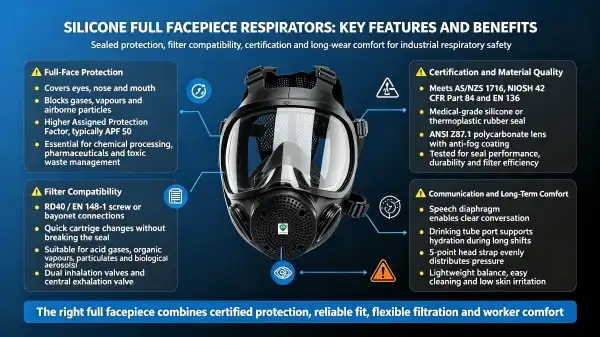
At PPE MAX, we've witnessed how Silicone Full Facepiece Respirator protection changes the result of safety in high-risk situations. Since 1956, our production knowledge has been focused on creating respiratory protection that protects against both breathing in harmful substances and eye exposure. The combined design gets rid of the need for separate eye protection and breathing gear. This keeps irritating gases from reaching mucous surfaces that are easily damaged and stops dangerous airborne substances from getting into the respiratory system in the first place.
Medical-grade silicone or thermoplastic rubber facepieces are built into the basic structure. These can be adjusted to fit different face shapes and ensure a good seal around the forehead, lips, and chin. This constant circular seal is what makes this design safer than half-mask designs. Wide-view polycarbonate glasses that meet ANSI Z87.1 standards give you clear vision and protect against contact and chemical splash. They are also treated with anti-fog coatings to keep their clarity during intense exercise.
Core Safety Features That Matter
Following the rules is the basis of effective lung protection. Our equipment is made to meet or go beyond foreign standards like AS/NZS 1716, NIOSH 42 CFR Part 84, and EN 136 (Classes 1, 2, and 3). These certifications show that each unit has been through strict tests to make sure the seals work, the materials last a long time, and the filters work well in situations that are like real-life workplace dangers.
Another important thing to think about is filter compatibility. Standardised RD40/EN 148-1 screw or bayonet connection systems on our respirators make it easy to change cartridges quickly while keeping the seal's integrity. Because of this, the same facepiece can protect against a range of dangers, from acid gases and organic vapours to nuclear particles and biological aerosols, by simply switching the filter combinations. The dual inhalation valve design makes it easier to breathe when you're working out hard, and the center-mounted expiration valves get rid of expelled air quickly and effectively, stopping CO2 buildup.
Communication Capabilities: Significant Impact
Communication skills have a big effect on how well operations run. Our speech diaphragms and voice transmitter systems make it possible to have clear conversations without breaking the face seal. This solves a common problem that comes up in noisy workplaces where teamwork is important. Some types have drinking tube ports that let you stay hydrated for long amounts of time without breaking the protection. This is especially helpful during emergency response operations or long abatement projects.
Long-Term Comfort and Usability
Comfort during extended wear has a direct effect on obedience and safety results. Our 5-point head strap systems are designed to spread pressure evenly across the brain. This keeps the head from feeling painful in certain places, which could affect the quality of the seal or make people not want to use them properly. Different-sized and shaped heads can use the adjustable straps, and the nontoxic materials keep your skin from getting irritated during 8-hour shifts.
Weight spread and balance are also important parts of practical design. The low weight makes it easier on the neck, and the center of gravity stays close to the face thanks to carefully placed parts. Surfaces that are easy to clean help enforce cleanliness rules between shifts, which extends the life of equipment and lowers the risk of contamination. These useful features have real-world benefits: workers wear the gear regularly and properly, maintenance teams do routine repair quickly and well, and purchasing managers get a better return on their investment because the equipment lasts longer between replacements.
Evaluating and Comparing Silicone Full Facepiece Respirator Types for Industrial Procurement
Reusable Versus Disposable Considerations
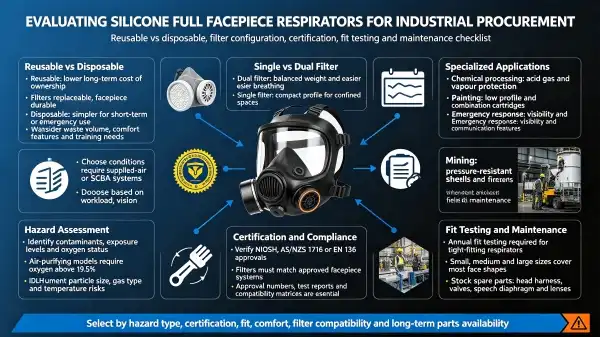
Smart purchasing choices are based on knowing how long different types of respirators last and how much they cost. Most industrial uses use reusable Silicone Full Facepiece Respirators with filters that can be changed and facepieces that are built to last for years. The starting cost per unit is higher, but the total cost of ownership goes down a lot when covering a lot of workers for a long time. We've worked with mining companies that have hundreds of workers who use the same facepiece for three to five years, only changing the filters when they get dirty or are used a lot.
There are disposable options for certain situations, like responding to a disaster only once or doing short-term cleanup jobs. These units make the facepiece and filter into a single unit that can only be used once. This gets rid of the need for cleaning procedures and filter tracking. They make more trash, though, and they don't usually have as many comfort features or ways to talk as reuse models. Reusable systems are usually more cost-effective and better for the environment for procurement teams that are in charge of regular business activities.
Single Filter Versus Dual Filter Configurations
Choices about configuration affect both the level of security and the user experience. Dual-filter types put cartridges on each cheek in a way that makes them equal in weight and makes breathing easier by creating parallel airflow paths. This design is especially helpful for people who do physically hard jobs that require a lot of breathing. The symmetrical setup also makes peripheral vision better than single-filter versions that are placed in the middle.
Single-filter setups with bigger cartridges work best in situations where weight reduction is important or where the side profile is limited by the room. Some specialised settings, like confined areas with small openings, need respirator profiles that are small. We've made single-filter types specifically for use in pharmaceutical cleanrooms, where streamlined equipment lowers the risk of pollution and makes cleaning easier.
Specialized Variations for Targeted Applications
In places where chemicals are processed, respirators that are better at blocking absorption and working with strong acids are often needed. For processes involving ketones, esters, and chlorinated solvents, we make models with butyl rubber parts. For painting and sealing jobs, low-profile designs make them easier to see and keep overspray from building up. These are best used with combination particulate/vapour cartridges, which protect against both mist and solvent vapour dangers.
Versions for emergency reaction include contact systems, heads-up displays, and better visibility features that help people make quick decisions when they're under a lot of stress. Models made for mining have shells that are resistant to pressure and easier upkeep steps that work better in the field. Knowing about these specific differences helps match tools to the needs of operations instead of settling for solutions that don't work well in all situations.
If you're evaluating personal protective equipment suppliers and require batch-specific testing documents before placing an order, PPE MAX is able to provide official Certificates of Analysis, professional laboratory test reports, and product samples for your verification. Feel free to contact our team at marketing@ppemax.com to discuss your sourcing needs and obtain complete documentation for your quality assessment and procurement approval.
How to Choose the Right Silicone Full Facepiece Respirator: Buyer's Criteria and ChecklistHazard Assessment and Protection Level Requirements
Thoroughly identifying job hazards is the first step in making a good choice. Monitor the air to find out how much pollution there is, what chemicals are in it, and whether the environment is directly dangerous to life or health (IDLH). This information sets the base APF needs and the right filter classes. Our basic types of air-purifying Silicone Full Facepiece Respirators are good for most industrial uses where oxygen levels are higher than 19.5%, and contaminant levels are lower than the limits set by the device. When there isn't enough oxygen in the air (IDLH), supplied air or self-contained breathing gear is needed.
Write down the specific flying dangers that are there, like the sizes of the particles, the types of gases and vapours, the lengths of exposure, and any other risk factors that make this situation special, like high or low temperatures or explosive atmospheres. This detailed profile helps with both the original choice and the ongoing filter setting. We give you thorough contaminant compatibility charts and work directly with procurement experts to make sure that the planned setups cover all the risks that have been found.
Certification Verification and Regulatory Compliance
Check to see if the respirators that are being considered have the right approvals for the areas where you work. In the United States, breathing safety at work must be approved by NIOSH. Australia and New Zealand use AS/NZS 1716, while activities in Europe need EN 136 approval. We keep our certifications up to date across these systems by sending goods in for re-evaluation on a regular basis as standards change.
In addition to basic certification, make sure that the right licenses are in place for the filter options you want to use. If you use an NIOSH-approved facepiece with filters that aren't qualified, the whole system loses its approval status. With every shipment, we include full documentation packages with approval numbers, test results, and compatibility matrices that make compliance checks and regulatory reviews easier.
Fit Testing Protocols and Size Availability
Even the best respirator won't protect you enough if it's not set right. Set up plans for numeric or qualitative fit testing before the first use and every year after that. Using special tools for quantitative testing, the real leakage rates are measured, giving a number that proves the fit is good. Qualitative methods that use irritating smoke or bitter/sweet sprays are easier and can be used for regular checks.
Our facepieces come in three sizes: small, medium, and large. These three sizes cover about 95% of human faces. By having a range of sizes in stock, you can make sure that your products fit a wide range of workers. Some operations need custom sizes for people who don't fit into normal ranges. Our OEM skills can help with these unique needs. Teach people who work in safety how to spot fit issues like too many gaps along the seal, pressure points that hurt, or lens placement that makes it hard to see.
Maintenance Requirements and Spare Parts Availability
Long-term performance of a respirator relies on regular upkeep and easy access to new parts. Set up cleaning routines that use disinfectants that are allowed by the maker and won't damage silicone seals or lens coatings. Plan to change the filter based on how often it is used, the amount of contaminants it contains, and any signs of a breakout, like smelling something or having more trouble breathing.
We keep a large inventory of extra parts, such as head harnesses, exhalation valves, inhalation valves, speech diaphragms, and lens kits. These parts are available, which increases the service life of the facepiece and stops unplanned downtime when parts wear out or get harmed. Our expert support team tells you how often to do maintenance, how to fix speed problems, and how to do pre-use inspections that find problems before they become dangerous.
Procurement Insights: Where and How to Buy Silicone Full Facepiece Respirators
Understanding Market Pricing and Value Factors
The price of a Silicone Full Facepiece Respirator depends on a lot of things, like the level of certification, the quality of the material, the number of features, and the name of the maker. Basic NIOSH-compliant entry-level models usually cost between $150 and $300 per unit, while advanced systems with talking features, drinking ports, and special materials cost between $400 and $800. These numbers show the price for a single unit. Buying in bulk lowers the price per unit by a large amount.
Instead of just looking at the purchase price, you should also look at the total costs of owning. When running large-scale operations, a $200 respirator with a filter that needs to be changed every 40 hours costs more than a $350 model with a filter that lasts 100 hours. Take into account the time and money needed for training, repair, extra parts, and the expected service life. We've shown that clients who moved from cheaper options that needed to be replaced more often and created more work for administrators saved 30 to 40 percent on their total costs.
Strategic Bulk Purchasing Advantages
Volume agreements bring about a lot of benefits, not just lower unit prices. Distributors and big end users can get specialised account management, priority production schedules, and specific inventory management programs made just for them. For better prices, the minimum order quantity is usually between 50 and 100 units, but we can take smaller orders for specific uses or test runs.
Buying in bulk also makes sure that there is a steady supply during market breakdowns or times of high demand. We've kept deliveries to mining operations in 134 countries steady by setting up established supply lines and strategically storing materials. Long-term supply deals that spell out prices and delivery times help buying managers stick to their budgets and avoid having to buy things on the spot at high prices. Custom labelling and package choices help distributors meet their branding needs and make warehouse work easier.
Evaluating Supplier Capabilities and Support Services
When choosing a supplier, it's not just about the quality of the goods; it's also about how well they can handle logistics and provide help after the sale. We offer engineering advice that helps clients choose the best breathing protection tools for their needs based on our more than 65 years of experience in the field. Our technical support number helps with fit problems, maintenance questions, and troubleshooting. This is especially helpful for businesses that don't have their own safety engineering staff.
Logistical services affect how ready an activity is to go. We handle customs paperwork and make sure that import rules are followed for worldwide shipping to 134 countries. You can get replacements quickly with expedited shipping choices, and consignment inventory programs let you keep stock at your facilities without having to pay for it up front. Usually, manufacturing defects are covered by warranties for 12 to 24 months. However, with proper care, the facepiece will last much longer than the guarantee period. Training programs that teach the right way to put on gear, check for fit, do upkeep, and spot hazards improve your safety culture and make tools work better.
Troubleshooting and Common Issues with Silicone Full Facepiece Respirators
Addressing Seal Integrity Problems
The worst thing that can happen with a Silicone Full Facepiece Respirator is that the seal breaks, letting unfiltered air get around the filtering system. Some of the most common reasons are wrong sizes, facial hair getting in the way of the sealing surface, seals that are broken or old, and the wrong way to put them on. Before each use, we suggest checking the positive and negative pressure seals. These are easy steps that find leaks before they get into dangerous environments.
If your facial hair is thicker than stubble, the edges of the facepiece can't be sealed properly. By requiring respirator users to shave before working, organisations get rid of this uncertainty. For people who can't get a good seal because of problems with their face structure, like severe scars, missing teeth that change the shape of their cheeks, or sizes that aren't standard, other types of protection, like powered air-purifying respirators with loose-fitting hoods, may be needed. When sealing surfaces are replaced regularly, they don't break down from cleaning chemicals, UV light, or the material wearing out.
Managing Filter Performance and Replacement Scheduling
Filter overload makes it harder to breathe and finally lets contaminants through. Set up replacement plans based on what the maker says should be done. This is usually given in terms of maximum usage hours or service life under certain conditions. The real service life depends on the amount of contamination, the humidity, the temperature, and how hard you work. Some types of filters have end-of-service-life markers that change colour when brightness levels get too high. These are objective ways to know when to replace the filter.
We have a large selection of filters for a wide range of dangers, including P100 particulate filters for dusts and mists, organic vapour cartridges for liquids, acid gas cartridges for chlorine and sulphur dioxide, and combination units that can handle more than one type of danger. Making sure there are enough filter supplies on hand keeps workers from extending the life of filters past the safe limit out of fear of running out. Filters that haven't been used should be kept in sealed containers out of direct sunlight.
Resolving Communication Challenges
Speech is harder to understand when sounds have to go through facepiece materials, and there is a lot of background noise. Our built-in speech diaphragms are made of thin membranes that vibrate with the rhythms of the vocal cords. This makes them better at releasing voice energy than other facepiece materials. Premium models come with voice amplification systems that automatically boost the volume of speech. This makes it easier to communicate in places with a lot of noise, like metal production shops or areas near heavy machinery.
Communication problems aren't always caused by equipment limits; they can also be caused by things like a microphone not being placed correctly or batteries dying. Training users to speak clearly and stand in a way that projects their voice best improves results without changing the tools. Two-way radios with throat mics are an option for jobs that need to communicate constantly over long distances, but they need to be mounted on systems that are compatible with breathing protection in order to be used with them.
Conclusion
When choosing the right Silicone Full Facepiece Respirator, you have to think about how to balance risk protection, user comfort, regulation compliance, and long-term cost-effectiveness. We looked at important evaluation criteria, such as verifying licensing, fit testing methods, filter compatibility, and upkeep needs that have a direct effect on worker safety and the efficiency of operations. When purchasing, professionals know the differences between choices that can be used more than once and those that can't, as well as between single and dual filter configurations and designs made specifically for certain tasks, so they can better match the capabilities of tools to the needs of the workplace. Strategic relationships with suppliers that offer expert support, easy access to extra parts, and discounts for buying in bulk add value beyond the cost of purchase. Companies create respiratory protection systems that keep workers safe, boost output, and follow safety rules in a wide range of workplace settings by using structured selection processes and preventative maintenance programs.
FAQ
1. How often should filters be replaced on reusable full-face respirators?
How often filters need to be replaced depends on the type of contaminants, their concentration, and how much they are used. Particulate screens usually need to be replaced when breathing becomes more difficult or after a certain number of hours, usually between 40 and 100 hours. Gas and vapour cartridges need to be changed when an odour, taste, or discomfort is detected or after the maximum use time listed in the product literature. Setting up usage logs helps keep track of exposure hours and regular replacement plans, which stops filters from wearing out too quickly and losing their protective power in a Silicone Full Facepiece Respirator.
2. Can full-face respirators protect against all airborne hazards?
Air-purifying respirators clear out many industrial pollutants well, but they have some problems. They need atmospheres with at least 19.5% oxygen and contaminant levels below certain standards, which are set by the APF and acceptable exposure limits. They can't protect you from environments with too little air, unknown contaminants, or IDLH situations. When these things happen, supplied-air respirators or self-contained breathing gear are needed. With the right risk assessment, you can find out if the air-purifying tools you're using are safe enough for your needs.
3. What certifications should procurement specialists verify before purchasing?
Check that the respirators you buy have been approved by the relevant regulatory groups in your area. For example, in the US, NIOSH is in charge, in Europe, EN136 is in charge, and in Australia/New Zealand, AS/NZS 1716 is in charge. Make sure that the whole respirator assembly, including the facepiece and filters, is certified, not just certain parts. For regulatory checks, we provide a lot of paperwork, like approval numbers, test results, and compliance statements. Also, make sure that the sellers' certifications are up-to-date, since standards change over time and goods need to be re-evaluated every so often to keep their approval status.
Partner With PPE MAX for Certified Respiratory Protection Solutions
For more than 65 years, PPE MAX has been making high-quality breathing protection that you can trust. Silicone Full Facepiece Respirators are something we've sold to businesses in 134 countries. These businesses include chemical makers, mining companies, drug manufacturers, and emergency response teams. The safety standards we meet are the highest. Our wide range of products includes models that are approved by NIOSH, EN 136, and AS/NZS 1716. These models have soft silicone seals, anti-fog polycarbonate glasses, and designs that allow for contact. We offer customised solutions with discounts for buying in bulk, expert support, and easy access to spare parts, whether you're a supplier looking for reliable OEM partnerships or a safety manager keeping a big staff secure. Email our team at marketing@ppemax.com to talk about your unique needs and find out how our cutting-edge production can improve the safety program at work.
References
1. National Institute for Occupational Safety and Health. Respiratory Protection Program Guidelines. Centers for Disease Control and Prevention, 2019.
2. Occupational Safety and Health Administration. 29 CFR 1910.134: Respiratory Protection Standard. U.S. Department of Labor, 2021.
3. European Committee for Standardization. EN 136:1998 - Respiratory Protective Devices: Full Face Masks - Requirements, Testing, Marking. CEN Publications, 1998.
4. American National Standards Institute. ANSI Z87.1-2020: Occupational and Educational Personal Eye and Face Protection Devices. ANSI Standards, 2020.
5. International Safety Equipment Association. Industrial Respiratory Protection: Selection and Use Guidelines for B2B Procurement. ISEA Technical Report, 2022.
6. Standards Australia/Standards New Zealand. AS/NZS 1716:2012 - Respiratory Protective Devices. SAI Global Publications, 2012.
Learn about our latest products and discounts through SMS or email