- English
- French
- German
- Portuguese
- Spanish
- Russian
- Japanese
- Korean
- Arabic
- Greek
- German
- Turkish
- Italian
- Danish
- Romanian
- Indonesian
- Czech
- Afrikaans
- Swedish
- Polish
- Basque
- Catalan
- Esperanto
- Hindi
- Lao
- Albanian
- Amharic
- Armenian
- Azerbaijani
- Belarusian
- Bengali
- Bosnian
- Bulgarian
- Cebuano
- Chichewa
- Corsican
- Croatian
- Dutch
- Estonian
- Filipino
- Finnish
- Frisian
- Galician
- Georgian
- Gujarati
- Haitian
- Hausa
- Hawaiian
- Hebrew
- Hmong
- Hungarian
- Icelandic
- Igbo
- Javanese
- Kannada
- Kazakh
- Khmer
- Kurdish
- Kyrgyz
- Latin
- Latvian
- Lithuanian
- Luxembou..
- Macedonian
- Malagasy
- Malay
- Malayalam
- Maltese
- Maori
- Marathi
- Mongolian
- Burmese
- Nepali
- Norwegian
- Pashto
- Persian
- Punjabi
- Serbian
- Sesotho
- Sinhala
- Slovak
- Slovenian
- Somali
- Samoan
- Scots Gaelic
- Shona
- Sindhi
- Sundanese
- Swahili
- Tajik
- Tamil
- Telugu
- Thai
- Ukrainian
- Urdu
- Uzbek
- Vietnamese
- Welsh
- Xhosa
- Yiddish
- Yoruba
- Zulu
What Industries Use Class 1 Insulating Gloves Most Frequently?
The main businesses that depend on Class 1 Insulating Gloves the most are electrical power companies, industrial manufacturing plants, building companies, phone companies, and oil and gas facilities. In these fields, workers are daily exposed to voltages of up to 7,500V AC. This means that approved rubber-insulated gloves are not only useful tools, but also lifesaving shields. During our 65-year history, PPE MAX has seen that these industries continue to buy a lot of Class 1 Insulating Gloves. This is because electrical work can't be done safely in these settings without the right voltage-rated hand protection.
Overview of Class 1 Insulating Gloves and Their Specifications
Knowing how electrical safety gloves work on a technical level helps buying teams make smart choices. Electrical dangers can be avoided with Class 1 insulating gloves up to a maximum use voltage of 7,500 volts AC and 11,250 volts DC. These standards aren't made up on the spot; they're based on strict adherence to the international safety standards ASTM D120 and IEC 60903, which spell out testing procedures, material needs, and performance standards.
Technical Design and Material Composition
These safety gloves are made from high-quality natural rubber latex that has been specially designed to have great insulation qualities while still being flexible. Our Class 1 gloves are made with thicknesses between 0.7 mm and 1.5 mm, which is just the right amount of safety and flexibility for electrical workers who have to do complicated jobs. The comfortable design makes it easy for workers to move tools, connect wires, and handle equipment without getting clumsy, which is bad for safety and productivity. Cuffs that are colour-coded make it easy to tell them apart right away. For example, Class 1 gloves have white stickers that make them stand out from gloves of other voltage classes. This simple design feature keeps workers from making mistakes that could be fatal, like using gloves with lower ratings on systems with higher power. The rubber materials don't break down when exposed to ozone or UV light, so they last longer even in tough outdoor settings where utility workers spend a lot of time.
Testing Standards and Quality Assurance
Before they leave our factory in Xi'an, each pair goes through proof testing at 10,000V AC and voltage testing at 20,000V AC. These checks aren't one-time events; OSHA 1910.137 and ASTM F496 say that electrical tests must be done on gloves every six months after they are put to use. We've set up thorough quality control systems that make sure every product meets or beats these high standards. This gives safety managers faith in the money they spend on safety gear. The dielectric voltage tests make sure that the glove can stop the flow of current, and the air leak tests look for tiny flaws that could make security less effective. Each package comes with paperwork that makes it possible to track and meet the requirements of governmental checks and purchase verification processes.
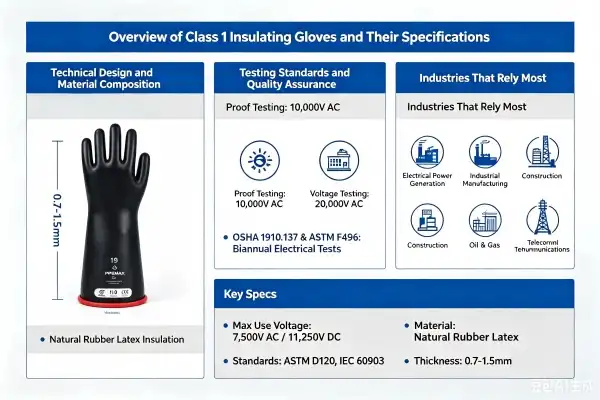
Industries That Rely Most on Class 1 Insulating Gloves
Medium-voltage electrical work defines the operational reality across multiple industrial sectors. The following industries demonstrate the highest consumption and most consistent procurement patterns for Class 1 Insulating Gloves and other voltage-rated hand protection.
Electrical Power Generation and Utility Companies
When they are doing maintenance, repairs, or emergency restoration work, lineworkers and substation techs are directly exposed to equipment that is live. The voltage sweet spot for Class 1 gloves is between 4kV and 7.5kV. These systems provide enough safety without adding too much bulk to higher-rated options. Utility companies that are in charge of huge electricity lines across continents buy a lot of these gloves. We've sold them to utilities in 134 countries, and we've seen buying cycles that reflect both regular repair plans and urgent storm recovery needs. In this area, buying choices are based on following the rules. The rules that buying teams have to follow are set by OSHA and private safety practices that have been built over many years of experience in the field. If people working in utility settings don't wear the right PPE, they could get hurt, or the grid could go down, which would affect thousands of customers.
Industrial Manufacturing and Heavy Machinery Operations
Heavy machinery like presses, elevators, robotic systems, and automatic production lines need skilled electrical repair staff who service motor control centers, variable frequency drives, and power distribution panels regularly. Most of the time, these systems work at levels that are perfectly safe according to Class 1 standards. Maintenance windows are small in factories that are open 24 hours a day, seven days a week. This means that techs who work long shifts need gloves that are reliable and comfortable. Strong demand is seen in the automobile, steel, food processing, and chemical production subsectors. The safety managers at these places of business like gloves that can't be punctured and have good gripping power for accurate work on junction blocks and circuit components. We made our gloves with features that industrial electricians specifically ask for during our client meeting sessions to meet both of these needs.
Construction and Infrastructure Development
Electricians on construction sites install and commission electrical systems for commercial buildings, hospitals, data centers, and infrastructure projects. Unlike controlled industrial environments, construction settings expose gloves to concrete dust, sharp metal edges, rebar, and varied weather conditions. The durability of rubber insulating gloves becomes paramount—inferior products fail prematurely, creating both safety hazards and cost overruns when replacement delays project timelines. Large construction firms managing multiple simultaneous projects require supply chain partners capable of delivering consistent product availability. Our global distribution network ensures construction procurement teams can maintain adequate PPE inventory across geographically dispersed job sites, avoiding the work stoppages that occur when safety equipment runs short.
Oil, Gas, and Petrochemical Facilities
Hazardous location electrical work in refineries, offshore platforms, and chemical processing plants presents compound risks. Electrical systems in these environments demand comprehensive PPE strategies where insulating gloves form one component of layered protection. Workers accessing motor control cabinets, junction boxes, and instrumentation panels in classified areas need gloves certified for both electrical protection and chemical resistance. Procurement in this sector emphasizes supplier reliability and certification authenticity. We regularly participate in industry exhibitions like the A+A Safety Exhibition in Germany, where oil and gas safety managers verify product claims through direct examination and technical discussions with our engineering team.
Telecommunications and Utility Field Services
Tower technicians, cable installers, and telecom maintenance crews encounter electrical hazards during equipment installation and service calls. Outdoor environments expose workers to lightning-induced voltages and utility line proximities that create shock risks. Lightweight construction and weather-resistant properties become selection priorities for Class 1 Insulating Gloves—gloves must perform reliably whether technicians are working during summer heat or winter cold. Telecommunications companies increasingly recognize that proper PPE reduces liability exposure and workers' compensation costs. The investment in certified insulating gloves yields returns through incident prevention that protects both human well-being and corporate financial health.
How to Select the Right Class 1 Insulating Gloves for Your Industry Needs
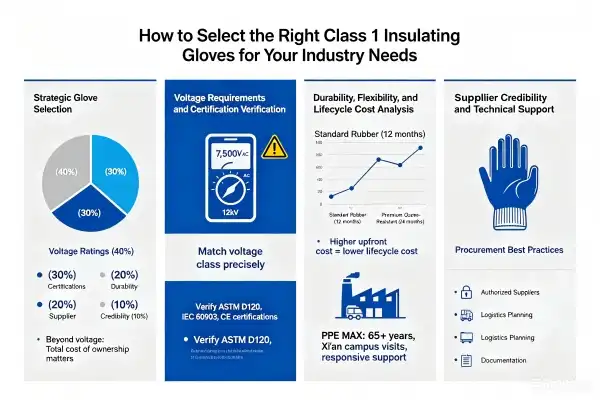
Strategic glove selection extends beyond simply ordering products that meet voltage ratings. Procurement professionals must evaluate multiple factors that impact both immediate safety performance and total cost of ownership.
Voltage Requirements and Certification Verification
Match glove voltage class precisely to your operational environment. Class 1 gloves protect against voltages up to 7,500V AC—attempting to use them on 12kV systems creates unacceptable risk. We've encountered procurement errors where buyers selected gloves based on price rather than voltage ratings, resulting in dangerous mismatches between equipment and hazard levels. Always verify that products carry authentic ASTM D120, IEC 60903, and relevant regional certifications like CE marking for European operations. Request certification documentation from suppliers and cross-reference batch numbers with test reports. Authorized distributors and established manufacturers maintain transparent traceability systems that withstand regulatory scrutiny.
Durability, Flexibility, and Lifecycle Cost Analysis
The initial purchase price represents only one component of the total glove cost. Factor in expected service life, re-testing expenses, and replacement frequency when evaluating supplier proposals. Higher-quality gloves manufactured from premium rubber compounds resist degradation, extending intervals between replacements. Our gloves incorporate ozone and UV-resistant formulations that maintain elasticity longer than standard products, reducing lifecycle costs despite potentially higher upfront investment. Flexibility directly impacts worker compliance—uncomfortable gloves get removed during tasks, negating their protective value. The ergonomic design we've refined over 65 years allows extended wear without hand fatigue, encouraging consistent usage that translates to genuine safety improvement rather than theoretical protection that workers circumvent.
Supplier Credibility and Technical Support
Partner with manufacturers offering comprehensive technical assistance. Questions about glove selection, testing protocols, storage requirements, and usage training arise throughout the product lifecycle. We provide responsive customer support through our technical assistance hotline and welcome facility visits to our Xi'an manufacturing campus, where procurement teams can observe quality control processes directly. Bulk order pricing should reflect volume commitments while maintaining product integrity. Suspiciously low prices often indicate counterfeit products or expired inventory being liquidated without proper disclosure. Established suppliers with decades of market presence—like PPE MAX, operating since 1956—have reputations to protect and stand behind their products with flexible return policies and warranty coverage.
Procurement Best Practices for Class 1 Insulating Gloves
Optimizing PPE supply chains requires systematic approaches that balance cost efficiency with uncompromising safety standards.
Sourcing from Authorized Suppliers
Work exclusively with distributors and manufacturers who provide verifiable certification documentation. Counterfeit electrical safety equipment has infiltrated markets globally, creating life-threatening situations when substandard gloves fail under voltage stress. We maintain strict distribution controls and welcome verification inquiries from procurement teams conducting supplier due diligence. Minimum order quantities vary by supplier and product configuration. We've structured our wholesale pricing to accommodate both large one-time purchases and recurring replenishment orders that match consumption patterns in facilities with ongoing electrical maintenance schedules. Custom packaging options serve distributors building their own branded PPE programs while benefiting from our manufacturing expertise.
Logistics and Inventory Management
Lead times for international shipments require planning that accounts for production cycles, quality testing, and freight transit. We maintain inventory across multiple distribution points to serve urgent replacement needs while offering expedited shipping options for critical situations. Construction projects with fixed safety compliance deadlines and utility storm-response scenarios both benefit from supplier relationships that prioritize delivery reliability. Establish reorder points based on consumption data and testing schedules. Gloves approaching their six-month re-test requirement should trigger replacement orders that arrive before existing stock expires, maintaining continuous compliance without emergency rush orders that increase costs.
Documentation and Compliance Records
Maintain comprehensive records linking purchase orders to certification documents, test reports, and usage logs. Regulatory audits and incident investigations require traceability from the Class 1 Insulating Gloves manufacturer through distribution channels to the end-user assignment. We provide detailed documentation with every shipment of Class 1 Insulating Gloves that simplifies recordkeeping for safety managers responsible for demonstrating OSHA compliance.
Maintenance, Testing, and Safe Usage Protocols in Industrial Settings
Product quality matters, yet proper maintenance determines whether certified gloves actually deliver their designed protection throughout their service life.
Inspection Procedures and Testing Frequency
Visual inspections before each use represent the first defense against compromised gloves. Workers should check for punctures, tears, embedded foreign objects, ozone cracking, and other visible damage that indicates removal from service. We recommend the air inflation test—a simple field procedure where gloves are inflated to detect small leaks that visual inspection might miss. Electrical re-testing every six months is mandatory per OSHA 1910.137. This isn't optional or subject to extension based on visual appearance—rubber degradation occurs invisibly at the molecular level, and only dielectric testing verifies continued protection. We partner with accredited testing laboratories globally and can recommend facilities convenient to your operational locations.
Storage Recommendations and Environmental Protection
Improper storage accelerates glove degradation, shortening service life and potentially creating undetected failures. Store gloves in protective canvas bags, fingers upward, in cool, dry, dark locations away from direct sunlight, steam pipes, electric motors, and ozone-generating equipment. Heat and UV radiation cause rubber to become brittle and crack, while ozone exposure creates surface checking that compromises dielectric properties. Never fold gloves unnecessarily or allow heavy objects to create permanent creases. Remove rubber gloves from leather protectors during extended storage to prevent deformation. These simple practices extend usable life significantly, improving return on PPE investments.
Leather Protectors and Complete PPE Systems
Cutting, poking, and abrasions from sharp edges, tools, and rough surfaces can still happen to rubber-insulated gloves on their own. Leather covers that meet ASTM F696 standards are required. They act as a mechanical shield that keeps the rubber's insulating integrity. Using rubber gloves without leather protection goes against safety rules and puts workers at risk of getting hurt when they don't have to. We have full sets of Class 1 Insulating Gloves that include rubber gloves, leather guards, and cotton liners that soak up wetness. This system method takes care of both electrical and mechanical risks while keeping people comfortable during long periods of wear in hot places where sweat can build up.
Conclusion
Choosing the right electrical safety gear and keeping it in good shape will protect your most important asset: your employees. The fields that depend on voltage-rated hand protection all have a lot in common: they have to deal with working regularly with powered systems, they have to follow rules, and they have to do electrical work that can't be put off or avoided. Focusing on approved goods, dependable suppliers, and lifetime cost optimisation during strategic buying leads to safe results that keep costs low and accidents from happening. Good care and training for users make sure that high-quality equipment works as planned for its whole time, giving modern industry processes the full safety they need.
FAQ
1. What voltage range do Class 1 electrical safety gloves protect against?
Class 1 gloves protect up to a maximum use voltage of 7,500 volts AC and 11,250 volts DC. The proof test voltage is 10,000V AC, with a withstand voltage of 20,000V AC. These ratings make them suitable for distribution systems, industrial machinery, and medium-voltage electrical maintenance, but not appropriate for higher voltage transmission work requiring Class 2 or higher protection.
2. How often must voltage-rated rubber gloves be electrically tested?
Per OSHA 1910.137 and ASTM F496, gloves must undergo electrical re-testing every six months once placed into active service. New gloves can remain on shelves for up to 12 months before initial use without testing, but the six-month clock starts immediately upon first issue to workers. Visual inspection before every use supplements but does not replace periodic electrical testing.
3. Why are leather protectors required with rubber insulating gloves?
Rubber compounds providing dielectric protection are susceptible to mechanical damage from cuts, punctures, and abrasions. Leather protectors rated to ASTM F696 provide essential mechanical barriers that prevent physical damage from compromising the rubber's electrical insulation properties. Using rubber gloves without leather protectors violates safety standards and creates unacceptable risk exposure.
Partner with PPE MAX for Your Class 1 Insulating Gloves Supply
Protecting your workforce demands more than purchasing compliant products—it requires partnering with a Class 1 Insulating Gloves manufacturer committed to quality, reliability, and long-term support. PPE MAX brings 65 years of manufacturing expertise, stringent quality control, and global distribution capabilities to every client relationship. Our comprehensive technical support helps safety managers implement proper usage protocols for Class 1 Insulating Gloves, while our competitive bulk pricing makes compliance affordable for organizations of any size. We invite procurement professionals, safety managers, and industrial buyers to contact our team at marketing@ppemax.com for personalized consultations, product specifications, and volume pricing tailored to your specific industry requirements. Strengthen your electrical safety program with equipment tested by our own team, trusted across 134 countries, and backed by decades of proven performance in the world's most demanding industrial environments.
References
1. American Society for Testing and Materials. (2016). ASTM D120: Standard Specification for Rubber Insulating Gloves. West Conshohocken: ASTM International.
2. International Electrotechnical Commission. (2014). IEC 60903: Live Working – Gloves of Insulating Material. Geneva: IEC Publications.
3. Occupational Safety and Health Administration. (2007). OSHA 1910.137: Electrical Protective Equipment Standards. Washington: U.S. Department of Labor.
4. National Safety Council. (2019). Electrical Safety in the Workplace: A Comprehensive Guide for Safety Professionals. Itasca: NSC Press.
5. IEEE Standards Association. (2018). IEEE Guide for Selection, Testing, and Handling of Electrical Protective Equipment. New York: Institute of Electrical and Electronics Engineers.
6. International Safety Equipment Association. (2020). PPE Procurement Best Practices for Industrial Safety Managers. Arlington: ISEA Industry Publications.
Learn about our latest products and discounts through SMS or email