- English
- French
- German
- Portuguese
- Spanish
- Russian
- Japanese
- Korean
- Arabic
- Greek
- German
- Turkish
- Italian
- Danish
- Romanian
- Indonesian
- Czech
- Afrikaans
- Swedish
- Polish
- Basque
- Catalan
- Esperanto
- Hindi
- Lao
- Albanian
- Amharic
- Armenian
- Azerbaijani
- Belarusian
- Bengali
- Bosnian
- Bulgarian
- Cebuano
- Chichewa
- Corsican
- Croatian
- Dutch
- Estonian
- Filipino
- Finnish
- Frisian
- Galician
- Georgian
- Gujarati
- Haitian
- Hausa
- Hawaiian
- Hebrew
- Hmong
- Hungarian
- Icelandic
- Igbo
- Javanese
- Kannada
- Kazakh
- Khmer
- Kurdish
- Kyrgyz
- Latin
- Latvian
- Lithuanian
- Luxembou..
- Macedonian
- Malagasy
- Malay
- Malayalam
- Maltese
- Maori
- Marathi
- Mongolian
- Burmese
- Nepali
- Norwegian
- Pashto
- Persian
- Punjabi
- Serbian
- Sesotho
- Sinhala
- Slovak
- Slovenian
- Somali
- Samoan
- Scots Gaelic
- Shona
- Sindhi
- Sundanese
- Swahili
- Tajik
- Tamil
- Telugu
- Thai
- Ukrainian
- Urdu
- Uzbek
- Vietnamese
- Welsh
- Xhosa
- Yiddish
- Yoruba
- Zulu
Dielectric Gloves Designed for Maximum Electrical Protection
When working with electrical equipment, dielectric gloves are your first line of defence. Workers are protected from deadly electric shocks by these special insulated rubber dielectric gloves, which create a shield between you and live wires. Every day, we see them at work in factories, power companies, and repair areas where electricity risks can't be avoided. Knowing how dielectric gloves are made, why they're certified, and how to use them correctly isn't just for safety; it's also for making sure that your team gets home safely every shift.
Understanding Dielectric Gloves: Functionality and Safety Standards
What Makes Dielectric Gloves Different from Standard Hand Protection
What Makes Dielectric Gloves Not the Same as Other Hand Protection
At PPE MAX, we've built our name on knowing the difference between life-saving gear and other safety gear. Dielectric gloves are completely different from regular work gloves because they are made from high-quality insulation rubber or elastomer materials that are designed to prevent electricity. While regular plastic gloves might be able to handle water or chemicals, these gloves are put through a lot of electrical tests to make sure they can handle certain voltage levels without sending current to your hands. The makeup of the material is very important. Because natural rubber is so flexible and easy to work with, techs can do difficult wiring jobs while staying completely safe. EPDM (Ethylene Propylene Diene Monomer) is more resistant to ozone, UV rays, and weathering, which are important for outdoor utility work where the weather breaks down other materials. At PPE MAX, we try both materials ourselves, and the difference in how well they work in harsh situations is clear.
International Standards That Protect Your Workers
Following rules isn't just a waste of time; it's your safety promise. Electrical safety glove guidelines in North America are set by ASTM D120, which includes strict testing procedures that all legal manufacturers must follow. In Europe, EN 60903 sets the same level of safety norms, and IEC rules govern markets around the world. Not only do these standards sort gloves into groups, but they also spell out the testing methods, power needs, and quality standards that keep electrical workers safe. Class 00 (500V maximum use) and Class 4 (36,000V maximum use) are the voltage levels set by each standard. Even higher voltages are used for the proof tests—up to 40,000V AC for Class 4 gloves—which gives a lot of safety. These safety measures are needed by OSHA rule 29 CFR 1910.137 and NFPA 70E in workplace safety programs. This means that approved gloves are not only a good idea for electrical work, they are also the law.
Material Properties That Save Lives
The technical specifications reveal why proper electrical protection demands specialized engineering. Maximum use voltage ratings correspond directly to dielectric glove class, but the material science behind dielectric strength determines real-world performance. We incorporate color-coded interior and exterior layers in our manufacturing process at PPE MAX, allowing visual inspection teams to quickly detect punctures or degradation in dielectric gloves before they enter service. Anatomical "curved-hand" designs reduce fatigue during extended wear—a seemingly minor detail that becomes critical during long maintenance shifts when concentration lapses lead to accidents. The rubber maintains its protective characteristics across temperature extremes, from freezing outdoor substations to hot manufacturing environments. Tensile strength, tear resistance, and puncture resistance undergo continuous testing because a single weak point negates all protection.
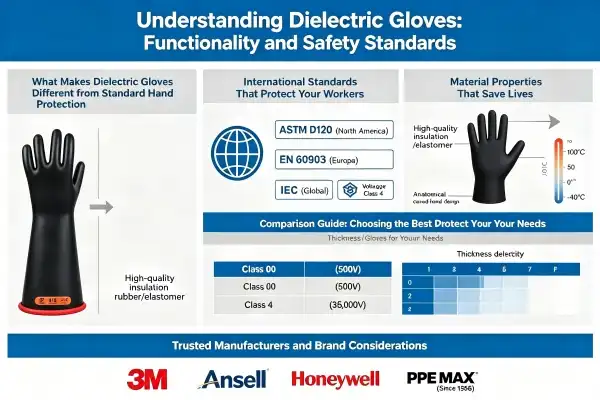
Comparison Guide: Choosing the Best Dielectric Gloves for Your Needs
Classification System: Matching Protection to Your Voltage Environment
Selecting the correct glove class requires understanding your actual exposure risks. Class 00 gloves protect against low-voltage environments up to 500V, making them ideal for electric vehicle battery systems and light industrial applications. Class 0 extends protection to 1,000V, suitable for many manufacturing and maintenance scenarios. Class 1 and Class 2 gloves (7,500V and 17,000V, respectively) serve utility linemen and substation technicians facing medium-voltage systems. Class 3 and Class 4 gloves represent the highest protection levels, designed for transmission line work and high-voltage substations where contact with 26,500V to 36,000V systems is possible. The voltage rating must exceed your maximum exposure by a comfortable margin—working at the upper limit of a glove's rating eliminates your safety buffer. We've spent decades helping procurement managers calculate these requirements, and underestimation remains the most common specification error.
Thickness Versus Dexterity: The Protection Trade-Off
Higher voltage protection necessitates thicker insulation, which reduces tactile sensitivity and manual dexterity. Class 4 gloves provide outstanding electrical protection but make fine motor tasks challenging. This physical reality drives a critical procurement decision: matching glove class to actual task requirements rather than simply ordering maximum protection for all applications. Utility workers performing complex wiring in tight spaces need sufficient dexterity to manipulate components safely. Overly thick gloves force workers to remove protection to complete tasks—defeating the entire purpose of electrical safety equipment. We design our glove lines at PPE MAX with task-specific considerations, balancing protection with the practical realities of electrical maintenance work.
Trusted Manufacturers and Brand Considerations
The market offers several established manufacturers with proven track records. Companies like 3M, Ansell, and Honeywell have invested heavily in electrical protection research and manufacturing quality. When evaluating suppliers, certification documentation matters more than marketing claims. Look for actual test reports, not just certification numbers printed on packaging. Brand reputation correlates directly with safety outcomes in this product category. We've operated since 1956 with zero tolerance for quality shortcuts because we know electrical protection equipment doesn't offer second chances. Our team uses the products we manufacture, testing them in real work environments before they reach distribution channels. This approach—being users, not just makers—has defined our quality philosophy across six decades.
Procurement and Bulk Purchasing: What B2B Buyers Should Know
Supplier Verification: Beyond the Lowest Quote
Cost considerations matter in B2B procurement, but electrical protection demands verification steps that commodity purchasing doesn't require. Authentic certification documentation from accredited testing laboratories confirms that dielectric gloves meet stated voltage ratings. Request copies of actual test reports, not certificates of compliance that merely reference standards. We provide complete documentation at PPE MAX because legitimate manufacturers have nothing to hide regarding dielectric gloves. Supplier credentials extend beyond product quality to encompass technical support capabilities. Electrical protective equipment requires expertise in proper selection, sizing, inspection protocols, and maintenance schedules. Distributors lacking this technical depth leave procurement managers without critical implementation guidance. We've built our customer relationships on comprehensive support—from initial specification through ongoing safety program management.
Cost Analysis for Volume Purchasing
Material composition and voltage class significantly impact unit costs. Natural rubber gloves typically cost less than EPDM variants, though lifecycle costs may favor the latter in high-ozone environments. Higher voltage classes require more material and undergo more extensive testing, increasing per-unit pricing proportionally. Volume purchasing agreements deliver meaningful cost reductions while ensuring supply chain reliability. Organizations managing large workforces benefit from contract-based procurement that guarantees consistent pricing, scheduled deliveries, and priority access during supply disruptions. We structure our bulk programs at PPE MAX around predictable safety equipment needs, eliminating emergency purchasing premiums while maintaining just-in-time inventory efficiency.
Custom Solutions and OEM Manufacturing
Large construction firms, utility companies, and industrial operations often require customized sizing, specialized cuff lengths, or private labeling for internal inventory control. OEM manufacturing partnerships allow organizations to specify exact requirements while leveraging established production expertise. We've manufactured custom electrical protection solutions for global brands across 134 countries, adapting designs to unique operational requirements without compromising safety certifications. Delivery timelines and logistics coordination become critical factors when managing multi-site operations or international distribution networks. Reliable suppliers maintain inventory depth and responsive logistics partnerships that prevent work stoppages due to protective equipment shortages. Our distribution network reaches clients from Asia to the Americas precisely because we've invested in the infrastructure that turns procurement commitments into delivered products.
Maintenance and Inspection: Ensuring Dielectric Glove Longevity and Safety
Daily Inspection Protocols That Prevent Accidents
The most sophisticated manufacturing means nothing if damaged gloves enter service. Daily air testing detects pinholes and tears before workers energize circuits. This simple procedure involves filling the glove with air, either by mechanical inflation or manual rolling, then listening and feeling for air escaping through compromised areas. Visual inspection identifies ozone checking (surface cracks), embedded foreign objects, or chemical degradation that compromises insulation integrity. We train our team at PPE MAX to recognize subtle damage indicators because real-world experience reveals what laboratory testing cannot. Abrasion patterns on fingertips, discoloration from chemical exposure, or brittleness from improper storage all signal that gloves should be removed from service immediately. OSHA mandates inspection before each use—a requirement that seems burdensome until the first time it catches a potentially fatal defect.
Testing Requirements and Recertification Schedules
OSHA requires electrical protective gloves to undergo professional testing every six months during active use. This testing duplicates manufacturing procedures, submerging gloves in water while applying high-voltage AC or DC to measure leakage. Testing facilities accredited to ASTM D120 standards provide certification documentation that validates ongoing protection compliance. The six-month requirement represents maximum intervals—gloves exposed to harsh conditions need more frequent testing. We recommend monthly inspections for utility field crews and quarterly testing for industrial applications where mechanical abrasion and chemical exposure accelerate degradation. The cost of professional testing is trivial compared to injury liability or workplace fatalities.
Storage and Handling Best Practices
Environmental factors dramatically affect glove longevity. Proper storage requires cool, dark, dry locations away from direct sunlight, ozone sources, and temperature extremes. Canvas storage bags with gloves positioned cuffs-down prevent dust accumulation inside while allowing air circulation. Never fold or compress electrical gloves—creasing damages the rubber structure at molecular levels that visual inspection cannot detect. Cleaning procedures must avoid harsh chemicals or petroleum-based products that attack rubber compounds. Mild soap and water remove contamination without degrading insulation properties. Thorough drying before storage prevents moisture-related deterioration and bacterial growth. These maintenance practices extend service life while maintaining protection integrity throughout the glove's operational period.
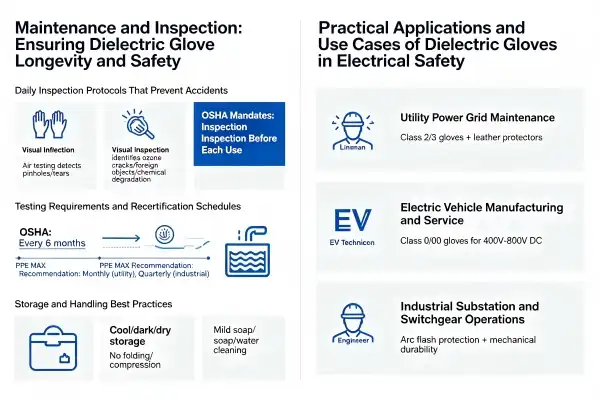
Practical Applications and Use Cases of Dielectric Gloves in Electrical Safety
Utility Power Grid Maintenance
Electrical utility operations present the highest-consequence exposure scenarios. Linemen working on overhead distribution systems routinely encounter medium-voltage circuits carrying 4,800V to 34,500V. Class 2 and Class 3 dielectric gloves provide essential protection during transformer servicing, line repairs, and hot-stick procedures where direct contact with energized conductors is unavoidable. Combined with leather protector gloves, these systems shield workers from both electrical hazards and mechanical damage from climbing equipment, rough conductor surfaces, and accidental contact with sharp edges. Utility companies have reduced electrical contact injuries by over 80% through comprehensive glove programs that specify appropriate classes for each task, enforce inspection protocols, and maintain testing schedules without exception.
Electric Vehicle Manufacturing and Service
The automotive industry's transition to electric propulsion creates new electrical hazards that traditional mechanics have never encountered. High-capacity lithium battery packs operate at 400V to 800V DC, with peak voltages exceeding 1,000V in some performance systems. Technicians servicing these vehicles need Class 0 or Class 00 gloves that provide adequate protection without sacrificing the dexterity required for diagnostic equipment operation and component replacement in confined spaces. Manufacturing facilities assembling battery packs and drive systems face similar challenges across larger workforces. We've helped automotive OEMs implement protection programs that balance safety requirements with assembly line efficiency, demonstrating that proper electrical protection doesn't require productivity sacrifices when specification matches actual tasks.
Industrial Substation and Switchgear Operations
Manufacturing plants, mining operations, and large commercial facilities maintain electrical substations that step down utility power to operational voltages. Maintenance engineers performing circuit breaker testing, switchgear operation, and busbar inspection work in environments where arc flash hazards and incidental contact with energized components pose constant risks. The confined spaces and high-energy systems in substations demand both electrical protection and mechanical durability from leather protectors guarding against sharp edges and abrasive surfaces. We've documented safety improvements in mining operations where comprehensive electrical protection programs reduced lost-time injuries by 67% over three-year implementation periods. The combination of proper glove selection, rigorous inspection protocols, and worker training creates safety cultures where electrical hazards receive the respect they demand.
Conclusion
Electrical protection isn't about checking regulatory boxes—it's about ensuring every worker returns home without injury. Dielectric gloves represent proven technology refined over decades of real-world use and continuous testing innovation. Proper specification matching voltage class to actual exposure, rigorous inspection before every use, scheduled professional testing, and appropriate maintenance determine whether protective equipment saves lives or provides false security. The procurement decisions you make today directly impact safety outcomes tomorrow. We've dedicated 67 years to perfecting electrical protection because this equipment doesn't tolerate shortcuts or compromises.
FAQ
1. What voltage rating do I need for electrical work?
Match glove class to your maximum voltage exposure with a safety margin. Low-voltage work under 1,000V requires Class 0 or Class 00 gloves. Distribution systems from 1,000V to 17,000V need Class 1 or Class 2 protection. Transmission work above 17,000V demands Class 3 or Class 4 gloves. Always verify actual system voltage and select the next higher class to maintain safety buffers during unexpected conditions.
2. How often should dielectric gloves be tested professionally?
OSHA requires electrical protective gloves to undergo professional testing every six months during active service. Harsh field conditions justify more frequent testing—monthly for utility field crews or quarterly for industrial maintenance teams. Testing facilities apply high voltage while measuring current leakage to verify insulation integrity. Never extend testing intervals beyond six months, regardless of apparent condition.
3. Can I use electrical protective gloves after the expiration date?
Manufacturing dates and service life recommendations guide replacement decisions, but physical condition and testing results determine actual safety. Properly maintained gloves passing professional testing remain serviceable beyond arbitrary expiration dates. Conversely, recent gloves failing air tests or showing visible degradation must be retired immediately, regardless of age. Testing validates safety; dates provide general guidance.
Partner with PPE MAX for Reliable Electrical Protection Solutions
PPE MAX brings unmatched expertise as a dielectric glove manufacturer serving critical industries across 134 countries since 1956. Our Northwest China facilities combine traditional quality craftsmanship with modern testing capabilities, delivering certified dielectric glove protection that meets ASTM D120, EN 60903, and IEC standards. We understand B2B procurement challenges because we've solved them for utility companies. construction firms, and industrial operations managing complex safety requirements. Our OEM capabilities allow custom specifications tailored to your exact operational needs while maintaining certification integrity. Contact our technical team at marketing@ppemax.com to discuss volume pricing, delivery schedules, and specification guidance that matches glove protection to your actual electrical environments.
References
1. American Society for Testing and Materials. (2019). Standard Specification for Rubber Insulating Gloves (ASTM D120-19). West Conshohocken, PA: ASTM International.
2. International Electrotechnical Commission. (2018). Live Working – Gloves of Insulating Material (IEC 60903:2018). Geneva, Switzerland: IEC Publications.
3. Occupational Safety and Health Administration. (2020). Electrical Protective Equipment (29 CFR 1910.137). Washington, DC: U.S. Department of Labor.
4. National Fire Protection Association. (2021). Standard for Electrical Safety in the Workplace (NFPA 70E-2021). Quincy, MA: NFPA Publications.
5. European Committee for Electrotechnical Standardization. (2017). Gloves of Insulating Material for Live Working (EN 60903:2017). Brussels, Belgium: CENELEC Standards.
6. Institute of Electrical and Electronics Engineers. (2020). Guide for Testing and Evaluation of Electrical Insulating Equipment. Piscataway, NJ: IEEE Standards Association.
Learn about our latest products and discounts through SMS or email