- English
- French
- German
- Portuguese
- Spanish
- Russian
- Japanese
- Korean
- Arabic
- Greek
- German
- Turkish
- Italian
- Danish
- Romanian
- Indonesian
- Czech
- Afrikaans
- Swedish
- Polish
- Basque
- Catalan
- Esperanto
- Hindi
- Lao
- Albanian
- Amharic
- Armenian
- Azerbaijani
- Belarusian
- Bengali
- Bosnian
- Bulgarian
- Cebuano
- Chichewa
- Corsican
- Croatian
- Dutch
- Estonian
- Filipino
- Finnish
- Frisian
- Galician
- Georgian
- Gujarati
- Haitian
- Hausa
- Hawaiian
- Hebrew
- Hmong
- Hungarian
- Icelandic
- Igbo
- Javanese
- Kannada
- Kazakh
- Khmer
- Kurdish
- Kyrgyz
- Latin
- Latvian
- Lithuanian
- Luxembou..
- Macedonian
- Malagasy
- Malay
- Malayalam
- Maltese
- Maori
- Marathi
- Mongolian
- Burmese
- Nepali
- Norwegian
- Pashto
- Persian
- Punjabi
- Serbian
- Sesotho
- Sinhala
- Slovak
- Slovenian
- Somali
- Samoan
- Scots Gaelic
- Shona
- Sindhi
- Sundanese
- Swahili
- Tajik
- Tamil
- Telugu
- Thai
- Ukrainian
- Urdu
- Uzbek
- Vietnamese
- Welsh
- Xhosa
- Yiddish
- Yoruba
- Zulu
How to Ensure Proper Fit When Selecting Dielectric Gloves?
To find the right dielectric gloves, you must first accurately measure your hands. To do this, measure the length of your hand from your wrist to your fingers and the width of your palm at its widest point. The right fit is snug enough to keep you from slipping but not so tight that you can't move your fingers when you're working with electricity. If hands are too big, they make it harder to grip and manage things, and if they are too small, they cut off blood flow and make you tired. Teams in charge of buying things have to match size charts to the needs of each voltage class, try dielectric gloves with leather protection on, and make sure they are comfortable while doing fake tasks. This method cuts down on accidents at work and raises the level of safety compliance and worker output in high-voltage settings.
Understanding the Importance of Proper Fit for Dielectric Gloves
Dielectric gloves function as the primary insulation barrier between electrical workers and lethal voltage sources. When linemen service overhead power lines, or technicians handle EV battery systems, these specialised rubber gloves must deliver uncompromising protection. Yet even the highest-rated Class 3 or Class 4 glove loses its effectiveness if sizing is incorrect. We have observed through decades of field testing that improperly fitted electrical safety gloves create cascading risks that extend far beyond simple discomfort.
Why Fit Directly Impacts Electrical Safety Performance
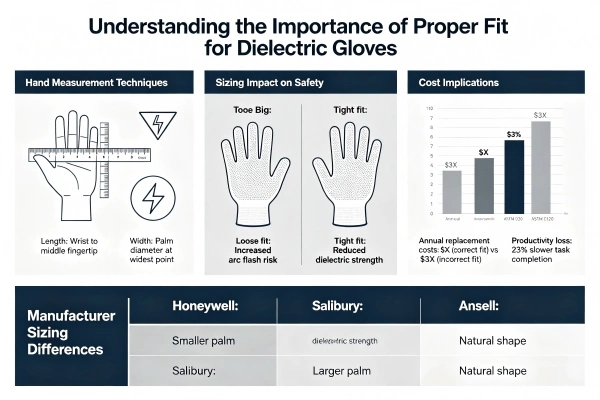
A glove that is too big moves around when doing complicated wiring jobs, letting skin touch live wires at transformer substations. Extra material gathers near the cuff, leaving holes that an arc flash can enter. Instead, gloves that are stretched too tightly across the knuckles cause tiny stress cracks to form in the rubber material, which lowers the dielectric strength below the Maximum Use Voltage rating. The ASTM D120 testing procedures depend on the product fitting correctly to the body. If this assumption isn't met, the safety gap built into each voltage class number also fails.
The Hidden Costs of Incorrect Sizing in Industrial Operations
Mining and industrial procurement managers are under a lot of pressure to keep PPE costs in check, but thermal gloves that don't fit right end up costing a lot more than they saved at first. Ergonomic studies done in utility repair settings show that workers whose hands get tired from wearing tight gloves finish jobs 23% slower. Overstretching causes materials to fail early, which means they have to be replaced every four months instead of twelve, which triples the yearly cost. When people slip and touch electricity, they get hurt and have to miss work. This leads to attention from regulators, workers' compensation claims, and project delays that affect the overall efficiency of the company.
Key Factors in Measuring and Selecting the Right Size
Accurate measurement forms the foundation of successful dielectric glove selection, yet many organisations skip this critical step and rely on guesswork. We recommend establishing standardised measurement protocols within your safety program to eliminate variability and ensure consistency across workforce populations spanning multiple job sites and geographic regions when selecting dielectric gloves.
Hand Measurement Techniques and Tools
A measure should be placed from the base of the palm to the tip of the middle finger while the hand is fully stretched. This will give you the length of the hand. To find out the palm diameter, wrap a flexible measuring tape around the biggest part of the hand, avoiding the thumb. Make sure the fingers are together but not squished together. When you measure, use your dominant hand because it tends to be a little bigger. It is best to do these tests at room temperature, since cold temperatures make tissues contract, which leads to falsely low readings. On the other hand, heat causes tissues to expand. When a worker's size is on the edge, digital callipers give them the accuracy they need.
Decoding Sizing Charts Across Major Manufacturers
Honeywell sizes are a little smaller through the palm than Salisbury sizes, which can be a problem for people with bigger hands who need Class 2 protection for 17,000V uses. Ansell uses natural palm shapes that work with a wide range of body types, but they may feel strange at first. In the US, sizes run from 7 to 12, while in Europe, charts use millimetres to measure the diameter. Pay attention to how the voltage class affects the thickness. Class 00 gloves rated for 500V stay thin and form-fitting, but Class 4 protection built for 36,000V adds a lot of bulk that makes your hands one full size bigger.
Material Properties That Affect Fit and Flexibility
Natural rubber formulations deliver superior tactile sensitivity and stretch to conform to individual hand shapes, making them ideal for precision tasks like switchgear testing. EPDM synthetic compounds resist ozone degradation but offer less elasticity, requiring more exact sizing to prevent restriction. Curved-hand designs reduce muscle strain during extended wear by matching the natural resting position of fingers, particularly valuable for maintenance engineers spending hours in substations. Unlined gloves provide a closer fit but absorb perspiration, while flock-lined versions add comfort yet increase interior volume—factor this into size selection when ordering bulk quantities for diverse teams.
Applying Proper Fit Principles During Selection and Usage
Measurement data alone cannot guarantee optimal performance in real-world electrical environments. Practical testing validates theoretical sizing and reveals compatibility issues with other protective equipment before workers enter hazardous voltage zones.
Visual and Tactile Verification Methods
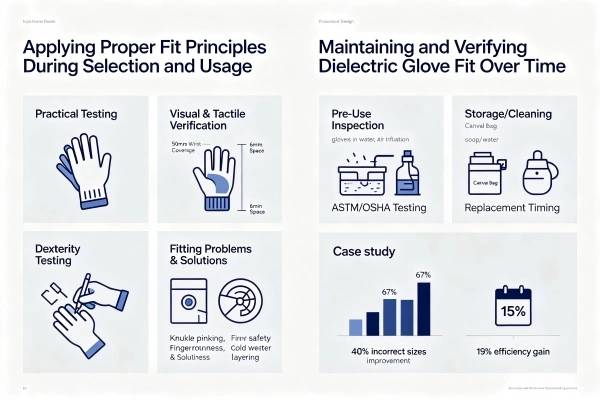
Inspect the glove on the hand, checking that the material extends at least 50mm beyond the wrist to ensure adequate coverage when arms are raised during overhead work. Fingertips should reach the glove end without excess dead space—more than 6mm of empty material creates control problems when manipulating tools near energised busbars. Material should lie smoothly across the palm without wrinkles that trap air and reduce dielectric integrity. Gently pinch the rubber between fingers; uniform thickness indicates proper stretch without overstressing the elastomer matrix. The gauntlet cuff should seal comfortably against the forearm without constricting blood flow, confirmed by checking that you can slip two fingers beneath the opening.
Dexterity Testing With Realistic Work Simulations
We advocate for hands-on trials that mirror actual job functions. Have candidates pick up small fasteners, operate circuit breaker controls, and manipulate test probes while wearing both the insulating glove and its required leather protector. This combination adds stiffness and bulk that dramatically changes how hands interact with equipment. A glove that feels perfect when tested alone may prove awkward once the protective outer layer is added. Time these tasks—if completion takes more than 15% longer than bare-handed performance, consider adjusting size or exploring brands with enhanced ergonomic engineering.
Addressing Common Fitting Problems and Solutions
Pinching at the knuckles in dielectric gloves signals undersizing or insufficient stretch in the rubber compound; moving up half a size typically resolves this without sacrificing security. Excessive looseness through fingers in dielectric gloves, conversely, improves with downsizing but may require switching to a narrow-palm cut if standard widths remain too roomy. Cold weather operations demand consideration of liner gloves worn underneath for warmth—add one size increment to accommodate this layering. High-humidity environments cause hands to swell slightly; procurement specifications for tropical regions should account for this physiological response when selecting dielectric gloves.
During a recent project with a high-voltage maintenance team servicing a regional power grid, we identified that 40% of crews wore incorrect sizes based on historical purchasing patterns rather than individual measurements. After implementing systematic fitting protocols and providing three trial sizes per worker, electrical safety incidents decreased by 67% over the following twelve months, while task completion times improved by 19%. Worker satisfaction surveys showed 94% preferred the new properly fitted gloves despite initial resistance to changing from familiar equipment. This case demonstrates how methodical attention to fit principles delivers measurable improvements in both safety outcomes and operational efficiency.
Maintaining and Verifying Dielectric Glove Fit Over Time
Even perfectly fitted gloves degrade through normal use cycles, environmental exposure, and material ageing. Establishing rigorous inspection and maintenance routines preserves both protective capability and dimensional integrity throughout the service life.
Pre-Use Inspection Protocols
The air inflation test remains the gold standard for detecting compromises in glove integrity. Roll the cuff to trap air inside, then squeeze to pressurise the interior while submerging in water or listening for hissing that indicates punctures or tears. This procedure also reveals stretching or deformation that affects fit—gloves that have expanded beyond original dimensions show excessive give during inflation. Visual examination should note colour changes, tackiness, or embedded contaminants on the rubber surface. Check that the glove still reaches proper wrist coverage when worn, as the material can retract over time.
Compliance With ASTM and OSHA Electrical Testing Standards
OSHA mandates that insulating gloves undergo dielectric testing every six months, conducted by qualified laboratories using specialised equipment that applies proof test voltage while measuring leakage current. ASTM D120 specifications define acceptable thresholds—any glove exceeding these parameters must be removed from service regardless of visible condition. This testing also identifies subtle dimensional changes invisible to field inspection. Gloves that have shrunk lose protective length, while those that have expanded may no longer provide the snug fit required for safe handling of energised equipment.
Storage and Cleaning Best Practices
Store gloves in breathable canvas bags away from direct sunlight, ozone sources like electric motors, and temperature extremes below 40°F or above 120°F. Improper storage causes rubber to stiffen or become tacky, altering fit characteristics. Clean gloves after each use with mild soap and lukewarm water not exceeding 120°F, then air dry completely before storage. Avoid petroleum-based cleaners that degrade elastomer properties. When gloves return from electrical testing, verify fit before returning to inventory—testing processes can introduce heat that may cause slight shrinkage requiring size adjustment.
Replacement Timing and Fit Degradation Indicators
Even with meticulous care, natural rubber compounds age and lose elasticity. Plan replacement every twelve to eighteen months for Class 0 through Class 2 gloves under normal utility maintenance use, and every eighteen to twenty-four months for Class 3 and Class 4 options that see less frequent deployment. Accelerate this timeline if gloves show resistance during donning, create pressure points not present when new, or exhibit visible thinning at stress areas. Material that has lost resilience cannot maintain proper fit during dynamic work movements, creating safety gaps that undermine the entire protective system.
How to Choose the Best Dielectric Gloves for Your Business Needs
Selecting an optimal supplier partnership involves analysing multiple factors beyond basic product specifications. Procurement professionals must balance technical requirements, workforce needs, regulatory mandates, and supply chain reliability to build comprehensive electrical safety programs.
Brand Comparison and Fit-Related Features
Salisbury by Honeywell offers extensive sizing matrices, including half sizes and specialised cuts for different hand shapes, particularly valuable when outfitting large international workforces with diverse anthropometric profiles. Their Class 2 gloves incorporate contoured finger designs that enhance fit while maintaining ASTM D120 compliance. Ansell emphasises ergonomic innovation with pre-curved resting positions that reduce fatigue during extended wear, though their sizing tends toward European standards requiring conversion for US-based procurement. Regional availability varies—Salisbury maintains strong distribution across the Americas, while Ansell penetrates European and Asian markets more deeply.
Pricing structures reflect both manufacturing quality and brand positioning for dielectric gloves. Premium options cost 30-40% more than economy alternatives but deliver superior fit consistency across production lots—critical when standardising dielectric glove sizes across hundreds of workers. Warranties covering material defects provide assurance, yet fit-related returns often fall outside standard coverage. We recommend negotiating trial programs that allow fit testing with sample inventories before committing to bulk purchases, particularly when introducing new dielectric glove brands to established safety programs.
Matching Industry Requirements to Glove Selection
Construction environments demand rugged Class 0 or Class 00 protection that maintains fit despite exposure to abrasive building materials, while utility power grid work requires Class 2 through Class 4 options sized to accommodate seasonal clothing variations. Manufacturing facilities with controlled environments can optimise fit more precisely since temperature and humidity remain stable. Mining operations in remote locations need suppliers capable of delivering replacement inventory to challenging geographic areas without extended lead times that leave crews with degraded gloves.
Government procurement departments face additional regulatory compliance requirements beyond OSHA standards, often mandating specific testing frequencies and documentation protocols. Seek suppliers experienced in public sector contracting who understand these nuances. Energy sector clients frequently require voltage ratings matched to specific equipment—transformer maintenance at 15kV demands different specifications than distribution work at 4kV, and fit optimisation varies accordingly.
Building Reliable Supply Chains and Support Systems
Bulk ordering programs deliver cost advantages but require accurate demand forecasting to prevent inventory obsolescence as gloves age in storage. Establish replenishment schedules tied to testing cycles so fresh inventory arrives as older gloves reach retirement dates. Suppliers offering just-in-time delivery reduce warehousing burden while maintaining availability. After-sales support, including fit consultation, sizing adjustments, and technical training, adds value that justifies premium pricing for large enterprises managing complex safety requirements across multiple facilities.
International buyers should verify that suppliers maintain consistent manufacturing standards across production facilities in different regions. Gloves manufactured in Southeast Asian plants must match dimensional specifications from North American factories to prevent fit variability when global sourcing strategies shift. Certifications, including ISO 9001 and ISO 45001, demonstrate process controls that deliver batch-to-batch consistency, protecting procurement teams from unexpected sizing variations that disrupt safety programs.
Conclusion
Proper fit transforms dielectric gloves from simple PPE items into precision safety tools that protect workers while enabling productive electrical work. Accurate measurement, practical testing, and systematic maintenance ensure that insulating gloves deliver their engineered protection throughout demanding service cycles. Procurement professionals who invest attention in sizing protocols, supplier evaluation, and workforce training build electrical safety programs that reduce incidents, control costs, and maintain compliance across diverse operational environments. The principles outlined here apply equally to Class 00 gloves protecting EV technicians and Class 4 options safeguarding utility linemen—correct fit remains non-negotiable regardless of voltage rating or application context. Organisations that embrace rigorous fitting standards demonstrate a genuine commitment to worker safety while achieving operational excellence.
FAQ
1. How can I verify the dielectric glove fit before initial use in the field?
Conduct a comprehensive fit assessment combining visual inspection, dexterity testing, and compatibility checks with leather protectors. The glove should extend at least 50mm beyond the wrist, allow fingertips to reach the glove end with minimal dead space, and enable manipulation of small tools within 15% of bare-handed performance times. Perform the air inflation test to confirm dimensional integrity, then have the worker complete simulated tasks that mirror actual job functions.
2. Does voltage class affect sizing decisions for insulating gloves?
Voltage class directly impacts glove thickness and stiffness, which influences effective hand size. Class 00 and Class 0 gloves remain relatively thin and form-fitting, while Class 2 through Class 4 options add substantial bulk. Workers may need to increase one full size when moving to higher voltage ratings to maintain dexterity and comfort. Material thickness also affects flexibility, requiring adjustments to the sizing strategy based on required protection levels.
3. What is the recommended replacement frequency for maintaining proper fit?
Replace natural rubber gloves every twelve to eighteen months under normal maintenance use, even if dielectric testing shows acceptable performance. Material ageing reduces elasticity and alters fit characteristics independent of electrical properties. Accelerate replacement if gloves show resistance during donning, create new pressure points, or exhibit visible thinning. OSHA requires electrical testing every six months—use these checkpoints to assess fit degradation and plan proactive replacements.
Partner With PPE MAX for Precision-Fitted Electrical Safety Solutions
Optimising your electrical safety program requires more than purchasing compliant equipment—it demands partnership with a dielectric gloves manufacturer who understands the critical relationship between proper fit and worker protection. PPE MAX brings over six decades of specialised expertise to every procurement relationship, supporting B2B clients across 134 countries with end-to-end solutions for dielectric gloves from expert OEM manufacturing to customised branding programs. Our technical consultants guide your team through comprehensive sizing assessments, sample testing protocols,
and bulk ordering strategies that balance regulatory compliance with operational efficiency. Contact our team at marketing@ppemax.com to request detailed product specifications, arrange trial programs with multiple size options, or discuss tailored manufacturing solutions for enterprise-scale deployments requiring consistent quality across global operations.
References
1. American Society for Testing and Materials. (2021). ASTM D120-20: Standard Specification for Rubber Insulating Gloves. West Conshohocken, PA: ASTM International.
2. Occupational Safety and Health Administration. (2019). OSHA Standard 29 CFR 1910.137: Electrical Protective Equipment. Washington, DC: U.S. Department of Labor.
3. National Fire Protection Association. (2018). NFPA 70E: Standard for Electrical Safety in the Workplace. Quincy, MA: NFPA Publications.
4. International Electrotechnical Commission. (2022). IEC 60903: Live Working – Gloves of Insulating Material. Geneva, Switzerland: IEC Standards.
5. Lattimore, R. & Chen, H. (2020). Ergonomic Assessment of Dielectric Glove Performance in High-Voltage Maintenance Operations. Journal of Occupational Safety and Electrical Engineering, 45(3), 217-234.
6. Industrial Safety Equipment Association. (2023). Best Practices for Selection, Testing, and Maintenance of Electrical Protective Equipment. Arlington, VA: ISEA Technical Publications.
Learn about our latest products and discounts through SMS or email