- English
- French
- German
- Portuguese
- Spanish
- Russian
- Japanese
- Korean
- Arabic
- Greek
- German
- Turkish
- Italian
- Danish
- Romanian
- Indonesian
- Czech
- Afrikaans
- Swedish
- Polish
- Basque
- Catalan
- Esperanto
- Hindi
- Lao
- Albanian
- Amharic
- Armenian
- Azerbaijani
- Belarusian
- Bengali
- Bosnian
- Bulgarian
- Cebuano
- Chichewa
- Corsican
- Croatian
- Dutch
- Estonian
- Filipino
- Finnish
- Frisian
- Galician
- Georgian
- Gujarati
- Haitian
- Hausa
- Hawaiian
- Hebrew
- Hmong
- Hungarian
- Icelandic
- Igbo
- Javanese
- Kannada
- Kazakh
- Khmer
- Kurdish
- Kyrgyz
- Latin
- Latvian
- Lithuanian
- Luxembou..
- Macedonian
- Malagasy
- Malay
- Malayalam
- Maltese
- Maori
- Marathi
- Mongolian
- Burmese
- Nepali
- Norwegian
- Pashto
- Persian
- Punjabi
- Serbian
- Sesotho
- Sinhala
- Slovak
- Slovenian
- Somali
- Samoan
- Scots Gaelic
- Shona
- Sindhi
- Sundanese
- Swahili
- Tajik
- Tamil
- Telugu
- Thai
- Ukrainian
- Urdu
- Uzbek
- Vietnamese
- Welsh
- Xhosa
- Yiddish
- Yoruba
- Zulu
Do Your Class 1 Insulating Gloves Pass the Air Inflation Test?
Founded in 1956, PPEMAX stands as a premier global manufacturer and supplier of full-range personal protective equipment. All our products comply with internationally recognized standards including IEC, ASTM, CE, UKCA, NIOSH and ISO9001. Equipped with a 2,000-square-meter modern production plant, we boast over 25 years of mature OEM & ODM capabilities to deliver one-stop customized solutions covering R&D design through worldwide logistics. Our safety gear is distributed across 134 countries globally. Upholding our core tenet “Safety First, Quality Priority”, we serve as a dependable long-term PPE partner for industrial enterprises around the world.
Quality Class 1 Insulating Gloves should pass the air inflation test—a critical field inspection that detects invisible punctures and defects before exposure to electrical hazards. If your gloves don't hold air pressure without leaking, they may have micro-perforations that compromise their 7,500-volt protection rating. This simple test protects workers from potentially fatal shocks by ensuring the glove's dielectric integrity remains intact between formal electrical testing cycles, making it an indispensable safety checkpoint.

|
Parameter |
Specification |
|
Voltage Rating |
7,500V AC / 11,250V DC (Maximum Use) |
|
Proof Test Voltage |
10,000V AC / 40,000V DC |
|
Material Type |
Type I (Natural Rubber) / Type II (EPDM Synthetic) |
|
Thickness Range |
1.02mm - 1.52mm |
|
Tensile Strength |
>17.2 MPa |
|
Standards Compliance |
ASTM D120, IEC 60903 |
|
Temperature Resistance |
Category A, H, Z rated |
|
Label Color |
White (Class 1 Standard) |
The Air Inflation Test Explained: Why It Matters for Class 1 Insulating Gloves
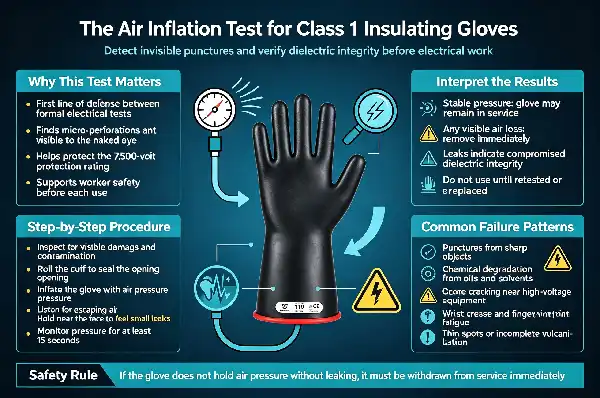
The air inflation test is your first line of defense against hidden glove failures between formal electrical testing sessions. This field-level checking method finds problems that can't be seen with the naked eye, which is why it's an important part of everyday safety procedures.
Understanding the Purpose and Mechanics of Air Inflation Testing
The air expansion test is based on a simple idea: adding air to the glove causes pressure inside that shows any tiny holes, problems with the seal, or wear and tear that can't be seen with the naked eye. When you seal the cuff and blow up the glove, any loss of pressure means that the integrity has been compromised, which could let electricity flow to the wearer's hand.
This method doesn't damage the Class 1 Insulating Gloves and only takes minutes to do. It also gives you immediate feedback on their condition. Air expansion testing can be done in the field before each use, unlike electrical testing, which needs special tools and a lab setting. This adds another important safety step to your electrical safety program.
Step-by-Step Procedure for Accurate Testing
To do an accurate air pressure test, you need to be careful with your method and pay close attention to the details. First, look at the glove to see if it has any obvious damage, foreign objects stuck inside it, or surface contamination. Seal the hole by rolling the cuff. Then, slowly roll the glove from the fingers to the cuff to fill it with air. For uniformity, some techs like to use mechanical inflation devices.
Listen carefully for air escaping and keep an eye out for deflation. Hold the inflated glove up to your face to find air leaks. The skin on your face is very sensitive, so even small pressure drops will show up. Pay extra attention to the seams on your fingers, the palm, and areas that have already been fixed. The hard pressure should stay on the whole glove for at least 15 seconds without letting up.
Interpreting Results and Common Failure Patterns
If a glove keeps its pressure during the test, it means that the dielectric integrity is still good, and it can be put to use. But any air loss that can be seen needs to be taken out of service right away, and the electrical system needs to be tested again or replaced. Punctures from sharp objects going through leather protectors, chemical breakdown from bad storage or cleaning products, and ozone cracking from being in the environment are all common reasons why things break.
Material wear and tear from repeated bending builds up at high-stress areas like the wrist crease and the joints in the fingers. Manufacturing flaws are rare in good products, but they can show up as thin spots or not enough vulcanization. Knowing these trends of failure helps buying managers check the quality of suppliers and set up safe storage methods.
Class 1 Insulating Gloves Testing, Maintenance, and Best Practices
Insulating gloves can be turned from just a piece of equipment into a reliable safety system by setting up thorough testing and repair procedures. How well your company takes care of gloves has a direct effect on keeping workers safe and following the rules.
Mandatory Testing Intervals and Compliance Requirements
Once rubber insulation gloves are in use, they must be tested for electrical safety every six months. This is a rule that can't be changed and is at the heart of electrical PPE programs. Gloves that are still in stock can stay ready to sell for up to a year before they need to be electrically tested again. These gaps show how rubber materials slowly lose their dielectric properties, even when they are not being used. This happens because environmental factors weaken them over time.
For each official electrical test, only qualified testing facilities with properly calibrated high-voltage equipment can do it. The gloves are put in water and put under a proof test voltage. Any current loss shows that the dielectric has failed. Keeping track of testing dates, results, and glove ID numbers provides the audit trail needed to meet OSHA standards and protect against risk.
Daily Inspection Routines That Prevent Failures
Besides regular tests, daily checks before use can find problems before they hurt someone. Before each use, the air inflation test should be done, and the surface should also be looked at visually for cuts, punctures, bits stuck in the material, or changes that could mean chemical exposure. It's important to check leather protector gloves for worn spots that no longer protect the rubber layer from damage.
Workers should be taught to spot subtle warning signs of material degradation, such as changes in color, stiffness, or tackiness that don't seem right. Any situation that makes you think the glove might not be safe should be taken out of service until a professional can confirm it is safe. This cautious method might seem expensive when it comes to replacing equipment, but it saves people from getting hurt by electricity, which has an unimaginable value.
Real-World Impact of Disciplined Maintenance
After making daily air inflation testing and electrical retesting every six months, a big utility company in the southwestern United States saw a 73% drop in electrical contact incidents. Their safety program used strict inspection procedures and centralized management of gloves to make sure that no gloves went past their service life limits or missed testing deadlines. The money spent on testing equipment and training paid off when there were fewer workers' compensation claims, no more deaths, and better compliance with regulations.
Gloves that get dirty from industrial processes are especially problematic in places that make things. One car company set up special places to store gloves that were away from chemical exposure. They also used ultraviolet inspection lights to find even the tiniest amounts of contamination, and they kept track of each glove's usage hours instead of just calendar time. These steps increased the average glove's service life by 40% and made protection more reliable.

If you're evaluating personal protective equipment suppliers and require batch-specific testing documents before placing an order, PPE MAX is able to provide official Certificates of Analysis, professional laboratory test reports, and product samples for your verification. Feel free to contact our team at marketing@ppemax.com to discuss your sourcing needs and obtain complete documentation for your quality assessment and procurement approval.
Choosing the Right Class 1 Insulating Gloves for Your Business Needs
When buying electrical insulation gloves, more than just the voltage number is taken into account. Knowing how different types of gloves and makers perform lets purchasing managers make the most of both worker safety and business funds.
Comparing Voltage Classes and Application Suitability
Class 1 gloves are in the middle of the range of insulating Class 1 Insulating Gloves, between Class 0 gloves (which can handle up to 1,000V AC) and Class 2 gloves (17,000V AC). This range of voltage works wonderfully with power distribution systems, industrial electrical equipment, and business power setups. Class 1 protection is enough for workers who deal with home service lines, small industrial machinery, or telecommunications infrastructure. They don't need the extra bulk and limited dexterity of higher-rated gear.
Choosing between Type I natural rubber and Type II manufactured materials has an effect on how well they work. Natural rubber is more flexible and sensitive to touch, which makes it easier to do complicated tasks while wearing it for long periods of time. But manufactured EPDM versions are better at resisting ozone cracking and UV degradation, which means they last longer in outdoor uses and storage conditions that change. At PPE MAX, our manufacturing team can help customers choose the best material for their needs based on the conditions they will be working in.
Quality Variations Among Leading Manufacturers
Well-known names like Honeywell, Ansell, and Grainger have built their reputations on reliable quality and a wide range of support services. PPE MAX is a star in its field and has been making products for 65 years. It has state-of-the-art factories and can serve 134 countries through its global supply chain. Before being sent out, our quality control system makes sure that every glove meets or beats international standards.
Prices vary between producers because of changes in the quality of the materials used, the consistency of the production process, and the accuracy of the certification. While cheap options might meet the bare minimum, they lack the durability and comfort features that keep workers from getting tired after long periods of use. Premium products have better ozone resistance, ergonomic designs, and better grip surfaces that make up for their higher initial costs through longer service life and better safety compliance.
Procurement Strategies for Bulk Orders and Supply Chain Optimization
When buying in bulk, especially when buying from other countries, approval validity needs to be checked. Managers in charge of buying things should ask for all the certification paperwork, such as test results for ASTM D120 and IEC 60903, information about each batch of products made, and quality assurance procedures. When you work with manufacturers directly instead of distributors, you can often get better prices, more customization choices, and faster access to expert help.
At PPE MAX, we offer low bulk prices and low minimum order amounts that are made to fit the needs of businesses. Individual polybags are used for distribution in the field, and strong cartons are used for keeping in warehouses. Distributors can keep their brand's identity while getting quality and prices directly from the manufacturer with custom packaging options. On-site training for proper use and maintenance is part of technical support services. This makes sure that your employees get the most protection from their safety gear.
How to Buy and Source Class 1 Insulating Gloves with Confidence
Finding real electrical insulation gloves requires careful screening and approval of suppliers. Forgery or poor-quality PPE can lead to more than just fines from the government; it can also cause accidents at work that could be deadly.
Identifying Reputable Suppliers and Distribution Channels
Established wholesale distributors with specialized electrical safety departments have strict procedures for qualifying suppliers and testing products. These middlemen add value by providing expert technical support, keeping track of supplies, and combining shipping from different makers. But when you work directly with makers like PPE MAX, you don't have to pay markups, and you can get customizable options and production know-how.
Some of the biggest online stores, like Amazon and Grainger, make it easy to buy common items and get them quickly. When you buy something through these channels, make sure the seller is who they say they are and read the product listings carefully to see all the specifications and certification information. Be wary of prices that seem too low to be true; they could mean that the goods are fakes or that they are getting close to the end of their shelf life.
Certification Verification and Quality Assurance
Genuine Class 1 Insulating Gloves have permanent markings that show the voltage rating, the date they were made, the size, and the certification standards. Ask for proof that you follow ASTM D120, IEC 60903, and any other area standards that apply. Manufacturers with a good reputation give test reports for each batch that include results from electrical proof testing, measurements of physical properties, and quality control checks.
Every glove that PPE MAX makes in our Xi'an facilities can be fully tracked. Our quality management system keeps track of where the raw materials come from, the parameters of production, the results of electrical tests, and the data from the final inspection. This openness gives people who work in procurement confidence that every purchase meets safety standards and works well for as long as it's supposed to.
Building Strategic Partnerships with Safety Equipment Suppliers
Long-term ties with suppliers are good for more than just one purchase. Preferred seller deals with companies like PPE MAX to make sure that products are always available, that customers get priority during supply chain problems, and that customers can get access to new products. Collaborative planning helps make sure that inventory levels are in line with yearly demand patterns while keeping costs and the risk of items going out of style to a minimum.
Some technical parts of a relationship are creating training programs, giving advice on safety protocols, and helping with investigations into accidents. Our team goes to customer sites to look at the needs of the application and suggest the best way to set up the equipment. We go to big events in our field, like the A+A Safety Exhibition in Germany, so procurement professionals can look at our products and talk to our engineering staff in person about any customization needs.
Conclusion
As part of comprehensive electrical safety programs, the air inflation test is a simple but useful tool. Along with official electrical testing every six months and daily eye checks, this field-level verification method makes sure that Class 1 Insulating Gloves keep their protective properties for as long as they are used. Purchasing managers who put an emphasis on quality products from reputable manufacturers, enforce strict upkeep procedures, and spend money on teaching workers create safety cultures that keep workers from getting hurt by electricity while also lowering the costs of equipment over its lifetime. Pre-use air expansion testing only takes a short amount of time, but it saves a lot of lives because it finds problems with gloves before they put workers at risk.
FAQ
1. How often should I perform the air inflation test on electrical insulating gloves?
As a field-level check to see if any damage has happened since the last official electrical testing, do the air-filling test before each use. This daily check is in addition to the electrical tests that must be done every six months. Together, they provide extra safety against glove breakdowns. The few minutes needed for inflation testing are a small price to pay for the highest level of safety.
2. What should I do if gloves fail the air inflation test?
Take worn-out gloves out of service right away and label them so they don't get used by chance. Do not try to fix insulating gloves in the field; dielectric integrity that has been compromised can not be reliably restored outside of professional testing facilities. Send failed gloves back for official electrical testing to find out if they can be recertified or need to be thrown away according to rules for toxic waste.
3. Can Class 1 gloves be used for voltages below their maximum rating?
It is safe to use Class 1 gloves that are rated for 7,500 volts AC for lower voltage tasks, but they might not be as flexible as Class 00 or Class 0 gloves that are made for those voltage ranges. But you should never use gloves with a lower rating on systems that are over their maximum voltage rating, because voltage class shows the absolute safety limits with no room for error.
Partner with PPE MAX for Certified Electrical Safety Solutions
Every worker who relies on solid safety gear is affected by choices about how to buy it. Every time PPE MAX works with a Class 1 Insulating Gloves supplier, they bring 65 years of experience making high-quality products that meet international standards and last long enough for use in the field. Our factories in Xi'an use high-tech quality control systems to make sure that all 134 countries we serve get the same level of service. Contact our team at marketing@ppemax.com to talk about custom bulk prices for your purchases, to get free product samples to test in the field, or to set up expert advice about how to make your electrical safety program work better. We give your employees the approved safety they need and the supply chain dependability your business needs.
References
1. American Society for Testing and Materials. (2019). ASTM D120-19: Standard Specification for Rubber Insulating Gloves. West Conshohocken, PA: ASTM International.
2. International Electrotechnical Commission. (2018). IEC 60903:2018 - Live Working – Gloves of Insulating Material. Geneva: IEC Standards.
3. Occupational Safety and Health Administration. (2020). OSHA 29 CFR 1910.137: Electrical Protective Equipment Standards and Compliance Guidelines. Washington, DC: U.S. Department of Labor.
4. National Fire Protection Association. (2021). NFPA 70E: Standard for Electrical Safety in the Workplace. Quincy, MA: NFPA Publications.
5. Cadick, J., Capelli-Schellpfeffer, M., & Neitzel, D. (2021). Electrical Safety Handbook (5th ed.). New York: McGraw-Hill Education.
6. IEEE Standards Association. (2020). IEEE Guide for In-Service Maintenance and Electrical Testing of Live-Line Tools. Piscataway, NJ Institute of Electrical and Electronics Engineers.
Learn about our latest products and discounts through SMS or email