- English
- French
- German
- Portuguese
- Spanish
- Russian
- Japanese
- Korean
- Arabic
- Greek
- German
- Turkish
- Italian
- Danish
- Romanian
- Indonesian
- Czech
- Afrikaans
- Swedish
- Polish
- Basque
- Catalan
- Esperanto
- Hindi
- Lao
- Albanian
- Amharic
- Armenian
- Azerbaijani
- Belarusian
- Bengali
- Bosnian
- Bulgarian
- Cebuano
- Chichewa
- Corsican
- Croatian
- Dutch
- Estonian
- Filipino
- Finnish
- Frisian
- Galician
- Georgian
- Gujarati
- Haitian
- Hausa
- Hawaiian
- Hebrew
- Hmong
- Hungarian
- Icelandic
- Igbo
- Javanese
- Kannada
- Kazakh
- Khmer
- Kurdish
- Kyrgyz
- Latin
- Latvian
- Lithuanian
- Luxembou..
- Macedonian
- Malagasy
- Malay
- Malayalam
- Maltese
- Maori
- Marathi
- Mongolian
- Burmese
- Nepali
- Norwegian
- Pashto
- Persian
- Punjabi
- Serbian
- Sesotho
- Sinhala
- Slovak
- Slovenian
- Somali
- Samoan
- Scots Gaelic
- Shona
- Sindhi
- Sundanese
- Swahili
- Tajik
- Tamil
- Telugu
- Thai
- Ukrainian
- Urdu
- Uzbek
- Vietnamese
- Welsh
- Xhosa
- Yiddish
- Yoruba
- Zulu
What Are the Top Benefits of Full Mask Respirators?
By sealing off the eyes, nose, and mouth with a full-mask respirator, full-mask respirators protect the whole face from harmful contaminants. In contrast to half-mask options, these full-mask respirator devices protect both the eyes and the lungs at the same time, with Assigned Protection Factors hitting 50 in negative pressure setups. A better seal is made around the face, lips, and chin to keep out dangerous particles, gases, and vapours. Built-in eye shields keep out irritants as well. This all-around method fills in important safety gaps in high-risk industrial settings where workers are exposed to acid vapours, volatile organic compounds, and tiny fibres that can hurt their eyes and lungs.
Understanding Full Mask Respirators: Safety Beyond Basics
Since 1956, at PPE MAX, we've seen how proper breathing protection changes the safety of the workplace. Our breathing devices that cover the whole face make a secure border seal that changes the way workers deal with dangerous surroundings in a basic way. There is a big difference between partial and full face protection that goes beyond just coverage area. It changes the way we think about workplace health.
Complete Facial Coverage and Superior Sealing
The tech behind our lung protection solutions is based on using medical-grade thermoplastic elastomers and silicone. Even at very high or very low temperatures, these materials stay flexible and don't let chemicals through. The 5-point changeable belt spreads pressure out evenly, so the seal doesn't get compromised when you move quickly. Our wide-view plastic glasses meet ANSI Z87.1 standards for impact protection, and hydrophilic coats keep them from fogging up, which could stop work from progressing.
Advanced Filtration Technology
Multilayer filter tubes connect with standard bayonet connectors, which lets the field change quickly without lowering protection. Depending on the dangers in the surroundings, our systems can use dust screens, gas cartridges, or mixed units. The two intake valves make breathing much easier than with a single valve, which helps keep workers from getting tired during long shifts. Center-mounted exhaling valves effectively remove inhaled air and moisture, keeping you comfortable even during hard work.
International Certification Standards
Global buying teams need to make sure that all countries are following the rules. Our breathing apparatuses are approved by NIOSH under 42 CFR Part 84, have a CE mark for sales in Europe, and are certified to AS/NZS 1716 for use in Australia and New Zealand. Based on the standard of the elements and structure, EN 136 rating sets performance levels for Class 1, 2, and 3. We keep all of our product lines up to date with approvals, which makes it easier for multinational companies that buy PPE from our factories in Xi'an, China to follow the rules.
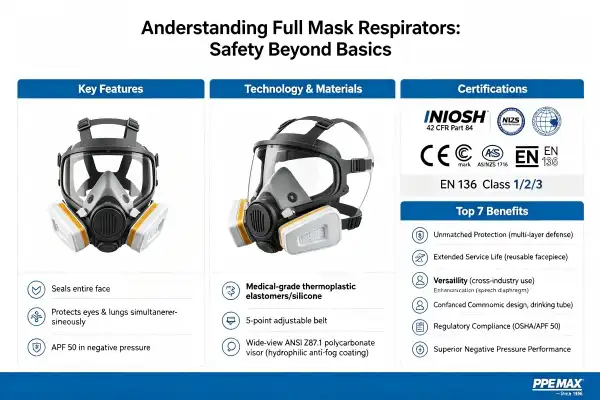
Top 7 Benefits of Using Full Mask Respirators in Industrial and Health Settings
Our decades serving industries across 134 countries have revealed patterns in how Full Mask Respirator protection impacts operational outcomes. These advantages extend beyond regulatory checkboxes to deliver measurable improvements in worker safety, productivity, and cost management through the use of Full Mask Respirator equipment.
Unmatched Protection Through Multi-Layer Defense
The main benefit is that it protects against various radiation routes at the same time. Chemical factories often have multiple threats at the same time. For example, chlorine gas can hurt the lungs, and formaldehyde vapours can irritate the eye tissue. Half-mask systems need separate safety glasses, which can break the seal and make workers uncomfortable. Our combined method gets rid of these holes. Polycarbonate visors protect against splash dangers up to certain speeds, and screens get rid of airborne contaminants before they can be breathed in.
Extended Service Life and Cost Efficiency
Reusability changes the costs of lung safety measures in a big way. While throwaway N95 masks only last for one shift, our rubber facepieces can be used for years as long as they are kept clean. Filters that need to be replaced are much cheaper than whole respirator units. This lets safety managers keep protection levels high while keeping costs down. This benefit is shown by industrial painting jobs that use isocyanate-based coatings: workers who do several spray sessions every day need to change the filter often, but the facepiece can be used for the whole project.
Versatility Across Diverse Applications
When organising goods across different types of sites, procurement workers like tools that can be used in a variety of ways. Our breathing devices are used in emergency response, mining, building, asbestos removal, chemical processing, and making medicines. Different filter types can fit into the same facepiece, which lets businesses standardise their core equipment while making refills that are specific to dangers. When compared to handling different mask systems for each type of application, this connectivity makes training easier and upkeep tasks simpler.
Enhanced Communication Capabilities
Speech diaphragms represent a frequently undervalued feature that dramatically affects operational efficiency. Clear verbal communication prevents errors in noisy industrial environments where hand signals prove insufficient. Our integrated voice transmission systems preserve voice clarity without compromising seal integrity, supporting team coordination during complex procedures. Emergency response scenarios particularly benefit from this capability when incident commanders must issue rapid instructions to personnel operating in contaminated zones.
Comfort Features Supporting Extended Wear
Worker compliance directly correlates with comfort during long shifts. Our ergonomic design distributes weight evenly while soft silicone contact surfaces prevent pressure points that cause headaches or facial fatigue. The optional drinking tube allows hydration without breaking the seal—a critical feature during hot work in chemical protective clothing where heat stress poses serious risks. These seemingly minor details accumulate into significant quality-of-life improvements that boost voluntary compliance with safety protocols.
Regulatory Compliance Assurance
Safety managers face escalating scrutiny from OSHA inspections and equivalent international regulatory bodies. Our Full Mask Respirator devices meet permissible exposure limit requirements for substances requiring APF 50 protection, including asbestos fibers, silica dust, and numerous chemical vapors. Documentation accompanying each Full Mask Respirator unit simplifies compliance verification during audits. We provide testing certificates, material safety data, and maintenance schedules that integrate directly into safety management systems, reducing administrative burden on EHS departments.
Superior Performance in Negative Pressure Environments
Asbestos remediation and heavy contamination response demand reliable protection in challenging conditions. The complete facial seal becomes essential when operating in containment zones where negative pressure differentials could draw contaminants through compromised seals. Our respirators maintain integrity across pressure variations, providing consistent protection factor performance that half-mask alternatives cannot match. This reliability proves critical when worker safety margins narrow in extreme exposure scenarios.
How to Maximize the Benefits: Maintenance and Proper Use
Equipment performance depends entirely on adherence to maintenance protocols and proper operational procedures. We've developed these guidelines from direct field experience supporting customers in demanding industrial environments.
Cleaning and Hygiene Protocols
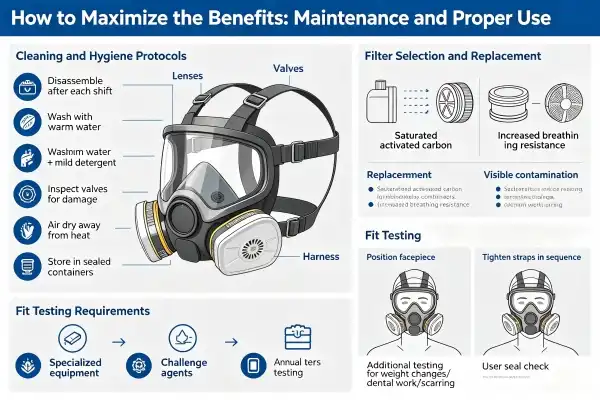
Disassemble the facepiece after each shift, separating lenses, valves, and harness components. Wash all parts in warm water with mild detergent, avoiding petroleum-based cleaners that degrade silicone seals. Inspect exhalation valves for cracks or distortion—damaged valves compromise protection immediately. Air dry all components away from direct heat sources before reassembly. Store respirators in sealed containers protecting them from dust, sunlight, and temperature extremes that accelerate material degradation.
Filter Selection and Replacement
Environmental hazard assessments determine appropriate cartridge types. Organic vapor cartridges contain activated carbon beds that become saturated over time—replacement schedules depend on contaminant concentration and exposure duration. Particulate filters require changing when breathing resistance increases noticeably or visible contamination appears. Combination filters serving dual purposes need evaluation against both criteria. Our technical support team assists with filter selection matching specific workplace conditions, considering factors like humidity, temperature, and contaminant chemistry.
Fit Testing Requirements
Quantitative fit testing using specialized equipment measures actual leakage rates, while qualitative methods employ challenge agents to verify seal integrity. We recommend annual fit testing for all users, with additional testing when workers experience significant weight changes, dental work, or facial scarring. Proper donning technique matters tremendously—workers must understand how to position the facepiece, tighten harness straps in correct sequence, and perform user seal checks before entering hazardous areas. Training programs should include hands-on practice with immediate feedback on common errors.
Making an Informed Purchase: What B2B Clients Should Know
Procurement decisions balancing safety, cost, and supply chain reliability require comprehensive evaluation frameworks. Our experience serving safety distributors, industrial end-users, and government agencies reveals patterns in successful purchasing strategies.
Total Value Assessment Framework
Purchase price represents only one component of lifetime costs. Evaluate warranty coverage, spare parts availability, and technical support responsiveness. We provide comprehensive after-sales service including training programs, maintenance guidance, and emergency replacement coordination. Our global distribution network reaching 134 countries ensures consistent supply even during demand surges—a capability tested during the pandemic when many suppliers failed delivery commitments.
Bulk Purchasing Optimization
Volume discounts significantly impact respiratory protection program budgets. Our flexible pricing accommodates everything from small initial orders for pilot programs to container-load shipments for large workforce deployments. Custom labeling options support safety distributors building proprietary product lines, while OEM manufacturing capabilities serve brands requiring specific design modifications. Negotiation strategies should address payment terms, delivery schedules, and inventory management solutions like consignment programs that reduce carrying costs.
Supplier Reliability Verification
Verify manufacturing capabilities through facility audits when possible—we welcome customer visits to our Xi'an production complex where quality control procedures are transparent and verifiable. Request certification documentation directly from testing laboratories rather than relying solely on supplier claims. Evaluate supplier financial stability and production capacity to ensure long-term partnership viability. Our 65-year operational history demonstrates commitment to the respiratory protection market through multiple economic cycles and technological transitions.
Future Trends and Innovations in Full Mask Respirators
The respiratory protection landscape continues evolving as Full Mask Respirator materials science, sensor technology, and manufacturing techniques advance. Procurement strategies must account for these developments to avoid Full Mask Respirator technology obsolescence and capitalize on emerging capabilities.
Smart Respirator Integration
Emerging devices incorporate environmental sensors monitoring contaminant levels in real-time, alerting wearers when exposure thresholds approach dangerous levels. Communication systems integrate with incident command structures, providing location tracking and biometric data to safety coordinators. These capabilities transform respiratory protection from passive barriers into active safety management tools. We're investing in these technologies while maintaining backward compatibility with existing filter systems, allowing gradual adoption without stranding legacy equipment investments.
Material Science Advancements
New rubber formulations make designs last longer while also making them lighter, which is something that users have been complaining about for a long time. Lens treatments work better against fog without needing extra steps for preparation. New developments in filter media make it easier to breathe while increasing the efficiency of particulate capture. This solves the problem of choosing between comfort and safety, which affects obedience. We keep an eye on these new developments and only put proven technologies into production after field testing shows they work better.
Regulatory Evolution
As agencies react to new threats, global health emergencies speed up changes to certifications. We take an active role in the process of making standards, making sure that our goods meet changing needs before they become law. Instead of reactive compliance scrambles that mess up supply lines and put workers' safety at risk during changeover times, procurement teams should work with suppliers who show this kind of forward-looking approach.
Conclusion
Complete oral breathing protection devices improve safety, working effectiveness, and cost management in ways that can be measured. These devices are necessary for high-risk industry settings because they cover a large area, filter better, last longer, and make sure they follow the rules. At PPE MAX, our 65 years of experience in manufacturing help us make every design choice, from choosing the right rubber material to making the best use of harness shape. We know that people who work in buying need more than just catalogue goods from their sellers. They also need partners who care about worker safety and will provide them with reliable tools, quick help, and new ideas all the time. Our technical skills and global reach help businesses meet the complicated safety standards of a wide range of industries.
FAQ
1. How often should respirator filters be replaced?
Replacement intervals depend on contaminant type, concentration, and exposure duration. Particulate filters require changing when breathing resistance increases noticeably or every 30 days of use. Gas and vapor cartridges need replacement based on breakthrough time calculations considering chemical properties and workplace concentration levels. We provide detailed replacement schedules with each product, customized for common industrial applications. Environmental monitoring data helps refine these schedules for specific workplace conditions.
2. Do full mask respirators protect against COVID-19 and viral pathogens?
When equipped with appropriate particulate filters rated P100 or HEPA equivalent, these devices provide highly effective protection against airborne viral particles. The complete facial seal prevents bypass around filter edges that compromises half-mask effectiveness. Our systems meet filtration efficiency requirements for healthcare and high-risk exposure environments. Proper donning, fit testing, and adherence to infection control protocols remain essential for optimal protection.
3. What distinguishes full mask respirators from powered air purifying respirators?
PAPRs use battery-powered blowers forcing air through filters, creating positive pressure inside the facepiece. This eliminates breathing resistance and accommodates users unable to pass fit tests for negative pressure respirators. However, PAPRs cost significantly more, require battery management, and add weight. Negative pressure full face units provide excellent protection for most industrial applications at substantially lower cost and complexity, making them preferred solutions when workers can physiologically tolerate slight breathing resistance.
Partner with PPE MAX: Your Trusted Full Mask Respirator Manufacturer
Xi'an PPE MAX Co., Ltd. brings unmatched expertise to Full Mask Respirator procurement challenges. Our manufacturing capabilities, honed since 1956, deliver certified Full Mask Respirator devices meeting NIOSH, EN 136, and AS/NZS 1716 standards across every market product line. We serve industrial safety distributors, construction companies, mining operations, government agencies, and manufacturing enterprises requiring reliable respiratory protection for large workforces. Contact our procurement specialists at marketing@ppemax.com to discuss your specific requirements, access competitive bulk pricing for full mask respirator units, and establish supply partnerships supporting long-term safety objectives. Our technical guidance, customization capabilities, and global logistics network ensure your workers receive proven protection when they need it most.
References
1. National Institute for Occupational Safety and Health. "Respiratory Protection Program Guidelines." DHHS Publication No. 2019-145, Centers for Disease Control and Prevention, 2019.
2. European Committee for Standardization. "EN 136:1998 Respiratory Protective Devices - Full Face Masks - Requirements, Testing, Marking." CEN Technical Committee, Brussels, 2018 revision.
3. Occupational Safety and Health Administration. "Respiratory Protection Standard 29 CFR 1910.134." U.S. Department of Labor, Federal Register Vol. 83, 2018.
4. International Safety Equipment Association. "Respiratory Protection: A Practical Guide for the Workplace." ISEA Technical Report, Arlington, Virginia, 2020.
5. Cohen, Howard J. and Birkner, Linda R. "Fundamentals of Industrial Hygiene: Respiratory Protection Equipment Selection and Use." National Safety Council Press, 6th Edition, 2018.
6. World Health Organization. "Advice on the Use of Masks in the Context of COVID-19: Interim Guidance on Respiratory Protection for Health Workers." WHO Technical Bulletin, Geneva, Switzerland, 2020.
Learn about our latest products and discounts through SMS or email