- English
- French
- German
- Portuguese
- Spanish
- Russian
- Japanese
- Korean
- Arabic
- Greek
- German
- Turkish
- Italian
- Danish
- Romanian
- Indonesian
- Czech
- Afrikaans
- Swedish
- Polish
- Basque
- Catalan
- Esperanto
- Hindi
- Lao
- Albanian
- Amharic
- Armenian
- Azerbaijani
- Belarusian
- Bengali
- Bosnian
- Bulgarian
- Cebuano
- Chichewa
- Corsican
- Croatian
- Dutch
- Estonian
- Filipino
- Finnish
- Frisian
- Galician
- Georgian
- Gujarati
- Haitian
- Hausa
- Hawaiian
- Hebrew
- Hmong
- Hungarian
- Icelandic
- Igbo
- Javanese
- Kannada
- Kazakh
- Khmer
- Kurdish
- Kyrgyz
- Latin
- Latvian
- Lithuanian
- Luxembou..
- Macedonian
- Malagasy
- Malay
- Malayalam
- Maltese
- Maori
- Marathi
- Mongolian
- Burmese
- Nepali
- Norwegian
- Pashto
- Persian
- Punjabi
- Serbian
- Sesotho
- Sinhala
- Slovak
- Slovenian
- Somali
- Samoan
- Scots Gaelic
- Shona
- Sindhi
- Sundanese
- Swahili
- Tajik
- Tamil
- Telugu
- Thai
- Ukrainian
- Urdu
- Uzbek
- Vietnamese
- Welsh
- Xhosa
- Yiddish
- Yoruba
- Zulu
How Do Electrical Rubber Gloves Enhance Workplace Safety?
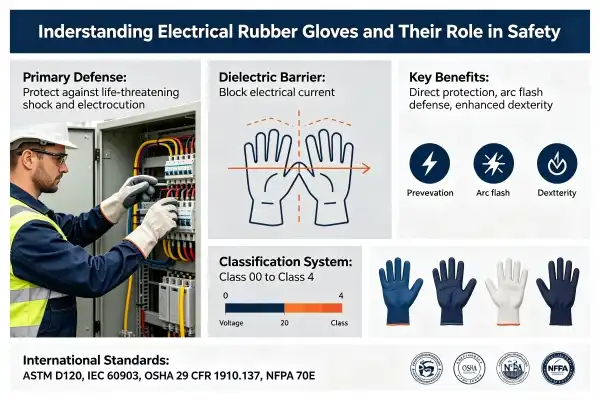
Electrical rubber gloves serve as the primary defense against life-threatening shock and electrocution in energized work environments. These specialized insulating gloves create a dielectric barrier between workers and electrical current, preventing injury during maintenance, installation, and repair tasks. By blocking the flow of electricity through the body, they reduce arc flash exposure and contact burns, making them indispensable for any operation involving voltage-bearing equipment. When properly selected and maintained according to voltage classification, electrical rubber gloves transform high-risk electrical work into manageable, compliant operations that protect both personnel and operational continuity.
Understanding Electrical Rubber Gloves and Their Role in Safety
What Makes Electrical Rubber Gloves Different from Standard Work Gloves
Electrical rubber gloves are made with exact electrical qualities that regular work gloves don't have at all. The rubber material goes through a strict compound formation process to get a certain level of insulation resistance, which is measured in ohms per layer. These gloves are different from general-purpose gloves that are made to resist injury or chemicals because they block the paths that electrical currents would take through the body to ground. This major difference makes them the only PPE that can be used in electrical repair settings where touching live wires is still possible, even though lockdown measures are in place.
The Classification System: From Class 00 to Class 4
The voltage rating method makes it easy to choose the right gloves based on the amount of electricity that is present at work. Class 00 Insulating Gloves protect workers from up to 500 Volts AC and are used for low-voltage control panels, smart meter installs, and utility work in homes where touch is important. As you move up the scale, Class 0 Insulating Gloves can handle up to 1,000 Volts AC and are used for repair on power grids and battery service for electric vehicles. Class 3 Insulating Gloves are necessary for work in substations and on power lines because they protect against voltages up to 26,500 Volts AC. This method of classification, which is based on ASTM D120 and IEC 60903, takes away the need to guess and sets safety standards that apply to all foreign markets. This makes it easier for procurement teams to define needs in a wide range of working situations, from control circuits on the factory floor to infrastructure for sending power to homes.
International Standards That Define Safety Performance
Gloves that meet the standards of ASTM D120 and IEC 60903 are put through strict Electrical rubber glove dielectric tests before they can be sold. As a result of these standards, proof testing has to be done at voltages that are much higher than the stated usage levels. This creates safety gaps that account for material degradation and voltage spikes that were not expected. Under situations that mimic ageing, testing procedures check for leaking current, dielectric breakdown resistance, and material stability. To show that Electrical rubber gloves meet the standards set by OSHA 29 CFR 1910.137 and NFPA 70E, they must have approval marks from recognised labs. This method for approval lowers an organization's risk of being sued, and it gives safety managers faith that certain PPE will work as expected during electrical events.
Key Benefits of Electrical Rubber Gloves in Enhancing Workplace Safety
Direct Protection Against Shock and Arc Flash Hazards
Direct defence against the dangers of shock and arc flash
Properly rated thermal gloves offer more than just theoretical safety benefits; they also avoid injuries in a way that can be measured. When looking at specific working situations where electricity dangers meet difficult physical jobs, these benefits become even clearer.
Dielectric gloves make a barrier that electrical current can't get through. This keeps body resistance above the levels that cause ventricular fibrillation and cardiac death. Formulations of natural rubber and EPDM don't break down when they are wet, dirty, or put under normal work-related mechanical stress. When you wear base rubber insulation and leather guard gloves together, you protect against both electrical and mechanical hazards at the same time.
Arc flashes produce temperatures of more than 35,000 degrees Fahrenheit in a matter of milliseconds, which can severely burn skin that is uncovered and normal work gloves. During the first milliseconds when arc plasma spreads, electrical rubber gloves rated for the right amounts of impact energy are very important for safety. The thick rubber material soaks up heat that would otherwise be transferred straight to skin tissue. This buys valuable time for circuit safety devices to stop the flow of fault current.
The longevity of the material is directly related to how well the glove protects over time. When exposed to chemicals, ozone, and ultraviolet light, which can damage insulation quickly, high-quality rubber materials don't crack. This length of time means that replacements are needed less often, which saves money on buying new ones while still protecting workers. Gloves that are made to survive a wide range of weather conditions, from wet, warm areas to very cold places where rubber flexibility is important, are especially useful for businesses that sell to customers in more than one country.
Enhanced Dexterity Supporting Compliance and Productivity
When safety gear doesn't get in the way of workers doing their jobs, they are much more likely to follow PPE guidelines. Modern insulation gloves have amazing physical sensitivity, even though they have thick dielectric barriers. This means that techs can work with small parts, use touchscreens, and make precise wire terminations without taking off their gloves. This flexibility makes it less tempting to take off gloves when doing difficult jobs, which is when the risk of electrical contact is highest. Lightweight versions keep your hands from getting tired after long periods of wear, so they can be used all day in repair settings where they need to be protected from electrical shocks all the time.
Best Practices: How to Select and Maintain Electrical Rubber Gloves for Safety
Matching Glove Classification to Workplace Voltage Exposure
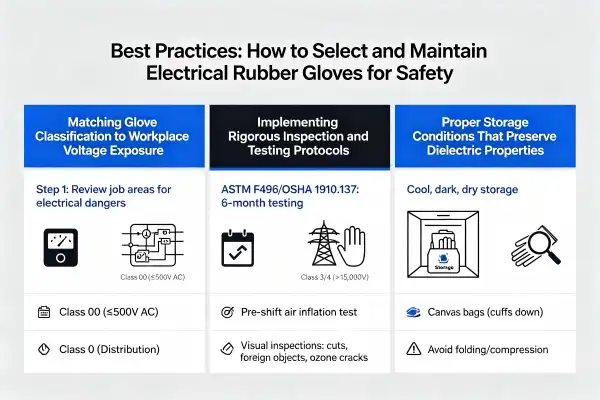
A thorough review of all job areas for electrical dangers is the first step in choosing the right PPE, including Electrical rubber gloves. Electrical experts and people who work in procurement must work together to figure out the highest voltages that can be expected, including short-term overvoltages from switching operations and spikes caused by lightning. This evaluation finds the lowest level of safety that is acceptable for Electrical rubber gloves classes, while avoiding over-specification that adds to costs without improving safety. For control circuits with less than 500 Volts AC, Class 00 Electrical rubber gloves are enough. For distribution work, however, you need Electrical rubber gloves with a Class 0 grade or higher. Transmission substations that work with voltages above 15,000 Volts need either Class 3 or Class 4 protection, based on the voltages in the system.
Implementing Rigorous Inspection and Testing Protocols
Regular testing schedules form the cornerstone of reliable electrical glove performance. ASTM F496 and OSHA 1910.137 mandate electrical testing every six months after gloves enter active service. Gloves remaining in storage must undergo testing within twelve months before issue to workers. Between formal testing intervals, users perform air inflation tests before each shift to detect pinhole leaks and visual inspections to identify cuts, embedded foreign objects, and ozone cracking patterns. Organizations managing large glove inventories benefit from establishing centralized testing facilities that maintain calibrated equipment and detailed documentation proving compliance during regulatory audits.
Proper Storage Conditions That Preserve Dielectric Properties
Storage methodology significantly impacts glove longevity and protective reliability. Dielectric gloves require cool, dark, dry locations away from direct sunlight and ozone sources such as electric motors and welding equipment. Canvas bags provide ideal storage containers, with gloves positioned cuffs down to prevent moisture accumulation inside finger cavities. Folding or compressing gloves creates stress concentration points that accelerate material breakdown and cracking. Temperature extremes degrade rubber compounds—excessive heat accelerates oxidation, while extreme cold reduces flexibility and increases puncture susceptibility. Facilities operating across multiple climate zones must adapt storage protocols accordingly, potentially requiring climate-controlled PPE storage rooms in regions experiencing severe temperature variations.
Comparing Top Electrical Rubber Gloves and Suppliers for Informed Procurement
Evaluating Manufacturer Credentials and Certification Documentation
Supplier selection extends beyond unit pricing into a comprehensive capability assessment spanning technical expertise, quality systems, and logistics reliability. Leading manufacturers maintain ISO 9001 quality management certifications alongside specific electrical safety testing laboratory accreditations. These credentials indicate systematic approaches to production consistency and batch-to-batch uniformity that prevent specification drift over time. Suppliers offering complete traceability documentation enable organizations to track individual glove manufacturing dates and test records, supporting root cause analysis if field failures occur.
Balancing Initial Costs Against Total Ownership Expenses
Procurement decisions frequently focus on purchase price minimization without adequate consideration of lifecycle costs spanning testing, replacement, and potential incident expenses. Premium gloves featuring superior rubber compounds justify a higher initial investment through extended service life and reduced testing failure rates. Volume purchasing arrangements with qualified suppliers secure favorable pricing while ensuring adequate inventory depth to support operational continuity. Customization options—including private labeling, voltage class color coding, and size range optimization—add value for organizations managing complex multi-site operations across different regulatory jurisdictions.
Supply Chain Considerations for Global Operations
Organizations operating across 134 countries require suppliers capable of supporting international logistics for Electrical rubber gloves with predictable lead times and compliant documentation for customs clearance. Established distributors maintain regional warehouse networks that reduce emergency shipping costs when expedited replacement of Electrical rubber gloves becomes necessary. Technical support availability in multiple languages and time zones helps safety managers troubleshoot application questions and resolve specification uncertainties during procurement cycles. These supply chain capabilities become particularly valuable for infrastructure projects in emerging markets where local Electrical rubber glove sourcing options may lack adequate certification verification.
Case Studies: Real-World Applications and Impact of Electrical Rubber Gloves
Utility Sector: Reducing Electrical Contact Injuries
A major regional utility serving 2.3 million customers implemented comprehensive electrical glove program standardization across 47 service centers, replacing inconsistent local procurement with centrally managed specifications aligned to ASTM D120. Within 18 months, electrical contact injuries decreased 64% compared to the prior three-year average. Cost analysis revealed that testing program investment and premium glove procurement totaling $127,000 annually prevented an estimated $890,000 in workers' compensation claims, lost time, and incident investigation expenses. The utility credited improved compliance rates to better glove dexterity that reduced worker resistance to continuous wear protocols.
Manufacturing: Protecting Maintenance Teams During Equipment Servicing
A multinational automotive manufacturer faced recurring electrical incidents during robot cell maintenance when technicians worked on energized 480-Volt control panels under hot work permits. Transitioning from generic rubber gloves to certified Class 0 Insulating Gloves with mandatory leather protectors eliminated shock incidents across 14 global production facilities over a 36-month monitoring period. Procurement centralization through a qualified OEM manufacturing partner reduced per-unit costs by 23% while improving size availability and replacement lead times. Safety metrics showed maintenance productivity improved 11% as technicians gained confidence working near energized equipment with appropriate protection.
Infrastructure Construction: Meeting Multi-National Compliance Standards
A consortium managing a $4.2 billion transportation infrastructure project spanning three countries required electrical PPE meeting EU, North American, and local regulatory standards simultaneously. Partnering with a supplier maintaining ASTM D120, IEC 60903, and EN 60903 certifications resolved compliance complexity while consolidating procurement logistics. The project avoided schedule delays attributed to PPE specification conflicts and customs documentation issues that plagued comparable projects lacking unified supplier relationships. Post-project analysis identified electrical glove program standardization as a key contributor to achieving zero electrical fatalities across 8,700 workers and 6.2 million work hours.
Conclusion
Electrical rubber gloves are still the best way to keep people from getting hurt by electrical shock in the building, utility, and manufacturing sectors. Modern material science has made them more flexible and durable, and their proven ability to stop current paths makes them essential PPE for companies that want to keep their workers safe. To make execution work, you need to carefully match voltage classifications, follow strict testing procedures, and work with qualified sources who can support operations around the world. Purchasing managers and safety experts can cut down on electrical accidents by investing in full training programs and only buying approved goods that meet international standards. This also shows that they are following the rules. Safety improvements and lower liability rates that can be measured across many industries show that electrical gloves are not just a nice-to-have, but a necessary investment. This is especially true for companies that have to deal with complicated electrical environments and large workforces in many places.
FAQ
1. How often should electrical rubber gloves undergo dielectric testing?
According to ASTM F496 and OSHA 1910.137, gloves in active service require electrical testing every six months. Gloves in storage must be tested within twelve months before issuing to workers. These intervals represent maximum allowances—more frequent testing provides additional safety assurance, particularly in demanding environments with high mechanical stress exposure. Organizations should maintain detailed testing records documenting each evaluation, including test voltage applied, leakage current measured, and the technician performing the inspection.
2. Why are leather protector gloves necessary with rubber insulating gloves?
Leather protectors provide essential mechanical defense against cuts, abrasions, and punctures that would compromise rubber dielectric integrity. Sharp edges on electrical enclosures, wire ends, and hardware easily penetrate rubber without the protective barrier that leather provides. Proper fit requires the rubber glove to extend at least two inches beyond the leather protector cuff, preventing electrical tracking along the interface. This combination addresses both electrical and mechanical hazard dimensions simultaneously, creating comprehensive hand protection.
3. What distinguishes Class 0 from Class 00 insulating gloves?
Class 00 gloves protect up to 500 Volts AC with proof testing at 2,500 Volts AC, suitable for residential electrical work and low-voltage control circuits. Class 0 gloves handle maximum use voltages of 1,000 Volts AC with 5,000 Volt AC proof testing, appropriate for utility distribution work and industrial power systems. The voltage rating difference reflects distinct application environments—Class 00 for building systems and Class 0 for industrial and utility infrastructure. Both maintain similar dexterity profiles, making classification selection primarily voltage-driven rather than comfort-based.
Partner with PPE MAX: Your Trusted Electrical Rubber Gloves Supplier
At PPE MAX, we have protected Electrical rubber glove workers worldwide since 1956 through comprehensive insulating glove solutions spanning Class 00 through Class 4 voltage ratings. Our manufacturing expertise delivers ASTM D120 and IEC 60903-certified products trusted across 134 countries, backed by rigorous quality systems honed over six decades. We understand that procurement managers require more than products—you need reliable partners offering customization capabilities, technical consultation, and logistics support matching your operational complexity. Whether you're sourcing utility fleets, manufacturing facilities, or government procurement programs, our team provides tailored solutions addressing your specific voltage classifications and compliance requirements. Contact us at marketing@ppemax.com to discuss bulk purchasing options with guaranteed certifications, explore OEM manufacturing partnerships, or request technical specifications aligned to your electrical hazard assessments. Make worker safety your operational priority with proven electrical rubber gloves from an established manufacturer committed to your success.
References
1. American Society for Testing and Materials. (2023). "ASTM D120-21: Standard Specification for Rubber Insulating Gloves." ASTM International Standards for Electrical Protective Equipment.
2. Occupational Safety and Health Administration. (2022). "29 CFR 1910.137: Electrical Protective Equipment Standards and Compliance Guidelines." U.S. Department of Labor OSHA Technical Manual.
3. International Electrotechnical Commission. (2021). "IEC 60903: Live Working – Gloves of Insulating Material." International Standards for Electrical Safety Equipment Performance.
4. National Fire Protection Association. (2023). "NFPA 70E: Standard for Electrical Safety in the Workplace." Electrical Safety Requirements and Risk Assessment Procedures.
5. Institute of Electrical and Electronics Engineers. (2022). "IEEE Guide for Testing and Maintenance of Electrical Rubber Protective Equipment." IEEE Standards Association Technical Documentation.
6. Canadian Standards Association. (2021). "CSA Z462: Workplace Electrical Safety Standard and Personal Protective Equipment Requirements." Canadian Electrical Safety Guidelines for Industrial Applications.
Learn about our latest products and discounts through SMS or email