- English
- French
- German
- Portuguese
- Spanish
- Russian
- Japanese
- Korean
- Arabic
- Greek
- German
- Turkish
- Italian
- Danish
- Romanian
- Indonesian
- Czech
- Afrikaans
- Swedish
- Polish
- Basque
- Catalan
- Esperanto
- Hindi
- Lao
- Albanian
- Amharic
- Armenian
- Azerbaijani
- Belarusian
- Bengali
- Bosnian
- Bulgarian
- Cebuano
- Chichewa
- Corsican
- Croatian
- Dutch
- Estonian
- Filipino
- Finnish
- Frisian
- Galician
- Georgian
- Gujarati
- Haitian
- Hausa
- Hawaiian
- Hebrew
- Hmong
- Hungarian
- Icelandic
- Igbo
- Javanese
- Kannada
- Kazakh
- Khmer
- Kurdish
- Kyrgyz
- Latin
- Latvian
- Lithuanian
- Luxembou..
- Macedonian
- Malagasy
- Malay
- Malayalam
- Maltese
- Maori
- Marathi
- Mongolian
- Burmese
- Nepali
- Norwegian
- Pashto
- Persian
- Punjabi
- Serbian
- Sesotho
- Sinhala
- Slovak
- Slovenian
- Somali
- Samoan
- Scots Gaelic
- Shona
- Sindhi
- Sundanese
- Swahili
- Tajik
- Tamil
- Telugu
- Thai
- Ukrainian
- Urdu
- Uzbek
- Vietnamese
- Welsh
- Xhosa
- Yiddish
- Yoruba
- Zulu
Welding Face Shield vs Welding Helmet: When to Use Each?
When picking between different types of welding safety gear, it usually comes down to what you need for your unique job. A Welding Face Shield is an important piece of safety gear for light welding, cutting, and basic contact situations. It is made to be light and gives you a better view of your surroundings. With improved auto-darkening technology and more coverage, welding helmets offer full safety for heavy-duty tasks. The choice you make will rely on how intensely you weld, how long you use it, and the specific dangers in your job. Both are important for safety, but choosing the right tools makes sure that workers are safest while keeping operations running smoothly and following safety rules.
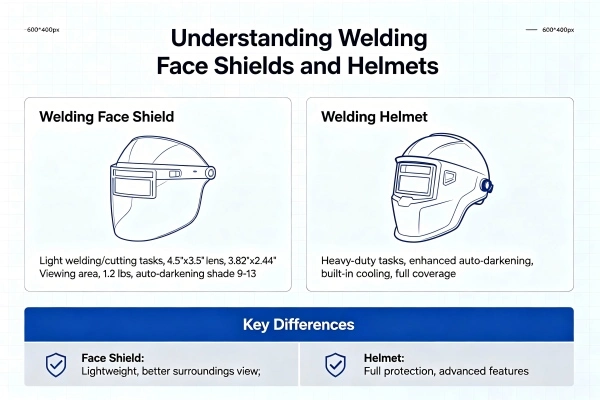
Understanding Welding Face Shields and Helmets
To choose the right welding protection, you need to know a lot about how these two important safety tools work and where they are most useful in the workplace.
Core Elements and the Design Philosophy
Face shields for welding are an important piece of personal protection equipment made to keep welders' eyes, face, and neck safe from actinic radiation, thermal burns, and high-velocity mechanical contact. These tools have special filter systems built in that change the amount of light that gets through while keeping the optics clear during welding. The ergonomic support systems used in modern Welding Face Shield designs help to lessen neck pain during long shifts. At PPE MAX, our shields are made of high-impact-resistant plastic and have lenses that are 4.5" x 3.5" and viewing areas that are 3.82" x 2.44". They weigh only 1.2 pounds, so you can wear them for a long time without any discomfort. The auto-darkening technology offers shade ranges from 9 to 13, which ensures that the best safety is provided for all welding tasks.
With their full coverage and high-tech features, welding helmets go one step further in protecting you. Most of the time, these devices have better auto-darkening features, built-in cooling systems, and longer sturdiness for high-risk areas. How well they protect you and the size of the area they cover are the main differences.
Situations and Uses in Operations
There are big differences in how safe welding equipment is used in different types of industries. In ships and big fabrication shops, equipment has to be able to handle the extreme heat from flux-cored arc welding while still working well with hard hats and breathing systems. High-sensitivity sensors that can find low-amp arcs without blinking are needed in automotive and precision manufacturing settings. True color lens technology is used to tell the difference between color-coded parts. For pipeline and outdoor building uses, toughness is needed to handle changes in temperature and rough handling. In these kinds of places, you usually need passive glasses or auto-darkening filters that work consistently in partial sunlight without false activation.
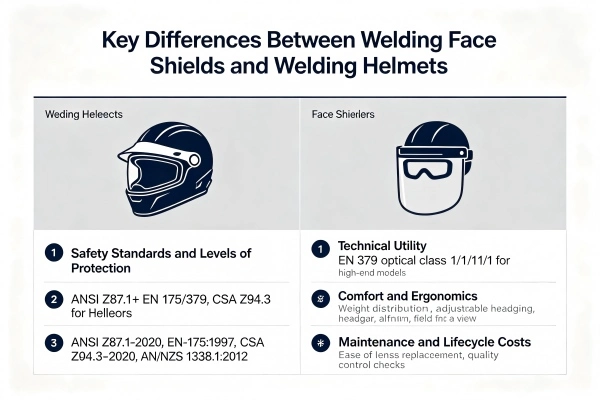
Key Differences Between Welding Face Shields and Welding Helmets
When procurement managers know the main differences between these safety devices, they can make choices that meet both safety standards and business efficiency.
Safety Standards and Levels of Protection
Following strict industry standards like ANSI Z87.1+, EN 175/379, and CSA Z94.3, welding hats usually offer better eye and face safety. These devices work great in places where people need to be protected from strong radiation and long-term welding operations. Welding Face Shield choices are great for light welding and cutting jobs because they provide enough protection while still letting you move around easily and comfortably. PPE MAX face shields are certified to meet the standards of ANSI Z87.1-2020, EN 175:1997, CSA Z94.3-2020, and AS/NZS 1338.1:2012. This means they are safe for a wide range of industrial uses.
The technical usefulness of safety gear is based on its optical class scores, change speed, and ability to withstand impacts. According to EN 379 guidelines, high-end models have optical clarity scores of 1/1/1/1. This means that there is no blurring, distortion, or uneven shading that could affect the accuracy of the welding.
Comfort for the user and ergonomics
Weight distribution and flexibility have a big effect on how well workers do their jobs and how much they get done. Face shields usually weigh less than helmets, which makes long operations easier on the neck. The changeable headgear systems let you make a unique fit for people with different-sized heads while still working with respirators and safety glasses. Comfort isn't just about weight; it's also about air flow, field of view, and how easy it is to clean. These things have a direct effect on how quickly workers adopt new safety gear and how cost-effective it is for businesses to buy in bulk.
Costs of Maintenance and Lifecycle
Different safety gear needs different kinds of upkeep, which changes the total cost of ownership. Face shields usually have easier care processes, and the lenses on the outside cover can be easily replaced when pitting or spatter makes them less clear. The working conditions and welding strength are directly related to how often repair needs to be done. The main steps in quality control are checking the switching time, the impact resistance, and the visual sharpness. These tests make sure that equipment keeps its defensive abilities over the course of its useful life while also meeting the requirements of regulations.
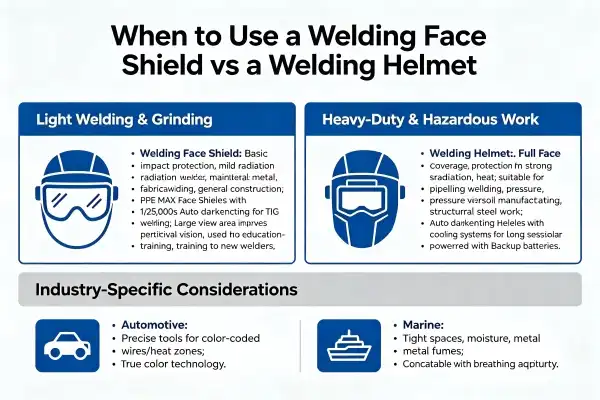
When to Use a Welding Face Shield vs a Welding Helmet
Advice on choosing the right equipment for a job relies on how hard the job is, how much danger there is, and the special needs of the job in different industrial settings.
Uses for light welding and grinding
Welding Face Shield gear works great when basic impact protection and mild radiation shields are needed. Some of these jobs are making things out of metal, doing upkeep welding, and general building work, where being able to move around and see around obstacles is more important than having the highest level of protection. PPE MAX face shields have auto-darkening technology that responds in 1/25,000 seconds. This makes them the best choice for TIG welding applications that need to identify arcs very accurately. The large watching area improves peripheral vision, which helps workers stay aware of their surroundings even when they are working in complicated settings. Face shields are useful in educational and training settings where new workers need to be able to see clearly and be comfortable while wearing gear that promotes good safety habits. These gadgets are great for teaching new welders how to use safety gear correctly because they are light and easy to use.
Heavy-duty and dangerous places to work
Welding helmets are good for jobs that require full coverage of the face, long-term exposure to strong radiation, and working in hot places. Pipeline welding, making pressure vessels, and big structural steel work are all examples of situations where full safety is required. Auto-darkening hats with built-in cooling systems allow for longer welding sessions while keeping the welder safe and comfortable. Modern types have solar-powered systems with backup batteries that make sure they work reliably in a variety of weather situations.
Industry-Specific Things to Think About
When making cars, you need precise tools that can tell the difference between color-coded wires and heat zones during the building process. Modern protective gear has visual clarity and true color technology that lets you do correct work while still providing important safety protection. Marine construction and shipbuilding require tools that can work in tight areas, with a lot of moisture, and with different types of welding. In these situations, where metal fumes pose extra health risks, cooperation with breathing equipment is very important.
Comparing Market Options: How to Choose the Right Welding Face Shield or Helmet
When businesses buy a lot of welding safety gear, they need to think about a lot of things that affect both the short-term prices and the long-term efficiency of their operations.
Brand Analysis and Comparison of Features
In different market segments, leading makers have clear benefits. Established names like 3M, Miller, Lincoln Electric, and Honeywell have a history of being reliable and offer full insurance support and easy access to replacement parts. Each company focuses on a different set of technological benefits that are useful in a variety of business settings. PPE MAX stands out because it has been making products since 1956 and has decades of knowledge. It also offers the best quality in the industry, which is backed by strict testing methods. Our customization choices let businesses show off their logos while keeping our bulk prices low enough to meet the needs of large-scale purchases.
New trends include auto-darkening systems that are driven by the sun, batteries that last longer, and technologies that make things clearer to see. These new ideas help buying managers make sure that their investments will still work in the future, even as safety standards and practical needs change.
Procurement Decision Factors
Price factors include more than just the initial buy cost. They also include the need for upkeep, the availability of replacement parts, and the need for training. Welding Face Shield procurement benefits from standard sizes and easier upkeep methods that lower running costs over the long term. Total cost of ownership is affected by warranty terms and how well the provider can help. Full expert help, easy access to replacement parts, and flexible return policies are some of the extra benefits that make high-quality tools worth the extra cost. Competitive pricing and the ability to buy in bulk make fleet management cost-effective while maintaining uniform safety standards across multiple operating sites. Custom packaging options meet the needs of unique delivery and inventory management tasks.
Procurement Best Practices and Recommendations After the Purchase
For welding equipment to work at its best, upkeep, compliance management, and ongoing relationships with suppliers that support operational success must all be done in a planned way.
Maintenance Protocols and Compliance
The right way to repair equipment makes sure it keeps its protective qualities and meets legal standards. Every day, you should check the outer cover glasses for damage, make sure the auto-darkening function works, and make sure the headgear is properly adjusted. Solvents that won't damage lens layers or blur the vision must be used during cleaning processes. Maintenance plans should take into account the conditions of the job; for example, more frequent checks are needed in places with a lot of debris or where welding is done a lot. Training programs teach workers how to use tools correctly and keep it in good shape. These training programs increase the number of people who follow the rules and make tools last longer by teaching people how to handle and care for it properly.
Supplier Relationship Management
Supplier partnerships that work well provide continuing value through technical help, new product releases, and consulting services. PPE MAX gives a wide range of support services after the sale, such as technical support hotlines, training materials, and flexible return policies that help customers be successful in the long run. Regular checks of the tools help find things that need to be replaced before they put safety at risk. Proactive replacement programs make sure that people are always safe and improve the way that material is managed and budgets are made. Using warranties and getting help from suppliers adds value to equipment purchases that go beyond the initial buy. Knowing what tools are available helps get the best return on investment while keeping safety standards at the highest level throughout the life of the equipment.
Conclusion
When picking between welding face shields and helmets, you need to carefully think about the job requirements, the amount of protection needed, and the limitations of the operation. Welding Face Shield choices work best for light welding, grinding, and maintenance tasks where comfort and movement boost output without putting safety at risk. When it comes to heavy-duty jobs that need full coverage and the latest technology, welding hats are the best way to stay safe. Success relies on matching the capabilities of the equipment with the dangers in the workplace, while also taking into account the equipment's long-term costs and upkeep needs. PPE MAX has a wide range of products and has been making them for many years, which helps buyers make smart choices that improve worker safety and working efficiency in many different types of industries.
FAQ
What are the fundamental safety distinctions between welding face shields and helmets?
While welding, welding hats protect the whole head and neck with advanced auto-darkening technology made for long, intense welding jobs. Face shields protect the face specifically, while being lighter and easier to move around. This makes them perfect for welding and grinding jobs where ease and peripheral vision are important.
Can welding face shields be used for all types of welding applications?
It is possible to use welding face covers for light to heavy welding, TIG welding, and grinding. They shouldn't be used for heavy-duty welding tasks like stick welding or flux-cored welding, which release strong radiation and need the highest level of safety that can only be provided by full helmets.
How often does it need to be changed or fixed safety gear?
When pitting or spray makes it hard to see, the outer cover lenses should be changed. In heavy industrial settings, this is usually done every day. Depending on how often they are used, auto-darkening screens usually last between 3 and 5 years. The protective shell, on the other hand, can last between 5 and 7 years with proper care and keeping.
What kinds of licenses should I look for in safety gear for welding?
ANSI Z87.1+ for North American markets, EN 175/379 for European approval, and CSA Z94.3 for Canadian standards are all important qualifications. These approvals make sure that equipment meets the basic safety standards for radiation protection, optical clarity, and impact resistance in industrial welding settings.
Partner with PPE MAX for Superior Welding Protection Solutions
Since 1956, PPE MAX has been making high-quality welding safety gear. Their Welding Face Shield technology and other protection products are used in over 134 countries. Our auto-darkening face shields have quick response times of 1/25,000 seconds and shade ranges from 9 to 13 to meet a wide range of industry needs. They are also very light and have excellent eye clarity. As a reliable welding face shield maker, we offer customization options, bulk price benefits, and strict quality control procedures that make sure everyone on your team is safe. Email our expert team at marketing@ppemax.com to talk about your unique needs and find out how our tried-and-true solutions can help your organization improve safety standards while also making operations run more smoothly.
References
1. American National Standards Institute. "ANSI Z87.1-2020: Occupational and Educational Personal Eye and Face Protection Devices." American National Standards Institute, 2020.
2. European Committee for Standardization. "EN 175:1997 Personal Protection Equipment - Equipment for Eye and Face Protection During Welding and Allied Processes." European Committee for Standardization, 1997.
3. Canadian Standards Association. "CSA Z94.3-20: Industrial Eye and Face Protectors." Canadian Standards Association, 2020.
4. International Labour Organization. "Safety and Health in the Use of Personal Protective Equipment at Work: An ILO Perspective." International Labour Organization, 2019.
5. Occupational Safety and Health Administration. "Eye and Face Protection Guidelines for Welding Operations in Industrial Settings." United States Department of Labor, 2021.
6. Standards Australia. "AS/NZS 1338.1:2012 Filters for Eye Protectors - Filters for Protection Against Radiation Generated in Welding and Allied Operations." Standards Australia International, 2012.
Learn about our latest products and discounts through SMS or email