- English
- French
- German
- Portuguese
- Spanish
- Russian
- Japanese
- Korean
- Arabic
- Greek
- German
- Turkish
- Italian
- Danish
- Romanian
- Indonesian
- Czech
- Afrikaans
- Swedish
- Polish
- Basque
- Catalan
- Esperanto
- Hindi
- Lao
- Albanian
- Amharic
- Armenian
- Azerbaijani
- Belarusian
- Bengali
- Bosnian
- Bulgarian
- Cebuano
- Chichewa
- Corsican
- Croatian
- Dutch
- Estonian
- Filipino
- Finnish
- Frisian
- Galician
- Georgian
- Gujarati
- Haitian
- Hausa
- Hawaiian
- Hebrew
- Hmong
- Hungarian
- Icelandic
- Igbo
- Javanese
- Kannada
- Kazakh
- Khmer
- Kurdish
- Kyrgyz
- Latin
- Latvian
- Lithuanian
- Luxembou..
- Macedonian
- Malagasy
- Malay
- Malayalam
- Maltese
- Maori
- Marathi
- Mongolian
- Burmese
- Nepali
- Norwegian
- Pashto
- Persian
- Punjabi
- Serbian
- Sesotho
- Sinhala
- Slovak
- Slovenian
- Somali
- Samoan
- Scots Gaelic
- Shona
- Sindhi
- Sundanese
- Swahili
- Tajik
- Tamil
- Telugu
- Thai
- Ukrainian
- Urdu
- Uzbek
- Vietnamese
- Welsh
- Xhosa
- Yiddish
- Yoruba
- Zulu
Top Insulating Gloves for Electrical Safety: China Buying Guide
Founded in 1956, PPEMAX stands as a premier global manufacturer and supplier of full-range personal protective equipment. All our products comply with internationally recognized standards including IEC, ASTM, CE, UKCA, NIOSH and ISO9001. Equipped with a 2,000-square-meter modern production plant, we boast over 25 years of mature OEM & ODM capabilities to deliver one-stop customized solutions covering R&D design through worldwide logistics. Our safety gear is distributed across 134 countries globally. Upholding our core tenet “Safety First, Quality Priority”, we serve as a dependable long-term PPE partner for industrial enterprises around the world.
When choosing insulating gloves for electrical work to protect workers, it is important to understand the voltage ratings, materials used, and certification criteria of the gloves. China has emerged as a reputable source for manufacturing cost-effective electrical safety gloves that comply with strict international requirements such as ASTM D120 and IEC 60903. This complete guide covers the important procurement factors for industrial safety distributors, PPE wholesalers, and company safety managers seeking reliable electrical protection equipment. We source from reputable Chinese manufacturers for low voltage applications ranging from Class 00 all the way to specialised high voltage applications, providing quality assurance and cost-effectiveness for organisations that manage complicated electrical safety programs in different industrial contexts.
|
Parameter |
Type I (Natural Rubber) |
Type II (Synthetic/EPDM) |
|
Maximum Use Voltage |
500V AC / 750V DC |
500V AC / 750V DC |
|
Proof Test Voltage |
2,500V AC / 10,000V DC |
2,500V AC / 10,000V DC |
|
Maximum Thickness |
0.75mm (30 mils) |
0.75mm (30 mils) |
|
Length Options |
11-14 inches |
11-14 inches |
|
Color Code |
Beige Label |
Beige Label |
|
Temperature Range |
Standard |
Extended (-25°C to +55°C) |
|
UV/Ozone Resistance |
Standard |
Enhanced |
Understanding Insulating Gloves – Materials, Types, and Standards
The cornerstone of electrical safety is knowing the difference between good insulating gloves and just any work gloves. These specialised safety devices provide a barrier between workers and electrical currents, avoiding potentially deadly mishaps during maintenance, installation, and repair activities.
Material Composition and Insulation Properties
Natural rubber latex is still widely used for electrical insulation owing to its excellent dielectric strength and flexibility. This material naturally inhibits the passage of electricity through it, yet is flexible enough to allow for precise finger movements. The natural rubber latex is of a higher quality with better elongation qualities, which enables the technician to retain a sense of touch while working with wiring, switches, and electrical components. Some manufacturers use synthetic chemicals like EPDM (ethylene propylene diene monomer) to improve resistance to ozone deterioration and exposure to UV light. These synthetic alternatives prolong product life in outdoor settings where environmental variables promote material degradation. The thickness of the material has a direct correlation to the voltage protection capability. Thicker rubber has better voltage ratings, but may affect finger dexterity for intricate work.
Voltage Classification System Explained
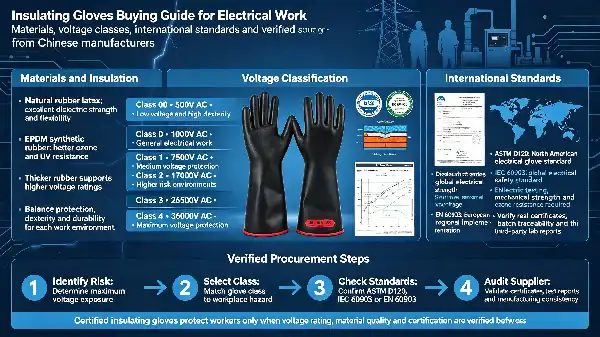
Understanding the voltage categorisation system helps procurement teams ensure glove specs reflect the real risks present in the workplace. Industry classifies electrical insulation into six classes according to maximum usage voltage and proof test criteria. The Class 00 gloves are the basic protective equipment for low voltage electrical work like telecommunications, domestic electrical repair and control panel work and are rated for a maximum usage voltage of 500V AC and a proof test of 2500V AC. These gloves provide a good level of protection and allow for more dexterity, hence are suitable for work that requires dexterity of the fingers. The higher classes are Class 0 (1000V AC), Class 1 (7500V AC), Class 2 (17000V AC), Class 3 (26500V AC) and Class 4 (36000V AC) respectively, each for more demanding electrical applications. The greatest voltage workers may be exposed to under regular working conditions and during abnormal or emergency conditions must be determined to choose the correct class.
International Certification Standards
Gloves that are internationally certified provide you with the certainty that they will function consistently under pressure. The ASTM D120 standard is generally recognised in North America and establishes the production criteria, testing methodologies and labelling practices for electrical protection gloves. IEC 60903 applies to the European and worldwide markets, and there are similar standards with minor differences in the testing approach. EN 60903 is the European implementation of the IEC standard with extra regional requirements. Such certifications require thorough dielectric testing, mechanical strength testing, and ozone resistance testing before items enter the market. When you purchase from Chinese manufacturers, you need to ensure that the certification papers are real. Then you will not end up with fake items that could break when you really need them to work. Good suppliers work with third-party testing labs and can give comprehensive traceability documents for each batch they produce.
How Insulating Gloves Work and Their Safety Benefits
The protective mechanism of electrical safety gloves is based on the basic principles of electrical physics along with advancements in material science. An understanding of these concepts may assist safety managers in grasping why correct selection and maintenance processes are so important.
The Science Behind Electrical Insulation
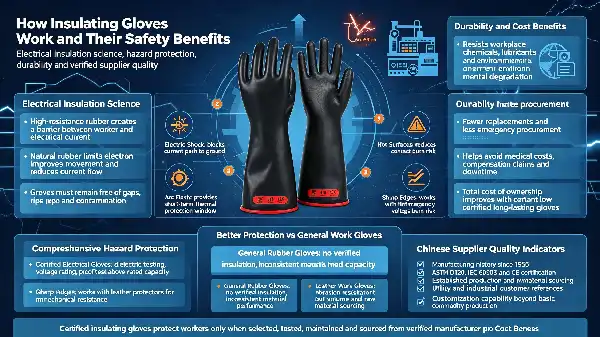
Electrical insulation is putting a high-resistance material between the worker's body and the route of the electrical current. Natural rubber has molecular characteristics that do not allow the movement of electrons and will effectively stop the passage of electricity via the glove material. The voltage potential seeks the least-resistance route to ground when the worker comes in touch with the energised circuit with suitably rated gloves. The high dielectric constant of the rubber causes the current to find other paths than via the glove material and into the worker’s body. The material’s thickness contributes to this protective effect: every extra millimetre of rubber improves the breakdown voltage threshold, enabling safe operation at greater voltages. Throughout its service life, the glove must keep its protective integrity by retaining its continuous barrier properties – no gaps, rips or contamination.
Comprehensive Hazard Protection
Good electrical gloves aren’t just shock-proof; they also protect workers from a number of occupational risks at the same time. Arc flash incidents involve explosive thermal energy from electrical faults and may cause serious burns even without direct touch. Although the primary purpose of insulating gloves is to avoid contact with electricity, the material also offers some protection from heat exposure during the first few milliseconds of an arc flash incident. This short protective window might be essential for the survival of workers in tight electrical areas. In addition, the gloves also protect from inadvertent contact burns from hot conductors and equipment surfaces, giving an extra layer of safety during maintenance procedures. The device, together with leather protection gloves, offers a higher level of mechanical puncture resistance to prevent sharp edges of electrical enclosures from breaching the insulating barrier. This multi-layered technique for protection greatly minimises the statistical chance of electrical injury throughout industrial processes.
Durability and Long-Term Cost Benefits
Purchasing certified electrical safety gloves from respected manufacturers brings tangible cost benefits beyond their original purchase price. Proper care of your gloves may make them last for hundreds of uses, meaning that you won’t replace them as often. The improved material formulas withstand typical workplace chemicals, lubricants, and environmental conditions that cause inferior goods to prematurely decay. This durability results in fewer regular replacement schedules and less need for emergency procurement. Just one electrical injury may cost employers the large direct costs (medical expenses, workers' compensation claims) and indirect costs (productivity loss, regulatory investigations, harm to reputation) connected with workplace mishaps, which can be avoided by using dependable PPE to prevent them. When assessing total cost of ownership rather than just the unit purchase price, the ROI on quality electrical gloves is apparent.
If you're evaluating personal protective equipment suppliers and require batch-specific testing documents before placing an order, PPE MAX is able to provide official Certificates of Analysis, professional laboratory test reports, and product samples for your verification. Feel free to contact our team at marketing@ppemax.com to discuss your sourcing needs and obtain complete documentation for your quality assessment and procurement approval.
Comparative Guide – Choosing the Best Insulating Gloves for Electrical Safety
Making informed procurement decisions requires understanding how electrical insulation gloves compare to alternative hand protection options and evaluating the factors that distinguish superior products within the category.
Electrical Gloves Versus General Work Gloves
Standard rubber work gloves and leather work gloves serve important functions but cannot substitute for certified electrical insulation. General-purpose rubber gloves lack the dielectric testing and voltage rating verification that electrical gloves undergo. Their material composition may include conductive additives or manufacturing inconsistencies that create unpredictable current pathways. Leather work gloves offer excellent abrasion resistance and grip enhancement but provide virtually no electrical insulation capacity—leather's moisture absorption properties actually increase conductivity risk when damp. Some workers mistakenly believe doubled general work gloves provide adequate electrical protection, a dangerous misconception that has contributed to preventable fatalities. Certified electrical gloves undergo rigorous proof testing at voltages significantly exceeding their rated capacity, ensuring they maintain protective integrity even when stressed beyond normal operating conditions.
Balancing Protection With Dexterity
The perpetual challenge in electrical glove design involves maximizing voltage protection while preserving the finger dexterity technicians need for precise work. Thicker glove walls provide superior insulation but reduce tactile feedback, potentially forcing workers to remove gloves to complete delicate tasks—a practice that dramatically increases risk exposure. PPE MAX's Class 00 Insulating Gloves address this balance through advanced material formulation and ergonomic design. With an average thickness of 0.5mm, these gloves deliver reliable 500V AC protection while maintaining exceptional flexibility for manipulating small fasteners, wire connectors, and testing equipment. The gloves weigh approximately 170 grams per pair, minimizing hand fatigue during extended work periods. This lightweight construction enables workers to maintain glove usage throughout entire shifts rather than removing them when fatigue sets in, thereby preserving continuous protection throughout the workday.
Evaluating Chinese Supplier Quality Indicators
China's manufacturing landscape includes operations ranging from basic producers to world-class facilities with decades of technical expertise. Distinguishing reliable partners requires examining specific quality indicators beyond marketing claims. Manufacturing history provides valuable insight—companies operating since the mid-20th century like PPE MAX (established 1956) demonstrate sustained commitment to quality and market credibility. Production volume capabilities indicate established supply chains and consistent raw material sourcing, critical factors for bulk procurement reliability. Certification portfolios reveal which markets suppliers actively serve—manufacturers holding ASTM D120, IEC 60903, and CE markings maintain quality systems capable of meeting diverse international requirements. Customer testimonials from established utilities, industrial corporations, and government agencies provide third-party validation of product performance under real-world conditions. Suppliers offering customization options demonstrate manufacturing flexibility and technical capabilities beyond basic commodity production.
Procurement Guide – Sourcing Insulating Gloves from China
Successfully navigating international procurement requires understanding sourcing channels, pricing dynamics, and quality verification protocols specific to the Chinese manufacturing environment.
Identifying Reliable Sourcing Channels
Multiple pathways exist for connecting with Chinese electrical glove manufacturers, each offering distinct advantages for different buyer profiles. Direct manufacturer relationships provide the greatest pricing flexibility and customization options but require more extensive vetting and communication management. Online B2B platforms like Alibaba and Global Sources aggregate thousands of suppliers, offering convenient comparison tools but necessitating careful verification of listed credentials. Trade shows and industry exhibitions, including the China Labour Protection Articles Fair and China International Safety & Health Protection Exhibition, enable face-to-face supplier evaluation and product inspection. Industry associations and chamber of commerce resources provide vetted supplier directories with pre-qualified manufacturers. PPE MAX maintains an established global distribution network serving 134 countries, offering responsive communication channels for enterprise buyers seeking reliable supply partnerships without extensive supplier development investments.
Negotiating Favorable Commercial Terms
Bulk purchasing strategies significantly impact total procurement costs and supply chain reliability. Minimum order quantities (MOQ) vary considerably among Chinese manufacturers—established operations serving international markets typically accommodate smaller initial orders to facilitate relationship building, while pure commodity producers enforce higher MOQs to maintain production efficiency. Volume discount structures reward larger commitments; buyers should request detailed pricing tiers spanning relevant order volumes to calculate optimal purchase quantities balancing unit costs against inventory carrying expenses. Payment terms negotiations deserve careful attention—standard international trade practices include a 30% deposit with 70% balance against the bill of lading, while established relationships may enable extended payment windows. Requesting samples before committing to production orders provides tangible product evaluation opportunities, verifying material quality, construction standards, and certification authenticity before financial commitments.
Understanding Price Determinants
Pricing variability across Chinese electrical glove suppliers reflects genuine differences in manufacturing approaches, material quality, and business models. Raw material selection dramatically impacts both cost and performance—gloves manufactured from premium natural rubber latex command higher prices than those incorporating blended or recycled compounds. Certification authenticity adds cost through third-party testing fees, laboratory relationships, and quality system maintenance, but provides essential protection assurance. Brand reputation influences pricing as established manufacturers with proven track records justify premium positioning through lower defect rates and superior customer support. Production scale affects unit economics—large-volume manufacturers achieve material cost advantages and production efficiency that smaller operations cannot match. For Class 00 gloves, budget buyers may find offers starting around $8-12 per pair, while premium certified options from established manufacturers range from $15-25 per pair depending on order volume, specifications, and included certifications. When evaluating quotations, procurement professionals should analyze total delivered cost including shipping, customs duties, and potential quality issues rather than focusing exclusively on FOB pricing.
Spotlight on PPE MAX Class 00 Insulating Gloves
Our Class 00 insulating gloves are the result of over 60 years of experience in producing PPE for the industrial, utility, and telecommunications markets across the world. These gloves are our commitment to safeguarding workers with the best in engineering and uncompromising quality.
Technical Specifications and Compliance
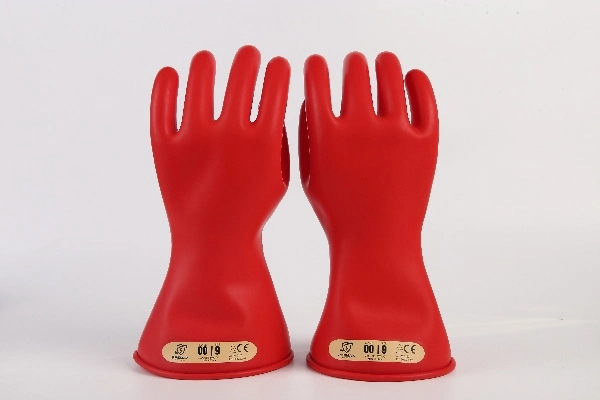
PPE MAX Class 00 gloves are certified to both ASTM D120 and IEC 60903 international standards to ensure global acceptability and regulatory compliance. The gloves provide dependable protection during operations up to 500V AC maximum usage voltage, having passed 2500V AC proof testing, which ensures integrity under harsh stress situations. These gloves are available in two lengths, 11” (280mm) for general use and 14” (360mm) for further cuff protection while working close to energised surfaces. Properly suited gloves increase safety and job effectiveness, and available sizes 8, 9, 10 and 11 offer a suitable fit for a variety of hand sizes. The gloves are available in red and black for visual differentiation in full PPE programs. A good combination of dielectric strength and hand dexterity is achieved through the construction of high-grade natural rubber latex.
Performance Features That Matter
Our Class 00 gloves for practical applications have many design aspects that set them apart. Ergonomic contour design that follows natural hand geometry, eliminating stress spots and increasing comfort over long use durations. The material composition provides outstanding grip characteristics in dry and wet circumstances and ensures secure handling of the tool even under difficult environmental conditions. Ozone-resistant materials and UV-stabilizing additives prolong service life in outdoor situations where environmental exposure damages inferior goods. Each glove is clearly marked with a class, size, and test date stamp for easy verification and inventory. The gloves are compatible with regular leather protector gloves and provide an all-around protection system against mechanical damage and maintain electrical insulation integrity.
Packaging and Logistics Considerations
Our packaging approach is based on the reality of international bulk buying. Boxing items in pairs individually saves the gloves during storage and shipping and allows us to distribute the goods to the end consumers. Master cartons of 20 pairs (54.5cm x 35cm x 42.5cm, 6.5kg gross weight) improve container loading and warehouse handling efficiency. The package structure allows effective inventory management in multi-site businesses. Our established logistics agreements provide us with the worldwide shipping capability to provide consistent delivery schedules to locations in North America, Europe, Asia, the Middle East, Africa, and Latin America. We appreciate the emphasis corporate customers have on supply chain efficiency and cost predictability within our competitive pricing structure for bulk purchases.
Maintenance and Longevity – Cleaning, Testing, and Storage of Insulating Gloves
The maintenance practices used have a direct influence on the safety performance and the total cost of ownership of an electrical protection equipment program. Developing regimented glove maintenance routines will extend the longevity of the gloves, while still offering dependable protection.
Cleaning Procedures and Material Care
Electrical gloves need particular cleaning procedures that remove pollution without deteriorating rubber composites. Mild soap solutions or cleaning chemicals specified by the manufacturer may be used to remove oils, grime, and chemical residues accumulated during routine usage. Avoid harsh detergents, petroleum-based solvents, and rough scrubbing since they can hasten rubber breakdown and may introduce conductive impurities. Hot water is a good temperature for cleaning – too hot, and the rubber will harden; too cold, and cleaning will be less effective. Any residual cleaning substance which might influence insulating qualities is removed by thorough washing. Air dry completely away from direct heat sources since this might cause moisture to be retained and lead to disintegration of the material. Once dried, the rubber surfaces may be dusted with talcum powder or authorised cornflour to prevent them from sticking together during storage and to keep them flexible between usage cycles.
Inspection and Electrical Testing Requirements
The pre-use inspection processes provide the first line of defence against compromised protection. Visual checks should reveal physical damage such as cuts, punctures, fractures, embedded foreign elements and evidence of chemical assault or ozone deterioration. Inflating the gloves with air and checking for air leaks (air inflation test) identifies tiny faults that are not seen during regular visual examination. The electrical test must be repeated every six months or less to ensure that the dielectric strength is still there. This is done by applying a certain amount of voltage in a controlled manner. This testing should be carried out by competent labs with calibrated equipment, capable of applying the proof test voltages and monitoring the leakage current. Gloves that fail electrical testing are to be taken out of use immediately regardless of how they look. Each pair of gloves has complete testing records that prove compliance during regulatory inspections. These records also give failure trend data to help schedule replacements.
Storage Environment and Practices
The integrity of the gloves is maintained by proper storage conditions during times of non-use. Storage places should be kept at reasonable temperatures, avoiding excessive heat, which increases ageing, and severe cold, which promotes brittleness. Inhibition of moisture absorption and biological development occurs in low-humidity conditions. UV-induced deterioration is prevented by protection from direct sunshine and fluorescent illumination. Atmospheric pollutants that damage rubber compounds are prevented by storing away from electrical equipment, especially ozone-producing equipment such as motors and welding equipment. Gloves should be preserved in their original form, not folded or compressed to minimise stress concentration spots. Physical protection from mechanical damage and dust contamination is provided by dedicated storage containers or glove boxes. First-in-first-out inventory rotation means that the older gloves are used before their maximum service life restrictions are reached.
Conclusion
Choosing which electrical safety gloves to buy is a matter of the combination of technical characteristics, validity of certification, dependability of the provider, and overall cost factors. Competitive pricing, large-scale manufacturing capacity, and improving quality benchmarks among established firms make China’s manufacturing industry a tempting value proposition for corporate purchasers. The PPE MAX Class 00 insulating gloves are a great example of the years of expertise in manufacturing that result in goods that not only fulfil the most stringent international standards but also realistic working requirements. Good procurement methods stress thorough screening of suppliers, validation of genuine certification, and disciplined maintenance processes that maintain protective capabilities during the life of the equipment. Organisations that adopt these principles create effective electrical safety plans that safeguard their staff and achieve ongoing cost effectiveness.
FAQ
1. How do I determine the correct glove class for my electrical applications?
Glove classification selection depends on the maximum voltage workers may contact during both normal operations and foreseeable fault conditions. Class 00 gloves rated for 500V AC suit low-voltage applications including residential electrical work, telecommunications infrastructure, control systems, and HVAC maintenance. Higher voltage environments require correspondingly rated gloves—utility distribution work typically demands Class 1 or Class 2 protection, while transmission operations require Class 3 or Class 4 ratings. Consulting with qualified electrical safety professionals and reviewing relevant standards like NFPA 70E ensures appropriate protection levels for specific operational contexts.
2. Can insulating gloves be reused after electrical testing?
Gloves successfully passing periodic electrical testing remain serviceable and may continue in active use until the next scheduled testing interval, provided they show no signs of physical damage or material degradation. Gloves failing electrical tests must be permanently removed from service and destroyed to prevent inadvertent reintroduction. Maintaining clear labeling with next test due dates prevents expired gloves from remaining in circulation beyond their validation period.
3. What documentation should suppliers provide to verify product quality?
Reputable suppliers provide comprehensive documentation including original certification test reports from accredited laboratories, material composition specifications, manufacturing quality system certifications (ISO 9001 or equivalent), batch-specific production records, and warranty terms. This documentation package enables procurement teams to verify product authenticity and maintain compliance records demonstrating due diligence in safety equipment selection.
Partner With PPE MAX for Certified Electrical Protection
Organizations requiring dependable electrical insulation gloves will benefit from PPE MAX's proven manufacturing expertise spanning nearly seven decades. As a leading insulating gloves manufacturer serving 134 countries, we deliver certified Class 00 protection meeting ASTM D120 and IEC 60903 standards through our advanced production facilities in Northwest China. Our enterprise clients appreciate competitive bulk pricing, flexible OEM/ODM capabilities, and responsive technical support throughout the procurement process. Safety managers value our rigorous quality control protocols, ensuring consistent performance across every production batch. Contact our team at marketing@ppemax.com to discuss your specific electrical safety requirements, request detailed product specifications, or arrange sample evaluation for your operations. We provide comprehensive documentation, customization options, and reliable global shipping that simplifies international procurement while ensuring your workforce receives protection you can trust.
References
1. American Society for Testing and Materials. (2016). ASTM D120-14a: Standard Specification for Rubber Insulating Gloves. West Conshohocken, PA: ASTM International.
2. International Electrotechnical Commission. (2014). IEC 60903:2014: Live Working – Gloves of Insulating Material. Geneva, Switzerland: IEC Central Office.
3. National Fire Protection Association. (2021). NFPA 70E: Standard for Electrical Safety in the Workplace. Quincy, MA: NFPA Publishing.
4. Occupational Safety and Health Administration. (2020). 29 CFR 1910.137: Electrical Protective Equipment Standards. Washington, DC: U.S. Department of Labor.
5. Institute of Electrical and Electronics Engineers. (2018). IEEE Guide for Testing and Evaluation of Dielectric Properties of Insulating Materials. New York, NY: IEEE Press.
6. International Safety Equipment Association. (2019). Guidelines for Selection, Care and Use of Electrical Protective Equipment. Arlington, VA: ISEA Publications.
Learn about our latest products and discounts through SMS or email