- English
- French
- German
- Portuguese
- Spanish
- Russian
- Japanese
- Korean
- Arabic
- Greek
- German
- Turkish
- Italian
- Danish
- Romanian
- Indonesian
- Czech
- Afrikaans
- Swedish
- Polish
- Basque
- Catalan
- Esperanto
- Hindi
- Lao
- Albanian
- Amharic
- Armenian
- Azerbaijani
- Belarusian
- Bengali
- Bosnian
- Bulgarian
- Cebuano
- Chichewa
- Corsican
- Croatian
- Dutch
- Estonian
- Filipino
- Finnish
- Frisian
- Galician
- Georgian
- Gujarati
- Haitian
- Hausa
- Hawaiian
- Hebrew
- Hmong
- Hungarian
- Icelandic
- Igbo
- Javanese
- Kannada
- Kazakh
- Khmer
- Kurdish
- Kyrgyz
- Latin
- Latvian
- Lithuanian
- Luxembou..
- Macedonian
- Malagasy
- Malay
- Malayalam
- Maltese
- Maori
- Marathi
- Mongolian
- Burmese
- Nepali
- Norwegian
- Pashto
- Persian
- Punjabi
- Serbian
- Sesotho
- Sinhala
- Slovak
- Slovenian
- Somali
- Samoan
- Scots Gaelic
- Shona
- Sindhi
- Sundanese
- Swahili
- Tajik
- Tamil
- Telugu
- Thai
- Ukrainian
- Urdu
- Uzbek
- Vietnamese
- Welsh
- Xhosa
- Yiddish
- Yoruba
- Zulu
Spark Proof Leather Welding Apron vs Fabric Alternatives
Spark Proof Leather Welding Apron vs. cloth alternatives: Which is better for worker safety and lowering costs? That is the question that needs to be answered when picking protective gear for welding. Aprons made of leather are better at withstanding heat and hot metal splatter, while aprons made of cloth are lighter and let air flow through them. Purchasing professionals can make better choices that combine safety needs, comfort, and long-term value for their industrial operations when they know the specific pros and cons of each material.
Understanding Spark Proof Leather Welding Aprons
Core Features and Material Properties
Spark Proof Leather Welding Apron units are made from high-quality split cowhide leather that is usually 1.2 to 1.4 mm thick to give you the best security without limiting your movement. The chrome-tanning process makes the leather even more fire-resistant, so it can handle direct touch temperatures of up to 250°C and still keep its shape when exposed to very high levels of radiated heat. The thick fiber structure of the material effectively blocks liquid metal droplets and flying sparks that are common in SMAW (Stick) and FCAW (Flux-Cored) welding methods. Synthetic materials can melt when they come in contact with hot particles, but leather's biological makeup lets it char instead of fire, giving you important seconds of protection in case of accidental exposure.
Enhanced Safety Performance
When Class 2 welding, where heavy spatter formation presents a high risk of burns, these protective clothes work really well. The natural ability of the leather to get rid of heat keeps thermal energy from building up and getting through to the skin or clothes underneath. Stress spots that are reinforced and Kevlar thread welding make sure that the seam stays strong even when it is hit with sparks over and over again. Professional welders who work with structural steel manufacturing and heavy building depend on these aprons to keep them from getting second- and third-degree burns, which happen a lot when hot slag goes through regular cotton work clothes. Its substantial thickness reliably shields important organs from UV and infrared radiation exposure during long welding sessions.
Comparing Spark Proof Leather Welding Aprons and Fabric Alternatives
Fire and Spark Resistance Capabilities
When it comes to thermal risks, leather and cloth welding safety are very different from one another. Spark Proof Leather Welding Apron units are important for high-intensity welding because they are very resistant to sparks and contact with molten metal. Cotton flame-retardant materials can be used for light TIG welding tasks, but they can't handle the direct contact of big molten droplets that happen when welding from above or below. Even though synthetic flame-resistant fabrics work better than regular cotton, they still have problems when they are exposed to high temperatures for long periods of time. These materials might stay strong for a short time, but they can break down over time when they are exposed to repeated rounds of high and low temperatures, which happen a lot in industrial welding.
Comfort and Breathability Considerations
Fabric options usually breathe better and weigh less, which is helpful for long work shifts. Cotton and synthetic flame-resistant materials let more air flow, which keeps welders cooler and more productive by lowering heat buildup and sweating. This benefit is especially useful when working in hot places or during the summer, when extra heat from safety gear can make it harder for workers to do their jobs. But the comfort benefits of cloth options need to be weighed against the fact that they don't protect as well. At first, lighter materials may feel more comfortable, but for safety-conscious operations, the chance of burn injuries in high-risk welding situations often trumps these comfort concerns.
Durability and Maintenance Requirements
Spark Proof Leather Welding Apron units last a very long time if they are taken care of properly. They usually last between 6 and 12 months of heavy-duty industrial use every day. The strong design stops tearing and puncture damage that happens quickly to cloth alternatives. When they are taken care of properly with regular cleaning and seasoning, good leather aprons keep their defensive qualities for a long time. Fabric alternatives usually need to be replaced more often because sparks and repeated cleaning processes damage them over time. At first, cloth aprons may be cheaper, but because they don't last as long, they usually cost more to repair over time in places where welding is done a lot.
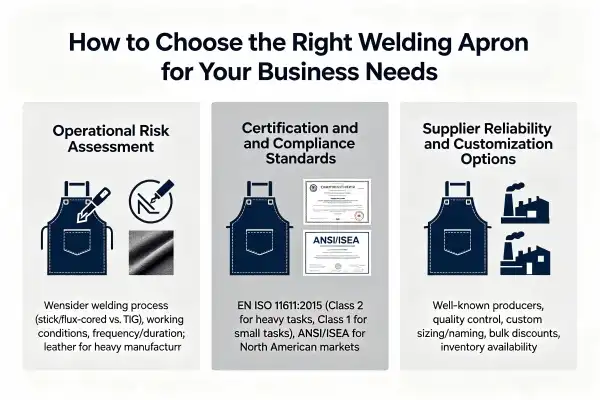
How to Choose the Right Welding Apron for Your Business Needs
Operational Risk Assessment
When choosing the right safety, procurement workers have to look at the specific welding process and the working conditions. When doing heavy manufacturing work with stick welding and flux-cored processes, you need the strong security that only leather aprons can give you. Fabric options may be possible with light construction work or precise TIG welding when spatter production is low. The selection factors are also affected by how often and for how long welding tasks are done. When welding is done all the time, leather lasts longer than fabric, but when welding is only done sometimes, fabric might be a better choice to save money.
Certification and Compliance Standards
Safety certificates are very important to look for in an apron for a work setting. Welding shields that follow EN ISO 11611:2015 are guaranteed to meet international safety standards for certain levels of protection. If it's certified as Class 2, it can be used for big welding tasks that make a lot of sparks. If it's certified as Class 1, it can be used for smaller welding tasks. Standards set by ANSI and ISEA help build trust in North American markets by making sure that safety gear meets local safety standards. Making sure that the right certifications are in place keeps you out of trouble with the law and meets government standards for worker safety.
Supplier Reliability and Customization Options
Product quality and stability for Spark Proof Leather Welding Apron are more likely to be guaranteed by well-known producers with a track record of success. Suppliers should show that they have experience making workplace PPE and keep up quality control systems that make sure the products work well. Custom sizing and naming choices let businesses protect workers in a way that meets their needs while still staying true to the company's image.
Large businesses can save money by buying in bulk and getting savings for doing so. This makes sure that products are always available. Reliable sellers keep enough inventory on hand and offer fast shipping choices so that work doesn't stop because of a lack of tools.
Procurement Insights: Where and How to Buy Spark-Proof Leather Welding Aprons
B2B Sourcing Strategies
The best way for industrial buyers to get professional safety equipment is through well-established trade outlets that focus on that type of equipment. When you deal directly with the maker, you can often get better prices and more customization choices than when you deal with a retail distributor. Online business-to-business (B2B) platforms make it easier to compare prices and handle large orders while keeping prices fair and clear. When you need a replacement quickly, regional dealers can save you money on shipping costs and delivery times. But buying teams should check that the distributor is authorized and that the product is real so that they don't get fake tools that might not meet safety standards.
Custom and OEM Manufacturing
Custom production services are helpful for businesses that need specific sizes or want to brand their products. Through OEM relationships, businesses can make their own safety gear that meets the specific needs of their operations while still meeting high-quality standards. Custom orders usually take longer to make, but they can be made to exact specs that standard goods can't match. Different suppliers have different minimum order amounts for custom manufacturing, but for most businesses, buying 100 or more units a year is enough to break even. Making a promise to buy a lot of something could lead to more discounts and better scheduling of production, which would make sure that planned growth or equipment upgrades are delivered on time.
Quality Verification and Support Services
Genuine sellers give a lot of paperwork, like material certifications, test records, and compliance statements, that prove the products are real. Support services after the sale, like expert help and the ability to get new parts, show that the seller wants to build long-term relationships with customers. Buyers are protected by warranties against problems with the way the product was made, and return policies give buyers a way to get their money back for goods that don't meet their needs. Established providers have customer service teams that can answer technical questions and give advice on how to use and keep tools correctly.
Maintaining Your Spark-Proof Leather Welding Apron for Optimal Life and Safety
Cleaning and Care Protocols
Regular cleaning with soft brushes to get rid of built-up dirt and dust is the first step in proper upkeep. You should stay away from harsh chemicals and cleansers because they take away the natural oils and coloring agents that keep leather heat-resistant. Cleaning leather safely without damaging the material is possible with cleaners made especially for commercial use.
Once a week, inspections find early signs of damage or wear that could make safety less effective. Cracks, areas that are stiff, or areas that are saturated with oil need to be fixed right away because they show that the material is less resistant to fire and could be dangerous.
Storage and Usage Best Practices
Properly keeping them in cool, dry places out of direct sunlight keeps them from breaking down or aging too quickly. Hanging clothes to store them keeps them from wrinkling and keeps their shape while letting air flow that keeps moisture from building up. Don't store leather in places with high or low temperatures or chemical fumes that could change its features. Using things in ways that don't put them under needless stress will make them last a lot longer. Avoiding touch with sharp objects, tightening the straps correctly to spread weight evenly, and taking off the apron when you're not welding can help keep it from getting worn out or damaged too quickly.
Replacement Guidelines
If you look closely and see that the Spark Proof Leather Welding Apron is weak, has a lot of cracks, or has spots where oils have soaked the leather fibers, you will need to replace it. These conditions show that the fire protection is low, which means that a spark could start a fire. Safety managers should set repair plans based on how often the aprons are used and do regular checks to see which ones need to be thrown away. When equipment breaks down suddenly, emergency replacement methods make sure that workers are always safe. Keeping extra parts on hand keeps work from stopping and makes sure that the right safety equipment is available right away when the main equipment breaks down.
Conclusion
Ultimately, the choice between the Spark Proof Leather Welding Apron and other fabrics relies on the needs of the job, the importance of safety, and the cost. When welding at high temperatures, where hot metal can burn easily, leather aprons are the best way to protect yourself. Fabric options may be more comfortable and cost less at first, but leather is usually the better choice for professional welding jobs because it lasts longer and protects better. To make the best purchasing choices, you need to carefully look at welding methods, safety standards, and long-term value to make sure that workers are safe and operations run smoothly.
FAQ
Can leather welding aprons be machine-washed?
When you wash leather in a machine, the fibers get damaged, and the protective coloring agents that make it resistant to heat are washed away. Water and cleansers dry out leather, make it crack, and make it less fire-resistant. Soft brushes and leather cleaners made for commercial use can be used to clean leather aprons.
What makes leather better than flame-retardant cotton for welding protection?
Leather provides physical deflection against molten metal droplets that would burn through cotton instantly. While cotton flame-retardant fabrics don't catch fire, they can't handle coming into direct contact with the big spatter particles that are typical in stick and MIG welding.
How long should a good leather apron for welding last?
Professional-grade leather aprons can usually handle heavy industrial use every day for 6 to 12 months. When leather becomes weak, cracks widely, or gets too oily, making it less fire-resistant, it needs to be replaced.
Do leather welding aprons protect against electrical shock?
Even though dry leather has some dielectric resistance, leather aprons are not approved as electrical protection gear. Their main job is to protect against heat and mechanical damage. For electrical safety, always make sure that the equipment is properly grounded.
Why use cotton straps instead of leather on welding aprons?
When it comes to comfort and flexibility, cotton webbing straps are better than leather straps. Cross-back styles evenly spread weight, and metal rivets and leather patches at attaching places make sure the link stays strong even when it's under a lot of stress.
Secure Premium Welding Protection with PPE MAX Today
Spark Proof Leather Welding Apron options from PPE MAX are the best in the business and are made for tough industrial settings. Our high-quality split cowhide design meets both EN ISO 11611:2015 and ANSI standards, and it also offers great security and longevity. We've been a trusted maker since 1956, and we offer low prices for large orders, the ability to make products to your exact specifications, and fast shipping to 134 countries. Contact our team at marketing@ppemax.com to talk about your specific needs and find out why top industrial companies choose PPE MAX as their go-to provider for spark-proof leather welding aprons and other safety solutions for the workplace.
References
1. International Organization for Standardization. "Protective clothing for use in welding and allied processes - Part 1: General requirements." EN ISO 11611:2015.
2. American National Standards Institute. "American National Standard for High-Visibility Safety Apparel and Accessories." ANSI/ISEA 107-2020.
3. Bureau of Labor Statistics. "Workplace Safety and Health: Welding and Cutting Operations Safety Guidelines." U.S. Department of Labor, 2023.
4. European Committee for Standardization. "Textiles - Determination of flame spread properties of vertically oriented specimens." ISO 15025:2016.
5. National Institute for Occupational Safety and Health. "Criteria for a Recommended Standard: Welding, Brazing, and Thermal Cutting." NIOSH Publication No. 88-110.
6. American Welding Society. "Safety and Health Fact Sheets: Personal Protective Equipment for Welding and Cutting." AWS Safety and Health Committee, 2024.
Learn about our latest products and discounts through SMS or email