- English
- French
- German
- Portuguese
- Spanish
- Russian
- Japanese
- Korean
- Arabic
- Greek
- German
- Turkish
- Italian
- Danish
- Romanian
- Indonesian
- Czech
- Afrikaans
- Swedish
- Polish
- Basque
- Catalan
- Esperanto
- Hindi
- Lao
- Albanian
- Amharic
- Armenian
- Azerbaijani
- Belarusian
- Bengali
- Bosnian
- Bulgarian
- Cebuano
- Chichewa
- Corsican
- Croatian
- Dutch
- Estonian
- Filipino
- Finnish
- Frisian
- Galician
- Georgian
- Gujarati
- Haitian
- Hausa
- Hawaiian
- Hebrew
- Hmong
- Hungarian
- Icelandic
- Igbo
- Javanese
- Kannada
- Kazakh
- Khmer
- Kurdish
- Kyrgyz
- Latin
- Latvian
- Lithuanian
- Luxembou..
- Macedonian
- Malagasy
- Malay
- Malayalam
- Maltese
- Maori
- Marathi
- Mongolian
- Burmese
- Nepali
- Norwegian
- Pashto
- Persian
- Punjabi
- Serbian
- Sesotho
- Sinhala
- Slovak
- Slovenian
- Somali
- Samoan
- Scots Gaelic
- Shona
- Sindhi
- Sundanese
- Swahili
- Tajik
- Tamil
- Telugu
- Thai
- Ukrainian
- Urdu
- Uzbek
- Vietnamese
- Welsh
- Xhosa
- Yiddish
- Yoruba
- Zulu
Insulating Gloves: Bulk Buying Tips for Safety Managers?
Founded in 1956, PPEMAX stands as a premier global manufacturer and supplier of full-range personal protective equipment. All our products comply with internationally recognized standards including IEC, ASTM, CE, UKCA, NIOSH and ISO9001. Equipped with a 2,000-square-meter modern production plant, we boast over 25 years of mature OEM & ODM capabilities to deliver one-stop customized solutions covering R&D design through worldwide logistics. Our safety gear is distributed across 134 countries globally. Upholding our core tenet “Safety First, Quality Priority”, we serve as a dependable long-term PPE partner for industrial enterprises around the world.
The details of insulating gloves take on critical importance when safety managers are charged with acquiring electrical protection equipment in bulk. This is an important choice for companies to make, since these specialised gloves are the first line of defence between workers and potentially deadly electrical risks. Bulk buying decisions may have a big impact on worker safety and productivity. A good procurement plan has to weigh up the need for strict safety requirements against practical issues such as cost, workforce diversity and longevity. Buy smart in bulk. Assess voltage classes, material quality, vendor trustworthiness and certification requirements. Negotiate favourable conditions without compromising the integrity of protection. At PPE MAX, we’ve seen how smart buying choices can revolutionise safety programmes, whether it’s for utility maintenance or telecommunications infrastructure.
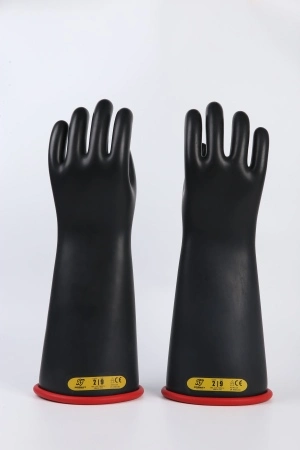
|
Parameter |
Specification |
|
Maximum Use Voltage |
17,000V AC / 25,500V DC |
|
Proof Test Voltage |
20,000V AC / 50,000V DC |
|
Typical Thickness |
2.3mm (ASTM D120 compliant) |
|
Material Type I |
Natural Rubber (high elasticity) |
|
Material Type II |
Synthetic/EPDM (ozone resistant) |
|
Standards Compliance |
ASTM D120, IEC/EN 60903 |
|
Temperature Range |
-40°F to +140°F (-40°C to +60°C) |
|
Color Options |
Orange, Red, Black |
Understanding Insulating Gloves: Types, Ratings, and Safety StandardsWhat Defines Electrical Insulating Gloves
Insulating gloves are a kind of personal protective equipment designed to protect against electrical shock when working on energised equipment. Unlike ordinary work gloves, these goods are tested for dielectric resistance to tolerate certain voltage levels. The rubber itself, whether natural latex or synthetic substitutes, is made of a non-conductive barrier that stops the electrical current. Safety managers need to be aware that these gloves are the ultimate last line of defence when administrative controls and de-energization procedures are not enough to control electrical hazards.
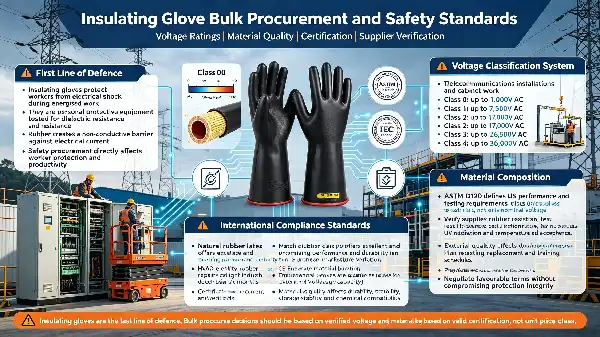
Voltage Classification Systems Explained
Electrical gloves are categorised by industry into six different types that match maximum usage voltages. PPE MAX manufactures Class 00 gloves to safeguard personnel dealing with circuits up to 500V AC. These gloves are tested at a proof voltage of 2,500V. The categorisation is useful for low voltage applications such as telecommunications installations, HVAC repairs and light industrial maintenance. The higher categories safeguard transmission level voltages, but the Class 00 grade takes care of most commercial and light industrial electrical operations. Understanding your operating voltage environment impacts the categorisation required by your workforce, and this immediately affects bulk purchase criteria.
Material Composition and Performance Characteristics
Natural rubber latex is still the most common material for voltage-rated gloves because of its excellent dielectric characteristics and flexibility. For our Class 00 models, we use high-quality natural rubber which retains elasticity throughout temperature ranges and resists ozone deterioration and UV radiation. Its average thickness of 0.5mm provides just enough protection without sacrificing tactile sensitivity, enabling professionals to operate microscopic components and wires without removing their main shielding. The material selection influences the electrical performance, but also the capacity to withstand many uses, the stability during storage, and the compatibility with chemical substances often used in the industrial field.
International Compliance Standards
Two major standards guide insulating glove manufacture and testing globally. The American standard ASTM D120 and the international specification IEC 60903 lay forth testing methodologies, voltage ratings, and quality standards. Both certifications are held by our goods, which means acceptability in worldwide markets and a wide range of regulatory jurisdictions. The standards specify periods for retesting (usually six months for gloves in active use), and acceptable fault limits. Safety managers who make bulk purchases should check that suppliers’ certificates are up to date and request proof to substantiate claims of compliance. For global enterprises, another important layer of certification is CE marking for the European markets.
Bulk Buying Considerations for Safety Managers
Assessing Workforce Requirements and Usage Patterns
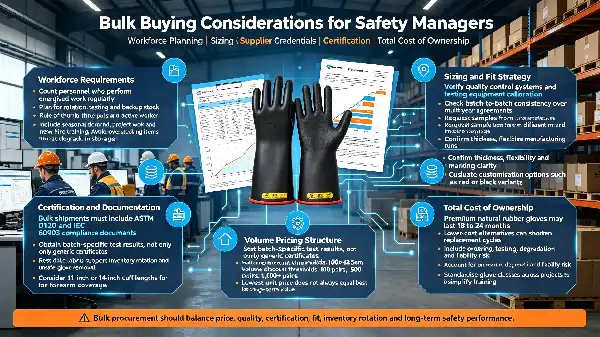
To start calculating proper order quantities, you’ll need to look at the makeup of your personnel and electrical exposure frequency. Count the number of individuals frequently conducting energised work, and then include in rotation schedules that allow for testing and maintenance cycles. A rule of thumb is to have three pairs of electrical leads for each person on the job—one pair in use, one pair being tested, and one pair as a backup. Turnover rates and training programmes that introduce new workers can affect volume needs. Bulk buying must handle the rise in demand from seasonal operations or project-based activity without overinvesting in inventory, which deteriorates with long-term storage.
Sizing Diversity and Fit Considerations
The correct fit is directly related to safety and to the worker’s adherence to PPE standards. Available in sizes 8-11, our Class 00 gloves address the anatomical differences in industrial workforces. When ordering in bulk, you want to base it on the size distribution of your squad. This will usually be a bell curve with the most demand around size 9-10. Gloves that do not fit well may reduce dexterity, induce dangerous removal throughout the course of work, and enable electrical tracking over loose material. Before making significant purchases, consider doing fit evaluations, especially when changing suppliers or adding new product lines. Available in 11-inch or 14-inch variants, depending on whether workers require more forearm protection or want to move around easily in tight locations.
Evaluating Supplier Credentials and Manufacturing Consistency
In the long run, the supplier relationship has repercussions beyond initial purchase cost. PPE MAX has a production history going back to 1956 with the process maturity to provide batch-to-batch consistency over multi-year supply agreements. • Verify quality control systems of prospective suppliers, testing apparatus calibration and traceability paperwork. Get samples from different manufacturing runs to check uniformity in thickness, flexibility and marking clarity. Some suppliers have the freedom to customise their products (and we can supply red or black variations, for example), which might be useful if you have a specific operational need or want to differentiate your brand.
Certification Validation and Documentation Requirements
Each bulk shipment must be accompanied by full certification documents showing conformity with ASTM D120 and IEC 60903 requirements. This documentation is crucial for any regulatory audits and liability enquiries after electrical events. Get test results for each batch from vendors, not just a generic certificate that may not apply to the items you actually received. We label test dates on every pair of gloves to help make it easier to maintain the inventory and schedule retirements. When dealing with government procurement and big company purchasers, we frequently have to provide extra layers of paperwork such as material safety data sheets and country of origin certificates for customs clearance in the 134 countries we service.
If you're evaluating personal protective equipment suppliers and require batch-specific testing documents before placing an order, PPE MAX is able to provide official Certificates of Analysis, professional laboratory test reports, and product samples for your verification. Feel free to contact our team at marketing@ppemax.com to discuss your sourcing needs and obtain complete documentation for your quality assessment and procurement approval.
Comparing Bulk Purchases: Quality vs. Cost
Understanding Pricing Structures in Volume Orders
Bulk purchasing creates opportunities for significant per-unit cost reductions for insulating gloves, but pricing structures vary considerably across suppliers. Our standard packing configuration—one pair per box, 20 pairs per carton—optimizes shipping efficiency while protecting product integrity. A full carton weighs just 6.5kg with dimensions of 54.5×35×42.5cm, keeping freight costs manageable even for international shipments. Volume discounts typically activate at threshold quantities: 100 pairs, 500 pairs, and 1,000+ pairs representing common breakpoints. However, the lowest per-unit price doesn't automatically deliver the best value when factoring in product lifespan, failure rates, and replacement frequency.
Total Cost of Ownership Analysis
Smart procurement extends beyond acquisition pricing to encompass the complete ownership cycle. High-quality gloves like our Class 00 models, manufactured from premium natural rubber, typically deliver 18 to 24 months of service life under normal industrial use with proper maintenance. Budget alternatives using inferior rubber compounds may cost 30% less initially but require replacement in half the time, ultimately increasing total expenditure. Factor in the administrative burden of more frequent ordering, the safety risks associated with premature material degradation, and the potential liability exposure from equipment failures. A comprehensive cost analysis reveals that mid-tier to premium products often provide superior long-term value.
Case Study: Infrastructure Contractor Optimization
A regional telecommunications contractor we supply reduced annual PPE spending by 23% through strategic bulk purchasing aligned with their project pipeline. Rather than ordering reactively, they established quarterly bulk orders sized to their rolling six-month workforce projections. This approach secured volume pricing while avoiding excessive inventory carrying costs. They standardized on our Class 00 gloves across all low-voltage projects, simplifying training and eliminating confusion about appropriate protection levels. The consistency also streamlined their testing and maintenance protocols, reducing administrative overhead. Their procurement manager reported that predictable supply costs improved project bidding accuracy, creating a competitive advantage in fixed-price contract negotiations.
Maintenance, Testing, and Safety Guidelines for Maximized Glove Lifespan
Storage Protocols and Environmental Controls
The life and durability of rubber gloves depend on proper storage. Keep gloves in a cool, dry place, away from direct sunlight, ozone-generating equipment, and chemical vapours. Extreme temperatures, including heat and cold situations, speed up rubber breakdown. We advocate the use of specialised storage cabinets with temperatures maintained between 50°F and 70°F and relative humidity of less than 60%. Do not store gloves in plastic containers that hold moisture. Store gloves in original packaging or in fabric bags that allow air to circulate. Do not use Class 00 gloves with leather protectors. Do not use Class 00 gloves with copper, brass, or other metals that may produce chemical reactions. Hanging storage minimises creasing, which may produce stress spots that are susceptible to electrical failure.
Inspection Routines and Testing Schedules
A visual assessment of the equipment before each use is the first line of defence against failure. Check for punctures, wounds, foreign objects embedded in the gloves, swelling, or changes in texture that may indicate contact with a chemical. The air inflation test, which includes inflating the glove and listening for escaping air, finds tiny leaks that are not evident to the naked eye. ASTM D120 also requires electrical testing of gloves in service every six months, in addition to the daily user checks. This proof testing uses a voltage higher than the rating of the glove to ensure that the dielectric integrity is still maintained. Keep thorough records on each glove pair, including the date of manufacture, date of introduction into service, testing history, and date of retirement. Our simple marking method, with class classification and size printed right on each glove, makes record-keeping easier and minimises misapplication.
Training Requirements and Usage Best Practices
Even the best electrical gloves won’t protect workers who don’t know how to use them correctly. Insulating gloves alone do not provide full protection; they must be worn with leather protector gloves on the outside to guard against mechanical harm from sharp edges, abrasion and punctures. Workers need to know the limits on voltage. We use class 00 gloves for up to 500V AC. Never higher classes. Emphasise that wet or infected gloves have no dielectric characteristics and must be taken out of use immediately. Training should include techniques for wearing and doffing without contaminating the inner surface, verification of correct size, and identification of deterioration signs. Keep records of all your training; it might prove your regulatory compliance and due diligence in case of any responsibility.
Procurement Strategies: Where and How to Buy Insulating Gloves in Bulk
Direct Manufacturer Relationships vs. Distributor Networks
The benefit of buying in bulk is that you are dealing with manufacturers directly, and in this case, PPE MAX. Cutting out the distributor markup via direct contacts often reduces prices by 15% to 25% on large purchases. Distributors can’t match the technical competence, customisation capabilities and visibility into product development roadmaps that manufacturers give. Our team collaborates with safety managers to define the right items for specific applications, propose size distributions and build delivery schedules that fit project timetables. But distributors provide ease to customers dealing with several PPE categories from different manufacturers by simplifying orders and offering local storage, which minimises lead times for urgent replenishment demands.
Negotiating Volume Agreements and Contract Terms
Long-term supply contracts provide price stability and assurance of availability, which is even more useful during supply chain interruptions. If you are negotiating bulk contracts, discuss price adjustment formulas based on the cost of raw materials, minimum order quantities that qualify for volume discounts, and flexibility in delivery schedules. Ask for warranty conditions for any manufacturing flaws found in your testing procedures. We guarantee that if a product is damaged within six months after delivery, we will replace it, provided that it has been properly stored and handled. Specify payment conditions ( net 30, net 60, letter of credit for foreign transactions, etc. ) . Consider consignment inventory where the supplier stocks goods at your location and charges you as you use inventory.
Authenticating Products and Avoiding Counterfeits
The electrical safety equipment industry is saturated with fake devices with bogus certificates and fabricated voltage ratings. These unsafe knock-offs put workers at risk and subject organisations to catastrophic responsibility. Confirm supplier credibility via company registration, facilities inspections and referrals from existing customers. Genuine items are always labelled, packaged in a suitable manner with unbroken tamper seals and fully documented. Our Class 00 gloves are permanently marked for conformity to standards, date of manufacture and traceability codes to the production batch records. Obtain certifications of compliance directly from the makers and not from the distributor, which may not be for the product supplied.
Leveraging Global Supply Chains Responsibly
International sourcing offers more possibilities, but adds complexities in terms of lead times, customs processes and quality assurance. PPE MAX ships to 134 countries, taking care of export paperwork, customs clearance cooperation and international freight optimisation. Include 30- to 45-day lead periods for maritime freight from production sites to North American destinations, longer for certain worldwide routes. Air freight cuts transit to 7 to 10 days, but costs 300% to 400% more. Build partnerships with freight forwarders that know the classifications and regulations for hazardous commodities and understand PPE imports. When choosing suppliers from other countries for key safety equipment, consider geopolitical stability and volatility of currency exchange rates and tariff risk.
Conclusion
Buying insulating gloves in bulk should be approached with a mix of technical expertise, supplier assessment and life cycle cost analysis. By taking the effort to grasp voltage classifications, compliance requirements, and material qualities, safety managers make buying choices that safeguard workers and organisational interests. From assessing your workforce, the size and diversity of your team, to testing methods and supplier verification, these tactics provide a foundation to purchase in bulk with confidence. At PPE MAX, our 60 years of manufacturing experience tells us that successful safety programmes view PPE procurement as a strategic function, not a commodity transaction, and that successful safety programmes build supplier partnerships that offer consistent quality, responsive support and continuous improvement in worker protection.
FAQ
1. How often should bulk-purchased insulating gloves be tested?
ASTM D120 and IEC 60903 standards require electrical testing every six months for gloves in active service. Some organizations adopt more conservative three-month intervals for high-use environments. Visual inspections occur before each use, supplemented by air inflation tests weekly or after any suspected damage incident. Maintain detailed testing logs tracking each glove pair individually to ensure no items exceed maximum service intervals. Retire gloves immediately upon test failure or when reaching manufacturer-specified maximum service life, typically three years from the manufacturing date regardless of testing results.
2. What is the typical lead time for bulk insulating glove orders?
Domestic suppliers with inventory stock can fulfill orders within 5 to 10 business days. Custom orders requiring specific size distributions, color variants, or private labeling typically require 20 to 30 days for production and quality verification. International orders from manufacturers like PPE MAX involve 30 to 45-day lead times via ocean freight or 7 to 10 days through air freight expediting. Plan procurement cycles accounting for testing downtime, seasonal demand fluctuations, and safety stock buffers preventing stockouts during production or transit delays.
3. Can we mix different glove classes in a single bulk order?
Absolutely. Many organizations standardize on Class 00 for general electrical work while maintaining smaller quantities of Class 0 or higher ratings for specialized high-voltage applications. Mixing classifications in a single purchase order typically qualifies for volume pricing calculated across total quantity rather than per-class volumes. Clearly segregate different classes in your storage and inventory systems to prevent workers from inadvertently using insufficient protection for their voltage environment. Color coding storage locations corresponding to glove label colors provides an effective visual management system.
Partner with PPE MAX: Your Trusted Insulating Gloves Manufacturer
At PPE MAX, we understand that bulk procurement decisions carry weight beyond simple cost calculations—they directly impact the lives and well-being of your workforce. Our Class 00 insulating gloves represent over six decades of manufacturing refinement, rigorous quality control, and unwavering commitment to worker protection. We offer competitive volume pricing without compromising the dielectric integrity, durability, and comfort that keep electrical workers safe across utilities, telecommunications, and industrial maintenance operations. Our global shipping network reaches 134 countries with comprehensive documentation supporting your compliance requirements. Contact our technical team at marketing@ppemax.com to discuss your specific bulk purchasing needs, request samples for evaluation, or explore customization options that align our products with your safety program requirements. We're not just an insulating gloves supplier—we're your partner in building a safety culture that brings every worker home safely.
References
1. American Society for Testing and Materials. "ASTM D120-20 Standard Specification for Rubber Insulating Gloves." ASTM International Standards, 2020.
2. International Electrotechnical Commission. "IEC 60903:2002+AMD1:2020 Live Working—Gloves of Insulating Material." IEC Standards Catalogue, 2020.
3. Occupational Safety and Health Administration. "1910.137 Electrical Protective Devices." OSHA Safety and Health Regulations for General Industry, U.S. Department of Labor, 2021.
4. National Fire Protection Association. "NFPA 70E: Standard for Electrical Safety in the Workplace." NFPA Codes and Standards, 2021 Edition.
5. Cadick, J., Capelli-Schellpfeffer, M., and Neitzel, D. "Electrical Safety Handbook, 4th Edition." McGraw-Hill Professional, 2012.
6. Institute of Electrical and Electronics Engineers. "IEEE Guide for the In-Service Use, Care, Maintenance, and Testing of Insulating Gloves and Sleeves." IEEE Standards Association, 2018.
Learn about our latest products and discounts through SMS or email