- English
- French
- German
- Portuguese
- Spanish
- Russian
- Japanese
- Korean
- Arabic
- Greek
- German
- Turkish
- Italian
- Danish
- Romanian
- Indonesian
- Czech
- Afrikaans
- Swedish
- Polish
- Basque
- Catalan
- Esperanto
- Hindi
- Lao
- Albanian
- Amharic
- Armenian
- Azerbaijani
- Belarusian
- Bengali
- Bosnian
- Bulgarian
- Cebuano
- Chichewa
- Corsican
- Croatian
- Dutch
- Estonian
- Filipino
- Finnish
- Frisian
- Galician
- Georgian
- Gujarati
- Haitian
- Hausa
- Hawaiian
- Hebrew
- Hmong
- Hungarian
- Icelandic
- Igbo
- Javanese
- Kannada
- Kazakh
- Khmer
- Kurdish
- Kyrgyz
- Latin
- Latvian
- Lithuanian
- Luxembou..
- Macedonian
- Malagasy
- Malay
- Malayalam
- Maltese
- Maori
- Marathi
- Mongolian
- Burmese
- Nepali
- Norwegian
- Pashto
- Persian
- Punjabi
- Serbian
- Sesotho
- Sinhala
- Slovak
- Slovenian
- Somali
- Samoan
- Scots Gaelic
- Shona
- Sindhi
- Sundanese
- Swahili
- Tajik
- Tamil
- Telugu
- Thai
- Ukrainian
- Urdu
- Uzbek
- Vietnamese
- Welsh
- Xhosa
- Yiddish
- Yoruba
- Zulu
How Thin Can Dielectric Gloves Get Without Losing Safety?
Founded in 1956, PPEMAX stands as a premier global manufacturer and supplier of full-range personal protective equipment. All our products comply with internationally recognized standards including IEC, ASTM, CE, UKCA, NIOSH and ISO9001. Equipped with a 2,000-square-meter modern production plant, we boast over 25 years of mature OEM & ODM capabilities to deliver one-stop customized solutions covering R&D design through worldwide logistics. Our safety gear is distributed across 134 countries globally. Upholding our core tenet “Safety First, Quality Priority”, we serve as a dependable long-term PPE partner for industrial enterprises around the world.
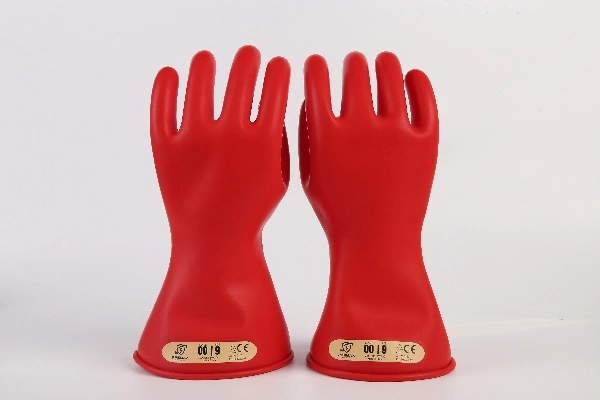
For Class 00 applications, dielectric gloves may be made as thin as 0.5mm and yet comply with ASTM D120 and IEC 60903 specifications. The minimum safe thickness is only a function of the voltage class requirements, ranging from 0.5 mm for work up to 500 V to 4 mm for Class 4 applications at 36,000 V. Material composition, manufacturing accuracy, and adherence to certification processes are critical factors in determining whether thinner gloves can provide safe electrical insulation without putting worker safety at risk during live electrical repair.
|
Parameter |
Type I (Natural Rubber) |
Type II (Synthetic/EPDM) |
|
Maximum Use Voltage |
500V AC / 750V DC |
500V AC / 750V DC |
|
Proof Test Voltage |
2,500V AC / 10,000V DC |
2,500V AC / 10,000V DC |
|
Maximum Thickness |
0.75mm (30 mils) |
0.75mm (30 mils) |
|
Length Options |
11-14 inches |
11-14 inches |
|
Color Code |
Beige Label |
Beige Label |
|
Temperature Range |
Standard |
Extended (-25°C to +55°C) |
|
UV/Ozone Resistance |
Standard |
Enhanced |
Understanding Dielectric Gloves and Their Safety Standards
When I talk to procurement managers who have questions regarding electrical safety equipment, one issue often comes up: what really makes these protective barriers effective? The secret is to know material science and strict certification schemes.
The Fundamental Principle Behind Electrical Insulation
Insulated electrical gloves are used to provide a high resistance barrier between personnel and energised wires. Natural rubber remains the benchmark material because of its high dielectric characteristics and mechanical flexibility. At PPE MAX, we test our own equipment since we know that the molecular structure has a direct influence on the resistance of electron flow. Premium rubber compounds have polymer chains that form convoluted routes that prevent electrical current from reaching the skin of the user even when stress conditions are created by normal work situations.
International Standards Governing Voltage Protection
ASTM D120 and IEC 60903 are the regulatory backbone for voltage-rated gloves in the worldwide market. These standards require certain testing procedures such as AC and DC voltage breakdown tests, ozone resistance testing, and physical property testing. Class 00 gloves are proof tested at 500V AC. Class 4 equipment is rated for 36,000V. Each classification has minimum wall thickness criteria that manufacturers cannot compromise on. Whether on a Dubai building site or a Peruvian mining operation, procurement teams need to confirm certifications are appropriate for the unique voltage exposure situations, since regulatory compliance is directly linked to liability minimisation and worker trust.
Performance parameters are influenced by material composition
In addition to natural rubber, current formulations also include synthetic polymers such as nitrile blends and neoprene composites. These options are designed for unique environmental difficulties such as chemical exposure, severe temperatures, or improved puncture resistance. The choice of material is a key factor in determining the minimum thickness of a glove, while maintaining safety margins. Our 1956 manufacturing experience has shown us that hasty material substitutions without thorough field testing result in false economies that harm workers and threaten brand reputations in competitive B2B markets.
The Relationship Between Thickness and Safety
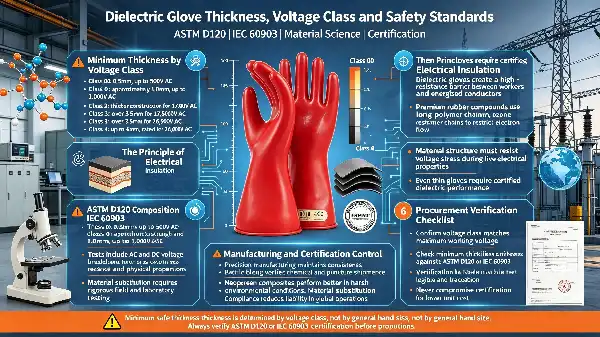
In electrical protection, dielectric glove thickness is not only a dimensional specification—it is the safety margin between normal maintenance and catastrophic harm.
Industry-Mandated Minimum Thickness Requirements
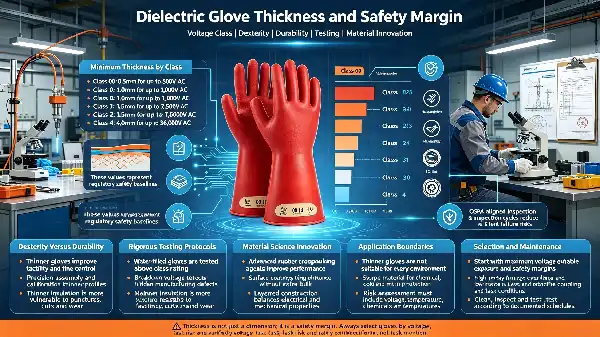
The minimum thicknesses are defined by the regulatory organisations for the voltage classes. Class 00 gloves should be a minimum of 0.5mm thick; Class 0 gloves should be a minimum of 1.0mm thick; Class 1 gloves should be 1.5mm thick and Class 4 gloves should be 4.0mm thick. These specs are the result of decades of event investigation and lab stress testing. We keep these minimums across our product lines sold in 134 countries because there are engineering margins for valid reasons, including manufacturing variability, material deterioration over the course of a service life, and unpredictable field conditions that theoretical calculations can’t fully account for.
Trade-offs Between Dexterity and Mechanical Durability
Thinner gloves certainly do improve tactile sense and manual dexterity. Especially so when it comes to precision electrical assembly or instrument calibration. When voltage exposure is allowed, electricians working on elaborate control panels always favour thinner profiles. But the thinner the insulation, the more susceptible it is to mechanical damage, such as punctures from sharp conductor edges, rips from rough surfaces, and wear from repeated handling. Procurement criteria should aim to reconcile operational efficiency with expectations of longevity. More frequent glove changes owing to mechanical failure reduce the cost savings gained via gains in productivity. This is especially true for organisations with thousands of workers at distant sites.
Validation Through Rigorous Testing Protocols
All of them are electrically tested under very specific settings. They fill the gloves with water, dip them in a conductive solution, and apply voltage over the gloves ' class rating. Breakdown voltage testing may find manufacturing problems that eye examination may miss. We require that in-service inspections be performed at six-month intervals, regardless of use. This is due to the fact that micro-cracks and material deterioration occur even in storage. This testing cycle is in compliance with OSHA guidelines and is an industry best practice that safety managers should use in their PPE management practices.
If you're evaluating personal protective equipment suppliers and require batch-specific testing documents before placing an order, PPE MAX is able to provide official Certificates of Analysis, professional laboratory test reports, and product samples for your verification. Feel free to contact our team at marketing@ppemax.com to discuss your sourcing needs and obtain complete documentation for your quality assessment and procurement approval.
Advances Enabling Thinner but Safe Dielectric Gloves
Recent advances in material science have revolutionised what manufacturers can do without compromising the protective levels required by regulatory agencies.
Innovations in Polymer Composite Engineering
Advanced rubber formulations with nano-fillers and crosslinking agents provide high dielectric strength per thickness. These formulations have greater breakdown voltages than conventional materials, allowing thickness reduction with retained voltage ratings. Historically, the principal limiting factor in reducing thickness has been mechanical susceptibility. Specialised surface coatings may improve puncture resistance without adding bulk. Layered construction processes, alternating materials with complementary features, allow us to optimise both electrical and physical performance characteristics within compact profiles that workers really enjoy throughout lengthy shifts.
Real-World Performance in Demanding Applications
Utilities who manage the electrical grids in our cities have successfully used Class 0 gloves, 1.0mm thick, for 1,000V applications when the requirements previously called for the heavier alternatives. Field reports suggest less hand fatigue during overhead line repair with no increase in incident rates. Similarly, in the manufacturing plants where equipment testing is performed at 7,500V, Class 2 gloves are used with optimised thickness profiles that provide better control while making fine changes. These included extensive training programmes and tight inspection processes, showing that smaller gloves work inside disciplined safety management systems, not as stand-alone equipment modifications.
Practical Limits and Application Boundaries
Ultra-thin dielectric gloves are not ideal for all circumstances, even in this age of technology. If you want maximal protection at a high-voltage substation, or an area with sharp metallic debris or chemicals, you may ignore the penalty to dexterity. Procurement teams need to be aware of the demand to specify smaller gloves across a wide range of operating settings. We recommend that customers do application-specific risk evaluations, including factors such as voltage exposure, environmental dangers, job length and worker experience levels, prior to picking thickness specifications that may compromise safety for small convenience advantages.
How to Select the Right Thickness for Your Application
Matching glove specifications to operational requirements demands systematic evaluation rather than defaulting to familiar options or lowest-cost alternatives.
Voltage Class Determines Baseline Requirements
Begin by documenting maximum voltage exposure across all tasks within your operation. Add safety margins accounting for transient overvoltage conditions during switching operations or fault scenarios. This voltage rating dictates minimum glove class, which inherently establishes thickness parameters. Many procurement errors stem from underestimating actual exposure—assuming nominal system voltage without considering inductive kick from motor loads or capacitive coupling in underground cable work that can generate unexpected voltage levels exceeding nameplate ratings.
Environmental and Task-Specific Considerations
Temperature extremes affect material properties and required thickness margins. Cold environments reduce rubber flexibility, necessitating thicker profiles to maintain mechanical integrity. Chemical exposure requires specific rubber formulations that may limit thickness reduction options. Task frequency and duration influence selection—intricate work lasting hours justifies prioritizing dexterity, while brief high-risk interventions favor maximum protection. We provide detailed selection matrices to our wholesale partners because these nuanced decisions directly impact end-user satisfaction and safety outcomes that define brand reputation in competitive industrial markets.
Maintenance Practices Extending Service Life
Proper cleaning, storage, and periodic testing dramatically extend glove longevity regardless of thickness. Store gloves away from ozone sources, direct sunlight, and temperature extremes in breathable containers that prevent moisture accumulation. Clean with approved solutions that remove contaminants without degrading rubber compounds. Our manufacturing protocols produce gloves built for extended service, but field maintenance practices ultimately determine whether equipment reaches its design lifespan or fails prematurely, generating unnecessary replacement costs and potential safety gaps during procurement delays.
Procurement Guidance: Buying Thin Yet Safe Dielectric Gloves
Sourcing selections have implications beyond immediate economic concerns; they impact worker safety, regulatory compliance, and long-term operating expenses.
Evaluating Supplier Credentials and Product Authenticity
Confirm that vendors have current certificates from accredited testing facilities authorised to certify ASTM and IEC conformity for dielectric gloves. Request proof of batch testing to show that individual inventory fulfils published criteria, not general certification declarations. 2. Counterfeiting of electrical safety equipment continues to be an issue in the marketplace, especially in price-sensitive buying contexts. Authorised distributors give a level of traceability—from product to production record, warranty support and technical consultation—that generic vendors just cannot match. In over six decades of servicing worldwide industrial markets, we’ve developed quality assurance methods that safety managers can trust when requirements allow no room for inferior equipment.
Strategic Bulk Purchasing and Cost Optimization
Buying in bulk may lead to considerable savings per unit, and it can also ensure you have enough inventory to continue operations if the supply chain is disrupted. Negotiate price arrangements that encourage long-term collaborations, not transactional spot purchases that undermine supplier responsibility. Think cost vs performance parameters; less costly gloves that need to be replaced more often will eventually cost more when you account for procurement administration, disposal and productivity losses due to equipment failure. For organisations managing huge workforce populations spanning mining operations, energy infrastructure or industrial complexes, standardised specifications provide for easier training, cut down on inventory complexity and leverage their buying power throughout their whole operation.
Partnering with Experienced Dielectric Gloves Manufacturers
Building ties with well-recognised manufacturers offers access to technical knowledge that optimises specifications to particular applications. We urge procurement managers to give operational information such as voltage ranges, ambient conditions, description of tasks, and current pain spots with existing equipment. This data helps manufacturers to propose the best solutions against generic catalogue products. As a dielectric gloves provider supplying to 134 countries, PPE MAX has vast application experience in a variety of sectors, voltage systems, and regulatory situations. This means specifications that operate well, not expensive adjustments after first deployment failures that delay projects and upset workers who depend on equipment that meets their real demands.
Conclusion
To develop smaller dielectric gloves with equivalent safety, it needs advanced material engineering, precise application-specific selection criteria, and adherence to testing methods. Modern production technologies allow for more flexibility with optimised thickness profiles, while yet allowing for the voltage protection required by international standards. In procurement, the key to success is to understand the link between thickness, voltage class and operational needs rather than to seek thinness as a target per se. Organisations gain the most value from partnering with seasoned manufacturers that provide end-to-end services – from developing specifications to maintaining compliance over time – that ensure electrical safety programmes are doing what they’re supposed to do to protect workers and ensure operational efficiency across the entire enterprise.
FAQ
1. Can ultra-thin gloves provide adequate electrical protection?
Ultra-thin gloves meeting ASTM D120 or IEC 60903 certification for their voltage class provide reliable protection when properly selected, maintained, and used within rated parameters. The key lies in matching glove class to actual voltage exposure rather than assuming thinner automatically means less safe. Certified Class 00 gloves at 0.5mm thickness safely protect workers at voltages up to 500V, validated through rigorous breakdown testing that confirms performance under stress conditions.
2. How frequently should electrical insulating gloves undergo inspection?
OSHA and industry best practices mandate visual inspection before each use, checking for punctures, tears, embedded foreign objects, or surface degradation. Comprehensive electrical testing must occur every six months for gloves in regular service or immediately before use if stored longer than twelve months. This testing interval ensures that material degradation does not compromise protection, particularly given that rubber compounds degrade over time regardless of usage frequency, making periodic validation essential for maintaining safety assurance.
3. What regulatory standards govern minimum thickness requirements?
ASTM D120 and IEC 60903 establish international standards defining minimum thickness correlated with voltage class ratings. These specifications emerged from extensive research correlating material properties, thickness parameters, and breakdown voltage performance. Manufacturers cannot arbitrarily reduce thickness below these minimums while maintaining certification, ensuring that compliant products meet baseline safety requirements regardless of where procurement occurs globally. Always verify certification authenticity through recognized testing laboratory documentation rather than supplier claims alone.
Ready to Source Certified Electrical Protection Equipment?
PPE MAX brings over six decades of manufacturing excellence to your electrical safety challenges. Our comprehensive range of certified insulating gloves spans Class 00 through Class 4 applications, engineered to balance optimal thickness with uncompromising protection for workers across construction, energy, mining, and manufacturing sectors. We understand the procurement complexities facing distributors, importers, and safety managers sourcing dielectric gloves for sale across international markets with varying regulatory requirements. Our technical team stands ready to evaluate your specific voltage exposure scenarios, environmental conditions, and operational requirements, recommending specifications that genuinely match your needs rather than generic catalog solutions. Contact us at marketing@ppemax.com to request free samples, discuss custom manufacturing capabilities, or receive detailed quotations for your upcoming projects—experience the difference that authentic expertise and proven quality deliver.
References
1. American Society for Testing and Materials. (2023). ASTM D120-20: Standard Specification for Rubber Insulating Gloves. West Conshohocken: ASTM International.
2. International Electrotechnical Commission. (2022). IEC 60903:2019 Live working - Electrical insulating gloves. Geneva: IEC Publications.
3. Occupational Safety and Health Administration. (2021). 1910.137 - Electrical Protective Equipment Standards. Washington: U.S. Department of Labor.
4. National Institute for Occupational Safety and Health. (2020). Electrical Safety: Personal Protective Equipment Guidelines. Cincinnati: NIOSH Publications.
5. Institute of Electrical and Electronics Engineers. (2022). IEEE Standard 1584: Guide for Performing Arc Flash Hazard Calculations. New York: IEEE Standards Association.
6. Canadian Standards Association. (2021). CSA Z462-21: Workplace Electrical Safety Standard. Toronto: CSA Group Publishing.
Learn about our latest products and discounts through SMS or email