- English
- French
- German
- Portuguese
- Spanish
- Russian
- Japanese
- Korean
- Arabic
- Greek
- German
- Turkish
- Italian
- Danish
- Romanian
- Indonesian
- Czech
- Afrikaans
- Swedish
- Polish
- Basque
- Catalan
- Esperanto
- Hindi
- Lao
- Albanian
- Amharic
- Armenian
- Azerbaijani
- Belarusian
- Bengali
- Bosnian
- Bulgarian
- Cebuano
- Chichewa
- Corsican
- Croatian
- Dutch
- Estonian
- Filipino
- Finnish
- Frisian
- Galician
- Georgian
- Gujarati
- Haitian
- Hausa
- Hawaiian
- Hebrew
- Hmong
- Hungarian
- Icelandic
- Igbo
- Javanese
- Kannada
- Kazakh
- Khmer
- Kurdish
- Kyrgyz
- Latin
- Latvian
- Lithuanian
- Luxembou..
- Macedonian
- Malagasy
- Malay
- Malayalam
- Maltese
- Maori
- Marathi
- Mongolian
- Burmese
- Nepali
- Norwegian
- Pashto
- Persian
- Punjabi
- Serbian
- Sesotho
- Sinhala
- Slovak
- Slovenian
- Somali
- Samoan
- Scots Gaelic
- Shona
- Sindhi
- Sundanese
- Swahili
- Tajik
- Tamil
- Telugu
- Thai
- Ukrainian
- Urdu
- Uzbek
- Vietnamese
- Welsh
- Xhosa
- Yiddish
- Yoruba
- Zulu
How to Train Workers on Insulating Gloves Properly?
Founded in 1956, PPEMAX stands as a premier global manufacturer and supplier of full-range personal protective equipment. All our products comply with internationally recognized standards including IEC, ASTM, CE, UKCA, NIOSH and ISO9001. Equipped with a 2,000-square-meter modern production plant, we boast over 25 years of mature OEM & ODM capabilities to deliver one-stop customized solutions covering R&D design through worldwide logistics. Our safety gear is distributed across 134 countries globally. Upholding our core tenet “Safety First, Quality Priority”, we serve as a dependable long-term PPE partner for industrial enterprises around the world.
The difference between a protected staff and avoidable accidents is proper training on electrical safety insulating gloves. Insulating glove training for workers should be tailored to include theoretical knowledge and hands-on experience, encompassing glove categorisation systems, pre-use inspection processes, appropriate donning and doffing procedures, and daily maintenance protocols. Good programmes include compliance standards from ASTM D120 and IEC 60903 with an emphasis on voltage rating awareness, visual fault identification and proper leather protector matching. Organisations that invest in good training decrease electrical occurrences by teaching workers to recognise faulty equipment, understand dielectric limits, and regularly perform safe work practices on low-voltage activities.
|
Parameter |
Type I (Natural Rubber) |
Type II (Synthetic/EPDM) |
|
Maximum Use Voltage |
500V AC / 750V DC |
500V AC / 750V DC |
|
Proof Test Voltage |
2,500V AC / 10,000V DC |
2,500V AC / 10,000V DC |
|
Maximum Thickness |
0.75mm (30 mils) |
0.75mm (30 mils) |
|
Length Options |
11-14 inches |
11-14 inches |
|
Color Code |
Beige Label |
Beige Label |
|
Temperature Range |
Standard |
Extended (-25°C to +55°C) |
|
UV/Ozone Resistance |
Standard |
Enhanced |
Understanding Insulating Gloves and Their Safety Importance
Electrical safety equipment is the vital barrier between workers and life-threatening shock risks. Rubber insulating gloves developed for electrical work offer verified dielectric strength to prevent electricity from flowing through to the wearer’s hands and body when contact is made with energised circuits.
The Foundation of Electrical Protection
Insulating gloves are not the same as regular work gloves. They are made of natural rubber latex or specific synthetic materials that do not allow electrical current to pass through. To guarantee dependability in actual field use, gloves are proof tested to a far greater voltage than the operating voltage for which the gloves are rated. The categorisation method splits gloves into six voltage classes, from Class 00 (for use up to 500V AC) to Class 4 (for use on applications up to 36,000V AC). Every class is designed for certain operating conditions, and the choice of the right one is directly related to the level of protection of the employee.
Standards That Define Safety
Legitimate producers must fulfil production and testing norms specified by compliance frameworks that are created by ASTM International and the International Electrotechnical Commission. ASTM D120 sets physical and electrical specifications for rubber insulating gloves used in the United States, whereas IEC 60903 applies to overseas markets. OSHA standards 29 CFR 1910137 require companies to supply suitable electrical protection equipment and ensure personnel are trained in its correct use. Together, these standards provide a safety ecosystem where the choices made in the procurement process have a direct influence on regulatory compliance and worker protection.
Class 00 Applications in Low-Voltage Environments
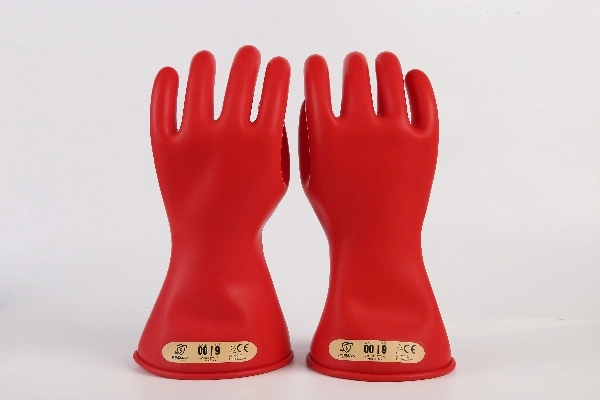
Class 00 insulating gloves are designed to meet the unique demands of telecommunications technicians, HVAC service technicians, and industrial maintenance personnel who are exposed to voltages up to 500V AC routinely. PPE MAX produces ASTM D120 and IEC 60903 Class 00 gloves with an AC proof test rating of 2,500V to assure performance dependability. These gloves come in lengths of 11 inches and 14 inches, offering differing levels of forearm covering while yet allowing the dexterity needed for intricate work. The lightweight design (around 170 grammes per glove) lowers hand tiredness during lengthy usage, a typical complaint that limits compliance in field activities.


Common Challenges in Training Workers on Insulating Gloves
Training gaps generate weaknesses that jeopardise even the highest-quality protective equipment. Observations in electrical work settings show consistent patterns where poor preparedness results in increased risk exposure.
Selection Errors and Rating Confusion
Class 00 gloves are rated for 500V AC; however, workers often do not grasp voltage categorisation systems and end up using them on circuits with voltages above the gloves’ specification. This misconception is due to the lack of attention in initial training on how to check the voltage of the circuit before choosing the glove. The issue is compounded when organisations carry various types of gloves without clear labelling methods, or when workers think that all rubber gloves offer the same level of protection regardless of colour coding or markings.
Inspection Neglect and Detection Failures
The most overlooked safety procedure is the pre-use check. Workers not confident in defect detection or working under time constraints continue to use compromised gloves that are punctured, cut, ozone-deteriorated, or with embedded contaminants. Air inflation checks, which may detect tiny leaks that are imperceptible to the naked eye, are essential but seldom performed in the field. Training programmes that just provide inspection procedures without experience do not develop the ability to consistently find defects.
Real Consequences of Inadequate Training
Improper usage of gloves causes electrical accidents and expenditures, apart from direct medical care. A single accident may lead to OSHA inspections, workers’ compensation claims, and even criminal negligence cases if training documentation is missing. Electrical mishaps that shut down production cost industrial businesses thousands of dollars an hour. Damage to reputation impacts client relationships and contract renewals. The effects are especially severe for organisations that serve government procurement markets where safety record criteria sometimes influence whether or not to be on the bid list for future contracts.
Core Principles for Effective Insulating Glove Training
Safety requirements are converted into worker capability via planned training programmes, as skills are purposefully developed and information reinforced. The best techniques blend classroom education with supervised, hands-on application.
Building Theoretical Foundations
Complete programmes start with a discussion of the need for electrical protection. Basic electrical theory is taught to the extent that workers understand how current flows, the concepts of resistance, and the human body's susceptibility to shock. Training materials should emphasise that voltage values are maximum safe exposure levels, not recommended operating levels. Participants need to be introduced to the requirements of ASTM and IEC standards; not to memorise specifications, but to grasp the technical rigour underlying equipment they will use regularly. The discussion of manufacturer testing protocols gives assurance that properly maintained gloves do deliver the protection they claim to provide.
Hands-On Skill Development
Practical training sessions should teach workers the proper sequences for donning, emphasising that rubber insulating gloves must always be worn with leather protection gloves to avoid mechanical harm from sharp objects, abrasion and punctures. They also get hands-on training on how to do air inflation checks, learning what it feels like and looks like when gloves have lost their integrity. Training should include suitable procedures for removal to avoid transmission of contamination and inspection methods inside-out. Storage methods are similarly important. Gloves placed in direct sunlight, near ozone-generating devices, or in temperature extremes degrade swiftly and unexpectedly.
Assessment and Certification Requirements
The written and practical exams confirm competency, validate training, and provide documentation that fulfils regulatory audits. Assessments should ask workers to show inspection of gloves, to recognise voltage class marks, to explain why retesting is required, and to describe conditions necessitating removal of gloves from service. Annual refresher training covers knowledge degradation and any revised standards or processes. Big workforces: Organisations with big workforces may benefit from train-the-trainer programmes that create internal competence to give consistent training across various sites and shifts.

If you're evaluating personal protective equipment suppliers and require batch-specific testing documents before placing an order, PPE MAX is able to provide official Certificates of Analysis, professional laboratory test reports, and product samples for your verification. Feel free to contact our team at marketing@ppemax.com to discuss your sourcing needs and obtain complete documentation for your quality assessment and procurement approval.
Tools and Methods to Enhance Insulating Glove Training
Modern training delivery leverages technology and proven instructional techniques to maximize retention and engagement. Diversified approaches accommodate different learning preferences while ensuring critical information reaches all participants.
Testing Equipment Integration
Training facilities equipped with voltage testers and inflation testing stations enable workers to practice evaluation procedures in controlled environments. Demonstrating electrical resistance testing on damaged versus intact gloves provides dramatic evidence of why inspection matters. Many effective programs incorporate deliberately damaged training gloves marked as non-protective to challenge participants' detection abilities during practical exercises. This approach builds confidence by proving workers can reliably identify defects before actual field deployment.
Case Study Analysis
Reviewing documented electrical accidents—particularly those involving glove failures—contextualizes training content and counters the complacency that develops during incident-free periods. Detailed incident analyses that trace accident causation back to specific training gaps or procedural violations demonstrate connections between classroom learning and real-world outcomes. Organizations sharing their own near-miss experiences create particularly powerful learning opportunities while reinforcing transparent safety cultures.
The evolution of e-learning platforms provides scalable solutions for organizations with geographically dispersed operations. Interactive modules allow workers to progress at individual paces while ensuring standardized content delivery. Video demonstrations showing correct and incorrect techniques prove especially valuable for visual learners. Some manufacturers now offer virtual reality simulations that replicate electrical work environments, allowing practice in high-consequence scenarios without actual risk exposure. These digital tools supplement rather than replace hands-on training, serving best as preparatory or refresher resources.
Procurement Considerations Impacting Training and Usage
Strategic sourcing choices will impact the short-term performance of the gloves and the long-term sustainability of the programme. Procurement experts should assess suppliers based on several characteristics, not just unit price.
Selecting Quality Equipment
There are many producers of insulating gloves on the market, but not all of them are equally committed to quality control and compliance with requirements. Since 1956, PPE MAX has accumulated 68 years of manufacturing experience and a track record of continuous competence and institutional knowledge acquisition. They should check that potential suppliers have up-to-date ASTM D120 and IEC 60903 certifications and ask for evidence that quality audits are conducted regularly. They should also ask how batch testing is conducted to guarantee uniformity across manufacturing batches. Acceptance by workers is driven by glove construction. Better wet grip properties, ergonomic designs that allow for natural placement of the hand, and minimise the temptation to operate barehanded on intricate chores.
Bulk Purchasing and Supply Chain Management
Large construction businesses, mining operations, and utility organisations must have dependable access to large glove inventories because of the need for frequent retesting and the inherent life constraints of service. Develop partnerships with skilled suppliers that can provide bulk pricing, customised labelling or packaging, and predictable lead times to avoid stockouts that result in job delays or unsafe improvisation. PPE MAX has the capability to ship globally to 134 countries, helping you to meet the logistical constraints of international operations. Vendors should keep a watch on stocks for organisations with high consumption rates, and shift the responsibility to the provider. This is called vendor-managed inventory.
Leveraging Supplier Training Support
Progressive manufacturers understand that product performance is dependent on correct use, and provide training resources as value-added services. When analysing possible suppliers, procurement teams should ask what training materials are available, if manufacturers give on-site training for bulk buyers, and the level of technical assistance provided via hotlines or email channels. Full product training from suppliers cuts down on the internal resources that organisations must devote to programme creation, while also assuring the accuracy of knowledge provided to staff. When calculating the overall cost of ownership, don’t only include the unit price and shipping conditions. Consider the availability of training assistance as well.
Conclusion
Proper training of the workers on electrical insulating gloves is a key factor in the protection of human lives and organisational interest via lower accident rates, compliance assurance and operational continuity. Good programmes integrate standards-based knowledge with practical skills, backed by suitable testing equipment and current delivery techniques. Procurement choices that favour quality equipment from manufacturers that support training boost safety measures. For organisations in sectors with high electrical exposure, there are no shortcuts when it comes to training—the repercussions of insufficient preparedness range from individual accidents to corporate survival. The pay-off for good training programmes is in the accidents avoided, the productivity preserved and the confidence of the staff to deal with electrical risks on a day-to-day basis.
FAQ
1. How often should workers receive insulating glove training?
OSHA regulations require initial training before workers perform electrical tasks and retraining when job assignments change, new equipment introduces unfamiliar hazards, or after incidents suggesting training deficiencies. Industry best practice recommends annual refresher training to address knowledge decay and reinforce proper procedures. Organizations with high turnover rates or seasonal workforces benefit from more frequent training cycles to maintain consistent competency levels across all personnel.
2. What inspection steps must workers perform before each use?
Pre-use inspection begins with visual examination for physical damage, including cuts, punctures, embedded foreign objects, and ozone deterioration appearing as surface cracking. Workers should then conduct air inflation tests by trapping air inside the glove and applying pressure while listening and feeling for escaping air indicating leaks. Gloves failing either inspection method must be immediately removed from service and tagged as defective to prevent inadvertent use by other workers.
3. Can training reduce the frequency of mandatory electrical testing?
Training effectiveness does not alter regulatory testing requirements. ASTM D120 and OSHA standards mandate periodic electrical proof testing at intervals not exceeding six months regardless of training quality or inspection diligence. This laboratory testing verifies continued dielectric integrity using specialized high-voltage equipment unavailable in field settings. Proper training does, however, reduce premature glove damage that necessitates early replacement before scheduled retesting dates.
Partner with PPE MAX for Complete Electrical Safety Solutions
At PPE MAX, we understand that superior insulating gloves represent only part of comprehensive electrical safety programs. Since establishing our manufacturing operations in 1956, we've supplied Class 00 insulating gloves to utilities, telecommunications companies, and industrial maintenance operations across 134 countries. Our products meet ASTM D120 and IEC 60903 standards through rigorous quality control processes developed over nearly seven decades. Beyond manufacturing excellence, we provide technical support and training resources that help procurement managers implement effective worker protection programs. Whether you need bulk orders with competitive pricing, customization options for specific applications, or guidance selecting appropriate voltage ratings, our team stands ready to assist. Contact us at marketing@ppemax.com to discuss how PPE MAX can serve as your trusted insulating gloves supplier, delivering the reliability your workforce deserves alongside the partnership your procurement team values.
References
1. American Society for Testing and Materials. (2021). ASTM D120-20 Standard Specification for Rubber Insulating Gloves. West Conshohocken, PA: ASTM International.
2. International Electrotechnical Commission. (2019). IEC 60903:2019 Live working - Electrical insulating gloves. Geneva, Switzerland: IEC Publications.
3. Occupational Safety and Health Administration. (2020). OSHA 1910.137 - Electrical Protective Devices. Washington, DC: U.S. Department of Labor.
4. National Fire Protection Association. (2021). NFPA 70E: Standard for Electrical Safety in the Workplace. Quincy, MA: NFPA Publications.
5. Cashdollar, K.L. & Valliere, D.M. (2018). Electrical Safety Handbook (4th ed.). New York: McGraw-Hill Education.
6. Cadick, J., Capelli-Schellpfeffer, M., & Neitzel, D. (2019). Electrical Safety Handbook (5th ed.). New York: McGraw-Hill Education Professional.
Learn about our latest products and discounts through SMS or email