- English
- French
- German
- Portuguese
- Spanish
- Russian
- Japanese
- Korean
- Arabic
- Greek
- German
- Turkish
- Italian
- Danish
- Romanian
- Indonesian
- Czech
- Afrikaans
- Swedish
- Polish
- Basque
- Catalan
- Esperanto
- Hindi
- Lao
- Albanian
- Amharic
- Armenian
- Azerbaijani
- Belarusian
- Bengali
- Bosnian
- Bulgarian
- Cebuano
- Chichewa
- Corsican
- Croatian
- Dutch
- Estonian
- Filipino
- Finnish
- Frisian
- Galician
- Georgian
- Gujarati
- Haitian
- Hausa
- Hawaiian
- Hebrew
- Hmong
- Hungarian
- Icelandic
- Igbo
- Javanese
- Kannada
- Kazakh
- Khmer
- Kurdish
- Kyrgyz
- Latin
- Latvian
- Lithuanian
- Luxembou..
- Macedonian
- Malagasy
- Malay
- Malayalam
- Maltese
- Maori
- Marathi
- Mongolian
- Burmese
- Nepali
- Norwegian
- Pashto
- Persian
- Punjabi
- Serbian
- Sesotho
- Sinhala
- Slovak
- Slovenian
- Somali
- Samoan
- Scots Gaelic
- Shona
- Sindhi
- Sundanese
- Swahili
- Tajik
- Tamil
- Telugu
- Thai
- Ukrainian
- Urdu
- Uzbek
- Vietnamese
- Welsh
- Xhosa
- Yiddish
- Yoruba
- Zulu
How to Select Class 1 Insulating Gloves for Substation Work?
Founded in 1956, PPEMAX stands as a premier global manufacturer and supplier of full-range personal protective equipment. All our products comply with internationally recognized standards including IEC, ASTM, CE, UKCA, NIOSH and ISO9001. Equipped with a 2,000-square-meter modern production plant, we boast over 25 years of mature OEM & ODM capabilities to deliver one-stop customized solutions covering R&D design through worldwide logistics. Our safety gear is distributed across 134 countries globally. Upholding our core tenet “Safety First, Quality Priority”, we serve as a dependable long-term PPE partner for industrial enterprises around the world.
Selecting the right electrical insulating gloves for substation environments starts with understanding voltage ratings, material quality, and certification standards. Class 1 insulating gloves are rated for a maximum use voltage of 7,500V AC and 11,250V DC, making them the standard choice for low-voltage substation tasks. To choose correctly, procurement teams must verify ASTM D120 or IEC 60903 certification, confirm the glove material suits the work environment, and assess ergonomic fit for long shifts. Getting this decision right protects workers and keeps your organization compliant.
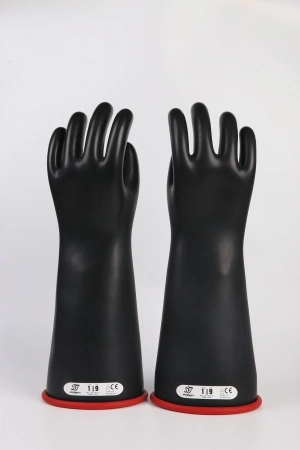
| Parameter | Details |
|---|---|
| AC Maximum Use Voltage | 7,500V |
| AC Proof Test Voltage | 10,000V |
| DC Maximum Use Voltage | 11,250V |
| Length | 16 inches |
| Available Sizes | 8 / 9 / 10 / 11 / 12 |
| Color | Bicolor (Black & Red) |
| Reference Weight | 420g / pair |
| Rubber Thickness | ~1.02 mm – 1.52 mm |
| Label Color | White (Class 1 standard) |
| Implementation Standards | IEC 60903, ASTM D120 |
| Packing | 1 pair/box, 6 pairs/carton |
| Carton Dimensions | 48 × 31 × 41 cm |
| Carton Weight | 7 kg |
Understanding Class 1 Insulating Gloves and Their Role in Substation Safety
There are live electrical parts in substations that need precise, tested protection. Choosing the wrong gloves can kill people. Make sure you know these things before you buy.
What Class 1 Protection Actually Means
Gloves made of Class 1 rubber are able to withstand 20,000V AC and have a proof test voltage of 10,000V AC. Their white name with a color code makes them easy to tell apart from Class 00 (beige, 500V max) and Class 0 (red, 1,000V max). This color method follows the rules set by ASTM D120 and IEC 60903, and it keeps workers from using a glove that isn't rated properly on live equipment by mistake.
Material Composition: Natural Rubber vs. Synthetic
Type I natural rubber latex is used in most certified electrical safety gloves because it is flexible and sensitive to touch. Type II synthetic rubber (EPDM) is better for outdoor substations or storage in areas that change often because it is more resistant to ozone and UV rays. Our Class 1 gloves at PPE MAX are made from high-quality natural rubber latex that is between 0.7mm and 1.5mm thick. This gives the gloves the right amount of dielectric strength and hand movement.
How Class 1 Compares to Other Glove Types
As per ASTM F696, leather protective gloves are worn over rubber insulation gloves to keep the rubber from getting cut or worn down. Cotton covers go under the clothes to keep the moisture out. Leather gloves or gloves that can withstand impact don't provide electrical insulation on their own. Class 1 rubber gloves are the only part that protects against dielectric damage; the other parts support mechanical durability around that main function.
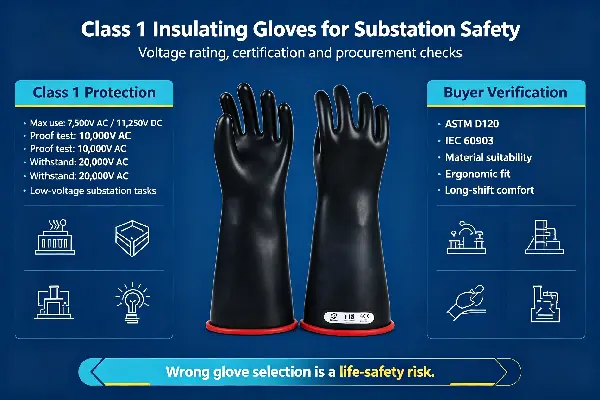
Essential Criteria for Selecting Class 1 Insulating Gloves for Substation Work
Choosing gloves based solely on voltage rating leaves gaps in your safety program. The following criteria give procurement managers a complete evaluation framework.
Certification Validation and Regulatory Compliance
Always request test certificates tied to specific production batches, not just general brand approvals. Compliant Class 1 insulating gloves should meet ASTM D120, IEC 60903, and where applicable, OSHA 29 CFR 1910.137 and NFPA 70E. CE marking is required for European markets. PPE MAX gloves meet or exceed all four of these standards, with documentation available for audit review.
Ergonomic Fit and Worker Comfort
An ill-fitting glove reduces grip control and increases hand fatigue, which leads to errors on energized equipment. Look for ergonomic shaping that mirrors the natural hand curve, straight finger alignment, and adequate cuff length for forearm coverage. Gloves that are too tight restrict circulation during extended substation maintenance; too loose and dexterity suffers on terminal work.
Durability, Shelf Life, and Testing Intervals
Under ASTM D120, rubber insulating gloves in active service must be electrically retested every six months. Unused gloves stored properly can remain on the shelf up to 12 months before requiring retest. Gloves should be stored flat in a canvas glove bag, away from heat, UV light, and chemical exposure. Ozone resistance — a feature of Type II rubber — significantly extends shelf life in outdoor storage conditions.
If you're evaluating personal protective equipment suppliers and require batch-specific testing documents before placing an order, PPE MAX is able to provide official Certificates of Analysis, professional laboratory test reports, and product samples for your verification. Feel free to contact our team at marketing@ppemax.com to discuss your sourcing needs and obtain complete documentation for your quality assessment and procurement approval.
Comparing Top Class 1 Insulating Gloves on the Market
The market for certified electrical gloves includes manufacturers across North America, Europe, and Asia. Here is how to evaluate what matters most when sourcing at volume.
Feature Comparison: What to Look For
When reviewing suppliers, the most useful comparison covers four dimensions: dielectric rating verification, rubber type, thickness uniformity, and post-sale support. The table below summarizes what high-performing products typically offer:
- Voltage compliance: Proof-tested to 10,000V AC with documented batch traceability
- Material type: Natural rubber (Type I) for indoor flexibility; EPDM (Type II) for outdoor durability
- Thickness range: 0.7mm–1.5mm accommodates different grip and insulation needs
- Certifications held: ASTM D120, IEC 60903, CE, OSHA-aligned
These four criteria help procurement teams filter out non-compliant products quickly, especially when ordering in large volumes across multiple project sites.
Cost-Quality Evaluation for Bulk Orders
Higher unit cost does not always mean better protection. What matters is cost-per-compliant Class 1 insulating gloves, factoring in retest frequency, return rates, and supplier support. A glove with a lower unit price that fails inspection after three months costs more than a certified product with a 12-month shelf life. PPE MAX offers competitive bulk pricing with volume-based discounts, and our quality control system ensures batch consistency across large orders.
After-Sales Support and Warranty Terms
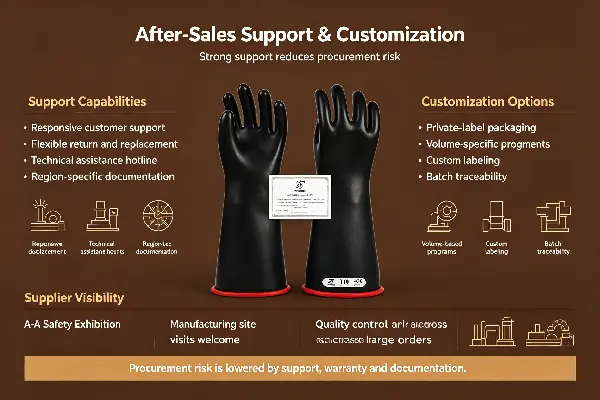
Strong after-sales support reduces procurement risk significantly. Look for suppliers offering a responsive customer support team, flexible return and replacement policies, and a technical assistance hotline. PPE MAX provides all three, along with customization options for distributors requiring private-label packaging or region-specific documentation. We regularly exhibit at industry events, including the A+A Safety Exhibition in Germany, and welcome facility visits to our manufacturing site in Xi'an, China.
Practical Buying Guide for Procurement Managers and Engineers
After finding the right goods, the next step is to make sure you have a reliable supply system.
Sourcing Channels and Supplier Qualification
Suppliers who are qualified should have factory certifications that can be checked, not just product certifications. Ask current B2B clients in your area for ISO paperwork, quality management records, and references. Lead-time risk is lower for global procurement teams that work with suppliers who already have an established international logistics network. PPE MAX sends to 134 countries using standard polybags for each item and strong boxes for large orders.
Matching Gloves to Specific Substation Roles
The risk of exposure is different for each substation task. When switching on live bus bars, you need full Class 1 safety with a leather protector covering. Regular checks on equipment that has been turned off may reveal lower-rated options. In their risk assessment paperwork, procurement teams should link different types of gloves to different jobs so that they don't provide too much or too little PPE for each part.
Logistics, Lead Times, and Custom Packaging
Predictable lead times are just as important as price when buying Class 1 insulating gloves in bulk across multiple sites. Find out what the minimum order size is, how long it takes to produce, and if custom packaging is available, like branded boxes for wholesalers. PPE MAX helps wholesale customers with custom packaging and lets you keep track of your orders as they move through our supply chain. This way, you can make sure that your projects stay on schedule.
Ensuring Safety and Maximizing Glove Lifespan on Site
It's not enough to just buy the right glove. How your team wears and takes care of those gloves will determine how well they work when it counts.
Worker Training and Correct Handling Procedures
Before each use, workers should do an air inflation test on their rubber insulating gloves. To do this, roll the cuff toward the fingers to trap air and look for holes, cracks, or leaks. If a glove fails this test, it must be taken out of service right away. The right way to put on layers should also be taught: cotton lining first, then rubber insulation glove, and finally leather protector glove on the outside.
Routine Inspection and Retesting Protocols
Visual inspection is not enough on its own. Every six months, gloves that are already in use need to go through formal electrical testing again. Safety officers should keep a glove log that lists when each pair was issued, when it was last tested, and when it is planned to be tested again. No matter what the test history is, gloves that show ozone cracking, discoloration, swelling, or embedded debris should be thrown away before the retest interval.
Storage Best Practices and Replacement Indicators
Keep rubber gloves in a cloth glove bag that is separate from the leather covers so that they don't get deformed over time. Keep storage places cool, dry, and free of things that make ozone, like electric motors. If the leather surface is cracked or stiff, the glove fails the expansion test, or the date for the next test has passed, you should get new gloves. Gloves should never be folded, squished, or kept near solvents.
Conclusion
There's more to choosing Class 1 insulating gloves for work in a substation than just looking at the voltage grade. Certifications must be checked by procurement teams, the type of material must be matched to the work setting, ergonomic fit must be confirmed, and a clear maintenance and retesting plan must be set. Buying from a company that has a history of quality control and global supply cuts down on compliance risk and protects your employees in the long run. PPE MAX has been making safety products for 60 years and offers professional help. This makes us a reliable partner for buying electrical safety products all over the world.
FAQ
How often must Class 1 insulating gloves be electrically retested?
Every six months, gloves that are being used must be tested again. They can stay on the shelf for up to 12 months without being tested again if they are stored and not used. Before giving gloves to workers, always check the date of the test that is stamped on the cuff.
Can I use a rubber insulating glove without a leather protector?
No, the dielectric stability of the rubber glove is instantly lost when it gets cut, punctured, or worn down. To protect your hands, you should wear an ASTM D120 glove with an ASTM F696 leather protective glove. In real life, skipping the protection takes away the safety grade of the glove.
What is the difference between Type I and Type II rubber gloves?
Type I (natural rubber) is better for indoor, controlled settings because it is more flexible and sensitive to touch. Type II (EPDM/synthetic rubber) doesn't break down when exposed to ozone or UV light, so it's the better choice for outdoor substations or storage where the weather changes often.
What does the white label on a Class 1 glove indicate?
The white label is the standard color code for Class 1 voltage protection that can handle up to 7,500V. Workers can't use a Class 0 (red) or Class 00 (beige) glove on a higher-voltage system by mistake thanks to this obvious identification system.
How should Class 1 gloves be stored long-term?
Keep them flat in a cloth glove bag, away from chemicals, heat, UV sources, and equipment that makes ozone. When storing rubber gloves for a long time, take them off of the leather protectors to keep the rubber from deforming and to make sure that both parts last as long as they are supposed to.
Get Certified Class 1 Insulating Gloves from PPE MAX
Since 1956, PPE MAX has been making certified electrical safety gloves. Our Class 1 insulating gloves are sold to customers in 134 countries. We are a reliable company that makes Class 1 insulating gloves. Our goods are in line with ASTM D120 and IEC 60903, and we offer large discounts, unique packaging, and committed customer service after the sale. To get a price right away, email marketing@ppemax.com with your requirements or go to www.ppemax.com.
References
1. ASTM International. ASTM D120: Standard Specification for Rubber Insulating Gloves. ASTM International, 2022.
2. International Electrotechnical Commission. IEC 60903: Live Working — Gloves of Insulating Material. IEC, 2014.
3. National Fire Protection Association. NFPA 70E: Standard for Electrical Safety in the Workplace. NFPA, 2021.
4. Occupational Safety and Health Administration. OSHA 29 CFR 1910.137: Electrical Protective Equipment. U.S. Department of Labor, 2019.
5. National Institute for Occupational Safety and Health. Preventing Occupational Fatalities from Electrical Hazards. NIOSH Publication, 2021.
6. American National Standards Institute. ASTM F696: Standard Specification for Leather Protectors for Rubber Insulating Gloves and Mittens. ASTM International, 2020.
Learn about our latest products and discounts through SMS or email