- English
- French
- German
- Portuguese
- Spanish
- Russian
- Japanese
- Korean
- Arabic
- Greek
- German
- Turkish
- Italian
- Danish
- Romanian
- Indonesian
- Czech
- Afrikaans
- Swedish
- Polish
- Basque
- Catalan
- Esperanto
- Hindi
- Lao
- Albanian
- Amharic
- Armenian
- Azerbaijani
- Belarusian
- Bengali
- Bosnian
- Bulgarian
- Cebuano
- Chichewa
- Corsican
- Croatian
- Dutch
- Estonian
- Filipino
- Finnish
- Frisian
- Galician
- Georgian
- Gujarati
- Haitian
- Hausa
- Hawaiian
- Hebrew
- Hmong
- Hungarian
- Icelandic
- Igbo
- Javanese
- Kannada
- Kazakh
- Khmer
- Kurdish
- Kyrgyz
- Latin
- Latvian
- Lithuanian
- Luxembou..
- Macedonian
- Malagasy
- Malay
- Malayalam
- Maltese
- Maori
- Marathi
- Mongolian
- Burmese
- Nepali
- Norwegian
- Pashto
- Persian
- Punjabi
- Serbian
- Sesotho
- Sinhala
- Slovak
- Slovenian
- Somali
- Samoan
- Scots Gaelic
- Shona
- Sindhi
- Sundanese
- Swahili
- Tajik
- Tamil
- Telugu
- Thai
- Ukrainian
- Urdu
- Uzbek
- Vietnamese
- Welsh
- Xhosa
- Yiddish
- Yoruba
- Zulu
How Is Full Mask Respirator Performance Tested and Certified?
Founded in 1956, PPEMAX stands as a premier global manufacturer and supplier of full-range personal protective equipment. All our products comply with internationally recognized standards including IEC, ASTM, CE, UKCA, NIOSH and ISO9001. Equipped with a 2,000-square-meter modern production plant, we boast over 25 years of mature OEM & ODM capabilities to deliver one-stop customized solutions covering R&D design through worldwide logistics. Our safety gear is distributed across 134 countries globally. Upholding our core tenet “Safety First, Quality Priority”, we serve as a dependable long-term PPE partner for industrial enterprises around the world.
A full mask respirator undergoes a series of standardized laboratory and field evaluations before it can be sold as certified protective equipment. These assessments measure filtration efficiency, inhalation and exhalation resistance, face seal integrity, lens optical clarity, and material chemical resistance. Independent accredited bodies—such as NIOSH in the United States or notified bodies under the EN 136 European standard—review test data and issue certification only when every parameter meets the required threshold. Without that certification, no respirator should enter a compliant industrial procurement program.
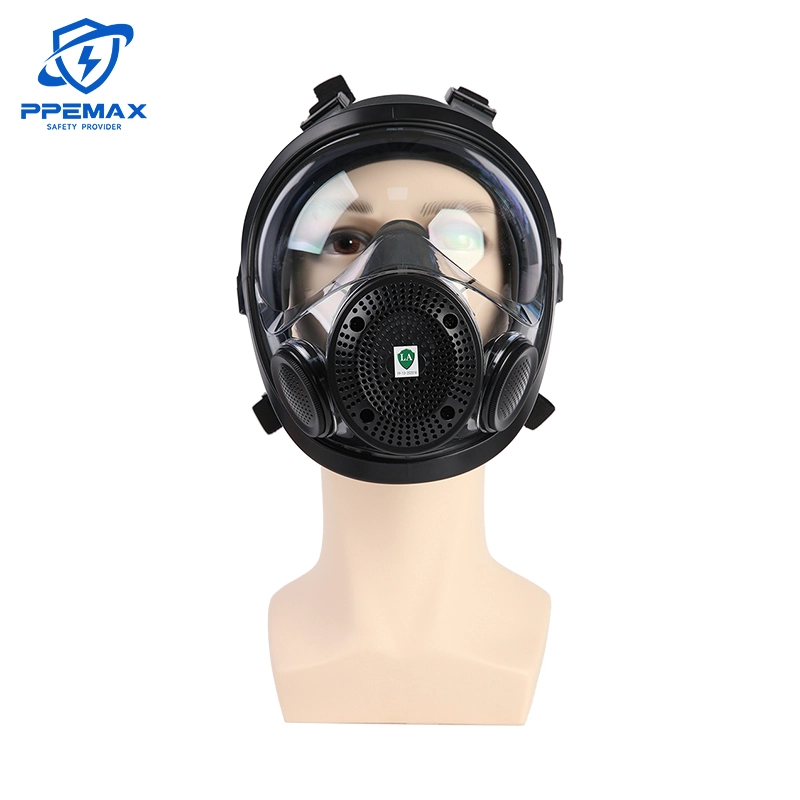
| Parameter | Details |
|---|---|
| Facepiece Material | Silicone |
| Head Harness | 6-point nylon mesh, adjustable |
| Filter Connection | 40mm NATO standard thread |
| Exhalation Valve | Low-resistance, anti-back-leakage design |
| APF (Assigned Protection Factor) | 50 (per OSHA standard) |
| MOQ | 1 piece |
| Lead Time | 15 days |
| OEM / Custom Packaging | Available |
Understanding Full Mask Respirator Performance Testing
Respiratory protection that works well starts long before the person puts on the gear. Each design has to go through a series of objective tests that are meant to mimic real-life exposure conditions in the workplace.
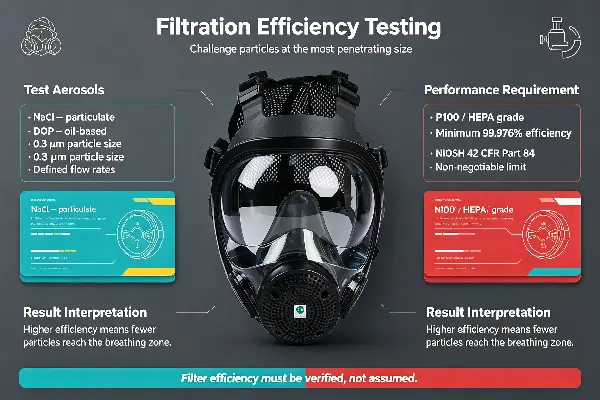
Filtration Efficiency Testing
Standardized droplets, such as NaCl for particulates and DOP (dioctyl phthalate) for oil-based particles, are sent through filter media at set flow rates. At 0.3 microns, the smallest size particles can get through, a P100 or HEPA-grade filter must be able to catch at least 99.97% of them. NIOSH 42 CFR Part 84 says that this limit cannot be lowered.
Inhalation and Exhalation Resistance
85 liters per minute of breathing force is used to simulate hard work. EN 136 says that the resistance to inhaling can't be more than 300 Pa and the resistance to exhale can't be more than 150 Pa. High resistance makes workers tired and leads to bad donning, which both lowers the level of protection.
Face Seal and Leakage Testing
Total inward leakage (TIL) tests are done on the facepiece of a full mask respirator using human test panels with different facial shapes. The NIOSH standards say that the Assigned Protection Factor (APF) of 50 must be reachable across that panel. The soft silicone seal on PPE MAX respirators and the 5-point adjustable harness work together to keep leakage rates low across a wide range of worker groups.
Key Safety Standards and Certification Bodies
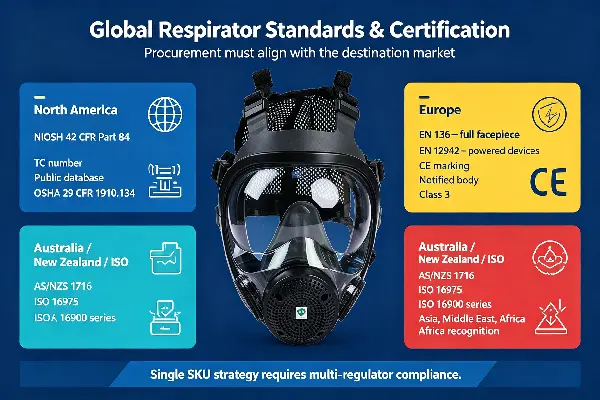
When buying respirators for multinational companies, procurement teams need to make sure that each standard is compatible with the market it applies to. The main frames are lined up like this:
NIOSH 42 CFR Part 84 (United States)
The only group that can approve air-purifying respirators for sale in the U.S. is NIOSH. Each approved unit has a TC number that can be found in a public database. As a result of OSHA's breathing protection standard (29 CFR 1910.134), all federally regulated businesses must have respirators that are approved by NIOSH.
EN 136 and EN 12942 (Europe)
EN 136 controls how full facepieces are made and how well they work, and EN 12942 controls powered screening devices. For these standards, CE marking needs to be tested by a notified body recognized by the EU. According to EN 136, Class 3 is the best building grade and is made for the harshest industrial settings.
AS/NZS 1716 and ISO Standards
AS/NZS 1716 covers respiratory protective equipment sold in Australia and New Zealand. The test criteria are similar to those used in Europe. The ISO 16975 and ISO 16900 series of standards give more information on how to choose, use, and test fit. These standards are recognized in Asia, the Middle East, and Africa. Xi'An PPE MAX Co., Ltd makes sure that all three approval families are met by its products. This way, wholesalers can sell a single SKU in more than one regulatory area.
If you're evaluating personal protective equipment suppliers and require batch-specific testing documents before placing an order, PPE MAX is able to provide official Certificates of Analysis, professional laboratory test reports, and product samples for your verification. Feel free to contact our team at marketing@ppemax.com to discuss your sourcing needs and obtain complete documentation for your quality assessment and procurement approval.
The Full Mask Respirator Fit Testing Process
Even a fully approved facepiece won't protect a person as well if it doesn't fit snugly over their face. Fit testing is required by OSHA 29 CFR 1910.134 before the first use and every year after that.
Quantitative Fit Testing
Quantitative ways use tools like a PortaCount to find out the amount of atmospheric aerosol particles both inside and outside the facepiece of a full mask respirator at the same time. Of course, OSHA says that the fit factor must be 500 or higher for full facepiece respirators. This method is objective, so testers don't have to worry about their own feelings, and it makes numbers that can be checked.
Qualitative Fit Testing
For qualitative testing, the person wearing the device has to find a test agent, like saccharin solution or Bitrex, while doing standard exercises. It's not as accurate, but OSHA still accepts it for some half-mask classes. For full facepiece devices, numerical testing is the best way to go because the amount of safety needed needs to be confirmed numerically.
Record-Keeping and Re-Testing Protocols
The wearer's name, respirator model, lot number, and test date must be written down next to each fit test result. When a worker says their face has changed (for example, after having surgery on their teeth or losing a lot of weight), when a different model of respirator is given to them, or when supervisors notice problems with the seal during routine safety audits, they need to be tested again.
Maintenance, Cleaning, and Filter Replacement
Certification shows how well a mask works when it is brand new and well taken care of. Equipment that isn't used breaks down quickly, so its stated amount of protection is no longer true.
Cleaning Procedures
PPE MAX says that facepieces should be cleaned with warm water and a mild soap after each use. They should then be rinsed well and dried in the air, out of direct sunshine. Harsh chemicals damage polycarbonate glasses and silicone seals, making them less flexible and less clear. The anti-fog polycarbonate lens in our models only keeps its hydrophilic coating when it is cleaned with gentle cleaners.
Filter Replacement Schedules
Under normal use, filters for a full mask respirator don't have a set expiration date. When they need to be replaced depends on the amount of contaminants, the length of time they are used, and the humidity in the air. As a general rule, gas-phase cartridges for organic vapors should be changed at the end of each shift in places with high concentrations, or according to a written schedule based on OSHA's advice on how to estimate service life. When breathing resistance goes up significantly, particulate screens should be thrown away.
Inspection Before Each Use
Workers should check the following places before putting on:
- Facepiece seal: No cracks, tears, or hardening in the silicone or TPE material.
- Inhalation valves: Flat, undistorted, and seated correctly in the valve seat.
- Exhalation valve: Clean, undamaged, and sealing fully when no exhalation pressure is applied.
- Lens: No deep scratches, crazing, or delamination of the anti-fog coating.
- Head harness: All straps intact, buckles functional, no fraying at attachment points.
These five checks don't take long—less than two minutes—but they tell you right away if the equipment meets the standards that were set during the shift.
Comparing Full Mask Testing to Other Respirator Types
When procurement managers know where the full facepiece fits in the hierarchy of respirator testing, they can choose the right level of protection for each job.
Full Facepiece vs. Half-Mask Respirators
OSHA's assigned protection factor table shows that half-mask respirators have an APF of 10, while full facepieces have an APF of 50. A fit factor of 100 is what they need to pass their test, which is a much smaller bar. A half-mask is not enough when the concentrations in the air are more than 10 times the occupational exposure limit (OEL) or when protection for the eyes and mucous membranes is needed, like when handling chlorine or ammonia. A full facepiece is needed instead.
Full Facepiece vs. PAPR Systems
Powered air-purifying respirators (PAPRs) have an APF of up to 1,000 because they keep positive pressure inside the hood or facepiece. This stops air from leaking in, even if the face seal isn't tight. But PAPR approval includes tests for electrical parts, battery run time, and blower motor airflow, which aren't needed for units that aren't driven. Because negative-pressure full facepiece respirators are lighter and don't need to be charged in a certain way, they are the best choice for mobile field teams working in mining, construction, and infrastructure maintenance.
Conclusion
A full facepiece respirator has to go through several steps to get certified. These steps include testing for filtration performance, seal integrity, material durability, and human fit. If a procurement manager knows about NIOSH 42 CFR Part 84, EN 136, and AS/NZS 1716, they can make sure that specs are in line with their legal markets and avoid costly non-compliance. Certification means that the equipment will work properly for as long as it is used as long as it is maintained and tested for fit. Since 1956, PPE MAX has made sure that our full mask respirator line meets these standards. These respirators have been used in 134 countries to protect workers in industrial settings.
FAQ
How often should fit testing be performed?
OSHA requires fit testing before initial use, when a new respirator model is issued, and at least annually thereafter. Re-test whenever a worker reports a significant change in facial structure.
Is manufacturer self-certification sufficient for procurement?
No. Regulatory compliance in the U.S. requires NIOSH approval verified through the public TC number database. European markets require CE marking issued by an accredited notified body. Always request third-party test reports.
What signs indicate a respirator no longer meets its rated performance?
Visible cracking or hardening of the facepiece seal, persistent leakage detected during a negative-pressure user seal check, elevated breathing resistance, lens crazing, or failed periodic fit testing all indicate that the unit should be removed from service immediately.
Can a single respirator model be certified under multiple standards?
Yes. Manufacturers who test against NIOSH 42 CFR Part 84, EN 136, and AS/NZS 1716 can hold concurrent certifications, giving distributors the flexibility to supply one product across multiple regulatory jurisdictions.
Partner with PPE MAX for Certified Full Mask Respirator Solutions
PPE MAX has been making and selling certified respiratory protection to businesses in 134 countries since 1956. Our full mask respirator line meets the standards set by NIOSH, EN 136, and AS/NZS 1716. You can buy in bulk, and we offer custom labels for wholesalers and expert help after the sale. You can email our buying team at marketing@ppemax.com or go to www.ppemax.com right now to get price information, specs, or a free evaluation for your business.
References
1. National Institute for Occupational Safety and Health (NIOSH). NIOSH Guide to the Selection and Use of Particulate Respirators Certified Under 42 CFR 84. Centers for Disease Control and Prevention, 1996.
2. European Committee for Standardization (CEN). EN 136:1998 – Respiratory Protective Devices: Full Face Masks – Requirements, Testing, Marking. CEN, 1998.
3. Occupational Safety and Health Administration (OSHA). Respiratory Protection Standard 29 CFR 1910.134. U.S. Department of Labor, 1998.
4. Standards Australia. AS/NZS 1716:2012 – Respiratory Protective Devices. Standards Australia, 2012.
5. Bollinger, N., and Schutz, R. NIOSH Guide to Industrial Respiratory Protection. National Institute for Occupational Safety and Health, 1987.
6. Zhuang, Z., Bradtmiller, B., and Shaffer, R.E. "New Respirator Fit Test Panels Representing the Current U.S. Civilian Work Force." Journal of Occupational and Environmental Hygiene, 2007.
Learn about our latest products and discounts through SMS or email