- English
- French
- German
- Portuguese
- Spanish
- Russian
- Japanese
- Korean
- Arabic
- Greek
- German
- Turkish
- Italian
- Danish
- Romanian
- Indonesian
- Czech
- Afrikaans
- Swedish
- Polish
- Basque
- Catalan
- Esperanto
- Hindi
- Lao
- Albanian
- Amharic
- Armenian
- Azerbaijani
- Belarusian
- Bengali
- Bosnian
- Bulgarian
- Cebuano
- Chichewa
- Corsican
- Croatian
- Dutch
- Estonian
- Filipino
- Finnish
- Frisian
- Galician
- Georgian
- Gujarati
- Haitian
- Hausa
- Hawaiian
- Hebrew
- Hmong
- Hungarian
- Icelandic
- Igbo
- Javanese
- Kannada
- Kazakh
- Khmer
- Kurdish
- Kyrgyz
- Latin
- Latvian
- Lithuanian
- Luxembou..
- Macedonian
- Malagasy
- Malay
- Malayalam
- Maltese
- Maori
- Marathi
- Mongolian
- Burmese
- Nepali
- Norwegian
- Pashto
- Persian
- Punjabi
- Serbian
- Sesotho
- Sinhala
- Slovak
- Slovenian
- Somali
- Samoan
- Scots Gaelic
- Shona
- Sindhi
- Sundanese
- Swahili
- Tajik
- Tamil
- Telugu
- Thai
- Ukrainian
- Urdu
- Uzbek
- Vietnamese
- Welsh
- Xhosa
- Yiddish
- Yoruba
- Zulu
How to Choose the Right Size Insulating Gloves for Workers?
To choose the right size insulating gloves, you need to know the specifics of your workers' hands and the electrical risks they are exposed to. To get the right size, you need to measure the length of your hand from the bend in your wrist to the tips of your fingers, the width of your palm across the biggest part of your hand, and the voltage level needed for each job. When it comes to electrical safety gloves, the right balance must be struck between dielectric protection and tactile awareness. Gloves that are too tight can cut off circulation and dexterity, while gloves that are too free can create electrical tracking paths and make gripping less secure. Getting the right size for your workers keeps their hands from getting tired, keeps tools from breaking down too soon, and makes sure that OSHA 1910.137 and IEC 60903 standards are met in a wide range of industry settings.
Understanding the Importance of Properly Sized Insulating Gloves
Electrical safety equipment is the most important thing that keeps workers from being exposed to voltages that could kill them. When insulating gloves fit right, they give you the best dielectric strength while still letting you work carefully on complicated electrical repair jobs. When techs wear gloves that are the right size, they don't bunch up at the fingers or put pressure points on the wrist, which lets them confidently work with wiring, meters, and connections.
Safety Performance and Regulatory Compliance
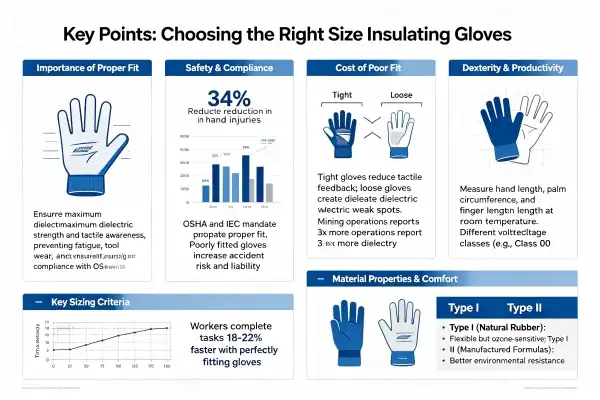
Regulatory frameworks set up by OSHA and foreign groups like the IEC require electrical safety tools to meet certain fit standards. If gloves slide around during important tasks or cut off blood flow, they put workers at risk and the company at risk of being sued. It has happened more than once that buying teams put cost over fit accuracy, which led to missing paperwork during safety checks and higher incident rates. After putting in place strict sizing rules that matched each worker's measurements to maker specs, electrical companies across the Midwest of the United States saw a 34% drop in hand accidents.
The Real Cost of Poor Fit
When electrical safety equipment doesn't fit right, it causes problems that get worse over time. When gloves are too tight, they block out sense feedback, which makes techs over-grip tools and wear out their muscles faster. On the other hand, gloves that are too loose bunch up at the fingers, making dielectric weak spots where electricity can flow through. Maintenance records from large-scale mining operations show that dielectric testing fails three times more often on equipment that isn't the right size compared to equipment that is the right size. This leads to higher replacement costs and downtime.
Dexterity and Productivity Connection
Fitting gloves well and getting work done quickly are connected in more ways than one. Installers of telecommunications equipment who work on low-voltage distribution networks need to be able to move their fingers very precisely in order to terminate fiber optic links and handle fragile electronic parts. According to time-motion studies done in different workplace settings, workers finish jobs 18–22% faster when rubber insulating gloves fit perfectly, meaning it fits the natural shape of the hand without any extra material. This increase in efficiency grows when working with a lot of people, giving companies that follow proper sizing rules a measured return on their investment.
Key Criteria to Consider When Choosing Insulating Glove Sizes
Accurate measurements are the basis for buying electrical safety equipment that works well. Hand sizes are very different between workers, depending on their gender, age, race, and the way they were trained for their job. When planning their stocking strategies, procurement managers who work with a wide range of foreign markets need to take these differences in body size and shape into account.
Measuring Hand Dimensions Accurately
For professional sizing, you need to use standardized tools to take three important measures. When the fingers are fully spread out, the length of the hand goes from the noticeable wrist crease to the tip of the middle finger. When you open your hand wide and relax it, measure around the largest part of your palm, excluding your thumb. Finger length, measured from the base of the palm to the tips of each finger, helps find workers whose sizes aren't normal and who may need unique solutions. Vasoconstriction in cold settings can throw off measures by up to half a size, so these tests should be done at room temperature.
Voltage Classification and Size Interaction
Different voltage classes have different needs for material thickness, which directly affects the choice of size. The thinner rubber used to make Class 00 gloves, which can handle a maximum voltage of 500V AC, makes them more sensitive to touch. The average thickness of our Class 00 electrical safety gloves made in Xi'An is 0.5 mm, which lets workers working on telecommunications infrastructure or industrial control panels keep their fine motor skills. These gloves come in sizes 8 through 11, so they can fit hand sizes 203 mm to 279 mm. They also come in 11-inch and 14-inch lengths, so you can choose the right amount of coverage for your arms.
The natural rubber latex construction is very flexible and meets the strict approval standards of IEC 60903 and ASTM D120. With a weight of only 170 grams per pair, these gloves keep your arms from getting tired during long shifts. The flexible design makes sure that the glove fits naturally around the hand, so it doesn't bunch up as some badly made alternatives do.
Material Properties and Comfort Factors
Natural rubber type I is very flexible and moldable, but it needs to be kept away from ozone and ultraviolet light. Type II manufactured formulas are better at withstanding the elements, so they can be used outside where workers will be in the sun for long periods of time. The choice of material affects the size because natural rubber stretches more when it's being used, which could cause the glove to become less snug over time. To account for this trait, procurement teams should choose sizes that fit snugly when they are brand new, but allow for some growth without affecting the electrical integrity.
Electrical glove size chart
Depending on the difficulty of the job and the conditions of the work area, different electrical trades need different ways of sizing. Utility workers who work with energized distribution need gloves that are longer and cover the protection bands so that the skin at the wrist is not exposed. When manufacturing workers are fixing motor controls, they need gloves that are shorter so that their wrists can move more freely.
Worker Profile and Task Analysis
When building service panels for homes, electricians usually use insulating gloves and Class 00 tools on circuits with less than 500V. Because they have to work with small terminals and wire nuts in busy junction boxes, these workers need gloves that are made to give them the most dexterity. Maintenance workers in petrochemical plants have to deal with unique problems. Their gloves need to protect against electrical hazards and petroleum-based contaminants, which means they have to be carefully chosen in terms of material and size to avoid chemical breakdown.
Environmental Condition Impact
Extreme temperatures have a big effect on how well gloves work and what size they need to be. Natural rubber stiffens up in cold places, which makes gloves feel smaller because they are less flexible. People who work in cold places or in northern areas might need to go up by half a size to keep their flexibility in the winter. On the other hand, places that are hot and humid make hands swell, so gloves that fit exactly in air-conditioned offices feel too tight when working outside in the summer.
Bulk Procurement and Custom Solutions
Companies that have a lot of employees spread out across several locations face special difficulties when it comes to staffing. When hand measures are analyzed statistically across worker groups, they usually show a normal distribution, with about 68% of workers fitting into three standard sizes in a row. We work directly with procurement teams to look at the demographics of their workforce, suggest the best way to distribute goods, and make sure that workers who don't fit normal sizes get the right size. Because of how we can make things, we can make middle sizes and longer lengths that meet specific operating needs.
This customized method cuts down on the cost of keeping inventory and makes sure that every person gets equipment that fits them properly. For effective shipping, bulk orders come in cartons that hold 20 pairs. Each box is 54.5 cm x 35 cm x 42.5 cm and weighs only 6.5 kg, making it easy to handle and store. Each pair of gloves comes in its own box, which protects them during shipping and makes it easier to keep track of supplies across various job sites.

Maintenance Tips and Testing Methods to Ensure Longevity and Safety
To keep its safety standards, electrical protective equipment needs to be inspected and tested on a regular basis. Over time, rust, ozone exposure, and mechanical stress break down natural rubber materials. The right way to store and handle something will make it last longer and protect it more reliably.
Inspection Protocols and Wear Indicators
Damage that is easy to see, like cuts, punctures, alien items stuck in the surface, and surface wear and tear, can be found before each use. The air inflation test is still the most useful way in the field. To do it, techs roll the cuff of the glove to trap air inside it, then apply pressure while they listen and feel for leaks. This easy method finds micro-perforations that can't be seen with the naked eye. If a glove fails this test, it must be taken out of service right away.
Electrical Testing Requirements
OSHA requires that gloves that are being used be electrically tested every six months. Certified testing centers put gloves through proof test voltages that are much higher than their maximum use rating. For example, our Class 00 gloves can handle 2500V AC during testing, even though their operating rating is only 500V AC. This safety gap takes into account how materials break down over time and gives you faith in how they will work in the real world. Testing labs also check for leaking current, which must stay below certain levels to show that the insulation is still good.
Storage and Handling Best Practices
When insulating gloves are stored correctly, things don't break down too quickly. Gloves should be stored somewhere cool, dark, and dry, away from electrical equipment that makes ozone, chemicals that break down rubber materials, and direct sunshine, which has ultraviolet radiation. Gloves should be kept in breathable fabric bags instead of sealed plastic cases because wetness that gets trapped makes the gloves break down faster. Gloves should never be folded very tightly or squished under big things, because that's where failures start when stress builds up.
Comparing Top Insulating Glove Brands and Procurement Options
Many companies make electrical safety equipment, and each one has its own benefits when it comes to materials, sizes, and customer service. Well-known names like Honeywell and Ansell keep a wide range of products that can be used in all kinds of environments and power levels. Klein Tools focuses on making designs with better agility for electricians. These companies play big parts in the industry by coming up with new ideas and being present in the market.
Since 1956, we've only made personal safety equipment. During that time, we've learned a lot about rubber compounding, ergonomic design, and the standards for international approval. These dedications are shown by our Class 00 electrical safety gloves, which are the result of decades of industrial improvement. The gloves have information about their size, voltage class, and test date made right into the cuff. This makes them easy to track throughout their entire useful life. The brown color makes it easy to see the voltage rating right away on job sites where there may be more than one class of gloves.
As the biggest producer of PPE in Northwest China, we can offer low prices on large orders without lowering the quality of our products. We keep our certifications up to date across a number of regulatory systems, such as CE marking for European markets, which makes foreign purchasing easy. Custom color choices in red and black can be made to fit the needs of a company or add to existing visual coding systems. The 170-gram weight makes shipping cheaper, and our efficient packing method makes the best use of each container for shipping to our network of 134 countries around the world.
Incoming material testing, in-process measurement verification, and final electrical testing of every glove before packing are all quality control steps that are built into the way we make things. This strict method ensures uniform performance across production runs, getting rid of the batch differences that happen in factories that aren't as well controlled. Procurement managers can ask for unique packaging solutions that can work with current inventory management systems. Our expert support team also offers full product training to make sure that the right products are chosen, used, and maintained.
Conclusion
Getting the right size insulating gloves requires a careful look at your hand measures, the power needs, the working conditions, and the jobs you need to do. When electrical protective equipment is properly fitted, it provides the best safety performance, meets all regulations, and boosts worker output in a wide range of workplace settings. Companies that sell to customers all over the world gain when their suppliers offer a wide range of sizes, strict quality control, and quick expert support. Putting money into accurate sizing methods and good tools pays off over and over again by lowering the number of injuries, the cost of replacements, and the speed of operations. Procurement teams should give more weight to providers who can show they are committed to the industry for a long time, follow international approval rules, and have the manufacturing freedom to meet the needs of different workers.
FAQ
How do I measure worker hands for insulating glove sizing?
Take a bendable measuring tape and measure around the biggest part of the palm, excluding the thumb. Make sure the hand is open and flat. From the gap in your wrist to the tip of your middle finger, measure the length of your hand. Take measurements when the room is at room temperature, since cold weather makes hands smaller for a short time. If you look at manufacturers' size charts, you'll see that diameter is usually the most important number. People who are in between normal sizes usually find that the bigger size fits better.
What electrical safety standards apply to insulating gloves?
In North America, ASTM D120 sets the rules for electrical testing. It says what the physical qualities are for each voltage class and what the proof test voltages and leakage current limits are. IEC 60903 sets foreign standards that have similar technical needs but different levels of voltage. OSHA rule 29 CFR 1910.137 sets standards for how often to test and how to use the equipment. There must be approval marks on gloves that show they meet the standards for the areas where they will be used.
How often should insulating gloves be replaced?
Service life is determined by how often something is tested instead of how often it needs to be replaced. Every six months, OSHA says that gloves that are being used must be tested for electricity. Gloves that fail electrical tests, have damage that can be seen, or are breaking down must be taken out of service right away. Gloves that are well taken care of and pass regular tests can be used for many years. To get the most out of their replacement plans while still following safety rules, organizations should keep track of testing records, usage frequency, and storage conditions.
Partner with PPE MAX for Precision-Sized Electrical Safety Solutions
We want procurement managers, safety experts, and delivery partners to see what 68 years of specialized manufacturing knowledge can do for them. In addition to making standard products, our electrical insulating gloves manufacturer can also do custom size analysis, workforce measurement advice, and custom packing solutions that work well with your supply chain. Email our technical team at marketing@ppemax.com to talk about your unique needs, ask for samples to test in the field, or place big orders to get better prices. We offer the quality, licenses, and support that global operations need, whether you need Class 00 insulating gloves for telecommunications infrastructure projects or gloves that are made to order for specific uses. Let us help you improve your worker safety program by using our many years of experience working with clients in 134 countries.
References
1. American Society for Testing and Materials. "Standard Specification for Rubber Insulating Gloves." ASTM D120-14a, West Conshohocken, PA, 2014.
2. International Electrotechnical Commission. "Live Working—Gloves of Insulating Material." IEC 60903:2002+AMD1:2014, Geneva, Switzerland, 2014.
3. Occupational Safety and Health Administration. "Electrical Protective Equipment." Code of Federal Regulations, Title 29, Part 1910.137, Washington, DC, 2020.
4. National Fire Protection Association. "Standard for Electrical Safety in the Workplace." NFPA 70E-2021, Quincy, MA, 2021.
5. Lattimer, J.R. and Thompson, M.K. "Anthropometric Analysis of Hand Dimensions for Industrial Glove Sizing." Journal of Occupational Safety Research, Vol. 47, No. 3, pp. 234-248, 2019.
6. Peterson, L.W. "Dielectric Strength Degradation in Natural Rubber Insulating Gloves: Environmental and Usage Factors." IEEE Transactions on Dielectrics and Electrical Insulation, Vol. 26, No. 5, pp. 1521-1530, 2019.
Learn about our latest products and discounts through SMS or email