- English
- French
- German
- Portuguese
- Spanish
- Russian
- Japanese
- Korean
- Arabic
- Greek
- German
- Turkish
- Italian
- Danish
- Romanian
- Indonesian
- Czech
- Afrikaans
- Swedish
- Polish
- Basque
- Catalan
- Esperanto
- Hindi
- Lao
- Albanian
- Amharic
- Armenian
- Azerbaijani
- Belarusian
- Bengali
- Bosnian
- Bulgarian
- Cebuano
- Chichewa
- Corsican
- Croatian
- Dutch
- Estonian
- Filipino
- Finnish
- Frisian
- Galician
- Georgian
- Gujarati
- Haitian
- Hausa
- Hawaiian
- Hebrew
- Hmong
- Hungarian
- Icelandic
- Igbo
- Javanese
- Kannada
- Kazakh
- Khmer
- Kurdish
- Kyrgyz
- Latin
- Latvian
- Lithuanian
- Luxembou..
- Macedonian
- Malagasy
- Malay
- Malayalam
- Maltese
- Maori
- Marathi
- Mongolian
- Burmese
- Nepali
- Norwegian
- Pashto
- Persian
- Punjabi
- Serbian
- Sesotho
- Sinhala
- Slovak
- Slovenian
- Somali
- Samoan
- Scots Gaelic
- Shona
- Sindhi
- Sundanese
- Swahili
- Tajik
- Tamil
- Telugu
- Thai
- Ukrainian
- Urdu
- Uzbek
- Vietnamese
- Welsh
- Xhosa
- Yiddish
- Yoruba
- Zulu
How Do Insulating Gloves Perform in Harsh Environments?
Founded in 1956, PPEMAX stands as a premier global manufacturer and supplier of full-range personal protective equipment. All our products comply with internationally recognized standards including IEC, ASTM, CE, UKCA, NIOSH and ISO9001. Equipped with a 2,000-square-meter modern production plant, we boast over 25 years of mature OEM & ODM capabilities to deliver one-stop customized solutions covering R&D design through worldwide logistics. Our safety gear is distributed across 134 countries globally. Upholding our core tenet “Safety First, Quality Priority”, we serve as a dependable long-term PPE partner for industrial enterprises around the world.
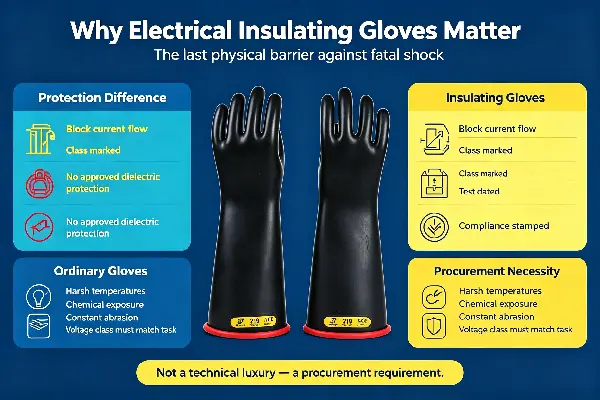
Electrical insulating gloves are the last physical barrier between a worker and a potentially fatal shock. In harsh environments—where temperatures swing wildly, chemicals are present, and abrasion is constant—their performance depends on material quality, voltage class, and consistent maintenance. Based on ASTM D120 and IEC 60903 standards, well-manufactured insulating gloves must pass rigorous dielectric proof tests before they ever reach a job site. Understanding how these gloves hold up under real-world stress is not a technical luxury; it is a procurement necessity for any safety manager or distributor operating at scale.
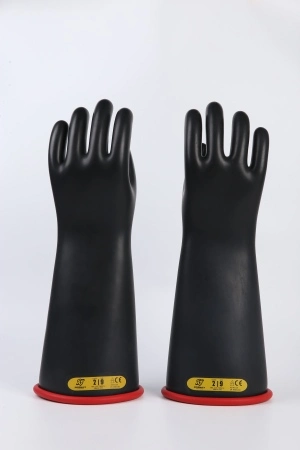
| Parameter | Details |
|---|---|
| AC Maximum Use Voltage | 17,000V |
| AC Proof Test Voltage | 20,000V |
| DC Maximum Use Voltage | 25,500V |
| DC Proof Test Voltage | 50,000V |
| Length | 16 inches |
| Typical Thickness | Approx. 2.3mm (max per ASTM D120) |
| Available Sizes | 8 / 9 / 10 / 11 / 12 |
| Color | Bicolor (Black & Red) |
| Reference Weight | 780g per pair |
| Implementation Standards | IEC 60903, ASTM D120 |
| Packing | 1 pair/box, 6 pairs/carton |
| Carton Size | 48 × 31 × 41 cm |
| Carton Weight | 7.5 kg |
Understanding Insulating Gloves and Their Key Performance Features
What Sets Electrical Insulating Gloves Apart
Most leather work gloves have a grip. Leather gloves are resistant to wear and tear. Neither one offers approved safety against dielectrics. Electrical shielding gloves, on the other hand, are made to stop the flow of current at fixed voltages. They have class marks, test dates, and compliance stamps that regular gloves don't have. Because of this difference, they can't be skipped when working with live electricity.
Glove Classifications: Class 00 Through Class 4
The voltage class system in ASTM D120 and IEC 60903 tells us what kinds of things each glove is safe to handle:
- Class 00 — 500V AC maximum use voltage; proof tested at 2,500V AC
- Class 0 — 1,000V AC; proof tested at 5,000V AC
- Class 1 — 7,500V AC; proof tested at 10,000V AC
- Class 2 — 17,000V AC; proof tested at 20,000V AC
- Class 3 — 26,500V AC; proof tested at 30,000V AC
- Class 4 — 36,000V AC; proof tested at 40,000V AC
Every class is for a different level of operational risk, from low-voltage telecom work to maintenance on high-tension transmission lines.
Material and Construction
Most high-performance electrical gloves are made from natural rubber latex, which is more flexible and strong against electricity. Synthetic options, like EPDM rubber, are better at resisting damage from ozone and UV light. Wall thickness has a direct effect on both the trustworthiness of the insulation and the sensitivity of the skin. Thinner gloves give you more flexibility, while thicker gloves protect against voltage for longer. What is the right balance? That depends on the job.
Performance Factors of Insulating Gloves in Harsh Environments
Temperature Extremes and Chemical Exposure
Natural rubber insulating gloves get harder when it gets below zero degrees and softer when it stays hot for a long time. The IEC 60903 standard has a category C for gloves that are made to withstand very cold temperatures. Standard rubber can break down quickly when it comes into contact with chemicals, especially fluids made from petroleum. Compounds that are resistant to oil are used in Category H and Category R gloves. Before placing bulk orders, procurement teams that are looking for items for use in offshore, mining, or chemical plant settings must make sure that these category ratings are correct.
UV, Ozone, and Mechanical Abrasion
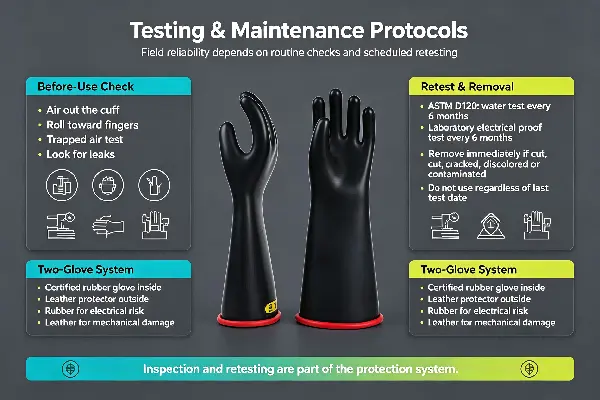
Long-term exposure to ozone and UV rays breaks down rubber in tiny cracks that you can't see until the glove breaks. Gloves made with ozone-resistant materials (Category Z) make this process go much more slowly. Even an approved glove can get a hole in it from rough surfaces, bolts, or tools. OSHA 29 CFR 1910.137 says that electrical gloves must be worn with leather protection over-gloves. The leather protects against physical damage, and the rubber protects against electrical risk.
Testing Protocols That Confirm Field Reliability
Workers should 'air out' the cuff before each use by rolling it toward their fingers to trap air and look for leaks. ASTM D120 says that every six months, water testing and laboratory electrical proof testing must be done. No matter when it was last tested, any glove that fails a visible check for cuts, cracks, particles stuck in the leather, or discoloration must be taken out of service right away.
If you're evaluating personal protective equipment suppliers and require batch-specific testing documents before placing an order, PPE MAX is able to provide official Certificates of Analysis, professional laboratory test reports, and product samples for your verification. Feel free to contact our team at marketing@ppemax.com to discuss your sourcing needs and obtain complete documentation for your quality assessment and procurement approval.
Comparing Insulating Gloves for Harsh Environment Applications
Insulating Gloves vs. Standard Rubber and Leather Gloves
Normal rubber gloves don't come with dielectric approval. Leather gloves protect against mechanical damage but don't insulate against electricity. When used together, certified electrical insulation gloves meet both needs. The two-glove system, which includes a certified rubber insulating glove worn under a leather protector, is the standard way to work with live electricity and is required by NFPA 70E for planning arc flash protection.
Market Comparison: Key Manufacturers
Hand protection against electric current is made by a number of companies around the world. For their Class 2 and Class 3 products, Klein Tools and Salisbury by Honeywell are well known in the North American utility market. Ansell and Regeltex are two of the biggest names in industrial buying in Europe. When buying insulating gloves for Class 00 and Class 0 uses, like telecom, HVAC, and low-voltage repair, buyers look at voltage grade along with tactile sensitivity, glove weight, and cycle life. PPE MAX Class 00 gloves are very light—only 170g per pair—so your hands won't get tired after long jobs.
How Thickness and Layering Affect Performance
PPE MAX Class 00 gloves have an average wall thickness of 0.5 mm, which lets you work with your fingers to do things like terminating wires and installing meters. Class 3 or Class 4 gloves may be 2.9 mm thick or more, which makes them less sensitive but more protective. When B2B buyers are in charge of multiple trades on the same site, keeping a range of classes on hand instead of just the highest grade makes safety better and worker productivity higher.
Procurement Insights: Selecting and Buying Insulating Gloves for Harsh Conditions
Certifications and Supplier Evaluation Criteria
The first thing that you should look at when choosing an insulating glove supplier is their certification. Base requirements include meeting ASTM D120, getting IEC 60903 certification, and putting a CE mark on something for European markets. In some countries, the government may need regional approvals before it will buy something. In addition to looking at paperwork, buyers should check the supplier's ability to handle large orders without affecting quality, as well as the uniformity of output and batch testing records.
Matching Glove Class to Job Role
For role-based buying choices, these are the main rules for matching:
- Electrical engineers and HVAC technicians working on systems up to 500V are well served by Class 00 gloves, which provide adequate protection without sacrificing grip or finger sensitivity.
- Line workers and utility technicians handling distribution-level voltages require Class 2 or Class 3 gloves, which are heavier but carry the dielectric ratings that high-energy environments demand.
- OEM manufacturers and safety distributors sourcing for resale should prioritize suppliers with documented quality control, customization capability, and flexible packing configurations.
These role-based matches help procurement teams avoid both gloves that don't protect enough and gloves that cost too much because they are too specific.
PPE MAX Class 00 Insulating Gloves: Specifications
Since 1956, PPE MAX has been making electrical gloves that are approved. These specs have been checked and are true for our Class 00 gloves:
- AC Maximum Use Voltage: 500V | AC Proof Test: 2,500V
- Material: High-grade natural rubber latex | Average thickness: 0.5mm
- Lengths: 11 inches (280mm) or 14 inches (360mm)
- Sizes: 8, 9, 10, 11 | Colors: Red / Black
- Reference Weight: 170g per pair
- Standards: IEC 60903, ASTM D120
- Packing: 1 pair/box, 20 pairs/carton | Carton weight: 6.5kg
Distributors and partners in building brands can get custom packaging and OEM labels.
Best Practices for Using and Maintaining Insulating Gloves in Harsh Environments
Donning, Doffing, and On-Site Handling
Before each use, workers should check their insulating gloves. To inflate the glove, roll the cuff and look for air leaks. Jewelry that is too sharp or rings should never be worn under gloves. To keep the inside of your gloves clean, peel them off from the cuff down. In places that are wet or have a lot of humidity, make sure the outside of the glove is dry before you start working to keep the surface from tracking.
Inspection and Testing Checklist
Do the following checks before putting it away or using it again:
- Visual inspection for cuts, embedded debris, color changes, or deformities
- Air inflation test to detect micro-perforations
- Tactile check along the palm, fingers, and cuff seams
- Record the test date and inspector ID on the glove tag
—A visual check for cuts, buried garbage, changes in color, deformities, or cuts
Storage and Shelf Life in Extreme Climates
Heat and humidity make rubber break down faster in hot or desert areas. Keep gloves out of direct sunlight in sealed bags or bags made just for gloves. According to ASTM D120, the glove should not be used for more than six months before it needs to be tested again for electrical safety. This is true even if it looks brand new. Keeping a rotation log helps safety managers meet all the requirements on time.
Conclusion
Electrical insulating gloves perform reliably in harsh environments only when the right class, material, and maintenance protocol align with actual site conditions. Class 00 gloves protect workers against 500V AC exposures and pass a 2,500V proof test—covering the majority of low-voltage industrial and telecom applications. Pairing them with leather protectors, following a six-month retest schedule, and sourcing from a certified manufacturer are the three practices that consistently extend glove life and keep workers safe. Procurement decisions made on verified specifications rather than price alone are the ones that hold up when conditions get difficult.
FAQ
How often should electrical insulating gloves be tested?
Under ASTM D120 and IEC 60903, electrical insulating gloves must be electrically retested every six months, regardless of visible condition. In addition, workers should perform an air inflation field test before each use. Any glove that shows signs of cuts, swelling, or discoloration should be pulled from service immediately—do not wait for the scheduled retest.
Can I wear leather gloves over electrical insulating gloves?
Yes—and in many jurisdictions, you must. OSHA 29 CFR 1910.137 and NFPA 70E both require leather protector gloves to be worn over certified rubber insulating gloves during live electrical work. The leather layer handles mechanical hazards like abrasion and puncture, while the rubber layer provides the dielectric protection. The two work as a system, not as alternatives.
What is the difference between Class 00 and Class 0 gloves?
Class 00 gloves are rated for a maximum use voltage of 500V AC and are proof tested at 2,500V AC. Class 0 gloves step up to 1,000V AC use voltage and are proof tested at 5,000V AC. Class 00 gloves are the better fit for HVAC, telecom, and low-voltage panel work, while Class 0 gloves cover meter installation and low-end distribution tasks that push closer to the 1,000V threshold.
Partner With PPE MAX for Certified Insulating Glove Supply
According to ASTM D120 and IEC 60903, electrical protective gloves need to be retested every six months, even if they look fine. A field test for air inflation should also be done by workers before each use. Any glove that has cuts, swelling, or changes in color should be taken out of service right away—do not wait for the planned check. You can email us at marketing@ppemax.com or go to www.ppemax.com.
References
1. ASTM International. ASTM D120: Standard Specification for Rubber Insulating Gloves. ASTM International, 2023.
2. International Electrotechnical Commission. IEC 60903: Live Working – Gloves of Insulating Material. IEC, 2022.
3. National Fire Protection Association. NFPA 70E: Standard for Electrical Safety in the Workplace. NFPA, 2024.
4. Occupational Safety and Health Administration. OSHA 29 CFR 1910.137: Electrical Protective Equipment. U.S. Department of Labor, 2023.
5. Lee, W.R., and Dunbar, A.M. "Dielectric Performance of Natural Rubber Gloves Under Thermal and Chemical Stress." Journal of Occupational Safety and Ergonomics, 2021.
6. Hand, A.T., and Mercer, D.J. "Inspection Protocols and Failure Rates in Low-Voltage Insulating Gloves." Safety Science, 2020.
Learn about our latest products and discounts through SMS or email