- English
- French
- German
- Portuguese
- Spanish
- Russian
- Japanese
- Korean
- Arabic
- Greek
- German
- Turkish
- Italian
- Danish
- Romanian
- Indonesian
- Czech
- Afrikaans
- Swedish
- Polish
- Basque
- Catalan
- Esperanto
- Hindi
- Lao
- Albanian
- Amharic
- Armenian
- Azerbaijani
- Belarusian
- Bengali
- Bosnian
- Bulgarian
- Cebuano
- Chichewa
- Corsican
- Croatian
- Dutch
- Estonian
- Filipino
- Finnish
- Frisian
- Galician
- Georgian
- Gujarati
- Haitian
- Hausa
- Hawaiian
- Hebrew
- Hmong
- Hungarian
- Icelandic
- Igbo
- Javanese
- Kannada
- Kazakh
- Khmer
- Kurdish
- Kyrgyz
- Latin
- Latvian
- Lithuanian
- Luxembou..
- Macedonian
- Malagasy
- Malay
- Malayalam
- Maltese
- Maori
- Marathi
- Mongolian
- Burmese
- Nepali
- Norwegian
- Pashto
- Persian
- Punjabi
- Serbian
- Sesotho
- Sinhala
- Slovak
- Slovenian
- Somali
- Samoan
- Scots Gaelic
- Shona
- Sindhi
- Sundanese
- Swahili
- Tajik
- Tamil
- Telugu
- Thai
- Ukrainian
- Urdu
- Uzbek
- Vietnamese
- Welsh
- Xhosa
- Yiddish
- Yoruba
- Zulu
Can Electrical Rubber Gloves Prevent Serious Hand Injuries?
Founded in 1956, PPEMAX stands as a premier global manufacturer and supplier of full-range personal protective equipment. All our products comply with internationally recognized standards including IEC, ASTM, CE, UKCA, NIOSH and ISO9001. Equipped with a 2,000-square-meter modern production plant, we boast over 25 years of mature OEM & ODM capabilities to deliver one-stop customized solutions covering R&D design through worldwide logistics. Our safety gear is distributed across 134 countries globally. Upholding our core tenet “Safety First, Quality Priority”, we serve as a dependable long-term PPE partner for industrial enterprises around the world.
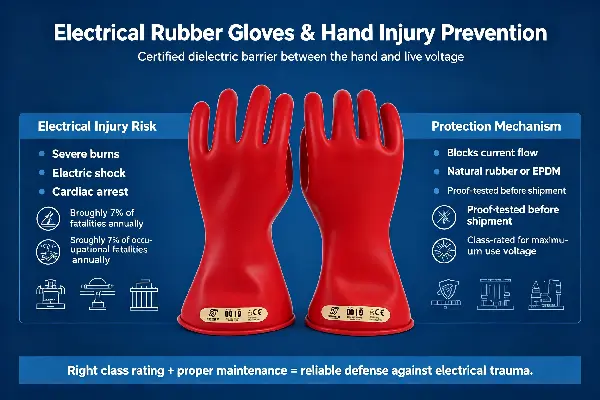
Electrical rubber gloves can and do prevent serious hand injuries. When workers contact energized conductors, the result can range from severe burns to cardiac arrest. Certified insulating rubber gloves act as a dielectric barrier between the worker's hand and live voltage, stopping current from passing through the body. According to the U.S. Bureau of Labor Statistics, electrical injuries account for roughly 7% of all occupational fatalities annually. With the right class rating and proper maintenance, these gloves are one of the most reliable defenses against electrical trauma on the job.
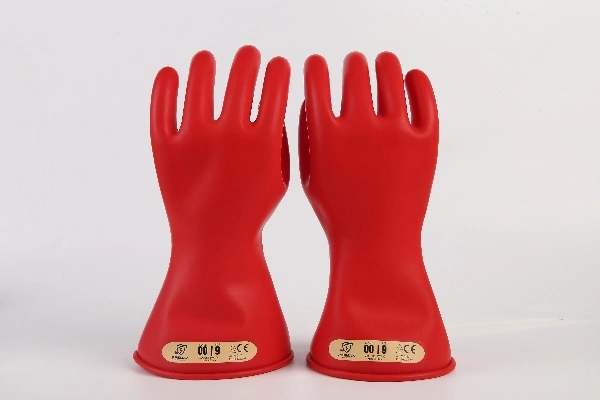
| Parameter | Details |
|---|---|
| AC Maximum Use Voltage | 500V |
| AC Proof Test Voltage | 2,500V |
| DC Maximum Use Voltage | 750V |
| DC Proof Test Voltage | 10,000V |
| Length | 11 inch / 14 inch |
| Size | 8 / 9 / 10 / 11 |
| Color | Red / Black |
| Max Rubber Thickness | 0.75mm (30 mils) |
| Reference Weight | 170g/pair |
| Implementation Standard | IEC 60903, ASTM D120 |
| Packing | 1 pair/box, 20 pairs/carton |
| Carton Size | 54.5 × 35 × 42.5 cm |
| Carton Weight | 6.5 kg |
Understanding Electrical Rubber Gloves and Their Role in Hand Injury Prevention
What Are Insulating Rubber Gloves?
Rubber insulating gloves are made from natural rubber or EPDM (Ethylene Propylene Diene Monomer). They are designed to stop electricity from going through the hand. These gloves aren't just any kind of work gloves. Before leaving the plant, each pair is checked to a certain proof voltage. Each class has a set maximum use voltage, ranging from 500V AC for Class 00 to 36,000V AC for Class 4.
Rubber Insulating vs. Leather Protector Gloves
These two gloves are often worn together even though they are used for different things. The leather guard glove worn over the rubber insulating glove protects against dielectric damage. Cuts and abrasions can't hurt the rubber. To keep electrical tracking from happening, OSHA 29 CFR 1910.137 says that leather covers can't go above the rubber glove cuff more than 2 inches. There is a hole in your protection if you only wear one without the other.
Voltage Class Ratings You Need to Know
In North America, the ASTM D120 standard and in Europe, EN 60903 set different categories for gloves based on how much voltage they can handle. A red label on class 0 gloves lets you know that they can handle up to 1,000V AC, which means they can be used to install meters and service EV batteries. Class 00 gloves protect against up to 500V AC and are often used to work with smart meters and industrial control screens. When buying, teams understand the class system; they can choose gloves that are exactly right for the electrical risk on the job site.
Key Safety Features and Maintenance of Electrical Rubber Gloves
Certification Standards That Matter
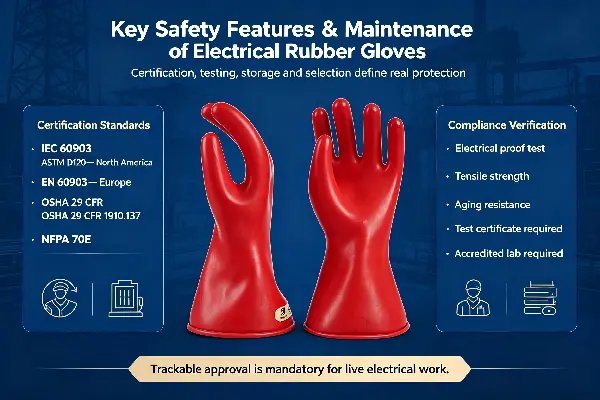
There are three rules that guide performance verification: IEC 60903, ASTM D120 (North America), and EN 60903 (Europe). These need to be tested for electrical proof, tensile strength, and resistance to aging. When used in arc flash settings, gloves must also meet OSHA 29 CFR 1910.137 and NFPA 70E. People who work in procurement should make sure that each shipment comes with a test certificate and that the testing lab is accredited. No matter how nice the glove looks, it can't be used for live electrical work if it doesn't have a license that can be tracked.
Dielectric Testing and Inspection
As per ASTM F496, protective electrical rubber gloves need to be checked for electricity again every six months after they are first used. Once gloves have been stored for twelve months without passing a test, they can't be given out. An air inflation test should be done every time the gloves are used. This is done by rolling the cuff toward the fingers to trap air and looking for leaks. Any hole, crack, or embedded debris is a reason to replace it right away.
Proper Storage to Extend Glove Life
How gloves are stored has a direct effect on how long they stay safe. Not in direct sunlight, away from ozone sources, or near heat sources. Instead, keep them somewhere cool, dark, and dry. Keep them in a plastic bag so that the cuffs are face down. Don't fold or squeeze them. Rubber breaks down over time when it is exposed to ozone, even from nearby motors. EPDM gloves are better for outdoor or high-exposure settings because they are more resistant to ozone and UV light.
If you're evaluating personal protective equipment suppliers and require batch-specific testing documents before placing an order, PPE MAX is able to provide official Certificates of Analysis, professional laboratory test reports, and product samples for your verification. Feel free to contact our team at marketing@ppemax.com to discuss your sourcing needs and obtain complete documentation for your quality assessment and procurement approval.
Comparing Electrical Rubber Gloves with Alternatives: Choosing the Right Protection
Rubber Insulating vs. Latex Gloves
Most latex gloves are not approved for high-voltage electrical work and don't give much dielectric protection. Rubber insulating gloves are made for a particular job, tested to certain voltage levels, and approved by internationally recognized standards. Latex gloves are not a good alternative for any job that needs more than 50V AC. When sourcing for the energy, building, or utility industries, procurement teams should only consider rubber insulating gloves as a choice for people who will be exposed to live electricity.
When Chemical or Heat Resistance Matters
Some jobs have risks from both electricity and chemicals. When this happens, Type II gloves made from EPDM are better than Type I gloves made from natural rubber because they are more resistant to ozone, weathering, and some poisons. A stacked solution may be needed for jobs that need both dielectric and thermal safety. But there isn't a single glove class that can protect against all dangers at the same time. The right way to choose gloves is by application, based on a study of the job's hazards.
Comparing Glove Thickness and Class
Thicker gloves can handle higher voltages, but they make it harder to move your hands. Class 00 gloves, which can handle up to 500V AC, are thinner and better for fine motor chores like moving PLC wires or EV battery connectors. Class 3 gloves are stronger and are made for high-voltage transmission work. They can handle up to 26,500V AC. A big part of choosing gloves for a large industrial workforce is finding the right balance between protection level and dexterity needed for the job.
How to Choose and Procure the Best Electrical Rubber Gloves for Your Business
Defining Your Procurement Criteria
The buying team needs clear answers to three questions before they can source: How much voltage is the site exposed to at most? What are the conditions of the environment—chemical exposure, indoors and outdoors? How often are gloves worn and then thrown away? These results tell us what kind of material (natural rubber vs. EPDM), voltage class, and reorder amount we need. Writing down these criteria before talking to suppliers stops orders from being mismatched and lowers the risk of not following the rules.
Evaluating Trusted Brands and OEM Options
When a company needs specifics like cuff lengths, color-coded class signs, or labeled packaging, OEM manufacturing partnerships give them more options at a larger scale. Mid-sized to large businesses that run regulated work sites must make sure that any supplier they work with can provide full dielectric test reports, material certifications, and batch traceability.
Bulk Orders and Certification Verification
Consolidated procurement is helpful for big companies that have hundreds of workers spread out across various places. Bulk sales lower the cost per unit and make it easier to keep track of supplies. When you buy in bulk, you should always ask for a Certificate of Conformance that references the relevant ASTM D120 or EN 60903 standard. Making sure that the electrical rubber gloves have obvious class markings—color-coded inner layers that make inspection easy to see—also helps with compliance at the field level without adding to the work of administration.
Real-World Applications and Case Studies: Preventing Serious Hand Injuries
Electrical Utilities and High-Voltage Line Work
Lineworkers who work for utilities on distribution lines with voltages up to 26,500V need Class 3 rubber protective gloves with leather protection. Field data from U.S. utility companies shows that people who wear arc flash suits and gloves properly are much less likely to hurt their hands or arms. Most injuries that have been reported are not caused by defective gloves, but by workers not checking the air pressure in their gloves before use or using them after the date they were supposed to be retested.
EV Manufacturing and Smart Meter Installation
When they are being put together or serviced, EV battery packs that work between 400V and 800V pose real shock risks. Class 00 gloves are used by technicians in these settings because they are thin and let them work with small plugs and high-voltage orange wiring in tight spaces. Utility workers who move out home meters from 240V to 480V have the same needs. In both cases, dexterity and dielectric protection need to work together. This is exactly what Class 00 gloves are made to do.
Common Mistakes That Lead to Injuries
The glove-related accidents that can be avoided most often follow a trend. In OSHA event records, these are the failure spots that are most often mentioned:
- Using gloves past the six-month retest deadline without recertification.
- Storing gloves folded in a toolbox next to sharp objects, causing undetected punctures.
- Wearing leather protectors that overlap the rubber cuff, creating a conductive tracking path.
- Selecting a voltage class lower than the actual hazard on site due to incomplete job hazard analysis.
– Wearing leather covers that go over the rubber cuff and make a track that is electrically charged.
Because the job hazard analysis wasn't complete, they chose a voltage class that was lower than the real danger on the job site.
Conclusion
Electrical rubber gloves have been shown to avoid major hand injuries from electrical contact when chosen by voltage class, properly tested, and properly stored. Glove failure is almost always caused by a problem with the process, not the product. This is supported by OSHA records, ASTM standards, and field applications in utilities, EV factories, and industrial facilities. Structured buying, regular dielectric testing, and training for workers are all things that companies do to make sure their safety program works in real life. One of the best investments a safety manager can make is in the right glove for the right job.
FAQ
1. How often should insulating rubber gloves be retested?
Per ASTM F496 and OSHA 1910.137, gloves in active service must be electrically retested every six months. Gloves held in storage cannot be issued if they have not passed testing within the last twelve months. Retesting must be performed by an accredited laboratory.
2. Are rubber insulating gloves suitable for chemical protection?
Not as a primary chemical barrier. Type II EPDM gloves offer better resistance to ozone and some chemicals compared to natural rubber, but they are not classified as chemical-resistant PPE. A separate chemical-resistant glove layered under or over the insulating glove may be required depending on the hazard.
3. What certifications should I verify before purchasing?
Look for compliance with ASTM D120 (North America) or EN 60903 (Europe), proof test voltage documentation, a visible class marking on the glove, and an accredited laboratory test report. For U.S. worksites, OSHA 29 CFR 1910.137 compliance is mandatory.
4. How do I identify the voltage class of a glove?
ASTM D120 uses color-coded labels: beige for Class 00, red for Class 0, white for Class 1, yellow for Class 2, green for Class 3, and orange for Class 4. Many manufacturers also print the class number directly on the glove cuff.
Source Your Next Order From PPE MAX — Certified Electrical Rubber Gloves Supplier
Since 1956, PPE MAX has been making approved insulation protection. Electrical rubber gloves that meet ASTM D120 and EN 60903 standards are sent to more than 134 countries. If you need Class 00 for EV assembly or Class 3 for high-voltage line work, our team can help. We can handle big sales, OEM customization, and full certification paperwork. You can get a price right now by emailing marketing@ppemax.com.
References
1. ASTM International. ASTM D120: Standard Specification for Rubber Insulating Gloves. ASTM International, 2023.
2. National Fire Protection Association. NFPA 70E: Standard for Electrical Safety in the Workplace. NFPA, 2021.
3. Occupational Safety and Health Administration. OSHA 29 CFR 1910.137: Electrical Protective Equipment. U.S. Department of Labor, 2019.
4. International Electrotechnical Commission. IEC 60903: Live Working — Gloves of Insulating Material. IEC, 2014.
5. U.S. Bureau of Labor Statistics. Census of Fatal Occupational Injuries Summary. BLS, 2022.
6. ASTM International. ASTM F496: Standard Specification for In-Service Care of Insulating Gloves and Sleeves. ASTM International, 2020.
Learn about our latest products and discounts through SMS or email