- English
- French
- German
- Portuguese
- Spanish
- Russian
- Japanese
- Korean
- Arabic
- Greek
- German
- Turkish
- Italian
- Danish
- Romanian
- Indonesian
- Czech
- Afrikaans
- Swedish
- Polish
- Basque
- Catalan
- Esperanto
- Hindi
- Lao
- Albanian
- Amharic
- Armenian
- Azerbaijani
- Belarusian
- Bengali
- Bosnian
- Bulgarian
- Cebuano
- Chichewa
- Corsican
- Croatian
- Dutch
- Estonian
- Filipino
- Finnish
- Frisian
- Galician
- Georgian
- Gujarati
- Haitian
- Hausa
- Hawaiian
- Hebrew
- Hmong
- Hungarian
- Icelandic
- Igbo
- Javanese
- Kannada
- Kazakh
- Khmer
- Kurdish
- Kyrgyz
- Latin
- Latvian
- Lithuanian
- Luxembou..
- Macedonian
- Malagasy
- Malay
- Malayalam
- Maltese
- Maori
- Marathi
- Mongolian
- Burmese
- Nepali
- Norwegian
- Pashto
- Persian
- Punjabi
- Serbian
- Sesotho
- Sinhala
- Slovak
- Slovenian
- Somali
- Samoan
- Scots Gaelic
- Shona
- Sindhi
- Sundanese
- Swahili
- Tajik
- Tamil
- Telugu
- Thai
- Ukrainian
- Urdu
- Uzbek
- Vietnamese
- Welsh
- Xhosa
- Yiddish
- Yoruba
- Zulu
Full Mask Respirator vs. Disposable Masks: Which Is Safer?
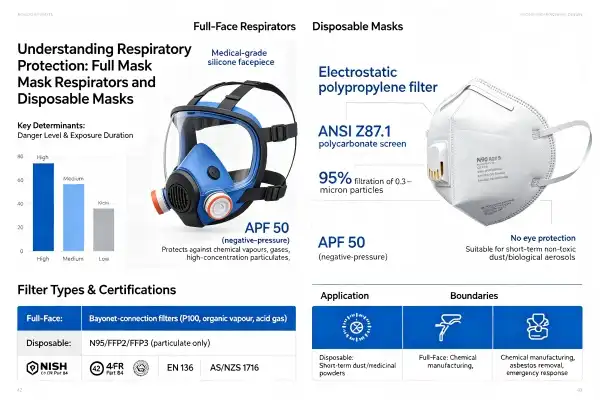
The main things that determine whether full-face respirators or throwaway masks are better for protecting your lungs in workplace settings are the level of danger and the length of time that you will be exposed to it. A full-mask respirator covers the whole face, has built-in eye protection, and has an Assigned Protection Factor (APF) of 50 in negative-pressure settings. It protects against chemical vapours, harmful gases, and high-concentration particulates. Disposable masks, like N95 and surgical masks, are good for short-term filtration of annoying dusts and biological aerosols, but they don't provide the sealed barrier and multi-hazard defence needed in chemical manufacturing, pharmaceutical production, and hazardous waste operations where threats to the eyes and lungs are present at the same time.
Understanding Respiratory Protection: Full Mask Respirators and Disposable Masks
Respiratory protection equipment forms the frontline defense against workplace airborne hazards, yet understanding which device matches your operational risk profile remains critical for procurement decision-makers. The design philosophies behind full-face respiratory devices and disposable filtering units differ substantially in construction, intended application, and regulatory compliance.
Design and Construction Fundamentals
Full-face respirators have a medical-grade silicone or thermoplastic rubber facepiece that fits over the forehead and chin to form a continuous seal. They also have a wide-view polycarbonate screen that meets ANSI Z87.1 impact standards. When we make things at PPE MAX, we use soft silicone face seals with dual inhalation valves to make breathing easier and center-mounted exhale valves to get rid of air quickly. The 5-point changeable head strap spreads pressure out evenly, so the seal doesn't break when you move around a lot. This technical method solves a problem that has been bothering the industry for a long time: keeping safety integrity across a wide range of face shapes and working situations. There are many kinds of disposable masks, from simple dust masks to approved N95 respirators and medical masks. Electrostatic polypropylene filter media that are held in place by elastic ear loops or head straps are common in these units. Even though N95 respirators are 95% effective at filtering out 0.3-micron particles, they can't be used in places where there is a risk of chemical splashes or gas exposure because they don't protect the eyes and need hair-free seal zones on the face.
Filter Types and Protection Certifications
The flexible filter method is what makes refillable respirators different from throwaway ones. At PPE MAX, we have bayonet-connection filters that are approved for particulate (P100), organic vapour, acid gas, and combo risks. This interchangeability means that a single facepiece can be used in several different risk situations. This makes inventory management easier for procurement managers who are in charge of a lot of different sites. When assessing breathing tools, it is important to understand how approval works. In the US, approval is based on NIOSH 42 CFR Part 84, and in Europe, EN 136 sets standards with Class 1, 2, and 3 levels based on how long they last and how well they fight chemicals. We keep up with NIOSH, EN 136, and AS/NZS 1716 standards to make sure our goods meet the buying needs of international companies with operations in Australia for mine sites, the Middle East for industrial plants, and the Americas for building projects.
There is a different approval process for disposable masks. The N95, FFP2, and FFP3 grades show the amounts of particulate filters, but they don't say anything about protecting against chemical vapours or gases. Because Full Mask Respirator devices are designed to protect against a broader range of airborne hazards, they follow different certification requirements. Surgical masks are mostly made to keep germs out rather than protect the person wearing them, so they don't have any lung protection approval and can't be used as a Full Mask Respirator for anything other than basic cleanliness in the workplace.
Application Boundaries in Industrial Environments
Figuring out where each type of breathing protection really shines can help you avoid costly mistakes. Disposable N95 respirators are useful for short-term exposures to non-toxic dusts, handling medicinal powders with low toxicity profiles and extra safety during building upkeep. Their one-time use makes them useful in situations where masks need to be changed often or where preventing cross-contamination is more important than saving money by reusing them.
When the danger level rises, full-face respirators become necessary. When chlorine, ammonia, or formaldehyde are used in chemical making, barriers must be put up around the eyes and nose because these chemicals are irritating to nasal tissues. Full-face negative pressure systems offer the APF 50 safety that is needed for asbestos removal and silica-containing work. Our tools help people who are making medicines, responding to emergencies, spray painting with coats that contain isocyanates, and going into tight spaces where the makeup of the air is unknown.
Safety and Performance Comparison Between Full Mask Respirators and Disposable Masks
Procurement professionals tasked with workforce protection must evaluate respiratory equipment through quantifiable performance metrics rather than acquisition cost alone. The safety differential between full-face systems and disposable masks manifests across filtration capability, seal reliability, and hazard versatility.
Filtration Efficacy Across Hazard Types
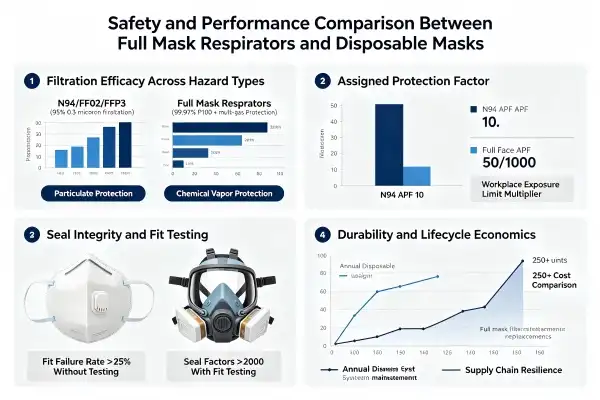
For lung safety, a particulate filter is the basic requirement. Under test settings, N95 throwaway masks filter out 95% of 0.3-micron particles, providing enough protection against a wide range of biological aerosols and irritating dusts. The European counterparts of FFP2 and FFP3 offer the same or better particulate performance. These devices work fine as long as the only thing they're exposed to is solid or liquid particles and not chemical vapours.
Full-face systems with the right filters protect against chemicals and gases that throwaway masks can't reach. Our P100 particulate filters work 99.97% of the time and are compatible with combination packs that remove ammonia, acid gases, and organic vapours at the same time. This ability to deal with multiple threats is very important in places like refineries, where hydrocarbon vapours and catalyst dusts interact, and in drug making, where active medicinal ingredients can be harmful if breathed in or come into touch with the eyes.
This performance gap is measured by the Assigned Protection Factor. OSHA gives throwaway N95 masks an APF of 10, which means that exposure in the workplace can be up to 10 times the allowed amount. Full-face negative pressure respirators have an APF of 50, which means they can be used safely in places with five times as many contaminants. This factor goes up to 1000 when powerful air-purifying systems are used together, allowing work to be done in situations that are immediately dangerous to life or health (IDLH).
Seal Integrity and Fit Testing Requirements
The seal between the mask and the face checks to see if the filter really does provide protection. Metal nose clips and stretchy straps are used in disposable masks to make them fit your face. Seal uniformity is affected by things like face hair, different facial structures, talking, and moving the head. Studies show that throwaway mask users have fit failure rates of more than 25% if they don't get formal fit testing. This gives workers and safety managers the wrong idea of how safe they are.
Because they have designed touch areas and thorough fit testing procedures, our full-face respirators solve problems with seals. The silicone face seal moulds to the shape of each person's face, and the 5-point strap lets you precisely change the tension at the forehead, temples, and crown. We help with rigorous fit testing, which shows that seal factors often go above 2000, which is much higher than the bare standards. This process, which is required by OSHA 1910.134 for tight-fitting respirators, makes sure that the safety is good before the dangerous exposure happens.
Fit testing should be done on a regular basis, like once a year or whenever your face changes. This will keep the safety working properly for as long as the equipment is in use. This proof feature helps procurement managers who are putting in place full-face mask programs. It turns breathing safety from a matter of faith into recorded compliance.
Durability and Lifecycle Economics
Disposable masks present straightforward replacement economics but accumulate substantial recurring costs. A single worker requiring mask changes every shift consumes 250+ units annually, generating disposal waste and continuous procurement demand. Supply chain disruptions, demonstrated during recent global health events, expose organizations to availability risks when dependent on high-volume disposable supply.
Full Mask Respirator systems reverse this economic model. At PPE MAX, our Full Mask Respirator facepieces withstand multiple years of service with proper maintenance, requiring only periodic filter cartridge replacement based on contaminant type and exposure intensity. A P100 particulate filter serving dusty environments may last weeks, while organic vapor cartridges require replacement when breakthrough occurs or service life indicators activate. This approach reduces long-term costs while minimizing supply chain vulnerability through extended Full Mask Respirator equipment lifecycle and standardized component inventory.
The durability advantage extends beyond economics into operational reliability. Industrial environments subject equipment to chemical exposure, physical impact, and temperature extremes. Our polycarbonate lenses resist scratching and chemical degradation, maintaining optical clarity throughout service life. Replaceable components—lenses, speaking diaphragms, inhalation valves—allow targeted part replacement rather than complete unit disposal, supporting sustainability objectives increasingly important to corporate procurement policies.
Operational and Maintenance Considerations for Procurement Managers
Selecting appropriate respiratory protection represents only the initial procurement decision. Lifecycle management protocols determine whether equipment investment translates into sustained worker safety and cost efficiency.
Maintenance Protocols for Reusable Respiratory Equipment
Full-face respiratory devices require systematic maintenance regimens that, when properly implemented, extend service life and maintain protection reliability. After each use, workers should disinfect facepieces using manufacturer-approved solutions—we recommend neutral pH detergents followed by sanitizing agents compatible with silicone and elastomeric materials. Harsh solvents or petroleum-based cleaners degrade sealing surfaces, compromising fit integrity.
Inspection protocols identify components requiring replacement before failure occurs. We advise examining the face seal for cracks, tears, or permanent deformation monthly. Inhalation and exhalation valves should seat properly without flutter or distortion. Lens scratches exceeding acceptable limits under ANSI Z87.1 necessitate replacement to maintain visibility and impact protection. Head harness elasticity degrades with UV exposure and repeated stretching; replacement intervals typically range from six months to two years depending on usage intensity.
Storage conditions directly influence equipment longevity. Respirators should rest in dedicated storage containers away from direct sunlight, extreme temperatures, and chemical vapors that accelerate material degradation. At PPE MAX, we provide protective storage cases with each respirator, facilitating proper storage practices and reducing damage during transportation between work areas.
Filter cartridge management requires distinct protocols. Particulate filters reach end-of-service when breathing resistance increases noticeably or visible loading occurs. Chemical cartridges demand replacement based on breakthrough time calculations considering contaminant type, concentration, humidity, and temperature. We supply end-of-service-life indicators on appropriate cartridges, eliminating guesswork and enhancing safety compliance.
Cost-Efficiency Analysis for Procurement Planning
To figure out the total cost of ownership, you have to look at more than just the price of the unit. At first glance, disposable masks seem like a good deal since each N95 unit costs around two to five dollars. Multiplying by annual usage (assuming only one shift before being thrown away) gives yearly costs per worker that range from $500 to $1,250 for jobs that need daily breathing protection.
Full-face breathing systems cost more to buy at first. Good units can cost anywhere from $150 to $400, based on their features and certifications. Filter refills cost an extra $15 to $60 per pair, and depending on the use, they need to be replaced every few weeks to months. If you spread the cost of the facepiece over a reasonable three-year service life and change the filters at the right times, the average yearly cost per worker is between $200 and $500. This is a big savings compared to disposable options while still providing better security.
Buying in bulk makes these economies stronger. We have bulk price models for companies that need to outfit a lot of people, and distributors who serve multiple client sites can save even more by custom labelling their products. This way of buying cuts down on the cost per unit while still making sure there is a supply because it uses known business ties instead of buying on the spot market.
More hidden costs favour methods that can be used again. Getting rid of dirty one-time masks, especially ones that were exposed to dangerous materials that need special treatment, adds to the cost and work of administration. Reusable systems cut down on training time because workers only have to learn how to use one device instead of having to learn how to use different throwaway mask models. Fit testing costs money up front, but it ensures safety and lowers legal risks compared to using throwaway masks without trying them first.
Choosing the Right Respirator: Decision Support for B2B Procurement
Strategic respiratory protection selection balances immediate hazard mitigation with long-term operational requirements. Procurement professionals benefit from structured decision frameworks addressing workplace variables and organizational objectives.
Hazard Assessment and Protection Factor Requirements
Begin by documenting airborne hazards through industrial hygiene monitoring. Identify contaminant types—particulates, gases, vapors, or combinations—and quantify exposure concentrations relative to established exposure limits. OSHA Permissible Exposure Limits, ACGIH Threshold Limit Values, and manufacturer Safety Data Sheets provide reference benchmarks.
Calculate required Assigned Protection Factor by dividing measured concentration by applicable exposure limit. Results below 10 may permit disposable N95 use, provided no eye hazards exist, and exposures remain brief. APF requirements between 10 and 50 necessitate full-face negative pressure respirators. Values exceeding 50 demand powered air-purifying respirators or supplied air systems.
Chemical properties influence selection substantially. Contaminants with poor warning properties—those lacking odor or irritation at hazardous concentrations—render end-of-service-life determination difficult, favoring positive-pressure systems or supplied air. Immediately Dangerous to Life or Health atmospheres require pressure-demand supplied air respirators with escape provisions, eliminating filtering respirators.
Ergonomic Factors and PPE Integration
Worker acceptance determines whether specified protection gets used consistently. Full-face respirators impose greater weight and bulk than disposable masks, potentially causing fatigue during extended shifts. Our ergonomic design approach distributes weight evenly and positions the facepiece center of gravity close to the face, minimizing neck strain. The optional drinking tube allows hydration without breaking the seal, addressing a common complaint during hot work or extended use.
Communication challenges emerge with any facial coverage. We incorporate speech diaphragms in our full-face models, maintaining voice clarity for team coordination and emergency communication. Some operations benefit from electronic communication systems integrated with respiratory equipment—an option we accommodate through accessory compatibility.
PPE integration requires considering interactions between respiratory protection and other safety equipment. Full-face respirators provide inherent eye protection, eliminating safety glasses and reducing equipment redundancy. Hard hat compatibility demands attention, as some suspension systems interfere with head harness placement. We engineer our harness systems for compatibility with standard hard hats and provide guidance for proper donning sequences.
Supplier Evaluation and Procurement Best Practices
Selecting respiratory equipment suppliers extends beyond product comparison to encompass service capabilities and long-term partnership potential. Certification verification forms the foundation—demand documentation proving NIOSH, EN, or relevant regional approvals rather than accepting claims without substantiation. At PPE MAX, we maintain transparent certification records and welcome verification inquiries, understanding that procurement professionals bear accountability for equipment adequacy.
Manufacturing capacity and supply chain resilience gained prominence through recent disruptions. Suppliers with dedicated production facilities, diversified raw material sources, and inventory depth weather demand fluctuations better than marketers relying on third-party manufacturing. Our Xi'an manufacturing campus has operated since 1956, providing production stability and quality consistency across 65+ years. This longevity translates into product reliability and supply continuity that procurement managers require when protecting workforces across 134 countries.
Technical support capabilities differentiate suppliers significantly. Respiratory protection programs demand expertise in hazard assessment, fit testing, training, and regulatory compliance. We provide comprehensive technical support including on-site assessments, fit testing equipment and training, and direct access to respiratory protection specialists. This service orientation transforms supplier relationships from transactional purchasing into collaborative safety partnerships.
Custom capabilities address unique operational requirements. Standard products serve most applications well, but specialized industries benefit from modifications—custom lens tinting for welding environments, specific filter combinations for unique chemical exposures, or private labeling for distributors. Our OEM and ODM experience supports these requirements, accommodating customization requests that strengthen your market position or operational effectiveness.
Practical Tips for Maximizing Safety and Longevity of Respiratory Equipment
Optimal Full Mask Respirator protection depends equally on equipment quality and proper use. These field-tested practices enhance Full Mask Respirator safety outcomes and extend equipment service life, maximizing procurement investment returns.
Fit Testing and Seal Verification Procedures
Quantitative fit testing using specialized equipment measures actual leakage, producing numerical fit factors demonstrating seal adequacy. This approach surpasses qualitative methods relying on taste or smell detection, particularly for workers with reduced sensitivity. We recommend annual fit testing along with testing after dental work, significant weight changes, or facial scarring that might compromise seal geometry.
Between formal fit tests, workers should perform user seal checks before each use. The positive pressure check involves blocking the exhalation valve and breathing out gently—pressure should build without air escaping around the face seal. The negative pressure check blocks inhalation ports while inhaling; the facepiece should collapse slightly and remain collapsed during breath-hold. Detecting leakage during either check demands harness adjustment or possible face seal replacement.
Strap adjustment technique influences seal quality substantially. The sequence matters: position the facepiece on the face, secure bottom straps at neck level, then adjust temple and crown straps. Over-tightening creates discomfort without improving seal, while insufficient tension allows shifting during movement. We provide adjustment training emphasizing even strap tension distribution through the multi-point harness system.
Storage and Handling Best Practices
Proper storage between uses prevents contamination and physical damage. Designate clean storage areas separated from contaminated work zones. Our protective cases shield respirators from dust, chemicals, and impact while allowing air circulation, preventing moisture accumulation and microbial growth. Avoid storing respirators in toolboxes where sharp objects cause punctures or in vehicle trunks where heat accelerates material degradation.
Cleaning frequency depends on use intensity and contamination levels. Light-duty applications may require weekly cleaning, while environments with heavy soiling or biological hazards demand cleaning after each shift. Remove filters before washing to prevent water damage. Disassemble components following manufacturer instructions—our respirators feature intuitive disassembly requiring no tools for routine cleaning. Air-dry all components completely before reassembly; moisture trapped in valves or sealing surfaces compromises performance.
Inspection during cleaning identifies wear before failure. Check the lens for crazing, deep scratches, or chemical staining. Examine all elastomeric parts for flexibility loss, cracking, or permanent deformation. Test valve function—inhalation valves should move freely without sticking; exhalation valves should seal completely when closed. Replace components showing degradation immediately rather than risking protection failure during use.
Conclusion
Selecting between full-face respiratory systems and disposable masks ultimately depends on hazard severity, exposure duration, and total cost of ownership priorities. Disposable masks serve temporary, low-toxicity particulate exposure adequately but cannot address chemical vapors, provide eye protection, or deliver the Assigned Protection Factor necessary for serious industrial hazards. Full-face respirators like those manufactured by PPE MAX offer comprehensive facial protection, verified fit, multi-hazard capability, and superior lifecycle economics for operations requiring reliable respiratory defense. Procurement managers protecting workforces in chemical, pharmaceutical, construction, and emergency response sectors gain both enhanced safety and reduced long-term costs through certified reusable respiratory equipment supported by proper training and maintenance protocols.
FAQ
1. What is the typical lifespan of a Full Mask Respirator compared to disposable options?
A quality full-face respirator facepiece serves three to five years with proper maintenance, while filter cartridges require replacement based on contaminant type—ranging from weeks for high-concentration chemical exposures to months for particulate-only applications. Disposable masks remain single-use or limited to single-shift applications before requiring disposal. This durability difference translates into substantial cost savings and reduced supply chain dependency for organizations with recurring respiratory protection needs.
2. Can disposable masks protect against chemical vapors in industrial settings?
Standard disposable masks, including N95 and FFP2 respirators, filter particulates exclusively and provide zero protection against gases or vapors. Chemical hazards demand respirators equipped with appropriate gas or vapor cartridges matched to specific contaminants. Only full-face or half-mask respirators with chemical cartridges address vapor hazards, making disposable masks unsuitable for environments containing solvents, acid gases, or other volatile chemicals regardless of concentration.
3. What certifications should procurement managers prioritize when sourcing respiratory protection equipment?
NIOSH approval under 42 CFR Part 84 remains essential for the United States market, while EN 136 governs European compliance for full-face respirators. Verify that suppliers provide genuine certification documentation rather than self-declared compliance. At PPE MAX, our respiratory equipment carries NIOSH, EN 136, and AS/NZS 1716 certifications, ensuring acceptance across international markets and providing procurement confidence in product performance and regulatory compliance for multinational operations.
Partner with PPE MAX for Certified Respiratory Protection Solutions
Procurement managers seeking reliable Full Mask Respirator suppliers benefit from partnering with manufacturers offering proven expertise, comprehensive certifications, and responsive support. PPE MAX brings 65 years of manufacturing excellence to your respiratory protection program, combining NIOSH and EN 136-certified Full Mask Respirator products with global supply capabilities reaching 134 countries. Our Xi'an facility produces complete respiratory protection systems featuring soft silicone face seals, anti-fog polycarbonate lenses, and versatile filter compatibility addressing particulate, gas, and vapor hazards across chemical, pharmaceutical, construction, and emergency response applications. We support procurement teams with bulk purchasing options, custom labeling for distributors, fit testing training, and technical guidance, ensuring optimal protection for your workforce. Contact our team at marketing@ppemax.com to discuss your respiratory protection requirements and discover how our comprehensive approach to manufacturing, certification, and customer support delivers both enhanced safety and operational efficiency for your organization.
References
1. National Institute for Occupational Safety and Health. (2019). NIOSH Guide to the Selection and Use of Particulate Respirators. DHHS (NIOSH) Publication No. 96-101.
2. Occupational Safety and Health Administration. (2020). Respiratory Protection Standard 29 CFR 1910.134. U.S. Department of Labor.
3. European Committee for Standardization. (2018). EN 136: Respiratory Protective Devices - Full Face Masks - Requirements, Testing, Marking. CEN Brussels.
4. American National Standards Institute. (2020). ANSI Z87.1: Occupational and Educational Personal Eye and Face Protection Devices. ANSI New York.
5. Cohen, H.J. & Birkner, L.R. (2017). Respiratory Protection Handbook: A Practical Guide for Users. CRC Press, Taylor & Francis Group.
6. Myers, W.R. & Zhuang, Z. (2018). Field Performance Measurements of Half-Facepiece Respirators - Study Design and Quality Assurance. Journal of Occupational and Environmental Hygiene, 15(3), 242-249.
Learn about our latest products and discounts through SMS or email