- English
- French
- German
- Portuguese
- Spanish
- Russian
- Japanese
- Korean
- Arabic
- Greek
- German
- Turkish
- Italian
- Danish
- Romanian
- Indonesian
- Czech
- Afrikaans
- Swedish
- Polish
- Basque
- Catalan
- Esperanto
- Hindi
- Lao
- Albanian
- Amharic
- Armenian
- Azerbaijani
- Belarusian
- Bengali
- Bosnian
- Bulgarian
- Cebuano
- Chichewa
- Corsican
- Croatian
- Dutch
- Estonian
- Filipino
- Finnish
- Frisian
- Galician
- Georgian
- Gujarati
- Haitian
- Hausa
- Hawaiian
- Hebrew
- Hmong
- Hungarian
- Icelandic
- Igbo
- Javanese
- Kannada
- Kazakh
- Khmer
- Kurdish
- Kyrgyz
- Latin
- Latvian
- Lithuanian
- Luxembou..
- Macedonian
- Malagasy
- Malay
- Malayalam
- Maltese
- Maori
- Marathi
- Mongolian
- Burmese
- Nepali
- Norwegian
- Pashto
- Persian
- Punjabi
- Serbian
- Sesotho
- Sinhala
- Slovak
- Slovenian
- Somali
- Samoan
- Scots Gaelic
- Shona
- Sindhi
- Sundanese
- Swahili
- Tajik
- Tamil
- Telugu
- Thai
- Ukrainian
- Urdu
- Uzbek
- Vietnamese
- Welsh
- Xhosa
- Yiddish
- Yoruba
- Zulu
Class 1 Insulating Gloves Solutions for Electricians and Technicians
When electricians and techs work with live wires every day, the right safety gear is what keeps them alive. Class 1 Insulating Gloves protect workers dealing with systems up to 7,500 volts AC from electrical shocks. They are the perfect mix of dielectric strength and physical sensitivity. These voltage-rated Class 1 Insulating Gloves are used by utility workers, industrial maintenance teams, and electrical contractors who need reliable protection against shock dangers while still being able to do precise tasks like installing meters, changing switches, and connecting cables. We at PPE MAX have spent more than 60 years making sure that workers can trust our electrical safety products with their lives. Our dedication began in 1956, and now we protect workers in 134 countries with protective gear that has been thoroughly tried and approved. It is made at our facilities in Xi'an, China, which is the biggest PPE production hub in Northwest China.
Understanding Class 1 Insulating Gloves: Key Features and Standards
What Makes Voltage-Rated Gloves Essential
Why voltage-rated gloves are important
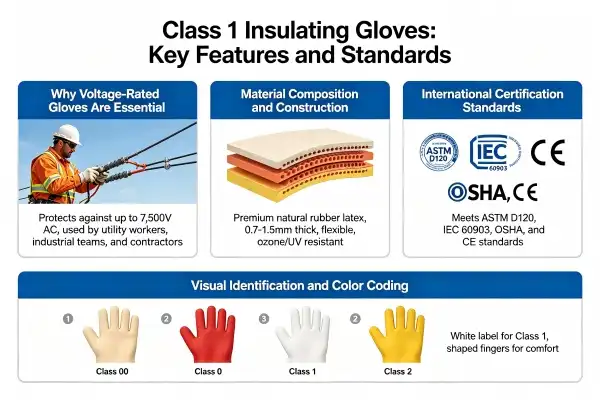
Electrical shielding gloves are the main thing that keeps workers safe from shock dangers that could be deadly. Unlike regular work gloves, these specialised tools are put through strict insulating tests to make sure they protect well. The classification system helps safety managers match glove ratings to specific voltage settings. This stops people from using equipment that isn't rated properly on high-energy lines, which is a dangerous practice. Our Class 1 rubber shielding gloves can handle maximum voltages of 7,500V AC and 11,250V DC. They have been tested and proven to be safe at 10,000V AC and can withstand up to 20,000V AC. This voltage class is important because it is in the middle of low-voltage control work and upkeep on the distribution grid. It meets the needs of utility substations, internet infrastructure, and industrial electrical systems.
Material Composition and Construction
Material science is at the heart of good electricity safety. Premium natural rubber latex, chosen for its excellent insulation qualities and flexibility, is used to make our insulated gloves. The material is between 0.7 mm and 1.5 mm thick, and was carefully designed to offer the most safety without limiting the workers' ability to move their fingers easily while doing complex work. Natural rubber latex is very stretchy and doesn't tear easily, which are very useful skills for workers who have to work with hard wires or get through tight areas near powered equipment. The material naturally doesn't break down when exposed to ozone and UV light, so it lasts longer even in harsh outdoor situations where sunshine and air pressure can speed up the breakdown of lower-quality goods.
International Certification Standards
As long as Class 1 Insulating Gloves meet recognised safety standards, you can be sure they will work when lives are at stake. The way we make our Class 1 Insulating Gloves products is in line with ASTM D120, which is an American standard that spells out how to test electrical insulated gloves, how to classify voltage, and what performance standards they must meet. This guideline calls for strict quality control measures to be used to make sure that every batch of products meets very high standards for dielectric strength.
We make sure that our gloves meet IEC 60903 standards as well as American ones. This is the worldwide standard that is used in markets in Europe, Asia, and the Middle East. This two-certification method lets international companies buy PPE in the same way for all of their global businesses. This makes managing compliance easier and makes sure that workers are always protected to the same level, no matter where they are in the world. Our design and testing procedures are based on OSHA rules and CE marking requirements. This way, buying teams can be sure that the goods they buy will meet all legal requirements. These certificates are more than just paperwork; they show that we are dedicated to thorough electrical testing, material verification, and ongoing quality control that keeps low-quality equipment from getting to job sites.
Visual Identification and Color Coding
Instant recognition is important for safety systems, especially in high-stress situations where decisions need to be made in a split second. Colour-coded bands are required by industry standards so that workers and managers can quickly check the voltage ratings. Our Class 1 gloves are set apart from Class 00 (beige), Class 0 (red), and Class 2 (yellow) gloves by their unique white labels. This visual method stops workers from making mistakes that could be fatal, like choosing gloves with lower ratings for jobs that need higher power. The intuitive design includes shaped fingers and structural shaping that keeps hands from getting tired after long periods of use. This is because comfort has a direct effect on obedience; workers who find PPE uncomfortable often come up with dangerous ways to get around it, which lowers their protection.
How to Use Class 1 Insulating Gloves Safely: Best Practices and Tips
Pre-Use Inspection Protocols
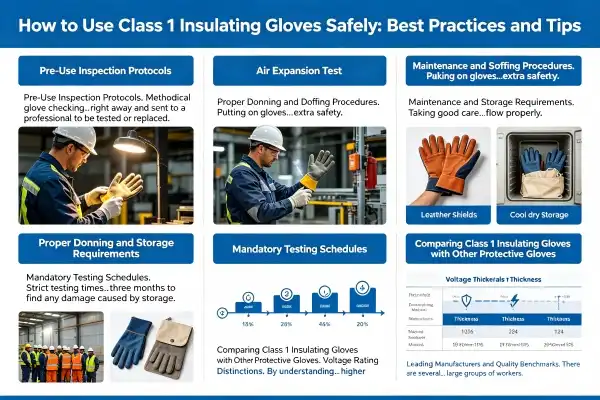
Methodical glove checking is a must-do at the start of every shift. It finds possible problems before workers are exposed to live equipment. Workers should look at both rubber insulation gloves and leather protection in good lighting, looking for holes, cuts, foreign objects stuck inside, or fine surface cracks that could be signs of ozone cracking.
The air expansion test is still the most effective way to check something in the field. Technicians pull up the cuff of the glove to trap air inside. They then apply light pressure while watching for deflation, which means there are holes or weak spots. Any glove that looks damaged or fails the air test must be taken out of service right away and sent to a professional to be tested or replaced.
Proper Donning and Doffing Procedures
Putting on gloves the right way is more than just pulling them on. It is important for workers to always wear leather shields over rubber insulation gloves because this gives them the best mechanical protection against cuts, punctures, and other damage that could quickly break down dielectric barriers. The top layer of leather protects against sharp metal edges, tool slips, and rough surfaces that electricians may come across.
When putting on the rubber glove, make sure it goes all the way up the wrist, and there are no bent pieces or air holes that make the protection less effective. The leather protection should go all the way around the rubber glove, and the cuff should meet to keep the rubber glove from being seen. This method uses multiple layers to create extra safety. The rubber stops electricity from flowing, and the leather stops damage to the item.
Maintenance and Storage Requirements
Taking good care of gloves greatly increases their useful life and keeps their protective structure. Clean your rubber gloves with light soap and warm water after each use to get rid of any dirt or germs that could damage the material. Cleaners made from gasoline, strong chemicals, and rough washing can hurt rubber materials. Let gloves dry fully in the air, away from direct heat sources that can make them break.
How Class 1 Insulating Gloves are stored has a direct effect on how long they last. To keep them from creasing, store Class 1 Insulating Gloves upright with their fingers looking up in protective cloth bags. The storage area should stay cool, dry, and dark, and it shouldn't be near any sources of ozone, like electric motors, welding tools, or UV light. When storing rubber gloves for a long time, take them off of the leather covers so that the rubber doesn't bend and air can flow properly.
Mandatory Testing Schedules
Strict testing times must be followed for regulatory compliance and worker safety. Once gloves are in use, OSHA 1910.137 and ASTM F496 say they must be tested for electricity every six months. During testing, special tools use proof test voltages and keep an eye on leaking current, which shows that the insulation is breaking down. Any glove that leaks more than the allowed levels fails the test and has to be taken out of service.
New gloves that are kept on shelves can go up to a year without being used before they need to be tested for the first time. This shelf-life option lets safety managers keep strategic inventory stocks without having to pay a lot for testing. However, products should still be visually inspected every three months to find any damage caused by storage.
Comparing Class 1 Insulating Gloves with Other Protective Gloves
Voltage Rating Distinctions
By understanding the rating system, you can choose the right tools for the risks of electricity exposure. Class 00 gloves, which can handle up to 500V AC, are used by home workers and people who work in low-voltage control positions where circuits rarely go above 480V in three-phase systems. Class 0 gloves guard up to 1,000V AC, which means they can be used on business electrical switches and industrial motor control centers.
Class 1 gloves are the most important medium level, rated at 7,500V AC. They are used in power distribution systems, industrial substations, and telecommunications facilities where high voltages need strong protection but don't need the size and limited movement of higher-rated hands. As you go up, gloves for Class 2 (17,000V AC), Class 3 (26,500V AC), and Class 4 (36,000V AC) protect people who work on power lines and in high-voltage substations.
Material Thickness and Flexibility Trade-offs
Higher voltage levels require thicker materials, which creates a strain between safety and the ability to work with your hands. The thickness of Class 1 gloves is just right—they are thick enough to provide solid dielectric strength while still being flexible enough for jobs that need finger sensitivity. Because of this, they work great for checking relays, working on utility meters, and fixing problems in control circuits where techs need to work with small ends and wire connections.
When purchasing, workers look at glove specs and think about the work setting and the needs of the job. Jobs that involve mostly hot-stick work with little hand touch may be able to handle less agility from thicker gloves. On the other hand, jobs that require a lot of component handling can benefit from Class 1's greater flexibility compared to higher voltage classes.
Leading Manufacturers and Quality Benchmarks
There are several well-known names in the market for electrical safety tools that are known for their quality and reliability. While 3M, Honeywell, and Ansell have good reputations in different types of PPE, PPE MAX has been specialising in one area for sixty years, making us a trusted partner for businesses that need reliable, certified electrical insulating gloves with full technical support.
Vertical integration and strict quality control systems that have been built up over generations give us an edge in production. Unlike wholesalers who only rename foreign goods, we are in charge of the whole production process, from choosing the raw materials to doing the final electrical testing. This gives us the control that procurement managers need to make sure that safety equipment is the same for all large groups of workers.
Procuring Class 1 Insulating Gloves: Smart Buying Guide for B2B Clients
Evaluating Supplier Credibility
Due diligence during supplier selection prevents costly mistakes that compromise worker safety and expose organizations to liability. Verify that manufacturers maintain current certifications from recognized testing laboratories, not merely claims of compliance. Request documentation showing ASTM D120 and IEC 60903 test reports, examining the specific testing laboratories and date stamps that confirm ongoing surveillance rather than outdated approvals.
Supplier reputation extends beyond certifications to encompass manufacturing consistency, quality control systems, and responsive technical support. Organizations managing large workforces across multiple sites benefit from partnering with manufacturers offering standardization guidance, training resources, and dedicated account management that simplifies compliance documentation during regulatory audits.
Bulk Purchasing Strategies
Volume procurement delivers significant cost advantages while ensuring supply continuity for organizations with recurring PPE demands. When requesting quotations, provide detailed forecasts covering six to twelve months, allowing suppliers to optimize production scheduling and offer competitive pricing that reflects economies of scale. Negotiating annual supply agreements often secures preferential pricing, priority allocation during high-demand periods, and flexible payment terms that improve cash flow management.
PPE MAX's global supply chain infrastructure supports reliable delivery to procurement departments across 134 countries, with strategic inventory positioning that reduces lead times. Our wholesale partnerships provide industrial safety distributors with competitive margins, while our OEM/ODM capabilities enable private labeling programs that help regional distributors build brand equity in their markets.
Customization and Private Labeling
Large enterprises and government agencies increasingly seek customized solutions that align protective equipment with organizational safety protocols and branding requirements. Our manufacturing flexibility accommodates custom packaging designs, incorporating client logos and safety messaging that reinforces corporate identity. Private labeling programs allow distributors to market premium electrical gloves under their own brands, supported by our manufacturing expertise and certification documentation.
Technical customization extends to cuff lengths, color specifications, and specialized material formulations addressing unique environmental conditions. Mining operations in extreme climates, offshore energy installations, or chemical processing facilities may require enhanced resistance to specific contaminants, temperature extremes, or mechanical abrasion beyond standard product capabilities.
Enhancing Safety and Performance with Class 1 Insulating Glove Solutions
Integrated PPE System Approach
Comprehensive electrical safety demands coordinated protection across multiple body regions potentially exposed to shock hazards. While Class 1 Insulating Gloves protect hands and forearms, complete systems incorporate voltage-rated sleeves extending coverage to shoulders, arc-rated clothing defending against thermal hazards, and dielectric footwear grounding protection during equipment operation.
Procurement managers should evaluate PPE compatibility when standardizing safety equipment, ensuring that glove cuff lengths overlap properly with sleeve openings and that leather protectors don't interfere with other equipment. Training programs should address proper layering sequences and adjustment techniques that maintain protection integrity throughout work shifts.
Technological Advancements Improving Comfort
Recent material science innovations have enhanced glove performance without compromising protective capabilities. Advanced rubber compounding techniques improve flexibility in cold environments where conventional materials become stiff and unwieldy. Ergonomic palm patterns and grip-enhancement technologies reduce hand fatigue during extended tool operation, acknowledging that worker comfort directly influences safety compliance rates.
Our research and development teams continuously explore emerging technologies, including conductive fiber integration that enables touchscreen device operation without glove removal, addressing the modern reality of tablet-based work instructions and digital documentation systems increasingly common on industrial job sites. These innovations maintain electrical protection while improving operational efficiency and reducing the temptation to remove gloves for administrative tasks.
Future Trends in Electrical PPE
The electrical safety equipment sector continues evolving in response to changing workplace hazards and technological capabilities. Smart glove technologies incorporating embedded sensors may soon provide real-time monitoring of dielectric strength, alerting wearers to material degradation before protection fails. RFID integration promises automated compliance tracking, recording inspection dates and testing history while preventing expired equipment from entering service.
Regulatory trends increasingly emphasize arc flash protection alongside traditional shock hazards, driving development of hybrid materials combining electrical insulation with flame resistance and thermal protection. Sustainability considerations are reshaping material selection, with manufacturers exploring bio-based rubber compounds and recyclable protective equipment that reduces environmental impact without compromising worker safety.
Conclusion
Electrical safety is still important in fields where workers are constantly at risk from powered tools. Picking the right voltage-rated safety gear based on the risks of exposure is the basis of good safety programs. Strict inspection rules and regular tests make sure that the safety gear stays in good shape for as long as it's supposed to. For decades, we've worked with electrical workers at utility companies, industrial facilities, and building sites. This has taught us how important it is to have reliable tools and quick expert help. Companies that care about worker safety know that the choices they make about PPE have effects that go beyond cost. These effects include the health and safety of employees, following the rules, and keeping operations running. Working with makers with a lot of experience means you can get approved goods, a lot of training materials, and the peace of mind that comes from knowing your safety systems will work when lives are at stake.
FAQ
1. How often must electrical insulating gloves be retested?
Regulatory standards mandate electrical testing every six months after gloves enter active service. This testing applies proof voltages while measuring leakage current that indicates insulation breakdown. New gloves held in inventory can remain on shelves for twelve months before requiring the first test, allowing strategic stockpiling without excessive testing expenses. Leather protectors don't require electrical testing but need daily visual inspections for tears, punctures, or deterioration that compromises mechanical protection.
2. Can rubber insulating gloves be used without leather protectors?
Safety standards and manufacturer guidelines universally require leather protectors worn over rubber insulating gloves during electrical work. The rubber layer provides dielectric protection but remains vulnerable to mechanical damage from sharp edges, tool impacts, and abrasive surfaces. Any puncture or cut instantly compromises electrical insulation, creating shock hazards. The leather outer layer absorbs physical impacts while allowing the rubber to maintain protective integrity.
3. What determines voltage class selection for specific jobs?
Choose glove classes rated above the maximum phase-to-phase voltage workers encounter, never matching ratings exactly to circuit voltage. Class 1 gloves rated at 7,500V AC protect workers on systems up to that voltage level. Higher voltage circuits require correspondingly rated equipment—12kV systems demand Class 2 gloves rated for 17,000V AC. This safety margin accounts for voltage transients and ensures adequate protection during normal operations and fault conditions.
Partner with PPE MAX for Certified Electrical Safety Solutions
Organizations managing electrical safety programs across utility infrastructure, industrial facilities, or construction operations need reliable Class 1 Insulating Gloves suppliers committed to quality and compliance. PPE MAX delivers manufacturer-direct access to certified electrical protective equipment, including Class 1 Insulating Gloves, backed by 65 years of production expertise and comprehensive technical support. Our wholesale pricing structures provide cost advantages for bulk orders while maintaining the rigorous quality standards that protect workers and satisfy regulatory requirements. Whether you need standard inventory
shipments, customized private labeling, or OEM manufacturing partnerships, our team stands ready to support your safety equipment requirements with responsive service and proven reliability. Contact our specialists at marketing@ppemax.com to discuss volume pricing, certification documentation, and delivery options tailored to your operational needs—because protecting your workforce requires partners who understand that strong products deliver strong protection.
References
1. National Institute for Occupational Safety and Health. (2021). Electrical Safety: Safety and Health for Electrical Trades Student Manual. DHHS (NIOSH) Publication No. 2009-113.
2. American Society for Testing and Materials. (2022). ASTM D120-21: Standard Specification for Rubber Insulating Gloves. ASTM International.
3. International Electrotechnical Commission. (2020). IEC 60903:2020 Live Working – Gloves of Insulating Material. IEC Standards.
4. Occupational Safety and Health Administration. (2023). 1910.137 – Electrical Protective Devices. U.S. Department of Labor.
5. Cadick, J., Capelli-Schellpfeffer, M., & Neitzel, D. (2019). Electrical Safety Handbook, 4th Edition. McGraw-Hill Education.
6. Zhang, L., & Morrison, R. (2021). "Performance degradation mechanisms in natural rubber electrical insulating gloves." Journal of Occupational Safety Engineering, 28(4), 156-172.
Learn about our latest products and discounts through SMS or email