- English
- French
- German
- Portuguese
- Spanish
- Russian
- Japanese
- Korean
- Arabic
- Greek
- German
- Turkish
- Italian
- Danish
- Romanian
- Indonesian
- Czech
- Afrikaans
- Swedish
- Polish
- Basque
- Catalan
- Esperanto
- Hindi
- Lao
- Albanian
- Amharic
- Armenian
- Azerbaijani
- Belarusian
- Bengali
- Bosnian
- Bulgarian
- Cebuano
- Chichewa
- Corsican
- Croatian
- Dutch
- Estonian
- Filipino
- Finnish
- Frisian
- Galician
- Georgian
- Gujarati
- Haitian
- Hausa
- Hawaiian
- Hebrew
- Hmong
- Hungarian
- Icelandic
- Igbo
- Javanese
- Kannada
- Kazakh
- Khmer
- Kurdish
- Kyrgyz
- Latin
- Latvian
- Lithuanian
- Luxembou..
- Macedonian
- Malagasy
- Malay
- Malayalam
- Maltese
- Maori
- Marathi
- Mongolian
- Burmese
- Nepali
- Norwegian
- Pashto
- Persian
- Punjabi
- Serbian
- Sesotho
- Sinhala
- Slovak
- Slovenian
- Somali
- Samoan
- Scots Gaelic
- Shona
- Sindhi
- Sundanese
- Swahili
- Tajik
- Tamil
- Telugu
- Thai
- Ukrainian
- Urdu
- Uzbek
- Vietnamese
- Welsh
- Xhosa
- Yiddish
- Yoruba
- Zulu
Full Mask Respirator Materials and Their Impact on Durability
How long a Full Mask Respirator lasts depends on the materials used and how well they are put together. How well the device can handle chemicals, muscular stress, and high temperatures and pressures depends on the materials used, such as medical-grade rubber, flexible elastomers, and impact-resistant polycarbonate. Since 1956, PPE MAX has put these materials through rigorous testing because we know that durability isn't just about lasting a long time; it's also about keeping the seal intact and protecting workers reliably throughout the respirator's useful life, so they stay safe in dangerous environments where failure isn't an option.
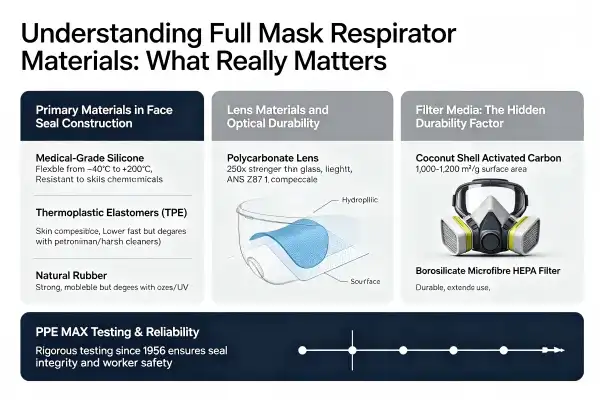
Understanding Full Mask Respirator Materials: What Really Matters
When we design respiratory protection equipment at our Xi'an facility, we think about the procurement officer who needs equipment that performs year after year, and the worker whose life depends on that consistent performance. Material science forms the foundation of this reliability.
Primary Materials in Face Seal Construction
The most important material choice in any full-face mask is the seal that touches your face. The soft silicone face seals on our respirators are made of this medical-grade material because it works well in a wide range of situations. Silicone stays flexible at temperatures ranging from -40°C to +200°C, which keeps the seal from tightening, which happens with lower-quality elastomers and leads to leaks. This material doesn't break down easily in the presence of skin oils, sweat, and most industrial chemicals, so it keeps that important face seal even during long shifts.
Thermoplastic elastomers are an option that we have looked into in great detail. Because TPE is very good at being compatible with skin and has slightly lower production costs, it is useful in some situations. However, our tests show that TPE usually breaks down more quickly when it comes in contact with petroleum-based fluids and harsh cleaning products that are widely used in workplace cleansing procedures.
Natural rubber has been used for a long time to protect the lungs because it has great strength and can be shaped right away. But rubber breaks down quickly when exposed to ozone and UV light, which is a big problem in mine and building sites where tools are left out in the open between jobs.
Lens Materials and Optical Durability
We make sure that every mask we sell has a plastic eye that meets ANSI Z87.1 standards for impact protection and has a wide field of view. Plastic called polycarbonate was chosen after many other options were carefully considered. It is 250 times stronger than regular glass and much lighter. This is important when workers have to wear the gear for 8 to 12 hours at a time, because big face shields put stress on the neck, which makes it harder to follow the rules, which is unsafe.
We use special hydrophilic coatings on these polycarbonate glasses to solve the fogging problem that has been a problem with breathing protection for a long time. The layer makes a surface at the molecular level that spreads water into a clear film instead of drops that block your view. Our covering recipe can be cleaned many times with industrial cleansers without breaking down. This is one of the things that sets professional-grade tools apart from cheaper options.
Filter Media: The Hidden Durability Factor
The materials used for activated carbon and HEPA filters have a direct effect on both how long they protect and how much they cost to repair. Activated carbon of higher quality with better cell structure keeps its ability to absorb for much longer than cheaper options. Our filter tubes use activated carbon made from coconut shells, which has a surface area of 1,000 to 1,200 m³/g and lasts longer in places where organic vapours are present.
It has been shown that HEPA filter media made from borosilicate microfibres is stronger than normal fibreglass versions. This means that the filter will keep working well even as the amount of particles inside it grows. This means that it can be used for longer before the breathing resistance becomes uncomfortable. The bayonet connection method we built into our respirators lets you change filters quickly and without tools. This cuts down on downtime and encourages replacement of worn-out filters before they become dangerously extended.
Key Dimensions of Material Impact on Respirator Durability
Durability extends far beyond simply lasting a long time. Industrial respiratory protection must maintain performance integrity across multiple stress dimensions simultaneously.
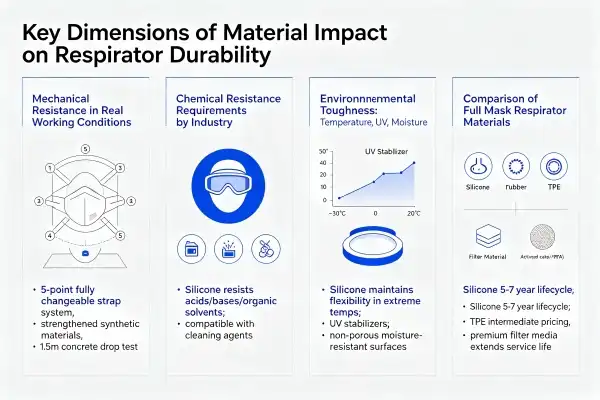
Mechanical Resistance in Real Working Conditions
In chemical plants, mines, and building sites, tools are hit, worn down, and put under mechanical pressures that can't really be measured in a lab. Our Full Mask Respirator has a 5-point fully changeable strap system that spreads strain out evenly. This stops stress buildup, which leads to early material failure and crack spreading. We make these straps out of strengthened synthetic materials that stay flexible even after being worn and taken off thousands of times.
The body of the mask can take drops from normal work-height objects without breaking or distorting the seal. This impact resistance comes from the choice of material and the way the ribs are designed to spread stress away from the most important closing areas. Each output mix is tested for quality by being dropped from 1.5 meters onto concrete. These tests are based on real-life working conditions, not idealised lab situations.
Chemical Resistance Requirements by Industry
Material specs should match up with real exposure patterns when decisions are made about what to buy. Because they are so resistant to acids, bases, and most organic solvents, our silicone face seals can be used in chemical manufacturing and industrial processes. The material keeps the integrity of the seal even after being exposed to petrol, diesel fuel, hydraulic oils, and cutting fluids for a long time, which are common in industrial settings.
With strict rules for cleaning, making pharmaceuticals poses special problems. The materials we chose can be exposed to quaternary ammonium chemicals, isopropyl alcohol, and hydrogen peroxide solutions over and over again without losing their surface or their plasticiser. This chemical compatibility makes sure that the respirator stays certified throughout its useful life, instead of slowly breaking down into non-compliant gear that looks like it works but doesn't protect as well.
Environmental Toughness: Temperature, UV, and Moisture
Temperature extremes challenge material performance in ways that matter tremendously for global distribution. Equipment shipped to Middle Eastern construction projects faces 50°C+ storage temperatures, while mining operations in northern Canada require functionality at -30°C. Our material selection ensures flexibility and seal performance across this entire range—silicone doesn't become brittle in cold or excessively soft in heat.
UV degradation destroys many elastomers within months of outdoor exposure. The materials we incorporate include UV stabilizers that maintain mechanical properties through years of intermittent sun exposure. This matters for emergency response equipment stored in vehicles and outdoor safety stations where controlled storage isn't feasible.
Moisture resistance prevents fungal growth and material degradation in humid tropical environments and prevents ice formation in cold climates. The smooth, non-porous surfaces of our silicone seals resist biological colonization while remaining easy to clean and disinfect between users in shared equipment programs.
Comparison of Full Mask Respirator Materials: Making Informed Procurement Choices
Procurement officers managing safety equipment for large workforces need transparent information about material trade-offs and performance characteristics.
Silicone Versus Rubber: The Durability Economics
Silicone represents a premium material choice with commensurately higher initial costs—typically 30-40% more than rubber alternatives. This price differential causes hesitation, yet total ownership cost analysis consistently favors silicone for organizations with multi-year equipment lifecycles.
Silicone face seals of Full Mask Respirator maintain sealing effectiveness for 5-7 years under normal industrial use, compared to 2-3 years for rubber components. The replacement cycle difference translates directly to procurement workload, inventory management complexity, and equipment downtime. Rubber's susceptibility to ozone cracking means outdoor equipment often requires replacement due to material degradation rather than mechanical wear, creating unpredictable replacement demand that complicates inventory planning.
The chemical resistance advantage of silicone prevents the gradual swelling and softening that rubber exhibits when exposed to petroleum products. This dimensional stability maintains consistent fit and seal performance, reducing the fit-testing frequency required to ensure ongoing protection. Reduced testing frequency lowers administrative burden and increases productive work time—operational benefits that justify premium material costs.
Thermoplastic Elastomers: Emerging Middle Ground
TPE materials have advanced significantly in recent years, offering characteristics between rubber and silicone at intermediate pricing. These materials provide skin-compatible, hypoallergenic contact surfaces suitable for workers with latex sensitivities. The recyclability advantages of TPE align with corporate sustainability initiatives increasingly important to procurement decision-makers.
However, TPE demonstrates reduced chemical resistance compared to silicone, particularly with aromatic hydrocarbons and chlorinated solvents. Organizations should evaluate actual exposure profiles carefully—TPE performs excellently in particulate-dominated environments with minimal chemical exposure, but may not suit chemical processing applications.
Filter Material Selection and Replacement Economics
Activated carbon quality dramatically affects filter service life and replacement frequency. Premium coconut-shell carbon maintains adsorption capacity 40-60% longer than cheaper wood-based alternatives, reducing replacement frequency and associated labor costs. The higher per-unit cost of quality filters delivers lower total cost of ownership when amortized across extended service intervals.
HEPA filter media quality affects breathing resistance throughout the filter's life. Low-quality media demonstrates rapid resistance increase as particulate loading occurs, forcing premature replacement to maintain worker comfort and compliance. Our filter media maintains acceptable breathing resistance across the full service interval, maximizing the useful life of each cartridge.
Best Practices for Maximizing Durability Through Material Care and Maintenance
Material durability potential only translates to actual longevity when combined with proper maintenance protocols tailored to specific material characteristics.
Cleaning Protocols That Preserve Material Integrity
Silicone components tolerate aggressive cleaning but perform best with mild detergent solutions and warm water. We recommend avoiding petroleum-based cleaners that can leave residues affecting seal performance. The smooth surface of our silicone face seals allows thorough cleaning without brushes that might scratch or abrade sealing surfaces.
Polycarbonate lenses require specific care to preserve coating integrity and prevent scratching. Rinsing with clean water before wiping removes abrasive particles that cause scratches. Cleaning solutions should be pH-neutral without ammonia or strong solvents that degrade anti-fog coatings. We provide detailed cleaning protocols with each respirator, and our technical support team offers guidance for developing site-specific procedures that balance hygiene requirements with material preservation.
Inspection Protocols and Material Fatigue Detection
Regular inspection catches material degradation before seal failure occurs. Visual inspection should identify surface cracks, excessive wear on high-friction areas, and discoloration indicating chemical attack or UV degradation. The speech diaphragm represents a particularly vulnerable component requiring attention—tears or holes compromise communication effectiveness.
Functional testing verifies seal integrity beyond visual assessment. Positive and negative pressure seal checks before each use detect leaks that visual inspection might miss. Organizations should implement documented inspection schedules with clear rejection criteria, ensuring degraded equipment exits service before compromising protection.
Replacement Parts and Material Compatibility
Mixing components from different manufacturers or using non-OEM replacement parts creates compatibility risks that compromise safety. Silicone formulations vary between manufacturers in hardness, chemical resistance, and dimensional specifications. A replacement seal that appears identical may not maintain the precise dimensions required for proper sealing, particularly around the nose cup and chin areas, where seal geometry proves most critical.
We maintain a comprehensive spare parts inventory for all respirator models, ensuring procurement departments can source material-compatible components with guaranteed fit and performance. Our after-sales support includes technical guidance on replacement part selection, helping organizations maintain equipment fleets effectively while ensuring continued compliance with safety certifications.
Making Strategic Procurement Decisions: Material Quality as Investment Protection
Material selection represents a strategic procurement decision affecting safety outcomes, operational costs, and regulatory compliance for years following the initial purchase.
Aligning Material Specifications With Hazard Profiles
Chemical processing facilities require maximum chemical resistance, making silicone face seals and chemically-resistant filter media non-negotiable specifications for the Full Mask Respirator. The premium cost represents the necessary investment for the hazardous environment. Construction and mining operations with primarily particulate hazards might appropriately specify TPE components with high-efficiency particulate filters, optimizing cost-performance balance for the actual exposure profile.
Our technical team assists with hazard assessment and material specification matching. We've supplied respiratory protection across 134 countries and countless industrial scenarios, developing expertise that helps procurement professionals navigate material choices confidently. This consultative approach ensures equipment specifications match actual workplace needs rather than following generic recommendations disconnected from specific use cases.
Certification and Supplier Quality Assurance
Material quality directly affects regulatory compliance and certification validity. Our respirators meet NIOSH, EN 136, and AS/NZS 1716 standards through rigorous material selection and quality control. These certifications require consistent material properties across production runs—variation that might seem insignificant can affect certification compliance and protection factors.
Supplier evaluation should verify materials quality systems, not just finished product certifications. We maintain strict incoming material inspection protocols with documented specifications for every component. This quality infrastructure ensures the silicone seal on unit 10,000 performs identically to unit 1, maintaining the consistent protection that certification testing verified.
Total Cost of Ownership Analysis
Initial purchase price represents only a fraction of the true equipment cost. Replacement frequency, maintenance labor, fit testing requirements, and productivity impacts from equipment failures comprise substantial ongoing costs. Our silicone-sealed respirators cost more initially than rubber alternatives but deliver 40-50% lower total ownership costs across typical 5-7 year service lives.
Extended service life reduces procurement administrative burden and inventory carrying costs. Fewer replacements mean less time managing purchase orders, receiving inspections, and equipment distribution. These soft costs substantially impact total ownership economics, particularly for organizations managing thousands of respiratory protection devices across multiple sites.
Warranty coverage and after-sales support extend equipment value beyond the physical materials. Our warranty service reflects confidence in material quality and manufacturing standards, providing procurement departments with risk mitigation and budget predictability. Technical support accessibility through our hotline ensures problems receive immediate attention, minimizing operational disruptions.
Conclusion
Material selection fundamentally determines respiratory protection durability, affecting safety outcomes and operational economics for years following procurement. Silicone, polycarbonate, and premium filter media deliver superior longevity and performance consistency compared to economy alternatives. The initial cost premium pays dividends through extended service life, reduced replacement frequency, and maintained protection integrity across demanding industrial conditions. At PPE MAX, our 65+ years of manufacturing experience inform material choices that balance performance, durability, and value. Organizations sourcing respiratory protection should evaluate materials against actual hazard profiles, consider total ownership costs, and partner with suppliers offering technical expertise and comprehensive support. Strategic material selection represents investment protection that safeguards both workers and budgets.
FAQ
How long should a silicone face seal last under normal industrial use?
Quality silicone face seals typically maintain effective sealing performance for 5-7 years under normal industrial conditions with proper maintenance. Factors affecting lifespan include exposure to extreme temperatures, aggressive chemicals, UV radiation, and cleaning protocol adherence. Regular inspection should assess seal condition rather than relying solely on age, as severe exposure conditions may warrant earlier replacement, while carefully maintained equipment in mild environments might exceed typical service life expectations.
Can I use replacement parts from different manufacturers?
Mixing components from different manufacturers creates serious compatibility risks that can compromise seal integrity and protection factors. Material formulations, dimensional tolerances, and design specifications vary between suppliers, even when parts appear visually identical. Using non-OEM components may void certifications and warranties while introducing unknown safety risks. We strongly recommend sourcing all replacement parts from the original equipment manufacturer to ensure material compatibility and maintain certification compliance.
What cleaning products are safe for respirator materials?
Mild detergent solutions with warm water safely clean most respirator materials without degradation. Avoid petroleum-based cleaners, strong solvents, and ammonia-containing products that can damage silicone, polycarbonate, and anti-fog coatings. Site-specific protocols should balance hygiene requirements with material preservation, considering contamination types encountered. Our technical support team provides detailed cleaning guidance tailored to specific industrial environments and contamination profiles, ensuring effective decontamination without compromising material integrity or shortening equipment service life.
Partner With PPE MAX: Your Trusted Full Mask Respirator Manufacturer
Strategic respiratory protection procurement requires a supplier combining proven material expertise, manufacturing excellence, and a comprehensive support infrastructure. PPE MAX has manufactured industrial safety equipment since 1956, supplying certified respiratory protection to organizations across 134 countries. Our Full Mask Respirator line features medical-grade silicone face seals, impact-resistant polycarbonate lenses, and premium filter media engineered for maximum durability and protection reliability. We offer customizable solutions for OEM/ODM partnerships, bulk packaging options, and technical support throughout the equipment lifecycle. Contact our team at marketing@ppemax.comto discuss your specific requirements with a Full Mask Respirator supplier who understands that material quality directly impacts worker safety and your operational success.
References
1. American Industrial Hygiene Association. (2019). Respirator Selection and Use: A Comprehensive Guide for Safety Professionals. AIHA Press.
2. National Institute for Occupational Safety and Health. (2018). NIOSH Guide to the Selection and Use of Particulate Respirators. DHHS Publication No. 96-101.
3. Occupational Safety and Health Administration. (2020). Respiratory Protection Standard 29 CFR 1910.134: Compliance Guide. U.S. Department of Labor.
4. British Standards Institution. (2017). EN 136:1998 Respiratory Protective Devices - Full Face Masks - Requirements, Testing, Marking. BSI Standards Publication.
5. International Safety Equipment Association. (2021). Material Durability and Performance in Respiratory Protection Devices: Industry White Paper. ISEA Technical Report.
6. Chen, W., & Morrison, G. (2016). Chemical Resistance and Degradation Mechanisms in Elastomeric Respirator Components. Journal of Occupational and Environmental Hygiene, 13(8), 612-624.
Learn about our latest products and discounts through SMS or email