- English
- French
- German
- Portuguese
- Spanish
- Russian
- Japanese
- Korean
- Arabic
- Greek
- German
- Turkish
- Italian
- Danish
- Romanian
- Indonesian
- Czech
- Afrikaans
- Swedish
- Polish
- Basque
- Catalan
- Esperanto
- Hindi
- Lao
- Albanian
- Amharic
- Armenian
- Azerbaijani
- Belarusian
- Bengali
- Bosnian
- Bulgarian
- Cebuano
- Chichewa
- Corsican
- Croatian
- Dutch
- Estonian
- Filipino
- Finnish
- Frisian
- Galician
- Georgian
- Gujarati
- Haitian
- Hausa
- Hawaiian
- Hebrew
- Hmong
- Hungarian
- Icelandic
- Igbo
- Javanese
- Kannada
- Kazakh
- Khmer
- Kurdish
- Kyrgyz
- Latin
- Latvian
- Lithuanian
- Luxembou..
- Macedonian
- Malagasy
- Malay
- Malayalam
- Maltese
- Maori
- Marathi
- Mongolian
- Burmese
- Nepali
- Norwegian
- Pashto
- Persian
- Punjabi
- Serbian
- Sesotho
- Sinhala
- Slovak
- Slovenian
- Somali
- Samoan
- Scots Gaelic
- Shona
- Sindhi
- Sundanese
- Swahili
- Tajik
- Tamil
- Telugu
- Thai
- Ukrainian
- Urdu
- Uzbek
- Vietnamese
- Welsh
- Xhosa
- Yiddish
- Yoruba
- Zulu
Do Class 1 Insulating Gloves Require Additional Leather Protectors?
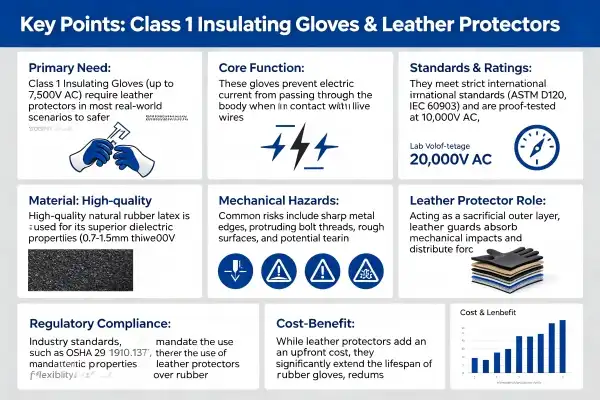
In almost all real-life situations, yes, Class 1 Insulating Gloves do need extra leather protection. Even though these rubber insulating gloves offer great dielectric protection up to 7,500 volts AC, the rubber they are made of still makes them subject to mechanical dangers like cuts, punctures, and chemical exposure. Leather guards are the most important outer barrier. They protect the integrity of the rubber and stop catastrophic failures that could put workers at risk of life-threatening electrical shock. This two-layer method is required by industry standards, such as OSHA 29 CFR 1910.137, to provide full safety in real-life electrical settings.
Understanding Class 1 Insulating Gloves and Their Protective Capabilities
Is leather conductive? Electrical shielding gloves have one very important job: they keep electrical current from flowing through a worker's body when they touch live wires. Class 1 Insulating Gloves are made to meet strict international standards, such as ASTM D120 and IEC 60903, which say how much power they can handle, what materials they are made of, and how they should be tested.
Voltage Rating and Testing Standards
There is a maximum energy of 7,500 volts AC (or 11,250 volts DC) that Class 1 Insulating Gloves can protect people from. Proof testing at 10,000 volts AC is done on these gloves during production and on a regular basis to make sure they are still dielectric. During tests in the lab, the withstand voltage hits 20,000 volts AC, which is a large safety margin. Because of these voltage limits, Class 1 Insulating Gloves can be used in industrial sites with medium-voltage distribution systems, by electrical contractors maintaining utility lines, and building telecommunications infrastructure.
Material Composition and Physical Properties
Our Class 1 Insulating Gloves at Xi'An PPE MAX Co., Ltd. are made from high-quality natural rubber latex, which was chosen for its excellent insulating properties and flexibility. The thickness of the material is between 0.7 mm and 1.5 mm, which is just the right amount of electrical safety and ease of use. The electrical protection in natural rubber is very good, and it stays flexible at different temperatures, so workers can move tools, lines, and parts with some accuracy.
The Inherent Limitation
Because of this technical weakness, electrical insulating gloves can't always be relied on as personal protective equipment (PPE) in most workplace settings, even though they protect against voltage very well. Construction sites, utility poles, electrical installations, and factory floors are all tough places where mechanical threats are always present that rubber alone can't handle. This basic flaw is fixed by leather guards, which have a strong top layer that rubber gloves don't have by nature.
Analyzing the Need for Additional Leather Protectors
Leather covers are more than just a suggestion; they are an industry best practice backed by government advice and decades of experience in the field. Purchasing workers can better understand why this two-layer method has become standard by learning about the specific threats and ways to protect against them.
Mechanical Hazards in Electrical Work Environments
Electrical workers wearing Class 1 Insulating Gloves face a lot of physical risks that could damage rubber gloves. Electrical panels with sharp metal edges, bolt threads that stick out, and broken wiring can all cause punctures. When gloves touch rough concrete, metal grates, or rough building materials while they are being installed or fixed, abrasion happens. Handling wire ends, stripped cable jackets, and metal frame parts can lead to cuts. When gloves get caught on parts of tools or buildings, they tear.
How Leather Protectors Mitigate Risks
Leather guards act as a sacrificial layer on the outside, taking mechanical hits and wear and tear that would normally damage the rubber barrier. Good leather is very resistant to holes, cuts, and tears, but it's still flexible enough for your hands to move around in. The natural material protects against sharp items and rough surfaces by spreading mechanical forces over a larger area instead of putting all the stress on the rubber below, which is more easily damaged.
Regulatory Guidance and Industry Standards
OSHA rules stress how important it is to keep insulated gloves from getting damaged. The agency's rules say that leather guards must be worn over rubber insulating gloves when they are being used, unless the job calls for leather to be worn on its own. This governmental stance is in line with what most safety experts agree on: mechanical protection is a must for solid electrical safety.
Cost-Benefit Analysis for Procurement
It costs more to buy leather covers up front, but they pay for themselves in the long run. Longer rubber glove life means that they don't have to be replaced as often, which lowers both the direct costs of the tools and the administrative work that comes with keeping track of inventory and re-testing rounds. Fewer glove failures mean less downtime and fewer injuries, which protects worker output and keeps workers' compensation costs low.
How to Properly Use and Maintain Class 1 Insulating Gloves with Leather Protectors
Managing PPE well involves more than just making decisions about what to buy. Following the right rules for use and care will make your equipment last longer and keep it safe, giving you the most out of your purchase.
Correct Donning Procedure
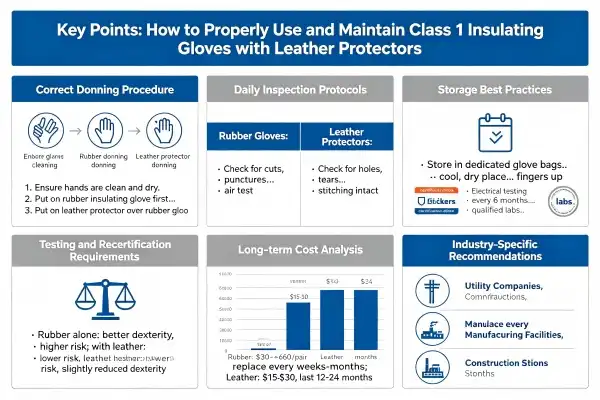
When putting on electrical safety gloves, the order is important. To begin, workers should make sure their hands are clean and dry. The plastic insulating glove is put on first, and it is pulled up to cover the whole hand and lower arm. The cuff should go up a few inches above the wrist so there is no safety gap. Make sure the plastic glove fits well, but not so well that it limits your ability to move your hands or get blood flowing.
Next, the leather cover goes over the rubber hand. The leather should go all the way over the rubber so that you can't see any rubber at all on the fingers or hands. The protection cuff should go at least as high as the rubber glove cuff so that the whole hand is covered. Some workers like it when the leather cuff goes a little past the rubber to make taking off the gloves easier, but this is a matter of personal choice and not safety.
Daily Inspection Protocols
Both the rubber gloves and the leather covers must be carefully looked at and touched by workers before each use. The first step in inspecting a rubber glove is to carefully look over the whole surface, looking for cuts, punctures, tears, foreign objects stuck inside, or any signs of chemical breakdown, such as swelling or odd stiffness. The air test is a good way to find small leaks: blow up the glove by rolling the cuff and catching air inside, then watch for deflation or listen for air leaving.
The main goal of checking a leather guard is to find holes, tears, or places where the leather is so thin that it's not protecting well anymore. Make sure the stitches are still in place and that there are no sharp items inside the leather that could cut the rubber below. Any glove or protection that looks like it has been damaged should be taken out of service right away.
Storage Best Practices
Proper keeping keeps equipment ready to use and stops it from breaking down too quickly. Rubber gloves and leather covers should be kept in glove bags made just for them. These bags will protect them from UV light, dust, and damage while they are being stored. Do not put gloves in direct sunlight, near hot equipment, or near electrical motors that make ozone. Instead, keep them somewhere cool and dry.
Place gloves with the fingers facing up to keep them from permanently bending or folding, which can make the rubber weak spots. Do not put heavy things on top of gloves that are being stored, as this can damage the rubber structure. When putting the rubber glove away for a long time, take it off the leather cover so that the rubber doesn't take on the shape of the leather, which could make the fit and flexibility worse.
Testing and Recertification Requirements
For rubber insulation gloves to be safe, they must always be tested for electricity. As a result of ASTM F496 and OSHA rules, electrical testing of Class 1 Insulating Gloves must be done every six months once they are in use. Gloves that are stored in a building can go up to a year without being used, but the six-month clock starts as soon as they are used for the first time.
Specialized high-voltage tools must be used by qualified labs to do the testing. While the gloves are buried in water, they are put through a proof test voltage (10,000 volts for Class 1 Insulating Gloves) to see if the dielectric properties break down. Gloves that pass the test get new stickers that say when they were certified and when they are due again. Any glove that fails the test has to be thrown away forever so that it can't be used by chance.
Comparing Class 1 Insulating Gloves with and without Leather Protectors
It's easier to understand why the two-layer method has become standard in the business when you know the real differences between protected and unprotected Class 1 Insulating Gloves.
Performance Trade-offs
When compared to rubber-plus-leather gloves, wearing rubber gloves alone does slightly improve your ability to feel things and move your fingers. Some workers like the slightly thinner shape because it makes it easier to do difficult tasks like adjusting delicate parts or handling small wire connections. Because of this small edge in handling, some specialized applications might take off leather protectors briefly for certain tasks.
But this small gain comes with a huge risk. If you don't have leather protection, every time you touch equipment, tools, or building parts, the rubber barrier could be broken. One small hole that goes unseen can make the glove electrically unsafe, giving the wearer a false sense of security that could lead to serious damage. In normal electrical work settings, the gain in skill is not worth the safety risk.
Long-term Cost Analysis
Due to lower initial costs, buying rubber gloves alone is obviously better than buying full sets of Class 1 Insulating Gloves and protectors. A normal pair of Class 1 Insulating Gloves could cost between $30 and $60. Good leather covers can add another $15 to $30 to each pair. This narrow cost comparison, on the other hand, doesn't look at the whole lifespan economy.
When rubber gloves are used without protection, they usually need to be replaced after only a few weeks or months of use because they get worn out. The leather on the same gloves can protect them for 12 to 24 months or longer, based on how often they are used. Over the course of three years, an operation might change gloves that aren't covered ten to fifteen times, but only two to three times for Class 1 Insulating Gloves that are.
Industry-Specific Recommendations
Different work settings have different levels of risk, which affects the choice of Class 1 Insulating Gloves and other safety measures. Utility companies that work on overhead distribution lines are exposed to a lot of technical dangers when they have to climb poles, move heavy equipment, and work on infrastructure that has been damaged by weather. Heavy-duty leather covers that are made to last the longest are best for these groups.
Chemical exposures happen along with mechanical risks in manufacturing facilities where electricity upkeep is needed. In this case, leather covers do double service by protecting against both physical damage and chemical contact that could break down rubber. Construction workers who work on busy construction sites are constantly at risk of damage and puncture from the chaos of the job site, so they need strong leather protection.
How to Source High-Quality Class 1 Insulating Gloves and Leather Protectors
To choose trusted electrical safety tools, you need to carefully check out the suppliers and pay attention to the certification standards. Too much is at stake to skimp on quality or sincerity.
Certification Requirements and Verification
Real Class 1 Insulating Gloves must have approval marks that show they meet the requirements of ASTM D120 and IEC 60903. Check that the goods you're looking at have clear testing certifications and meet OSHA standards. For sales into European markets, the CE mark gives buyers extra proof that the product meets safety standards.
Make sure that any possible suppliers you talk to can give you all the paperwork you need, like test results, records of certifications, and data on manufacturing quality control. Manufacturers with a good reputation have clear quality systems and are happy to share compliance paperwork with professional buyers.
Supplier Credibility Assessment
When it comes to buying electrical safety equipment, the most trusted partners are well-known companies that have been around for a long time. Companies that have been around for a long time have improved their manufacturing processes, built strong quality control systems, and built names that they keep up by always doing a good job.
At Xi'An PPE MAX Co., Ltd., we have been protecting workers for more than 65 years, learning how to do this through many versions of PPE technology and the growth of the industry. At every step of the production process in our factories in Xi'an, China, strict quality control rules are followed, from choosing the raw materials to testing and packing the finished goods. This all-around method makes sure that every pair of Class 1 Insulating Gloves that leaves our plant meets or beats safety standards around the world.
Procurement Strategies for B2B Buyers
When buying a lot of PPE, you need to pay attention to more than just the unit price. Minimum order numbers are different for each maker and product line, so it's important to be clear about volume needs right away. Many sellers offer discounts for buying in bulk, which means that big orders could save you 10–20% compared to small ones.
When you're in charge of safety tool supplies, lead times become very important. Make sure everyone knows what to expect from production plans, shipping times, and the ability to place urgent repair orders quickly. Reliable providers keep enough standard goods in stock and can adjust production to meet changes in seasonal demand or sudden volume increases.
Conclusion
There is a clear answer to the question of whether Class 1 Insulating Gloves need extra leather protection. This answer is based on safety science, government rules, and real-world field experience. Protectors made of leather are not extras; they are necessary parts of a good electrical safety system. Even though rubber gloves are great for protecting against dielectrics, they pose too many mechanical risks when used alone in most electrical work settings.
Quality leather guards are a small extra expense that pays off in a big way by making Class 1 Insulating Gloves last longer, lowering the risk of harm, and making sure that regulations are followed better. People who are in charge of buying electrical safety tools for big businesses should make sure that full sets of Class 1 Insulating Gloves and protectors are supplied as standard. This will protect workers the most and save money in the long run. Buying from well-known, approved makers guarantees that the products you buy are real and will work as expected, which is important for your employees.
FAQ
What voltage protection do Class 1 insulating gloves provide?
Class 1 Insulating Gloves keep workers safe from electrical dangers up to a maximum of 7,500 volts AC or 11,250 volts DC. During the production and re-certification processes, they are put through proof testing at 10,000 volts AC. The white sign color-coding makes it easy to tell what it is right away, which keeps it from being used incorrectly on higher-voltage systems.
How frequently must electrical gloves be retested?
Once rubber gloves are in use, OSHA 1910.137 and ASTM F496 say they must be retested for electrical safety every six months. New Class 1 Insulating Gloves that are stored in a building can be kept for up to 12 months before they are used for the first time without being tested. Leather covers don't need to be tested electrically, but they should be looked at every day for damage.
Can I use Class 1 gloves without leather protectors for brief tasks?
Technically, this is possible for some tasks where there are no mechanical risks, but it is strongly not recommended. Leather protection should be used in almost all situations, according to standard business practice and OSHA guidelines. The small increase in skill is not worth the loss of safety, since even short exposures can cause damage that can't be seen.
What happens if a leather protector becomes damaged during use?
Leather covers that are damaged should be changed right away. Rubber gloves need to be tested in a lab, but leather covers only need to be looked at. Having extra shields on hand means that workers can quickly replace broken ones without stopping work or putting safety at risk.
Partner with PPE MAX for Certified Electrical Safety Solutions
We at Xi'An PPE MAX Co., Ltd. have been making things for 65 years, and that experience shows in every Class 1 Insulating Gloves and leather guard set we make. Because we care about worker safety, we have strict quality control procedures that make sure that all of the millions of pairs of gloves we send to 134 countries around the world work the same way. We know that procurement managers, safety engineers, and distributors need more than just goods. They also need production partners they can trust to provide certified products, quick customer service, and low prices for large orders.
Our full-service technical support team helps you with program needs, questions about compliance, and ways to make changes that fit your unique business needs. PPE MAX has the production capabilities, industry experience, and partnership approach that sets excellent suppliers apart from common vendors, whether you are buying Class 1 Insulating Gloves as a wholesaler building inventory or as a safety manager covering a big workforce. Email our team at marketing@ppemax.com to talk about your needs for electrical safety equipment, get full product specifications, or look into OEM options that could help your business stand out in the market.
References
1. American Society for Testing and Materials. (2016). ASTM D120-14a Standard Specification for Rubber Insulating Gloves. West Conshohocken, PA: ASTM International.
2. International Electrotechnical Commission. (2002). IEC 60903 Ed. 3.0: Live Working - Gloves of Insulating Material. Geneva: IEC.
3. Occupational Safety and Health Administration. (2007). 29 CFR 1910.137: Electrical Protective Equipment. Washington, DC: U.S. Department of Labor.
4. National Fire Protection Association. (2018). NFPA 70E: Standard for Electrical Safety in the Workplace. Quincy, MA: NFPA.
5. American Society for Testing and Materials. (2016). ASTM F496-14a Standard Specification for In-Service Care of Insulating Gloves and Sleeves. West Conshohocken, PA: ASTM International.
6. Jones, R. and Cawley, J. (2015). Electrical Safety Engineering: Industrial and Commercial Power Systems Risk Assessment. Hoboken, NJ: Wiley-IEEE Press.
Learn about our latest products and discounts through SMS or email