- English
- French
- German
- Portuguese
- Spanish
- Russian
- Japanese
- Korean
- Arabic
- Greek
- German
- Turkish
- Italian
- Danish
- Romanian
- Indonesian
- Czech
- Afrikaans
- Swedish
- Polish
- Basque
- Catalan
- Esperanto
- Hindi
- Lao
- Albanian
- Amharic
- Armenian
- Azerbaijani
- Belarusian
- Bengali
- Bosnian
- Bulgarian
- Cebuano
- Chichewa
- Corsican
- Croatian
- Dutch
- Estonian
- Filipino
- Finnish
- Frisian
- Galician
- Georgian
- Gujarati
- Haitian
- Hausa
- Hawaiian
- Hebrew
- Hmong
- Hungarian
- Icelandic
- Igbo
- Javanese
- Kannada
- Kazakh
- Khmer
- Kurdish
- Kyrgyz
- Latin
- Latvian
- Lithuanian
- Luxembou..
- Macedonian
- Malagasy
- Malay
- Malayalam
- Maltese
- Maori
- Marathi
- Mongolian
- Burmese
- Nepali
- Norwegian
- Pashto
- Persian
- Punjabi
- Serbian
- Sesotho
- Sinhala
- Slovak
- Slovenian
- Somali
- Samoan
- Scots Gaelic
- Shona
- Sindhi
- Sundanese
- Swahili
- Tajik
- Tamil
- Telugu
- Thai
- Ukrainian
- Urdu
- Uzbek
- Vietnamese
- Welsh
- Xhosa
- Yiddish
- Yoruba
- Zulu
Dielectric Gloves: Can Pinholes Really Go Undetected?
Founded in 1956, PPEMAX stands as a premier global manufacturer and supplier of full-range personal protective equipment. All our products comply with internationally recognized standards including IEC, ASTM, CE, UKCA, NIOSH and ISO9001. Equipped with a 2,000-square-meter modern production plant, we boast over 25 years of mature OEM & ODM capabilities to deliver one-stop customized solutions covering R&D design through worldwide logistics. Our safety gear is distributed across 134 countries globally. Upholding our core tenet “Safety First, Quality Priority”, we serve as a dependable long-term PPE partner for industrial enterprises around the world.
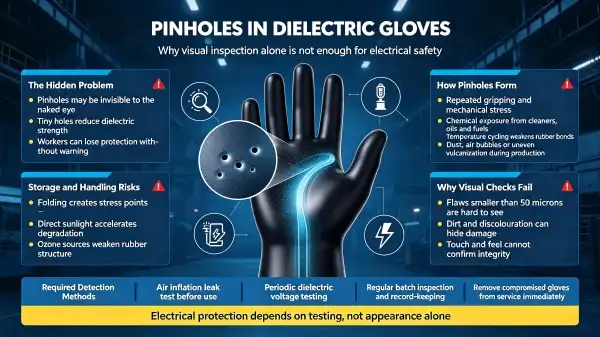
Pinholes in dielectric gloves can go unnoticed if they are not tested properly. Workers depend on this electrical protection for their lives, but these tiny flaws make it less safe. Although dielectric gloves are supposed to protect people from high-voltage dangers, they don't work at all because of tiny holes in them that you can't see. Visual inspections alone aren't enough to find these tiny cracks, which is why regular electricity testing and air pressure checks are necessary parts of any workplace safety program. Knowing the limits of spotting helps procurement teams set up thorough check schedules that really keep their workers safe.
Understanding the Problem of Pinholes in Dielectric Gloves
What Makes Dielectric Gloves Essential for Electrical Safety
Electrical insulation gloves are the most important safety gear for people who work in industry, utility repair, and electrical engineering. When working on or near electrical tools, these special rubber shields keep electrical current from getting to the wearer's hands. Linemen have been seen using gloves with a Class 2 or Class 3 voltage rating while fixing overhead lines, where they are constantly exposed to high-voltage alternating current. In the same way, techs who work on electric vehicles use Class 0 or Class 00 gloves to handle large battery packs because they allow them to move precisely in small areas.
The main thing that sets these safety items apart is their dielectric strength, which is the strongest electric field the material can handle without breaking. The flexibility and agility of natural rubber mixtures are better, so workers can move tools and parts around with good tactile input. EPDM plastic materials are better at resisting damage from ozone and UV light, which makes them last longer in outdoor settings. Colour-coding the inside and outside of the glove makes visible inspections easier and helps safety workers find possible damage to the dielectric glove's structure.
How Pinholes Compromise Glove Integrity
There are several ways that tiny flaws can appear during production and in the field. When you grip something over and over, the mechanical stress causes wear points in the rubber matrix, which are places where chemical bonds start to break. Chemicals like cleaning agents, hydraulic fluids, and gasoline products can break down the structure of polymers, making them less strong against tearing and stretching. When temperatures change from one extreme to another, they cause materials to expand and shrink, which weakens their ability to stick together over time.
Imperfections in the manufacturing process can sometimes cause problems during the hardening or moulding processes. When dust, air bubbles, or uneven vulcanisation get into rubber layers, they can contaminate weak spots that can finally turn into pinholes. Even gloves that meet the original quality standards can get damaged if they are stored incorrectly. Folding creates stress concentration spots, and direct sunlight or ozone sources speed up material degradation.
Why Traditional Detection Methods Fall Short
Visual checking is still the most common method, but flaws smaller than 50 microns can't be seen by the naked eye. The size of many pinholes is much smaller than this, so they can't be seen with the human eye, even in bright light. Workers often think that surface dirt or small spots of discolouration are normal wear patterns and miss important integrity failures.
Touch and feel also give results that can't be trusted. When touching the rubber by hand, it is impossible to tell the difference between whole areas and areas that have tiny holes in them. Using physical handling alone isn't always enough to find compromised areas, not even for expert safety staff. This detection gap gives workers false confidence, which makes them trust safety gear that no longer protects them from electricity properly.
Dielectric Gloves Inspection and Testing Standards
Global Certification Requirements That Define Safety Benchmarks
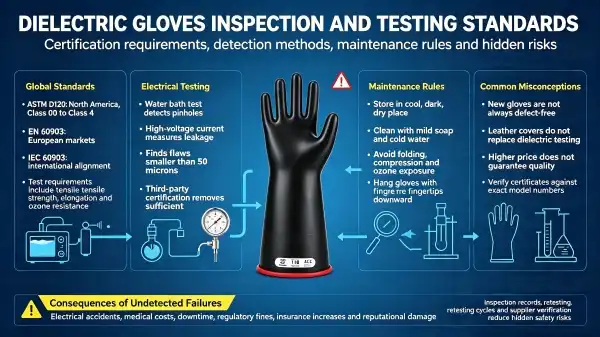
Electrical protective equipment approval in North America is based on ASTM D120 guidelines, which set voltage levels from Class 00 to Class 4. The highest voltages that can be used are between 500 volts for Class 00 situations and 36,000 volts for Class 4 commercial situations. For the toughest jobs, proof test voltages can go up even more, up to 40,000 volts AC. European markets use EN 60903 standards, which are very similar to International Electrotechnical Commission standards. This makes sure that safety demands are the same everywhere.
Not only does each group list electricity performance requirements, but it also lists physical property requirements. Tensile strength standards make sure that materials can handle being pulled apart by machines without breaking. Specifications for elongation ensure enough flexibility for real work tasks. Ozone resistance testing makes sure that materials stay strong even when they are exposed to ozone. Because these standards cover a lot of different areas, they help make complete security systems that work in real life.
Accredited testing labs' certification marks give buying teams an objective way to check that a product meets requirements. Validation by a third party takes away any doubt about what the maker says, giving you a solid foundation of trust in the equipment's performance. We suggest making sure that the certification paperwork fits the exact models of dielectric gloves being bought, since makers sometimes show certifications that are only valid for certain product lines.
Electrical Testing Procedures That Reveal Hidden Defects
The best way to find pinholes is to use the water bath electrical test. In testing labs, gloves are put in conductive water solutions, and high-voltage current is run through them while the loss is measured. Any path through the rubber, big or small, lets current run, which is picked up right away by testing equipment. This method consistently finds flaws as small as a few microns across, which is much smaller than what the human eye can see.
Air inflation checking is a useful option to field inspection that can be done by workers before each use. Technicians pump air into the gloves to create internal pressure. They then carefully look at the surface while listening for air escape. Rolling the filled glove around gives even pressure to all areas, which can help find pinholes by making hissing sounds or showing weak spots by ballooning. This method is not as accurate as electrical testing in a lab, but it finds many flaws that would not have been seen otherwise.
OSHA rules say that the gloves that are being used must be retested every six months. This is because work conditions can wear down even the best goods over time. To keep the best safety gaps, organisations with aggressive usage habits sometimes test more often, like every three months or even once a month. These testing times strike a mix between realistic operating concerns and the statistical fact that the chance of a defect rising with increased exposure to mechanical and environmental stressors.
Maintenance Practices That Extend Protective Lifespan
The way gloves are stored has a big effect on how long they last and how often defects appear. Heat and UV light can speed up the ageing process, but cool, dark, dry places stop this. Canvas storage bags keep things from getting damaged while they're being moved or stored, and they let air flow so that wetness doesn't build up. If you hang gloves with the ends down, any wetness that is still on them can drain away instead of building up at the tips of your fingers, where it could damage the material.
When following cleaning instructions, it's important not to cause more damage. Mild soap and cold water (never more than 120°F) can get rid of dirt and grime without hurting the rubber's qualities. Scrubbing too hard or using strong chemical cleaners breaks down the polymer structure, which makes it more likely for pinholes to form. Drying something completely before putting it away stops biological growth and chemical processes that weaken its structure.
Avoiding compression and folding while storing keeps stress from building up and creating weak spots that could fail in the future. A lot of businesses buy special racks to store gloves that help them hang correctly and keep tools organised so that they can keep track of their inventory. These seemingly small storage details have a big effect on field reliability, lowering the number of sudden equipment failures that stop work and put workers at risk.
If you're evaluating personal protective equipment suppliers and require batch-specific testing documents before placing an order, PPE MAX is able to provide official Certificates of Analysis, professional laboratory test reports, and product samples for your verification. Feel free to contact our team at marketing@ppemax.com to discuss your sourcing needs and obtain complete documentation for your quality assessment and procurement approval.
The Truth Behind Pinhole Detection: Common Misconceptions and RealitiesDebunking Dangerous Assumptions About Glove Durability
A lot of safety managers think that when new gloves come from the factory, they are perfect. But statistical quality control means that almost all production settings have small numbers of products that don't meet standards. Manufacturers with good reputations and ISO-certified quality systems sometimes send out products that have hidden flaws. Because of this, inbound inspection procedures are required, not optional. This is especially true for companies that buy in bulk, since there is a statistically high chance that some percentage will have manufacturing flaws.
Another common misunderstanding is that leather covers mean you don't need to check your dielectric gloves. Although leather upper gloves are very good at protecting against cuts, punctures, and abrasions, they can't stop or find electrical insulation failures in the rubber layer below. The leather doesn't do the same thing twice; it protects against different types of hazards as part of a complete set of personal safety equipment.
Some teams that buy things think that paying more means better quality and fewer mistakes. Even though there is a link between manufacturing investment and product stability, price alone doesn't give enough confidence. We looked at both expensive foreign gloves that failed lab tests and cheaper options that met all the requirements. Documentation of certification and regular testing methods are much more reliable ways to tell if something is of good quality than the price it costs.
Environmental and Operational Factors That Accelerate Defect Formation
Ozone pollution is one of the most sneaky ways that the environment can damage natural rubber mixtures. Ground-level ozone levels, which are higher in industrial areas and during the summer, damage unsaturated bonds in rubber molecules. This makes surface cracks that spread into pinholes. Type I gloves made from natural rubber are especially sensitive to ozone damage. Type II gloves made from EPDM manmade materials are more resistant to ozone, which means they last longer when used outside.
Extreme temperatures cause thermal stress by causing different amounts of growth and contraction. When workers wear gloves, they are constantly going between climate-controlled rooms and outside, which wears down chemical structures. Because cold conditions make rubber less flexible, it is more likely to crack when it is put under mechanical stress. Chemical ageing happens faster when there is too much heat, which shortens the time before a material's qualities drop below accepted levels.
Different job functions have very different patterns of mechanical stress. When utility workers hold tools and wires, they put a lot of stress on their palms and fingers. When repair workers at a substation work on equipment, their gloves wear out in different ways. Understanding application-specific stress concentrations helps companies make inspection focus areas and replacement plans that work in the real world instead of just following what the maker says to do.
Financial and Safety Consequences of Undetected Failures
Electrical accidents at work cost money right away because they require medical care, time off from work, and emergency response. Serious accidents cost a lot in the long run because of workers' compensation claims, rehabilitation services, and the chance of getting lasting disability payments. These direct costs usually only make up a small part of the total financial effect when you add in the costs of investigating the event, filing with the government, and possible fines or citations.
A lot of the time, indirect costs are much higher than direct costs. Production plans are thrown off by operational problems, which lead to late deliveries and unhappy customers. When there are major events at work, morale drops, which hurts productivity across teams, not just those directly involved. After accidents that show they didn't follow safety rules properly, organisations may have to pay more for insurance or even have their coverage limited.
Damage to a company's reputation affects many ties at once. Potential workers look at safety records when they are deciding whether to accept a job offer. Customers who do checks of suppliers look closely at incident records as a sign of how well operations are run. After accidents that could have been avoided, regulatory agencies step up their control, which adds to the work of administration and takes resources away from more useful tasks. These domino effects show why putting money into good spotting and testing procedures pays off many times over in equipment costs.
Comparing Dielectric Gloves: Materials, Ratings, and Detection Reliability
Natural Rubber Versus Synthetic Material Performance Characteristics
Natural rubber latex is very flexible and sensitive to touch, which is great for workers who need to be precise. The molecular structure has great electrical resistance across a wide range of voltages, meeting the needs of Class 00 to Class 4 uses. Natural rubber, on the other hand, can crack when exposed to ozone and petroleum products and age faster when exposed to ultraviolet light. Because of these issues, it is very important to store Type I gloves properly and change them regularly.
EPDM-manufactured formulations give up some flexibility in exchange for better protection of the environment. Natural rubber would crack within months of being exposed to ozone, but EPDM isn't really impacted. Chemical protection includes oils, hydraulic fluids, and many industrial agents that break down natural rubber very quickly. This longevity means that it will last longer in harsh settings, which could lower long-term costs even though it costs more at first.
By layering or mixing natural and manufactured rubbers, hybrid mixtures try to find a balance between these different properties. For the best electrical qualities, the inner layers may use natural rubber, and for environmental protection, the outer layers may use EPDM. These tailored solutions are made to solve specific problems in certain applications, but they need to be carefully looked over to make sure that the voltage levels and flexibility meet the needs of the operation. In the end, the choice of material relies on the risks of exposure, the voltage levels, and the skill requirements of each work setting.
Voltage Classification Systems and Their Practical Implications
Class 00 and Class 0 gloves are used for tasks that involve smaller voltages, like 120-volt and 240-volt circuits that are popular in businesses and light industry settings. When working on battery systems and drive technology for electric vehicles, service techs often choose these categories. The thinner rubber construction still provides great tactile feedback, which is necessary for testing processes that need fine motor skills and putting together connectors.
When it comes to medium-voltage situations up to 17,000 volts, Class 1 and Class 2 gloves are good for most power distribution systems and industrial substations. These are the most general categories used in the industrial, mining, and building industries. When compared to lower classes, thickness goes up, which means less flexibility but more important thermal capacity. Most workers get used to the bulk in a short amount of time and can regain most of their hand accuracy through familiarisation.
Transmission-level voltages of 36,000 volts or more can't hurt people wearing Class 3 or Class 4 gloves. Utility companies that take care of high-voltage transmission lines depend on these categories to make sure that work on energised lines is done safely. The thick rubber needed for electrical safety makes it much harder to move your hands and requires stronger grips. Companies that use these classes usually make sure that their tools and work methods are designed in a way that makes them useful for people with limited manual dexterity.
How Material Composition Influences Pinhole Vulnerability
Pinholes are less likely to form in dielectric gloves that are thicker because there is more material between the possible defect starting points and the other surface. Because manufacturing flaws or mechanical damage have to go farther, Class 3 and Class 4 gloves naturally have lower pinhole rates than Class 00 gloves, which are thinner. Using the right voltage class for the real risk of exposure seems to offer extra safety benefits over basic electrical protection, as shown by this link.
Once the first damage happens, material consistency affects how quickly defects spread. Because the molecules in natural rubber are all the same, cracks can sometimes spread more easily than in manufactured materials with crosslinked polymer networks. Synthetic materials, on the other hand, may develop weak spots near chemical contact areas that natural rubber would be better able to fight. Because of these complicated relationships, there isn't a single material makeup that is better at all defect processes.
Anatomical design factors affect how stress is distributed, which in turn determines where pinholes form most often. Curved-hand designs that match natural resting positions keep materials from bending when holding, which keeps people from getting tired. When you first touch a tool, it puts a lot of mechanical stress on certain areas. Reinforced fingertip areas take that into account. We've seen that design optimisation has a big effect on field reliability, sometimes being more important than material selection for stopping pinholes from forming.
Procurement Insights: Buying Dielectric Gloves That Ensure Safety and Compliance
Critical Selection Criteria Beyond Price Considerations
Verification of certification validity is the first step in the buying process. It is objective proof of compliance to ask for copies of real lab test results, not just claims of certification. By comparing certification numbers to records of awarding laboratories, you can be sure that the numbers are real and find out if the testing covered the specific version of the product being talked about. This careful attention sometimes finds lies when companies show qualifications that only apply to certain product lines.
The evaluation of material quality goes beyond meeting standards to checking for consistency in making. Asking for paperwork on the material's composition and processing factors helps you figure out if the maker has tight controls. Companies that use ISO 9001 quality control systems show that they are committed to being consistent, but certification doesn't mean that their goods are perfect. When comparing written processes to real production practices, visiting manufacturing facilities or reading third-party audit reports can help.
Lifecycle cost analysis shows the total costs of ownership that are hidden by single-unit prices. Even though they cost more, dielectric gloves that need to be replaced every three months because they wear out faster end up costing more than high-quality gloves that last nine months. When you think about the costs of testing, administration, and possible safety incidents when making purchasing decisions, the best choices become more focused on stability rather than the lowest cost. For these detailed cost models to be made, the buying, safety, and management teams need to work together across departments.
Evaluating Supplier Credibility and Support Capabilities
Established makers that have been making things for decades show institutional knowledge and process refinement that younger companies don't have. We've been selling electrical insulating goods since 1956, so we've seen how technology changes and safety standards change, which affects how we make things now. This looks at the past to help sellers predict what customers will want and help them find their way through complicated regulatory settings.
Suppliers who see deals as long-term partnerships instead of one-time sales stand out because they offer technical help. Companies that offer application engineering help customers find goods that are right for their needs based on voltage levels and weather conditions. Training programs that teach workers the right way to check and use goods add worth to more than just the products themselves. These support services are especially helpful for businesses that are growing their safety programs or moving into new areas where they can do business.
Geographic reach and transport dependability are very important for businesses that do business in more than one place or country. When suppliers keep inventory in area delivery hubs, wait times are cut down, and emergency replacements can be made more quickly. We currently have users in 134 countries, and we're building logistics networks that can handle a wide range of shipping needs and issues. This global presence makes sure that products are always available, whether they are being bought for sites in the United States or other countries.
Navigating Warranty Terms and Return Policies for Bulk Purchases
The length of the warranty covering shows how confident the maker is in the product's durability. Standard offerings usually cover flaws in the way the product was made that were found during the first review times, which are usually 30 to 90 days after delivery. Some sellers lengthen warranty periods or offer replacements based on a percentage of the original cost, recognising that some problems only show up after being used in the field. Making it clear under what conditions guaranteed replacements happen stops arguments when real problems happen.
When buying in bulk, return policies need to be carefully negotiated before deals are finalised. Standard return dates for consumers don't work well for industrial purchases because receiving inspections can take weeks after delivery. Setting longer evaluation times, like 60 to 120 days, lets you check the quality thoroughly without rushing through the key assessment steps. These talks are especially important for businesses that are hiring new sellers whose products haven't been tested yet.
Defect rate limits help keep everyone in the loop about what level of quality is acceptable for big orders. ISO 2859-based statistical sampling plans make it possible to set pass/fail criteria based on sample numbers and failure rates that have been seen. Setting these measures up front makes it clear to everyone when it makes sense to reject or replace part of a shipment and when it makes sense to accept some goods that don't meet standards. We work together with buying teams to make quality deals that are based on what can actually be made and what the customer wants.
Conclusion
Electrical insulating gloves with pinhole flaws are quite a threat that can be effectively dealt with through systematic inspection processes. Visual inspection is not enough to protect workers from failures that are very small. Regular electricity tests and air filling checks must be included in all safety programs. When choosing between natural rubber and synthetic compositions, the real outdoor hazards should be taken into account, not just the price. Using the right voltage classification matching, checking every six months, and paying attention to storing conditions can greatly lower the risk of an incident. When it comes to safety, making choices about purchases that balance certification authenticity, seller trustworthiness, and lifecycle costs is better than just focusing on the lowest price. Companies that use these methods that have been proven to work really do protect their most important assets: the workers who come home every day safely using their dielectric gloves.
FAQ
1. Can visual inspections reliably detect pinholes in voltage-rated protective equipment?
An eye check can find clear damage like cuts, tears, or surface cracks, but it can't find microscopic flaws that are too small for a person to see. Even though pinholes smaller than 50 microns can't be seen, they still let electricity pass through them. Using visible checks, regular air inflation tests, and electrical proof in the lab together makes layered detection that finds flaws of all sizes in your dielectric gloves.
2. How often should organisations conduct electrical retesting on rubber insulating equipment?
Because the chance of a flaw rising with more time spent in the field, OSHA requires gloves to be replaced every six months. Companies that use their equipment a lot, like those that work with utilities or high-voltage manufacturing equipment, may plan tests every three months. In cases of low use, testing intervals might be a little longer, but once a year is the longest time between tests that is still recommended, no matter how much they are used.
3. Do all rubber insulating glove manufacturers provide equivalent protection quality?
Material composition, control of the manufacturing process, and the level of quality guarantee vary a lot from one provider to the next. Even though certification gives you a basic idea of how well an electrical system works, long-term dependability, comfort, and failure rates are all very different. Manufacturers that have been around for a long time, have a lot of production experience, and have complete quality systems usually produce more regular results than younger companies. Instead of thinking that all certified goods are protected the same, procurement teams should look at certifications, ask for test reports, and check out the technical help skills of suppliers.
Partner With PPE MAX for Certified Electrical Protection Solutions
To keep your employees safe from electrical dangers, you need to do more than just buy gloves. You need to work with a dielectric gloves provider that knows how to balance material science, regulatory compliance, and real-world application needs. Since 1956, PPE MAX has been making electrical insulating goods that people in 134 countries trust, from utility repair teams to people who run factories and have to deal with strict safety rules. Our testing methods go beyond ASTM D120 and EN 60903 requirements to make sure that every pair gives your workers the security they need. To talk about your unique voltage classifications, environmental exposures, and purchase amounts, please email our expert team at marketing@ppemax.com. We'll give you samples, thorough specs, and application advice that will help you set up inspection programs that really protect your most valuable assets, which are the people who make your business run smoothly.
References
1. American Society for Testing and Materials. (2019). ASTM D120-19: Standard Specification for Rubber Insulating Gloves. West Conshohocken, PA: ASTM International.
2. International Electrotechnical Commission. (2018). IEC 60903: Live Working – Gloves of Insulating Material. Geneva: IEC Central Office.
3. Occupational Safety and Health Administration. (2020). OSHA 1910.137: Electrical Protective Equipment Standards and Testing Requirements. Washington, DC: U.S. Department of Labour.
4. National Institute for Occupational Safety and Health. (2017). Electrical Safety in the Workplace: Detection and Prevention of Protective Equipment Failures. Cincinnati, OH: NIOSH Publications.
5. Institute of Electrical and Electronics Engineers. (2021). IEEE Guide for Testing and Maintenance of Electrical Protective Equipment. Piscataway, NJ: IEEE Standards Association.
6. European Committee for Electrotechnical Standardisation. (2020). EN 60903: Live Working – Electrical Insulating Gloves – Testing Protocols and Classification Systems. Brussels: CENELEC Central Secretariat.
Learn about our latest products and discounts through SMS or email