- English
- French
- German
- Portuguese
- Spanish
- Russian
- Japanese
- Korean
- Arabic
- Greek
- German
- Turkish
- Italian
- Danish
- Romanian
- Indonesian
- Czech
- Afrikaans
- Swedish
- Polish
- Basque
- Catalan
- Esperanto
- Hindi
- Lao
- Albanian
- Amharic
- Armenian
- Azerbaijani
- Belarusian
- Bengali
- Bosnian
- Bulgarian
- Cebuano
- Chichewa
- Corsican
- Croatian
- Dutch
- Estonian
- Filipino
- Finnish
- Frisian
- Galician
- Georgian
- Gujarati
- Haitian
- Hausa
- Hawaiian
- Hebrew
- Hmong
- Hungarian
- Icelandic
- Igbo
- Javanese
- Kannada
- Kazakh
- Khmer
- Kurdish
- Kyrgyz
- Latin
- Latvian
- Lithuanian
- Luxembou..
- Macedonian
- Malagasy
- Malay
- Malayalam
- Maltese
- Maori
- Marathi
- Mongolian
- Burmese
- Nepali
- Norwegian
- Pashto
- Persian
- Punjabi
- Serbian
- Sesotho
- Sinhala
- Slovak
- Slovenian
- Somali
- Samoan
- Scots Gaelic
- Shona
- Sindhi
- Sundanese
- Swahili
- Tajik
- Tamil
- Telugu
- Thai
- Ukrainian
- Urdu
- Uzbek
- Vietnamese
- Welsh
- Xhosa
- Yiddish
- Yoruba
- Zulu
Class 1 Insulating Gloves: Testing, Care, and Compliance
Founded in 1956, PPEMAX stands as a premier global manufacturer and supplier of full-range personal protective equipment. All our products comply with internationally recognized standards including IEC, ASTM, CE, UKCA, NIOSH and ISO9001. Equipped with a 2,000-square-meter modern production plant, we boast over 25 years of mature OEM & ODM capabilities to deliver one-stop customized solutions covering R&D design through worldwide logistics. Our safety gear is distributed across 134 countries globally. Upholding our core tenet “Safety First, Quality Priority”, we serve as a dependable long-term PPE partner for industrial enterprises around the world.
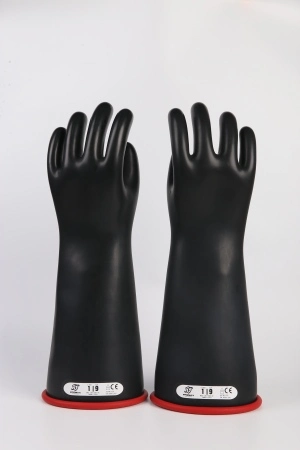
Class 1 insulating gloves are rated electrical PPE designed to protect workers from voltage hazards up to 7,500V AC and 11,250V DC. Used across utility, construction, and industrial maintenance environments, these gloves must pass strict dielectric testing, meet recognized standards like ASTM D120 and IEC 60903, and follow structured care routines to remain effective. For B2B procurement teams managing large workforces, understanding testing schedules, storage requirements, and compliance documentation is not optional — it directly affects worker safety and legal accountability.
|
Parameter |
Specification |
|
Voltage Rating |
7,500V AC / 11,250V DC (Maximum Use) |
|
Proof Test Voltage |
10,000V AC / 40,000V DC |
|
Material Type |
Type I (Natural Rubber) / Type II (EPDM Synthetic) |
|
Thickness Range |
1.02mm - 1.52mm |
|
Tensile Strength |
>17.2 MPa |
|
Standards Compliance |
ASTM D120, IEC 60903 |
|
Temperature Resistance |
Category A, H, Z rated |
|
Label Color |
White (Class 1 Standard) |
Understanding Class 1 Insulating Gloves: Specifications and Safety Standards
What Defines a Class 1 Rating?
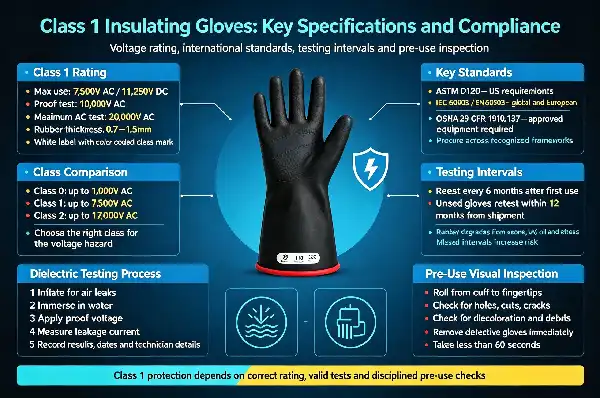
A Class 1 rubber insulating glove has a white label with a color code that lets you know right away on the job site what voltage class it is. The glove has to be able to handle a proof test power of 10,000V AC and no more than 20,000V AC. The ideal width for rubber is between 0.7mm and 1.5mm, which gives it the right amount of insulating strength and flexibility for precise electrical work. These rules are required by both ASTM D120 and IEC 60903, so they are not just ideas from the maker.
Key International Standards
In the US, ASTM D120 sets the rules for rubber insulation gloves, including how they should be sized, how they should work with electricity, and how the material should behave. IEC 60903 and EN 60903 are both used for testing and apply to markets in Europe and around the world. When working on powered systems, OSHA 29 CFR 1910.137 says that you must use approved insulation gear. For global procurement teams, buying from a manufacturer that has certifications in all three frameworks is very important.
Comparing Class 1 With Adjacent Classes
Class 0 gloves can handle up to 1,000V AC, which means they can be used on low-voltage control panels and meters. For work with medium-voltage wires, Class 2 gloves must be able to step up to 17,000V AC. Class 1 is in the middle and includes a wide range of jobs where 7,500V AC exposure is likely, such as industrial repair, operating equipment, and work for utility contractors. It's not a conservative mistake to pick the wrong class; it's a risk.
Testing and Inspection Procedures for Class 1 Insulating Gloves
Why Testing Intervals Matter
Even if gloves don't look broken, rubber breaks down over time when it comes into contact with ozone, UV light, oil, and mechanical stress. As per ASTM D120, gloves must be retested for electrical safety every six months after they are put to use. Class 1 insulating gloves that have been kept and not used must be checked again within 12 months of being sent out. Missing a test cycle puts workers at risk of micro-failures that can't be found and puts companies at risk of OSHA fines.
Step-by-Step Dielectric Testing Process
High-voltage equipment that has been calibrated and is located in a certified facility must be used for testing. First, the glove is inflated to see if there are any air leaks. Next, it is put in water, and the necessary proof voltage is applied. Any leakage current that is higher than the normal limit causes the device to fail right away and be thrown away. For auditing reasons, all test results, dates, and technician qualifications must be written down and kept. Documentation is not just a procedure; it protects you from not following the rules.
Visual Inspection Before Every Use
Before each shift, workers should roll their gloves from the cuff to the tip of their fingers to look for holes, cracks, discoloration, or debris that might be inside. No matter when the last electrical test was done, any flaw that can be seen needs to be taken out of service right away. This daily habit, which takes less than 60 seconds, has kept many industrial workers from getting hurt by electricity. Managers of procurement should make sure that this process is included in training tools for suppliers.
Effective Care and Maintenance Tips for Longevity
Cleaning Routines That Protect the Rubber
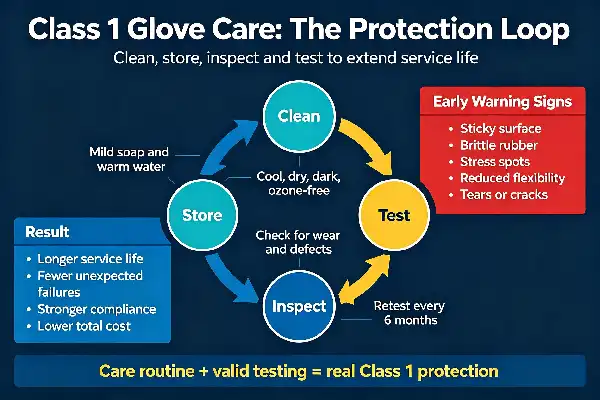
To clean the gloves' surface, wipe them down with a clean, wet cloth after each use. Cleaners, acids, and chemicals made from gasoline should not be used on natural rubber latex. Mild soap and warm water are all you need to clean something thoroughly. Dry your gloves in the air, away from direct heat sources, before putting them away. At PPE MAX, we use high-quality natural rubber latex that is treated to be resistant to ozone and UV light. However, cleaning your gloves properly will still make them last longer.
Storage Conditions That Prevent Premature Degradation
Rubber gloves that keep you warm should be kept in a cloth glove bag, away from heat, bright lights, and chemical vapors. When you fold or crease gloves too tightly, stress lines form that can turn into cracks. Keep gloves away from leather covers when storing them for a long time to keep them from deforming. The temperature should stay below 32°C, and the storage area should be away from electrical motors and other things that make ozone.
Recognizing Wear Before It Becomes a Hazard
Early signs of wear and tear include a surface that is sticky or brittle, stress spots with light darkening, and the wrist being less flexible when stretched. These signs show up before tears do and let you know that the glove is almost done for good. Along with the required electrical testing every six months, procurement teams in charge of large field operations should set up a schedule for physical audits every three months. Replacing gloves before they wear out is much cheaper than the alternative.
If you're evaluating personal protective equipment suppliers and require batch-specific testing documents before placing an order, PPE MAX is able to provide official Certificates of Analysis, professional laboratory test reports, and product samples for your verification. Feel free to contact our team at marketing@ppemax.com to discuss your sourcing needs and obtain complete documentation for your quality assessment and procurement approval.
Procurement Considerations for B2B Clients: Choosing the Right Class 1 Insulating Gloves
Essential Criteria When Evaluating Suppliers
When buying electrical insulated gloves, you should think about the scope of the approval, the quality of the materials, and how consistent the production batches are. Before making a decision about a seller, buying teams must look at these main factors:
- Certification coverage: The supplier should hold valid ASTM D120, IEC 60903, and CE certification — particularly if your operations span both North American and European markets.
- Material specification transparency: Confirm whether Class 1 insulating gloves use Type I natural rubber or Type II EPDM synthetic rubber. Type II offers better ozone resistance for outdoor applications; Type I provides greater tactile dexterity for precision indoor work.
- Batch consistency and QC documentation: Large-volume orders require proof of systematic quality control, including third-party test records and production traceability.
By looking at these things before making a large order, you can keep your buying program from having to pay a lot of money to fix problems that came up after delivery.
Bulk Ordering and Lead Time Realities
Lead times for large orders are usually between 4 and 8 weeks, but can be longer or shorter depending on how customized the order is and where it needs to be shipped to. Xi'An PPE MAX Co., Ltd offers custom packaging for wholesalers, as well as polybags for single items and strong export boxes for shipping in bulk. Because we have a supply chain that goes through more than 134 countries, we can predict lead times without having to discuss them case by case.
OEM and Brand-Building Options
Global brands and regional distributors are looking for OEM manufacturing partners instead of off-the-shelf wholesalers. OEM and ODM production options are available at PPE MAX, so customers can choose the glove sizes, color coding for the cuffs, sticker language, and package design. This choice works for distributors who are making their own safety brands or for government programs that need labels to be made in the local language.
Ensuring Compliance and Safety: Best Practices for User Training and Regulatory Adherence
Training Electricians on Correct Glove Use
If a certified glove is used incorrectly, it will still not work. The air-inflation inspection method, the need to wear leather protectors over rubber gloves while working, and the fact that rubber gloves without protectors are not allowed in the field must all be covered in training programs. OSHA 29 CFR 1910.137 says that training must be recorded; verbal teaching alone is not enough to pass an audit.
Building Audit-Ready Documentation Systems
A glove log should be kept by procurement and safety managers to keep track of each unit's serial number, test dates, assigned worker, and retirement date. Digital tracking tools let teams that are in charge of hundreds of pairs do this. When you buy from a manufacturer that gives you test certificates, material compliance sheets, and batch traceability reports, you don't have to do as much paperwork on your own.
ROI of Structured Safety Compliance
Formal PPE inspection and training programs regularly lead to fewer lost-time accidents and lower workers' compensation costs for companies that use them. A study from 2022 in the Journal of Safety Research found that organized PPE compliance programs cut the number of electrical injuries in factories by 34% compared to ad hoc programs. The money you spend up front on certified equipment and written training is recouped in 18 to 24 months.
Conclusion
Any electrical safety program that works needs to be based on proper testing, organized care, and consistent cooperation. Class 1 insulating gloves that can handle 7,500V AC are only as safe as the rules that say how to use them. For B2B buying teams, this means only working with certified sellers, making sure workers get thorough training, and keeping records that can be tracked. From 1956 to the present, PPE MAX has met these needs in 134 countries. You can email us at marketing@ppemax.com or go to www.ppemax.com to ask for details, bulk prices, or an OEM meeting.
FAQ
1. How often must Class 1 insulating gloves be electrically retested?
Once placed in service, rubber insulating gloves must be retested every six months under ASTM D120. If kept in storage without use, retesting is required within 12 months. Missing this interval voids the glove's certified status.
2. Can rubber insulating gloves be used without leather protectors?
No. Rubber gloves must be worn with leather protectors (ASTM F696) during active work. Without them, mechanical damage from sharp edges or abrasive surfaces can compromise the dielectric barrier — even if no visible puncture appears.
3. What should B2B buyers check when ordering in bulk?
Verify that the supplier provides third-party test certificates per ASTM D120 or IEC 60903, confirms rubber type (Type I or Type II), and can deliver consistent batch quality at scale. Request production traceability documentation before finalizing any large-volume contract.
4. What does the white label on Class 1 gloves indicate?
The white label is the industry color-code for Class 1 (7,500V AC maximum use). This visual system prevents field workers from accidentally selecting a lower-rated glove — such as Class 0 (red) — for tasks requiring higher protection.
Partner With PPE MAX for Certified Class 1 Insulating Gloves
Since 1956, PPE MAX has been making approved electrically protective PPE. We are a reliable provider of Class 1 insulating gloves that serves more than 134 countries. Our goods are in line with ASTM D120 and IEC 60903, and we offer OEM production options and dedicated bulk order support. Our team replies quickly with information about the goods, samples, and prices. Send an email to marketing@ppemax.com to start talking about sourcing right away.
References
1. American Society for Testing and Materials. ASTM D120: Standard Specification for Rubber Insulating Gloves. ASTM International, 2021.
2. International Electrotechnical Commission. IEC 60903: Live Working – Gloves of Insulating Material. IEC, 2014.
3. Occupational Safety and Health Administration. OSHA 29 CFR 1910.137: Electrical Protective Equipment. U.S. Department of Labor, 2019.
4. National Fire Protection Association. NFPA 70E: Standard for Electrical Safety in the Workplace. NFPA, 2021.
5. Sorock, G. S., et al. "Electrical Injury Prevention Through PPE Compliance Programs." Journal of Safety Research, Vol. 80, 2022.
6. European Committee for Electrotechnical Standardization. EN 60903: Live Working – Gloves of Insulating Material. CENELEC, 2014.
Learn about our latest products and discounts through SMS or email