- English
- French
- German
- Portuguese
- Spanish
- Russian
- Japanese
- Korean
- Arabic
- Greek
- German
- Turkish
- Italian
- Danish
- Romanian
- Indonesian
- Czech
- Afrikaans
- Swedish
- Polish
- Basque
- Catalan
- Esperanto
- Hindi
- Lao
- Albanian
- Amharic
- Armenian
- Azerbaijani
- Belarusian
- Bengali
- Bosnian
- Bulgarian
- Cebuano
- Chichewa
- Corsican
- Croatian
- Dutch
- Estonian
- Filipino
- Finnish
- Frisian
- Galician
- Georgian
- Gujarati
- Haitian
- Hausa
- Hawaiian
- Hebrew
- Hmong
- Hungarian
- Icelandic
- Igbo
- Javanese
- Kannada
- Kazakh
- Khmer
- Kurdish
- Kyrgyz
- Latin
- Latvian
- Lithuanian
- Luxembou..
- Macedonian
- Malagasy
- Malay
- Malayalam
- Maltese
- Maori
- Marathi
- Mongolian
- Burmese
- Nepali
- Norwegian
- Pashto
- Persian
- Punjabi
- Serbian
- Sesotho
- Sinhala
- Slovak
- Slovenian
- Somali
- Samoan
- Scots Gaelic
- Shona
- Sindhi
- Sundanese
- Swahili
- Tajik
- Tamil
- Telugu
- Thai
- Ukrainian
- Urdu
- Uzbek
- Vietnamese
- Welsh
- Xhosa
- Yiddish
- Yoruba
- Zulu
How Often Should Electrical Rubber Gloves Be Tested?
Founded in 1956, PPEMAX stands as a premier global manufacturer and supplier of full-range personal protective equipment. All our products comply with internationally recognized standards including IEC, ASTM, CE, UKCA, NIOSH and ISO9001. Equipped with a 2,000-square-meter modern production plant, we boast over 25 years of mature OEM & ODM capabilities to deliver one-stop customized solutions covering R&D design through worldwide logistics. Our safety gear is distributed across 134 countries globally. Upholding our core tenet “Safety First, Quality Priority”, we serve as a dependable long-term PPE partner for industrial enterprises around the world.
Electrical rubber gloves must be tested on a structured schedule to maintain worker safety. According to ASTM F496 and OSHA 29 CFR 1910.137, insulating gloves require dielectric retesting every six months after being placed in service. Gloves stored but not yet issued must be tested if more than 12 months have passed since their last certification. Daily air inflation checks and visual inspections should also be performed before each use. Following this layered testing schedule keeps your electrical rubber gloves compliant and protects workers from potentially fatal shock hazards.
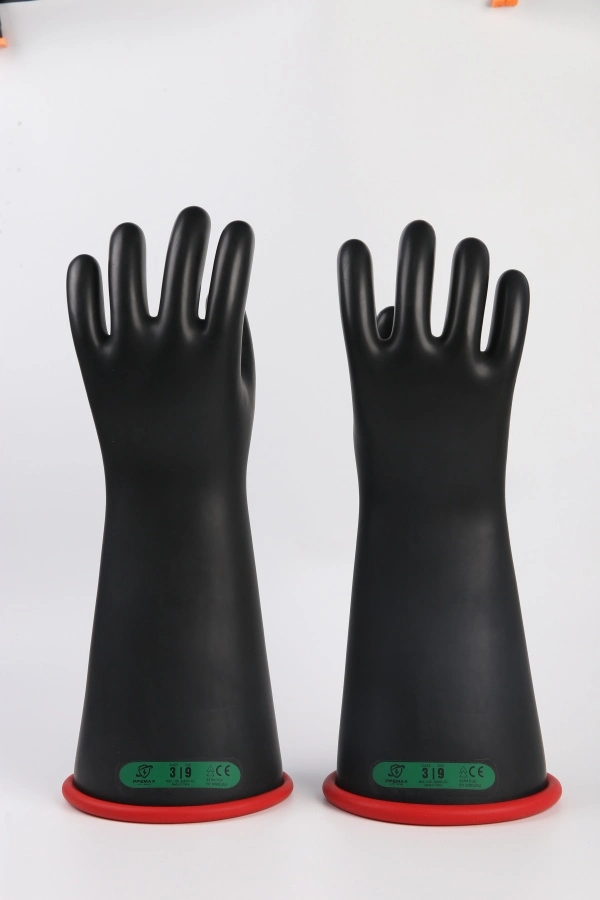
|
Parameter |
Specification |
Standard |
|
Maximum Use Voltage |
26,500V AC / 39,750V DC |
ASTM D120 / IEC 60903 |
|
Proof Test Voltage |
30,000V AC / 45,000V DC |
ASTM D120 |
|
Material Types |
Type I (Natural Rubber) / Type II (EPDM) |
ASTM D120 |
|
Thickness Range |
2.3mm - 2.9mm |
Industry Standard |
|
Length Options |
14" - 18" inches |
Customizable |
|
Label Color |
Green |
International Standard |
|
Temperature Range |
-25°C to +65°C |
Operating Conditions |
Understanding Electrical Rubber Gloves and Their Testing Requirements
Insulating gloves are the primary line of defense for electrical workers facing shock and electrocution hazards. But even a perfectly manufactured glove degrades over time — from UV exposure, ozone, mechanical stress, and chemical contact. Testing catches invisible defects before they cause harm.
What Standards Govern Testing?
Two primary frameworks apply globally. ASTM D120 covers North American manufacturing requirements, specifying material composition, physical tolerances, and proof test voltages. IEC 60903 / EN 60903 applies across Europe and many international markets. Both standards classify gloves from Class 00 (500V max use) through Class 4 (36,000V max use), each requiring specific proof test voltages during manufacture and periodic retesting in service.
What Are the Voltage Classes?
- Class 00: 500V AC / 750V DC max use voltage; proof test at 2,500V AC
- Class 0: 1,000V AC / 1,500V DC; proof test at 5,000V AC — identified by a red label under ASTM D120, used widely in low-voltage utility work and EV battery servicing
- Class 1–4: Rated for progressively higher voltages up to 36,000V AC, each demanding higher proof test thresholds
What Materials Are Used?
Gloves are produced in Natural Rubber — prized for flexibility and dexterity during precision tasks — or EPDM (Ethylene Propylene Diene Monomer), which resists ozone and UV degradation better, making it ideal for outdoor and high-ozone environments. Many products use color-coded interior and exterior layers, making visual puncture checks faster and more reliable.
How Often Should Electrical Rubber Gloves Be Tested?
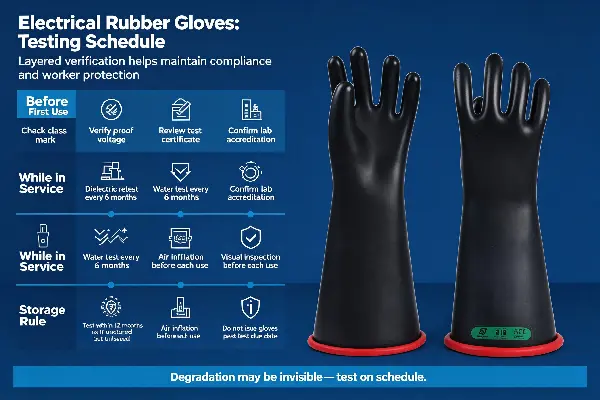
Testing is not a single event; it happens in three separate stages, and each one protects in a different way.
Daily Visual and Air Inflation Inspection
Before each shift, workers should check electrical rubber gloves for air leaks and fill their gloves by rolling the cuff tightly. They should then look at both sides for cuts, punctures, discoloration, or ozone cracking. This only takes two minutes and finds serious damage that would be missed by lab tests.
Biannual Dielectric Testing
Both ASTM F496 and OSHA 1910.137 say that electrical testing must be done on work gloves every six months after they are issued to the worker. Certified labs use high-voltage proof testing tools to do this dielectric test. The glove has to be able to handle its class-rated proof voltage without breaking down or leaking too much current.
Annual Certification for Stored Gloves
Gloves that are in stock are still subject to testing deadlines. If gloves that have been kept haven't been electrically tested in the last 12 months, they can't be given out until they've been tested again and are approved again. To avoid gaps in compliance during audits or OSHA checks, procurement teams that are in charge of big stocks should keep track of certification dates by lot number.
If you're evaluating personal protective equipment suppliers and require batch-specific testing documents before placing an order, PPE MAX is able to provide official Certificates of Analysis, professional laboratory test reports, and product samples for your verification. Feel free to contact our team at marketing@ppemax.com to discuss your sourcing needs and obtain complete documentation for your quality assessment and procurement approval.
The Electrical Rubber Gloves Testing Process Explained
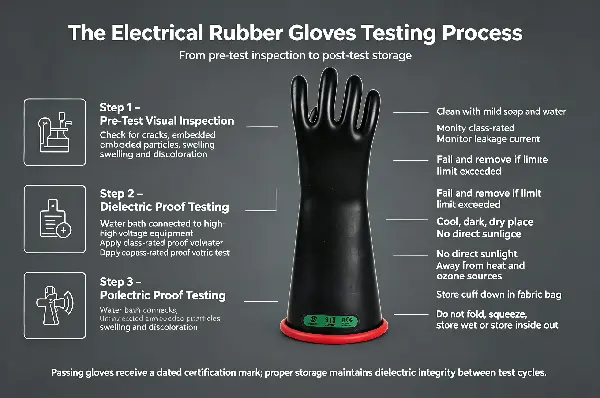
Knowing what happens during testing helps procurement managers be clear about what they need when they're sourcing, and it also helps safety officers train field workers correctly.
Step 1 — Pre-Test Visual Inspection
Technicians look for damage to the object's surface, such as cracks, embedded particles, swelling, or changes in color. Gloves that are dirty are cleaned with mild soap and water and then left to dry completely in the air before moving on. This is a very important step, because dielectric testing won't work if the glove is wet or dirty.
Step 2 — Dielectric Proof Testing
The glove is in a bath of water that is linked to high-voltage equipment. The voltage is set to the class-rated proof level, like 20,000V AC for Class 2, and the leakage current is watched. If the current goes over the ASTM F496 limit, the glove stops working and needs to be taken out of service right away. A certified sticker with a date is made or stamped inside the cuff of passing gloves.
Step 3 — Post-Test Storage and Handling
Once certified, proper storage directly makes service intervals longer. Keep electrical rubber gloves in a cool, dark, dry place that is out of the sun, away from heat sources, and away from things that make ozone. Gloves should be stored in fabric bags with the cuff face down. They should never be folded or squished, and they should never be kept wet or inside out. These actions slow down the aging process and help keep the dielectric integrity between test cycles.
Comparing Testing Frequencies and Benefits for Procurement Decisions
Frequency of testing is not just a legal checkbox for procurement managers who are in charge of big teams. It is also a financial and practical factor.
Testing costs money up front, but think about what could happen instead: OSHA fines for not wearing the right PPE can reach $16,131 per violation, and one electrical death has human and financial effects that can't be fully captured by a cost-benefit analysis. Structured testing programs lower the total cost of ownership because they find wear and tear early and replace gloves before they break, instead of after an accident.
Here are the most important practical things to think about when buying things on a large scale:
- Supplier certification documentation: Verify that your electrical rubber gloves supplier provides dated ASTM or IEC test certificates with each shipment, traceable by lot number.
- Retesting turnaround time: For operations running continuous shifts, fast lab turnaround — or access to on-site certified testing — prevents PPE shortages during rotation.
- Bulk replacement planning: Build retesting schedules into procurement cycles. Ordering replacement gloves in advance of certification expiry dates prevents last-minute emergency purchases at premium prices.
- OEM/ODM branding options: Global brands procuring large volumes can work with manufacturers to embed custom certification tracking — such as QR codes or RFID tags — directly into glove branding for easier fleet management.
These things affect the choice of supplier of electrical rubber gloves just as much as unit price. Over the course of a multi-year deal, a partner that offers testing help, tools for tracking, and bulk price structures is worth a lot more than a cheap supplier that only sells gloves.
Choosing the Right Electrical Rubber Gloves and Testing Solutions for Your Business
The first requirement is to match the glove class to the actual voltage exposure on the job site. Getting Class 4 gloves for a team working on a 480V panel wastes money, and getting Class 0 gloves for work in a distribution center leaves a safety gap. Do a voltage risk assessment first, and then make your choice.
Class Selection and Compliance Scope
When shopping for gloves, make sure they are certified under both ASTM D120 and EN 60903. This is important for businesses with locations in more than one country, because they only need to keep one type of glove in stock to meet the requirements of both North American and European legal authorities.
Type I vs. Type II Material Selection
Click on Type I (Natural Rubber) if you need to be very dexterous for tasks like installing meters, servicing EV batteries, or wiring control panels. Choose Type II (EPDM) for outdoor teams working in high-UV or high-ozone situations, like when they are maintaining power lines, because ozone cracking is a known way for these materials to fail.
Partnering with a Proven Manufacturer
Since 1956, PPE MAX has been making and selling approved insulated gloves to people in 134 different countries. Our team tries the equipment we make themselves, not as a marketing ploy but as a high standard we hold ourselves to. When procurement teams work with us, they can access certification paperwork that can be tracked, OEM and ODM production options, and direct technical support on choosing the right voltage class and making sure testing rules are followed.
Conclusion
Electrical rubber gloves protect lives only when tested on schedule. The standard framework — daily visual checks, six-month dielectric retesting, and 12-month storage certification limits — exists because glove degradation is often invisible to the naked eye. Procurement professionals who build these intervals into sourcing plans, inventory rotations, and supplier contracts reduce both compliance risk and operational disruption. Selecting the right glove class, material type, and certified supplier forms the foundation of any effective electrical safety program. When safety and supply chain reliability depend on the same product, testing frequency is not optional — it is the minimum standard.
FAQ
How long can electrical rubber gloves stay in storage before they need retesting?
Gloves in storage that have not been electrically tested within the last 12 months cannot be issued to workers. Always track certification dates by lot number and schedule retesting before expiry to avoid compliance gaps.
Can dielectric testing be done on-site, or does it require a laboratory?
Dielectric testing requires specialized high-voltage equipment and calibrated measurement instruments. Most operations use certified third-party laboratories. Some large utilities operate in-house test benches, but these must meet ASTM F496 calibration and procedural requirements to produce valid results.
What are the early warning signs that a glove needs immediate replacement?
Replace gloves immediately if you notice ozone cracking along the cuff or fingers, discoloration or swelling of the rubber, embedded foreign particles, a failed air inflation check, or any visible puncture or tear — regardless of when the last dielectric test was performed.
Are leather protector gloves required when wearing insulating rubber gloves?
Yes. Leather protectors are mandatory for Class 1 through Class 4 gloves during live electrical work. They guard the rubber layer against cuts and abrasions that would compromise insulation. The rubber glove cuff must extend beyond the leather protector by a minimum gap distance.
Do testing requirements change for DC voltage applications?
Class-rated gloves can be used for DC applications — for example, Class 3 gloves are rated for 39,750V DC — but the proof test voltage for DC is higher than AC. Confirm with your testing laboratory that DC-specific proof testing has been performed if DC use is the primary application.
Source Certified Electrical Rubber Gloves from PPE MAX
Since 1956, PPE MAX has sold approved electrical rubber gloves to businesses in 134 countries. As one of the biggest companies that makes and sells electrical rubber gloves, we fully comply with ASTM D120 and EN 60903, can produce OEM/ODM items, and offer bulk price structures that are designed for big buying programs. You can email our team at marketing@ppemax.com or go to https://www.ppemax.com/ to get a quote, specifications, or certifications.
References
1. ASTM International. ASTM D120: Standard Specification for Rubber Insulating Gloves. ASTM International, 2023.
2. ASTM International. ASTM F496: Standard Specification for In-Service Care of Insulating Gloves and Sleeves. ASTM International, 2021.
3. Occupational Safety and Health Administration (OSHA). 29 CFR 1910.137: Electrical Protective Equipment. U.S. Department of Labor, 2019.
4. National Fire Protection Association. NFPA 70E: Standard for Electrical Safety in the Workplace. NFPA, 2024.
5. International Electrotechnical Commission. IEC 60903: Live Working — Gloves of Insulating Material. IEC, 2014.
6. Bureau of Labor Statistics. National Census of Fatal Occupational Injuries in 2022. U.S. Department of Labor, 2023.
Learn about our latest products and discounts through SMS or email