- English
- French
- German
- Portuguese
- Spanish
- Russian
- Japanese
- Korean
- Arabic
- Greek
- German
- Turkish
- Italian
- Danish
- Romanian
- Indonesian
- Czech
- Afrikaans
- Swedish
- Polish
- Basque
- Catalan
- Esperanto
- Hindi
- Lao
- Albanian
- Amharic
- Armenian
- Azerbaijani
- Belarusian
- Bengali
- Bosnian
- Bulgarian
- Cebuano
- Chichewa
- Corsican
- Croatian
- Dutch
- Estonian
- Filipino
- Finnish
- Frisian
- Galician
- Georgian
- Gujarati
- Haitian
- Hausa
- Hawaiian
- Hebrew
- Hmong
- Hungarian
- Icelandic
- Igbo
- Javanese
- Kannada
- Kazakh
- Khmer
- Kurdish
- Kyrgyz
- Latin
- Latvian
- Lithuanian
- Luxembou..
- Macedonian
- Malagasy
- Malay
- Malayalam
- Maltese
- Maori
- Marathi
- Mongolian
- Burmese
- Nepali
- Norwegian
- Pashto
- Persian
- Punjabi
- Serbian
- Sesotho
- Sinhala
- Slovak
- Slovenian
- Somali
- Samoan
- Scots Gaelic
- Shona
- Sindhi
- Sundanese
- Swahili
- Tajik
- Tamil
- Telugu
- Thai
- Ukrainian
- Urdu
- Uzbek
- Vietnamese
- Welsh
- Xhosa
- Yiddish
- Yoruba
- Zulu
Are Insulating Gloves Suitable for Outdoor Electrical Work?
Insulating gloves are great for electrical work outside as long as they are chosen and kept in good shape. In a variety of weather situations, these special rubber insulating gloves offer important dielectric protection against electrical shock and arc flash events. Standard work gloves don't protect you from electricity when you're working outside with live wires. Properly rated insulating gloves that are approved to ASTM D120 and IEC 60903 standards create a crucial safety shield that lets electrical pros work on live systems while still meeting OSHA 1910.137 requirements. The important thing is to choose the right voltage class and protect the gloves with leather covers to keep them from getting damaged by things that could happen outside.
Understanding Insulating Gloves and Their Role in Outdoor Electrical Work
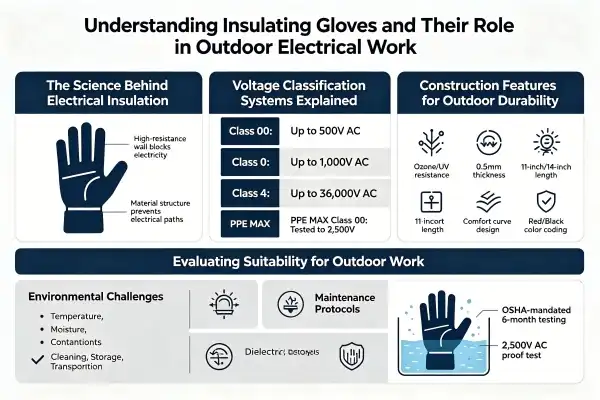
The Science Behind Electrical Insulation
How electrical insulation works: the science behind it
Rubber insulator gloves work by putting up a high-resistance wall that stops electricity from getting to the skin of the person wearing them. Natural rubber latex or manmade materials made just for insulating qualities are used to make these gloves. Because the structure of the material doesn't have any connecting paths, electrical energy stays on the outside of the glove instead of going through to the hand. How well this safety works depends on how strong the glove's dielectric is—how well it keeps electricity from breaking down when voltage stress is applied. Every batch that we make goes through strict proof testing at voltages much higher than their listed capacity to make sure they are reliable. The rubber material must stay the same width, not have any tiny flaws, and not break down when exposed to the environment.
Voltage Classification Systems Explained
Based on the highest power they can handle, insulating gloves are divided into six separate groups. If you work with low voltages like in telecommunications, control circuits, or repair, Class 00 insulating gloves will keep you safe from voltages up to 500V AC. Class 0 adds safety up to 1,000V AC, making it good for work with electricity meters and light industrial tasks. The next level of rating is Class 4, which protects high-voltage transmission line work up to 36,000V AC. Understanding voltage levels is a key part of making choices about what to buy. Using gloves that aren't rated properly can put your life at risk, and using gloves that are rated too highly could mean giving up comfort and flexibility for extra safety. PPE MAX's Class 00 Insulating Gloves, which have been tested to 2,500V safe standards, are the first level of security for low-voltage outdoor uses in the telecom, power, and industrial sectors.
Construction Features for Outdoor Durability
Modern electrical safety gloves are made with features that are especially designed to deal with problems that come up outside. Our Class 00 types are made of high-quality natural rubber latex that is more resistant to ozone breakdown and UV rays, two things that quickly wear down regular rubber materials. The average thickness of 0.5 mm strikes a good balance between security and physical awareness. This lets workers work with small parts and wires without taking off their gloves. These gloves come in 11-inch and 14-inch lengths and cover the forearms well to keep electricity from running down wet sleeves, which is a common outdoor danger. The comfortable curve design keeps hands from getting tired after long periods of use, which addresses worker comfort concerns that lower obedience rates. Our types come in both red and black, so you can quickly see which glove class it is. This keeps you safe on multi-voltage job sites where there are many voltages.
Evaluating the Suitability of Insulating Gloves for Outdoor Electrical Work
Environmental Challenges and Material Response
When electrical work is done outside, stresses that aren't found in climate-controlled buildings are put on protection gear. Temperature changes affect the flexibility of rubber. Extreme cold makes it stiff, which makes it less flexible, and too much heat speeds up the breakdown of the material. Two problems arise when there is wetness: water on the surface of gloves can make electrical paths, and moisture inside gloves from sweating makes them less comfortable and less good at grip. Through complex formulation, our production process gets around these problems. The natural rubber latex in PPE MAX Class 00 gloves stays flexible in a wide range of temperatures that are common in most work areas. Surface treatments make it easier to grip both dry and wet surfaces, which means that workers are less likely to take off their gloves to do precise work. Because the material is naturally resistant to ozone and UV rays, the gloves will last longer even if they are often in full sunlight while working outside.
More risks are caused by contaminants. Oil, grease, fluids, and chemicals can break down rubber materials, leaving weak spots that will break when electrical stress is applied. When used outside, it's important to check the item visually before each use. Workers must check their gloves for cuts, punctures, trash lodged inside, swelling, or changes in texture that could mean a chemical attack. Any glove that has been tampered with must be taken out of service right away.
Maintenance Protocols for Outdoor Use
Proper maintenance extends glove lifespan and ensures consistent protection. After exposure to outdoor conditions, gloves should be cleaned using mild soap and water, then thoroughly dried before storage. Aggressive cleaning agents or petroleum-based products must be avoided as they attack rubber molecular structures. Storage locations should be cool, dark, and dry, away from electrical equipment that generates ozone or ultraviolet radiation. The storage method matters significantly. Gloves should be placed in breathable canvas bags rather than sealed plastic containers that trap moisture. Folding or sharp creasing creates stress concentration points that develop into cracks, so gloves should be stored in a relaxed, natural position. When transporting gloves to outdoor job sites, protective cases prevent mechanical damage during transit.
Dielectric Testing Requirements
Electrical proof testing represents the only definitive method to verify insulation integrity. OSHA mandates testing intervals of six months for gloves in active service, though many safety programs implement quarterly testing for gloves subjected to harsh outdoor conditions. Testing involves inflating the glove and submerging it in conductive solution while applying the specified proof test voltage—for our Class 00 models, this means 2,500V AC. Testing identifies pinhole leaks, thin spots, and material degradation invisible to visual inspection in insulating gloves. We recommend partnering with certified testing facilities or investing in portable testing equipment for large fleets of insulating gloves. Every glove that passes testing receives a date stamp indicating the next test due date, enabling straightforward compliance tracking. Insulating gloves that fail testing must be destroyed to prevent accidental reuse.
Comparison of Insulating Gloves vs Other Protective Gloves for Outdoor Use
Leather Gloves: Mechanical Protection Without Electrical Safety
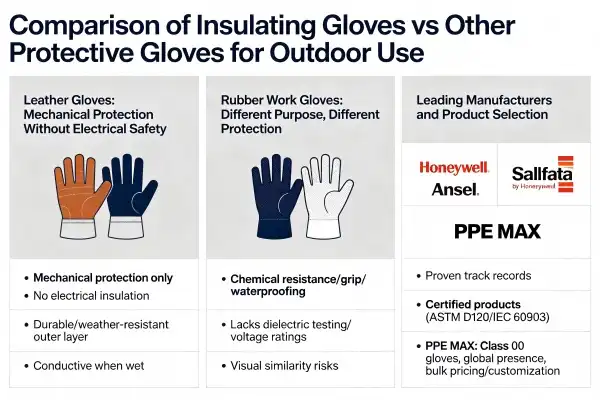
Leather protector gloves serve an essential role in electrical work, but they provide zero electrical insulation. Their purpose is purely mechanical—guarding rubber insulating gloves against cuts, abrasions, and punctures from sharp edges, tools, and rough surfaces common in outdoor environments. Leather offers excellent durability and weather resistance, making it ideal for the outer protective layer. The confusion arises when workers mistakenly believe leather alone provides adequate protection for electrical work. This dangerous misconception has contributed to numerous fatalities. Leather's natural fibers retain moisture, creating conductive pathways when wet. The material offers no rated dielectric strength and will not prevent current flow during electrical contact. All outdoor electrical work on energized circuits requires rated insulating gloves worn underneath leather protectors.
Rubber Work Gloves: Different Purpose, Different Protection
General-purpose rubber work gloves—designed for chemical resistance, grip, or waterproofing—differ fundamentally from certified electrical insulating gloves. These industrial rubber gloves lack the dielectric testing, voltage ratings, and material purity standards required for electrical safety applications. Their manufacturing processes don't control for conductive contaminants or ensure consistent thickness distribution. The visual similarity between work rubber gloves and electrical insulating gloves creates procurement risks. Safety managers must ensure purchasing specifications explicitly reference ASTM D120 and IEC 60903 certification. The presence of voltage rating labels and proof test date stamps distinguishes genuine insulating gloves from look-alike products. When equipping teams for outdoor electrical work, there is no acceptable substitute for properly certified equipment.
Leading Manufacturers and Product Selection
The electrical safety equipment market includes several manufacturers with proven track records. Companies like Honeywell, Ansell, and Salisbury by Honeywell offer comprehensive product lines spanning all voltage classes. These manufacturers maintain rigorous quality control systems and provide detailed technical documentation supporting their certifications. PPE MAX has served the global electrical safety market since 1956, establishing ourselves as a trusted manufacturer for utilities, telecom providers, and industrial facilities across 134 countries. Our Class 00 Insulating Gloves meet both ASTM D120 and IEC 60903 standards, carrying CE marking for European markets along with additional regional certifications. The combination of decades-long manufacturing expertise, competitive bulk pricing, and customization capabilities positions us as a strategic partner for organizations managing large-scale PPE procurement.
Procurement Guide: Buying the Right Insulating Gloves for Outdoor Electrical Work
Technical Specifications That Matter
Voltage rating stands as the primary specification—it must meet or exceed the maximum voltage workers will encounter. Our Class 00 gloves with 500V AC maximum use voltage suit telecommunications installations, HVAC electrical systems, low-voltage industrial maintenance, and control circuit work. The 2,500V proof test provides a substantial safety margin above the use voltage, accounting for voltage spikes and transient conditions. Sizing directly impacts both safety and productivity. Gloves too small create hand fatigue and may tear during donning, while oversized gloves reduce dexterity and allow excessive material bunching. We manufacture sizes 8, 9, 10, and 11 to accommodate diverse hand dimensions. Procurement teams should conduct sizing assessments, ensuring workers receive properly fitted equipment rather than defaulting to one-size-fits-all purchasing.
Length selection depends on arm exposure risks. Standard 11-inch gloves provide hand and wrist coverage adequate for most low-voltage outdoor work. The 14-inch option extends protection further up the forearm, preventing electrical contact when reaching into equipment or working overhead where sleeves may pull back. Material weight also factors into comfort—our Class 00 gloves average 170g per pair, light enough for extended wear without causing excessive fatigue.
Certification and Compliance Verification
Legitimate electrical insulating gloves carry permanent markings indicating class, size, manufacturing date, and applicable standards. Before purchasing, verify that products reference ASTM D120 (North American standard) and IEC 60903 (international standard). Regional requirements may mandate additional certifications—CE marking for European Union markets, for instance. Request documentation proving certification testing. Reputable manufacturers provide test reports, material certifications, and quality system documentation. PPE MAX maintains comprehensive technical files demonstrating compliance across all regulatory frameworks applicable to our distribution markets. This documentation proves essential during safety audits and incident investigations where PPE adequacy comes under scrutiny.
Supplier Evaluation and Partnership Considerations
Choosing suppliers based solely on unit price creates long-term risks. Evaluate manufacturers based on quality consistency, testing capabilities, technical support availability, and supply chain reliability. Suppliers with decades of operational history demonstrate stability unlikely to vanish mid-contract. We've operated continuously since 1956, surviving multiple market cycles while maintaining quality standards. Bulk ordering capabilities matter for organizations managing large workforces. Our standard packaging—1 pair per box, 20 pairs per carton—facilitates inventory management and distribution. Carton dimensions of 54.5×35×42.5cm and a weight of 6.5kg optimize shipping costs. We accommodate custom packaging requirements for organizations with specific distribution needs. Technical support availability proves crucial when field questions arise—our team provides comprehensive product training, maintains a technical support hotline, and delivers rapid response to inquiries and issues.
Customization options allow organizations to implement specialized requirements. Private labeling supports distributor branding strategies, while modified cuff designs or color specifications can address unique operational needs. Lead times for custom orders vary based on modification complexity, though our manufacturing capacity enables responsive production scheduling even for substantial order volumes.
Real-World Applications and Case Studies of Using Insulating Gloves Outdoors
Telecommunications Infrastructure Maintenance
Telecommunications technicians routinely work on powered systems in outdoor environments, servicing cell towers, fiber optic networks, and telephone infrastructure. These applications typically involve voltages within the Class 00 range—48V DC power systems and 120V AC service connections. Work conditions vary from desert heat to winter precipitation, demanding gloves that maintain performance across environmental extremes. A regional telecommunications contractor supplying services across the southwestern United States implemented our Class 00 insulating gloves as standard equipment for field crews. The decision followed an incident where a technician received a shock from a 120V circuit while wearing non-rated gloves. After switching to certified electrical insulating gloves paired with leather protectors, the company achieved three consecutive years without electrical contact incidents despite over 10,000 service calls performed on energized equipment.
The contractor noted that initial worker resistance to wearing "bulkier" gloves diminished once technicians experienced the maintained dexterity our ergonomic design provides. The ability to manipulate small connectors and fasteners without removing gloves improved both safety compliance and work efficiency. Quarterly glove inspection and semi-annual testing protocols were integrated into the equipment management program, creating systematic accountability for PPE condition.
Industrial Electrical Maintenance in Manufacturing Facilities
Manufacturing plants require continuous electrical system monitoring and maintenance, much of which occurs in outdoor switchyards, rooftop HVAC installations, and exterior lighting systems. Maintenance electricians face exposure to weather while servicing 480V distribution panels, motor control centers, and disconnect switches. The combination of voltage levels and environmental exposure creates elevated risk profiles. A food processing facility in the Midwest reorganized its electrical safety program after a near-miss incident where moisture on a worker's cotton gloves contributed to current flow during troubleshooting. The safety manager implemented a comprehensive PPE upgrade, including properly rated insulating gloves, leather protectors, arc-rated clothing, and dielectric footwear. Workers received training emphasizing the specific purpose of each PPE component and the importance of maintaining equipment integrity.
The facility established a centralized PPE management system with individual glove assignments, testing schedules, and storage lockers, maintaining proper environmental conditions. Gloves returning from outdoor work undergo cleaning and inspection before storage. This systematic approach reduced PPE-related compliance violations by 89% within the first year while building a culture where workers actively participated in equipment condition monitoring rather than viewing it as an administrative burden.
Best Practices from Industry Leaders
Organizations with exemplary electrical safety records share common practices. Regular training reinforces proper donning procedures—workers must inspect gloves before each use, check for proper fit, and confirm voltage ratings match the task. Leather protectors are mandatory for any outdoor work where physical hazards exist. Gloves are removed and inspected after any unusual stress, impact, or suspected contamination. Progressive companies implement job hazard analyses requiring explicit identification of voltage levels and required PPE before work begins. This prevents the casual decision-making that leads to inadequate protection. Equipment tracking systems monitor testing due dates, automatically flagging gloves requiring inspection before they're inadvertently used beyond certification periods. These systematic controls transform electrical safety from individual worker responsibility to organizational accountability, dramatically improving compliance and outcomes.
Conclusion
Insulating gloves are unequivocally suitable for outdoor electrical work when organizations implement proper selection, maintenance, and compliance protocols. The unique challenges of outdoor environments—moisture, temperature extremes, UV exposure, and contaminants—require thoughtful PPE strategies extending beyond simple product purchase to encompass comprehensive management systems. Proper voltage classification, certified manufacturing standards, routine testing, and worker training create layered protection against electrical hazards. Our experience across six decades and 134 countries confirms that investment in quality electrical insulating gloves delivers measurable returns through injury prevention, regulatory compliance, and workforce confidence. The relatively modest cost of certified gloves becomes negligible when weighed against the consequences of electrical contact incidents.
For procurement managers, engineers, and safety distributors, the decision framework centers on partnering with manufacturers demonstrating technical expertise, quality consistency, and support capabilities matching your organization's operational requirements.
FAQ
1. Can electrical insulating gloves be safely used in wet conditions?
Certified insulating gloves maintain their dielectric properties when wet, but moisture on the exterior surface creates slip hazards and can allow current tracking along the glove surface. Workers should dry gloves before handling energized equipment when possible. Wet conditions require heightened attention to maintaining dry leather protectors, as moisture-saturated leather offers reduced mechanical protection and grip. The glove's interior should remain dry—moisture from perspiration compromises comfort but doesn't eliminate electrical protection. Some organizations provide multiple glove sets, enabling rotation while pairs dry between uses.
2. What are the testing requirements for gloves used outdoors?
OSHA mandates electrical testing every six months for gloves in active service. Organizations subjecting gloves to harsh outdoor conditions often implement quarterly testing, providing additional safety margins. Testing must be performed by qualified facilities using calibrated equipment, applying the full proof test voltage specified for the glove class. Visual inspection occurs before every use, checking for cuts, embedded debris, texture changes, or other damage indicators. Any glove showing wear or failing testing must be removed from service immediately.
3. Do insulating gloves require leather protectors?
Leather protectors are mandatory for outdoor electrical work. While rubber insulating gloves provide electrical protection, they lack mechanical abrasion resistance. Sharp edges, rough surfaces, tools, and debris encountered in outdoor environments can easily puncture or cut rubber. Leather protector gloves worn over insulating gloves guard against this mechanical damage, significantly extending service life while maintaining safety. The leather layer also improves grip on tools and materials, reduces UV degradation of the rubber, and provides additional thermal insulation during cold-weather operations.
Partner with PPE MAX for Certified Electrical Safety Solutions
When your teams depend on reliable protection during outdoor electrical work, equipment quality and manufacturer expertise make the difference. PPE MAX delivers Class 00 insulating gloves combining proven dielectric performance with outdoor durability, backed by ASTM D120 and IEC 60903 certification. As an insulating gloves manufacturer serving global markets since 1956, we understand the procurement challenges facing safety managers and distributors.
Our competitive bulk pricing, customization capabilities, and technical support streamline your equipment management while ensuring workforce protection. Whether you're equipping telecommunications crews, industrial maintenance teams, or utility workers, we provide the expertise and product quality your operations demand. Contact our team at marketing@ppemax.com to discuss your specific requirements, request technical specifications, or place volume orders. We're not just suppliers—we're partners in protecting the professionals who keep critical infrastructure operating safely across 134 countries.
References
1. American Society for Testing and Materials. (2022). ASTM D120-20: Standard Specification for Rubber Insulating Gloves. ASTM International.
2. International Electrotechnical Commission. (2023). IEC 60903:2023 Live working – Gloves of insulating material. IEC Standards Publications.
3. Occupational Safety and Health Administration. (2021). 1910.137 - Electrical Protective Equipment. U.S. Department of Labor.
4. National Fire Protection Association. (2023). NFPA 70E: Standard for Electrical Safety in the Workplace. NFPA Publications.
5. Institute of Electrical and Electronics Engineers. (2022). IEEE 1584: Guide for Performing Arc-Flash Hazard Calculations. IEEE Standards Association.
6. Occupational Safety and Health Administration. (2020). Personal Protective Equipment for Electrical Workers: A Guide for Selection, Use and Maintenance. OSHA Technical Publications.
Learn about our latest products and discounts through SMS or email