- English
- French
- German
- Portuguese
- Spanish
- Russian
- Japanese
- Korean
- Arabic
- Greek
- German
- Turkish
- Italian
- Danish
- Romanian
- Indonesian
- Czech
- Afrikaans
- Swedish
- Polish
- Basque
- Catalan
- Esperanto
- Hindi
- Lao
- Albanian
- Amharic
- Armenian
- Azerbaijani
- Belarusian
- Bengali
- Bosnian
- Bulgarian
- Cebuano
- Chichewa
- Corsican
- Croatian
- Dutch
- Estonian
- Filipino
- Finnish
- Frisian
- Galician
- Georgian
- Gujarati
- Haitian
- Hausa
- Hawaiian
- Hebrew
- Hmong
- Hungarian
- Icelandic
- Igbo
- Javanese
- Kannada
- Kazakh
- Khmer
- Kurdish
- Kyrgyz
- Latin
- Latvian
- Lithuanian
- Luxembou..
- Macedonian
- Malagasy
- Malay
- Malayalam
- Maltese
- Maori
- Marathi
- Mongolian
- Burmese
- Nepali
- Norwegian
- Pashto
- Persian
- Punjabi
- Serbian
- Sesotho
- Sinhala
- Slovak
- Slovenian
- Somali
- Samoan
- Scots Gaelic
- Shona
- Sindhi
- Sundanese
- Swahili
- Tajik
- Tamil
- Telugu
- Thai
- Ukrainian
- Urdu
- Uzbek
- Vietnamese
- Welsh
- Xhosa
- Yiddish
- Yoruba
- Zulu
How to Ensure Proper Fit of Your Full Mask Respirator?
To make sure a Full Mask Respirator fits right, it's important to test the fit, choose the right size, and check the seal often, just as with insulating gloves. When it fits right, it keeps contaminants away from the wearer's face, protecting the eyes, nose, and mouth from harmful exposures. To do this, you need to know the size of your face, keep the objects you touch clean, and follow the manufacturer's instructions. Even the most advanced lung protection equipment, like insulating gloves and respirators, won't work as well as it should if it doesn't fit right. This means that workers in chemical, industrial, and emergency response settings are open to airborne hazards.
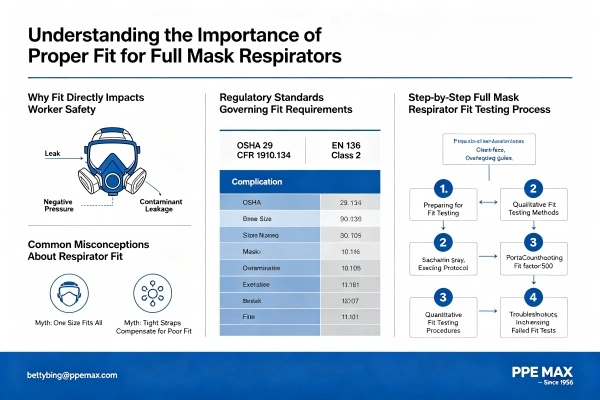
Understanding the Importance of Proper Fit for Full Mask Respirators
When you invest in respiratory protection for your workforce, the fit determines whether your equipment will truly safeguard lives. At PPE MAX, we've witnessed how even premium-grade masks fail when the seal between silicone and skin is compromised. The concept extends beyond comfort—it's the difference between an Assigned Protection Factor of 50 and zero protection.
Why Fit Directly Impacts Worker Safety
When you breathe in, a properly fitting mask creates negative pressure, which forces air only through approved filters. Any hole, no matter how small, lets contaminants that haven't been filtered get through the filtration media. Researchers at NIOSH have found that loss rates as low as 1% can make safety up to 50% less effective. When volatile organic compounds are used to make chemicals in amounts that are higher than what is allowed, they leak out and cause short-term and long-term health problems.
Regulatory Standards Governing Fit Requirements
Compliance frameworks like OSHA 29 CFR 1910.134 require workers who wear tight-fitting respirators to get a fit test every year. In European markets, the EN 136 standard divides full facepieces into three groups based on how much air leaks in. At PPE MAX, we use automatic seal testing to make sure that every unit meets Class 2 requirements (leakage <0.05%). This level of quality control gives procurement managers the proof they need for workplace checks to show that they are following the rules.
Common Misconceptions About Respirator Fit
A lot of people think that facial safety is "one size fits all," but measurement studies show that people's faces are very different in terms of width, depth, and shape. Another myth says that fixing the straps can make up for bad size matches. In fact, overtightening changes the shape of the facepiece, which creates pressure points that allow the seal to break when the piece is moved. The right fit comes from matching the respirator's measurements to each person's face, not from putting too much stress on the straps.
Step-by-Step Full Mask Respirator Fit Testing Process
Procurement teams responsible for large workforces must establish standardized fit testing protocols. We've developed training programs covering both qualitative and quantitative methodologies, reflecting six decades of field experience since our founding in 1956.
Preparing for Fit Testing
Make sure the facepiece of the mask is clean and that the person wearing it doesn't have any makeup or grease on their face before the test starts, just as with insulating gloves. The person should be physically cleared by filling out surveys that check their lung health. Choose the right size using the manufacturer's sizing guide. PPE MAX offers models that measure bitragion width (the distance between the temples) and menton-sellion length (the height of the bridge from the chin to the nose). In the closing area, users must be clean-shaven because even one day's hair can make leak tracks. When using insulating gloves, the same attention to proper fit and preparation is important.
Qualitative Fit Testing Methods
Qualitative testing uses the test subjects' senses to find test agents. Most of the time, saccharin or Bitrex spray is used in the procedure. A person wears a mask inside a test hood while the person in charge sprays the agent around the seal area. To stress the seal, the person who wears it does exercises like normal breathing, deep breathing, head movements, talking, grimacing, and bending. The fit is good if there is no leakage. This method is easier for scattered workforces to use because it costs less and doesn't need many tools.
Quantitative Fit Testing Procedures
Quantitative testing uses tools like PortaCount machines to measure real leaks. These gadgets measure the number of particles inside and outside the mask and figure out a "fit factor," which is the ratio of the contamination inside to the contamination outside. OSHA says that full-face respirators must have a fit factor of at least 500. The person wearing it does the same workout routine while probes constantly sample the air. This objective data is very helpful when the law or insurance companies look into something. Our technical support team (bettybing@ppemax.com) helps clients set up quantitative testing tools on-site.
Troubleshooting Failed Fit Tests
When testing reveals leaks, systematically identify the source. Check head harness adjustment—the five-point system on our models distributes pressure evenly when positioned correctly. Inspect the silicone seal for damage or residue. Try alternate sizes; facial swelling or weight changes may necessitate different dimensions. Some wearers require low-profile models to accommodate eyewear temples without compromising the seal. Document each adjustment attempt to build institutional knowledge about which models suit specific worker populations.
Tips and Best Practices for Achieving Optimal Fit
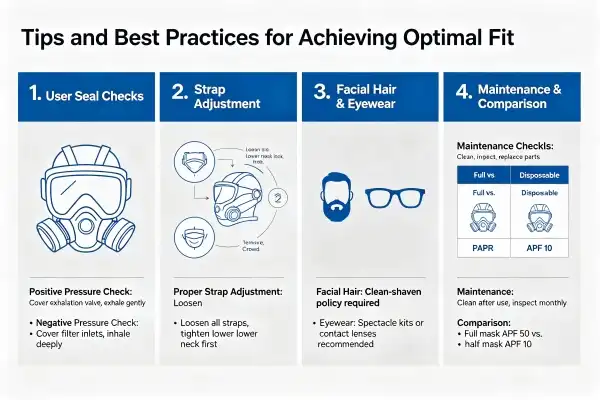
Maintaining seal integrity requires daily discipline from end users. Training programs should emphasize that fit verification is not a one-time certification but an ongoing responsibility.
Performing User Seal Checks Before Each Use
Every donning event demands a positive and negative pressure check. These simple practices catch ninety percent of fit problems before exposure occurs. Positive Pressure Check: Cover the exhalation valve with your palm and exhale gently. The facepiece should bulge slightly, and no air should escape around the seal. Hold for ten seconds to verify sustained pressure. Negative Pressure Check: Cover filter inlets and inhale deeply. The mask should collapse against your face and remain so without air entering. This confirms the absence of inward leakage paths. These checks take under thirty seconds but provide immediate feedback about seal integrity. Instruct workers to repeat checks after any adjustment or if they notice odors during work. The anti-fog polycarbonate lens on PPE MAX respirators allows visual confirmation of seal collapse during negative pressure checks.
Proper Strap Adjustment Techniques
The head harness creates the contact force between the facepiece and skin, similar to how proper fit is crucial for insulating gloves. Begin by loosening all straps completely before donning. Position the mask on your face, then tighten the lower neck straps snugly. Next, adjust the temple straps, followed by the crown strap. This sequence prevents the facepiece from riding up during tightening. Straps should feel secure without causing discomfort or leaving deep marks. Users should re-tighten straps at the start of each shift, as silicone relaxes slightly with temperature changes, just as insulating gloves require periodic adjustment to maintain proper fit.
Accommodating Facial Hair and Eyewear
Beards, sideburns, or stubble in the sealing area create leak channels that no amount of tightening can eliminate. Research published by the National Institutes for Health confirms that even a two-day growth reduces protection factors below acceptable levels. Organizations must enforce clean-shaven policies in areas requiring tight-fitting respirators or provide alternative protection like powered air-purifying respirators with loose-fitting hoods.
Eyeglasses pose challenges as temples penetrate the seal. Our masks accommodate spectacle kits—frames that mount inside the facepiece without crossing the seal boundary. Contact lenses offer another solution, though users should consult eye care professionals about wearing them in environments with irritant gases.
Maintenance Protocols for Long-Term Fit Integrity
Clean respirators after each use with mild detergent and warm water, avoiding petroleum-based cleaners that degrade silicone. Inspect the facepiece for cracks, tears, or permanent deformation monthly. Replace inhalation and exhalation valves annually or when they show signs of stiffening. Store masks in a cool, dry location away from sunlight and chemicals. Our replacement parts inventory ensures procurement managers can maintain fleet readiness without long lead times. Proper maintenance extends service life beyond five years, delivering superior total cost of ownership compared to disposable alternatives.
Comparing Full Mask Respirator Fit with Other Respirator Types
Understanding how facial coverage affects fit requirements helps procurement professionals select appropriate protection levels for various exposure scenarios.
Full Mask Versus Half Mask Respirators
Half-face designs seal at the chin, cheeks, and nose bridge, covering only the respiratory tract. Full-face models extend the seal to the forehead and jawline, integrating eye protection. The expanded sealing perimeter increases the potential points of leakage but achieves this through medical-grade silicone that conforms to complex facial contours. The tradeoff yields substantial benefits: full masks provide an APF of 50 compared to 10 for half-face models, and they protect mucous membranes in the eyes from irritants like ammonia or formaldehyde. In environments where both respiratory and ocular hazards exist simultaneously—such as chemical processing or pharmaceutical compounding—full masks eliminate the need for separate goggles, reducing compatibility concerns.
Full Mask Versus Powered Air-Purifying Respirators
Powered air-purifying respirators (PAPRs) use battery-driven blowers to push filtered air into loose-fitting hoods or tight-fitting facepieces. Loose-fitting PAPR hoods don't require fit testing since they maintain positive pressure that prevents inward leakage. This makes them ideal for wearers who cannot achieve a seal due to facial scars or unique anatomy. However, PAPRs cost significantly more—often five times the price of our Full Mask Respirator—and require battery maintenance. The added weight and bulk reduce mobility in confined spaces. Tight-fitting PAPR facepieces still demand fit testing but reduce breathing resistance, benefiting workers engaged in strenuous activity during extended shifts.
Disposable Versus Reusable Full Masks
Disposable filtering facepiece respirators (like N95 types) rarely include full-face coverage. When they do, achieving a consistent fit proves difficult because the rigid media cannot adapt to facial movements. Reusable full masks, particularly those with replaceable cartridges, maintain seal integrity through flexible silicone that moves with the wearer. The initial investment in reusable units is recouped through filter replacement economics. PPE MAX clients in mining operations report three-year lifecycles for facepieces, with cartridge changes every thirty days. This durability reduces waste streams and procurement frequency, advantages that matter to large enterprises managing thousands of workers across multiple sites.
How to Choose the Right Full Mask Respirator for Your Business Needs
Selecting respiratory protection involves balancing performance specifications, certification requirements, and supplier capabilities. Procurement decisions impact worker safety and operational budgets for years.
Key Fit-Related Features to Evaluate
Examine the facepiece material—silicone offers superior comfort and durability over rubber or TPE alternatives. Verify the strap system includes at least five adjustment points for facial diversity within your workforce. Check for speech diaphragms if communication is critical; our units include this feature to facilitate team coordination without removing the mask. Evaluate lens design—wide-view polycarbonate lenses expand peripheral vision, reducing accidents in environments with moving equipment. Confirm filter compatibility; bayonet-style connections meeting EN 148-1 standards allow interchangeability across brands, protecting your investment if you change suppliers.
Certification Compliance and Standards
Under 42 CFR Part 84, respirators used by U.S. workers must have NIOSH approval. Australia and New Zealand use AS/NZS 1716, while European markets accept EN 136 approval. All three of PPE MAX's certifications are kept up to date by independent testing labs. This makes it easier for international businesses to stay in compliance. Ask for test results that show the rates of inward leaks, breathing resistance, and field-of-view measures. When comparing different makers, these detailed specs let you compare like with like, and ensure compatibility with insulating gloves for full personal protection.
Supplier Reliability and After-Sales Support
Working with a skilled maker gives you access to technical support and new parts. Since 1956, we've sold breathing protection in 134 countries and built relationships with end users, safety experts, and wholesalers. Our after-sales service includes on-site training sessions where our team shows you how to properly put on, check the fit, and maintain your gear. We keep extra parts like silicone seals, breathing valves, head straps, and speech diaphragms on hand so that we can get replacements quickly in case of an emergency. Occupational health experts who work in technical support hotlines can answer questions about choosing the right filter, how to clean it, and how to fix fit problems.
Bulk Ordering and Customization for Large Fleets
Our tiered price system lets people who buy a lot of things take advantage of savings of scale. Custom labelling is available for orders over 500 units, which lets your name show up on the package. This is a useful choice for wholesalers and companies that give out safety gear. We offer size profile services, in which our agents measure your staff and suggest buying rates (30% small, 50 % medium, and 20 % large). This method, which is based on data, keeps stocking prices low while still making sure there is enough stock. When you work with an OEM or ODM, you can ask for special features like straps that match your company's colours or built-in communication systems. These changes make your safety program stand out and make it easier to justify purchases during budget reviews.
Conclusion
Proper fit transforms a Full Mask Respirator from a compliance checkbox into genuine protection for your most valuable asset—your people. The process demands attention to selection, testing, daily verification, and ongoing maintenance. By implementing systematic fit testing, training workers on seal checks, and partnering with manufacturers who understand industrial realities, procurement professionals create safety cultures that reduce incidents and boost morale. PPE MAX combines 65 years of manufacturing expertise with global supply capabilities, delivering certified respiratory protection that fits diverse workforces across demanding environments. When fit is prioritized from initial selection through end-of-life replacement, organizations achieve measurable improvements in compliance rates, worker confidence, and operational continuity.
FAQ
1. How Often Should Fit Testing Be Conducted?
OSHA regulations require annual fit testing at a minimum. Additional testing is necessary when the employee experiences significant weight change (gain or loss of 20 pounds), dental work affecting facial structure, or facial scarring. Organizations should retest whenever switching to a different respirator model or manufacturer, even if the visual appearance seems similar. Some industries with heightened risk profiles conduct fit testing semi-annually to maintain maximum protection assurance.
2. Can Facial Hair Ever Be Compatible with a Proper Seal?
No amount of careful donning compensates for facial hair in the sealing area. Research consistently demonstrates that even minimal stubble creates leakage sufficient to fail fit testing. Goatees, mustaches, and beards prevent the silicone-to-skin contact necessary for negative pressure operation. Workers unwilling or unable to maintain clean-shaven faces should use positive-pressure supplied-air respirators or loose-fitting PAPR hoods that do not rely on facial seals. Religious or medical accommodations require alternative protection methods rather than exceptions to fit requirements.
3. What Maintenance Practices Preserve Fit Effectiveness Over Time?
Inspect the silicone facepiece before each use for tears, cracks, or permanent distortion. Clean after every shift using manufacturer-approved solutions—harsh chemicals degrade seal materials. Store respirators in protective cases away from temperature extremes and direct sunlight, which accelerate material aging. Replace components according to the maintenance schedule: exhalation valves annually, head straps when elasticity diminishes, and the entire facepiece every five years regardless of visible condition. Maintain calibration on quantitative fit testing equipment per manufacturer specifications to ensure measurement accuracy during periodic retesting.
Partner with PPE MAX for Superior Respiratory Protection Solutions
Protecting your workforce demands more than purchasing equipment—it requires a Full Mask Respirator manufacturer committed to your long-term safety outcomes. PPE MAX brings 65 years of engineering excellence, serving clients across chemical processing, mining, construction, and emergency response sectors in 134 countries. Our NIOSH-certified, EN 136-compliant respirators feature medical-grade silicone seals, and we also provide insulating gloves to ensure comprehensive worker protection, anti-fog polycarbonate lenses, and five-point adjustable harnesses designed for diverse facial profiles. We support your procurement team with fit testing consultation, bulk ordering discounts, and replacement parts availability that keep your fleet operational. Contact our specialists at marketing@ppemax.com to discuss your specific requirements, request product samples, or schedule a facility tour at our Xi'an manufacturing center. Your workers deserve protection backed by decades of proven reliability.
References
1. National Institute for Occupational Safety and Health. (2019). Respirator Fit Testing: OSHA Compliance and Best Practices. DHHS (NIOSH) Publication No. 2018-129.
2. Occupational Safety and Health Administration. (2020). Respiratory Protection Standard 29 CFR 1910.134: Compliance Guide for General Industry.
3. European Committee for Standardization. (2018). EN 136:1998 Respiratory Protective Devices - Full Face Masks - Requirements, Testing, Marking. CEN-CENELEC Management Centre.
4. Clayton, M. & Vaughan, N. (2017). Fit Testing Protocols and Performance Factors in Negative Pressure Respirators. Journal of Occupational and Environmental Hygiene, 14(8), 589-602.
5. Han, D. H., et al. (2021). Effect of Facial Hair on Respirator Fit: Quantitative Assessment Using Advanced Leak Detection Methods. Annals of Work Exposures and Health, 65(4), 412-425.
6. International Safety Equipment Association. (2022). Respiratory Protection: Selection, Use, and Maintenance Guidance for Industrial Applications. ISEA Technical Report TR-2022-08.
Learn about our latest products and discounts through SMS or email