- English
- French
- German
- Portuguese
- Spanish
- Russian
- Japanese
- Korean
- Arabic
- Greek
- German
- Turkish
- Italian
- Danish
- Romanian
- Indonesian
- Czech
- Afrikaans
- Swedish
- Polish
- Basque
- Catalan
- Esperanto
- Hindi
- Lao
- Albanian
- Amharic
- Armenian
- Azerbaijani
- Belarusian
- Bengali
- Bosnian
- Bulgarian
- Cebuano
- Chichewa
- Corsican
- Croatian
- Dutch
- Estonian
- Filipino
- Finnish
- Frisian
- Galician
- Georgian
- Gujarati
- Haitian
- Hausa
- Hawaiian
- Hebrew
- Hmong
- Hungarian
- Icelandic
- Igbo
- Javanese
- Kannada
- Kazakh
- Khmer
- Kurdish
- Kyrgyz
- Latin
- Latvian
- Lithuanian
- Luxembou..
- Macedonian
- Malagasy
- Malay
- Malayalam
- Maltese
- Maori
- Marathi
- Mongolian
- Burmese
- Nepali
- Norwegian
- Pashto
- Persian
- Punjabi
- Serbian
- Sesotho
- Sinhala
- Slovak
- Slovenian
- Somali
- Samoan
- Scots Gaelic
- Shona
- Sindhi
- Sundanese
- Swahili
- Tajik
- Tamil
- Telugu
- Thai
- Ukrainian
- Urdu
- Uzbek
- Vietnamese
- Welsh
- Xhosa
- Yiddish
- Yoruba
- Zulu
Electrical Rubber Gloves for High-Voltage Equipment Handling
Electrical rubber gloves are the best way for workers to protect themselves from life-threatening electrical shocks when they get close to high-voltage equipment. These special insulating electrical rubber gloves are very different from regular work gloves because they are designed to have dielectric qualities that stop electrical current from flowing through them. Made from rubber materials that have been through a lot of tests, they protect people who work with live circuits in power plants, substations, and other industrial settings. The gloves have voltage ratings from Class 00 to Class 4, with each rating corresponding to a different maximum use voltage. These ratings help industrial safety distributors, PPE wholesalers, and groups that manage complex electrical infrastructure in the mining, construction, energy, and manufacturing sectors decide what to buy.
Understanding Electrical Rubber Gloves and Their Role in High-Voltage Safety
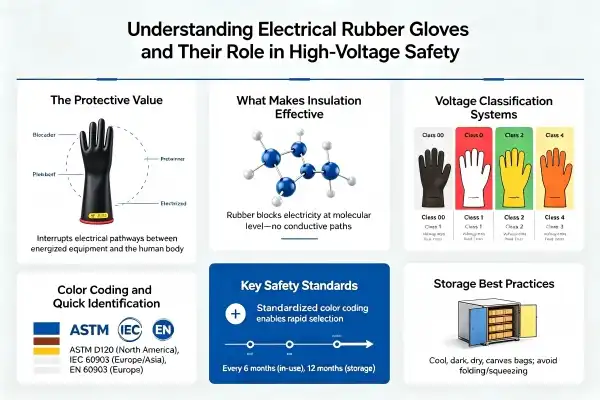
The protective value of insulating gloves lies in their ability to interrupt electrical pathways between energized equipment and the human body. At PPE MAX, we have witnessed how proper glove selection transforms safety outcomes across 134 countries where our products serve frontline electrical workers.
What Makes Electrical Insulation Effective
Insulating gloves made of rubber work by blocking the flow of electricity at the molecular level. The vulcanised rubber structure doesn't have any conductive paths, so electricity has to find other ways to get to ground instead of going through the material and through the worker's body. This dielectric strength is carefully tested at levels higher than its working rates. This makes sure that it is reliable even when it is under a lot of stress. Since 1956, when we started making these important safety tools, we've seen that gloves that don't work right are almost always due to poor upkeep or damage that wasn't noticed.
Voltage Classification Systems Explained
The framework of the rating makes it easy to see the levels of safety right away. Class 00 gloves with brown marks protect people who work with circuits that are up to 500 volts AC. This makes them perfect for installing smart meters and doing work on utilities for homes. Class 0 gloves, which can be identified by their red stickers and meet ASTM D120 standards, protect against up to 1,000 volts AC and can be used for repair on control panels and battery service for electric vehicles. Classes 1, 2, 3, and 4 are the higher classes. Class 3 gloves can handle a maximum power of 26,500 volts AC, which is necessary for maintaining the distribution grid and running substations. Proof tests are done on each classification at voltages much higher than their working ratings. For example, Class 0 gloves are tested at 5,000 volts AC to make sure they have enough safety gaps.
Color Coding and Quick Identification
Beyond voltage ratings, manufacturers employ standardized color coding for electrical rubber gloves that enables rapid glove selection during emergency response situations. Red labels indicate Class 0 protection, white labels designate Class 1, yellow identifies Class 2, green marks Class 3, and orange signals Class 4. This visual system prevents potentially fatal errors when workers transition between tasks involving different voltage levels throughout their workday while using electrical rubber gloves.
Key Safety Standards and Testing Procedures for Electrical Rubber Gloves
International regulatory frameworks establish non-negotiable performance benchmarks that govern manufacturing, testing, and field deployment of insulating gloves. Procurement professionals must verify compliance documentation before integrating any gloves into their PPE programs.
Certification Requirements Across Global Markets
International trade in electricity safety tools is based on three main standards. In North American markets, ASTM D120 sets the rules for standards. It describes physical qualities, electrical testing methods, and performance levels. IEC 60903 sets the rules for both European and Asian markets, with testing methods that are close but not the same. EN 60903 is the European version of the IEC standards, which include some extra needs for the area. At PPE MAX, our production methods are in line with all three models at the same time. This makes compliance easy, no matter what market the product is going to. This multi-standard method makes buying easier for businesses that work in more than one region.
Mandatory Testing Intervals and Protocols
Electrical tests have to be done on gloves on a regular basis, even if there are no obvious signs of damage. Every six months after gloves are put to use, ASTM F496 and OSHA 1910.137 say they must be tested. Storage material needs to be tested within twelve months of being given to workers. For the electrical test, gloves are inflated underwater while voltage is applied to find current leaking through insulation that isn't working right. Before the electrical test, the product is visually inspected to look for foreign objects, changes in structure that could mean ozone decay, and damage from mechanical stress. Having ties with approved testing labs that provide paperwork that meets OSHA inspection standards is helpful for companies that keep a lot of gloves on hand.
Storage Best Practices That Extend Service Life
Proper storage has a direct effect on how long gloves last and how well they work. We tell our clients to keep their storage places cool, dark, and dry, and to keep them away from direct sunshine and things that produce ozone, like electric motors and welding tools. With the gloves' cuffs down to avoid stress focus, canvas bags are great for storing things. When you fold or squeeze gloves, you make weak spots where dielectric failure could happen when they are exposed to voltage. Extreme temperatures speed up the wear and tear on rubber, which is why climate-controlled storage is especially important in places with tough weather. These rules, which come from decades of experience in the field, keep gloves from being retired too soon and make the best use of budgets for purchases.
Comparing Electrical Rubber Gloves: Making Informed Procurement Decisions
Material science advances have expanded options available to procurement teams for electrical rubber gloves, requiring evaluation of competing priorities, including protection level, tactile sensitivity, durability, and cost efficiency.
Material Type Considerations
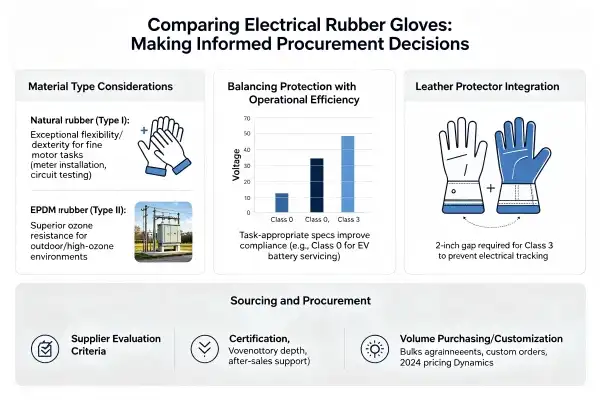
Natural rubber dominates Type I glove construction, offering exceptional flexibility and dexterity that enables manipulation of small components and precise tool control. This flexibility proves particularly valuable during meter installation, circuit testing, and maintenance requiring fine motor control. Type II gloves utilize EPDM (ethylene propylene diene monomer) rubber, sacrificing some flexibility to gain superior ozone resistance. EPDM construction suits outdoor applications and environments with high ozone exposure from electrical equipment. When our team tests both material types, the dexterity difference becomes apparent in tasks requiring sustained precision, though both materials provide equivalent dielectric protection within their rated voltage class.
Balancing Protection with Operational Efficiency
Voltage rating selection requires analysis of actual workplace exposures rather than defaulting to maximum protection levels. Specifying Class 3 gloves for tasks involving only 480-volt circuits unnecessarily reduces worker dexterity and increases fatigue during extended wear periods. Class 0 insulating gloves adequately protect technicians servicing EV battery packs operating between 400 and 800 volts while maintaining the tactile sensitivity needed for connector manipulation and diagnostic equipment operation. This task-appropriate specification improves compliance by reducing the discomfort that tempts workers to bypass PPE protocols.
Leather Protector Integration
Rubber insulating gloves require leather protector overgloves in all applications. The leather layer shields the rubber from punctures, cuts, and abrasions that would compromise dielectric integrity. Protector gloves must fit properly without extending beyond the rubber glove cuff, maintaining a minimum two-inch gap for Class 3 applications to prevent electrical tracking across the interface. This two-component system addresses both electrical and mechanical hazards simultaneously.
Sourcing and Procurement: Where and How to Buy Electrical Rubber Gloves for Your Business
Strategic supplier partnerships determine whether safety equipment programs succeed or create vulnerabilities through quality inconsistencies, delivery failures, or certification gaps.
Supplier Evaluation Criteria
Certification authenticity represents the foundation of supplier assessment. Requesting copies of ASTM, IEC, and EN test reports from accredited laboratories verifies that gloves meet published specifications rather than relying on manufacturer claims alone. Inventory depth indicates supplier capacity to fulfill urgent orders when workplace incidents damage gloves or operational expansions increase workforce size. After-sales support, including technical consultation, sizing guidance, and training resources, adds value beyond product delivery. We built PPE MAX's reputation by maintaining a comprehensive inventory across all voltage classes and responding to urgent requirements with expedited shipping that keeps operations running safely.
Volume Purchasing and Customization Options
Bulk purchasing arrangements provide cost advantages while ensuring supply continuity for organizations managing large workforces. Negotiating annual supply agreements locks in pricing despite market fluctuations and guarantees inventory allocation during shortage periods. Custom orders accommodate specialized requirements such as extended cuff lengths for additional forearm protection, company branding for inventory control, or packaging configurations optimized for specific storage systems. Our OEM manufacturing capabilities, developed over six decades, enable production flexibility that standard catalog offerings cannot match.
Understanding 2024 Pricing Dynamics
Raw material costs, certification expenses, and testing requirements establish baseline pricing structures that vary by voltage class and order volume. Class 00 gloves typically range from moderate to mid-tier pricing, while Class 3 and Class 4 gloves command premium prices reflecting their specialized construction and limited production volumes. Comparing suppliers requires evaluation of the total cost of ownership, including testing services, replacement frequency based on durability, and logistics expenses, rather than focusing solely on unit price. Organizations achieving the lowest total cost typically partner with experienced electrical rubber glove manufacturers offering integrated solutions rather than purchasing from commodity distributors.
Best Practices for Using Electrical Rubber Gloves in High-Voltage Equipment Handling
Procurement excellence means nothing if field implementation fails to translate product capabilities into actual worker protection. Comprehensive programs integrate equipment, training, and maintenance protocols into cohesive safety systems.
Training Programs That Drive Compliance
Effective training begins with demonstrating why insulating gloves matter through case studies of prevented injuries and near-miss incidents. Workers who understand the physiological effects of electrical shock and the protective mechanism of dielectric barriers become advocates rather than resistant participants. Hands-on practice with proper donning sequences, air inflation pre-use checks, and correct integration with leather protectors builds confidence and muscle memory. Refresher training at six-month intervals, coinciding with glove testing, maintains awareness and addresses complacency that develops during incident-free periods.
Inspection Routines Before Each Use
Pre-use inspection represents the final defense against electrical rubber glove failure. Workers should visually examine electrical rubber gloves under good lighting, looking for embedded conductors, texture changes, punctures, or tears. The air inflation test involves trapping air inside the glove by rolling the cuff, then observing whether the glove maintains pressure or slowly deflates, indicating a leak. This simple field test takes thirty seconds but detects damage that laboratory testing might not identify if it occurred after the glove's last formal inspection.
Integration with Complete PPE Systems
Insulating gloves function within broader electrical safety protocols, including voltage-rated sleeves for forearm protection, arc-rated clothing, face shields, and safety footwear. Regulatory standards such as NFPA 70E specify PPE ensembles based on incident energy analysis and arc flash boundaries. Organizations achieving superior safety outcomes implement layered protection rather than relying on single protective elements. Our experience supplying complete PPE solutions across mining, energy, and manufacturing sectors demonstrates that integrated approaches reduce incidents more effectively than fragmented equipment selections.
Maintenance Schedules That Preserve Protection
Beyond mandatory six-month electrical testing, establishing cleaning protocols after exposure to contaminants extends glove service life. Manufacturer guidelines typically recommend mild soap and water for routine cleaning, avoiding petroleum-based solvents that degrade rubber compounds. Thorough drying before storage prevents moisture-related deterioration. Tracking individual glove service history through identification numbers enables retirement of gloves approaching manufacturer-specified maximum service life even when testing results remain acceptable.
Conclusion
Electrical shielding gloves are a must-have for workers in industrial, power, and building settings who are exposed to high voltage dangers. To be good at procurement, you need to know how voltage classification systems work, make sure that they follow ASTM, IEC, and EN standards, and work with sellers who offer approved products backed by technical knowledge. The best way to improve safety and lower the total cost of ownership is to choose materials that balance the amount of protection with how well they work and make sure they are stored properly. The success of implementation relies on thorough training programs, daily check schedules, and full PPE systems that are intended to deal with electrical shock, arc flash, and mechanical dangers all at the same time. When companies put these things at the top of their list of priorities, they protect their most valuable assets: the skilled workers who keep key systems running safely and efficiently.
FAQ
1. What distinguishes Class 0 from Class 00 insulating gloves for procurement decisions?
Class 00 gloves protect workers handling circuits up to 500 volts AC and 750 volts DC, making them suitable for residential utility work, smart meter installations, and low-voltage control systems. Class 0 gloves extend protection to 1,000 volts AC and 1,500 volts DC, accommodating industrial control panel maintenance, EV battery servicing, and secondary distribution line work. The classification difference reflects both proof test voltages and maximum use voltages, with Class 0 gloves tested at 5,000 volts AC compared to Class 00 testing at 2,500 volts AC. Procurement teams should specify Class 0 for industrial environments where voltage exposures regularly approach or exceed 500 volts, while Class 00 suits applications with confirmed lower voltage exposure and requirements for maximum dexterity.
2. How should leather protector gloves fit relative to rubber insulating gloves?
Leather protectors must cover the rubber glove completely without extending beyond the rubber cuff. This configuration prevents mechanical damage to the rubber while avoiding electrical tracking across the leather-rubber interface. A minimum two-inch gap between leather and rubber cuff edges applies to Class 3 applications, with proportional spacing for other classes based on voltage ratings. Improperly sized protectors that extend beyond rubber cuffs create pathways for current to bypass the insulating barrier, negating the primary protective function.
Partner with PPE MAX for Certified Electrical Rubber Gloves Solutions
PPE MAX brings 68 years of electrical safety expertise to organizations requiring dependable electrical rubber gloves backed by genuine certifications and proven field performance. As the largest PPE manufacturer in Northwest China, we maintain a comprehensive inventory across all voltage classes from Class 00 through Class 4, ensuring immediate availability for both routine procurement and emergency requirements. Our manufacturing capabilities extend beyond standard catalog offerings to include OEM and ODM solutions for electrical rubber gloves tailored to your specific operational requirements, workforce demographics, and branding preferences. Every glove leaving our facility undergoes rigorous testing protocols meeting ASTM, IEC, and EN standards, documented with certificates traceable to accredited laboratories. When you contact our team at marketing@ppemax.com you connect with electrical rubber gloves supplier specialists who understand the procurement challenges facing industrial safety distributors, infrastructure developers, and safety managers across 134 countries. We invite procurement professionals to discuss how our end-to-end solutions—from technical consultation through customized manufacturing and logistics support—can strengthen your electrical safety programs while optimizing your PPE investment.
References
1. American Society for Testing and Materials. (2021). ASTM D120-20: Standard Specification for Rubber Insulating Gloves. ASTM International, West Conshohocken, PA.
2. Occupational Safety and Health Administration. (2020). 29 CFR 1910.137: Electrical Protective Equipment Standards. U.S. Department of Labor, Washington, DC.
3. International Electrotechnical Commission. (2022). IEC 60903:2022: Live Working – Electrical Insulating Gloves. IEC Central Office, Geneva, Switzerland.
4. National Fire Protection Association. (2021). NFPA 70E: Standard for Electrical Safety in the Workplace, 2021 Edition. NFPA, Quincy, MA.
5. American Society for Testing and Materials. (2019). ASTM F496-19: Standard Specification for In-Service Care of Insulating Gloves and Sleeves. ASTM International, West Conshohocken, PA.
6. European Committee for Electrotechnical Standardization. (2020). EN 60903:2003+A11:2020: Live Working – Electrical Insulating Gloves. CENELEC, Brussels, Belgium.
Learn about our latest products and discounts through SMS or email