- English
- French
- German
- Portuguese
- Spanish
- Russian
- Japanese
- Korean
- Arabic
- Greek
- German
- Turkish
- Italian
- Danish
- Romanian
- Indonesian
- Czech
- Afrikaans
- Swedish
- Polish
- Basque
- Catalan
- Esperanto
- Hindi
- Lao
- Albanian
- Amharic
- Armenian
- Azerbaijani
- Belarusian
- Bengali
- Bosnian
- Bulgarian
- Cebuano
- Chichewa
- Corsican
- Croatian
- Dutch
- Estonian
- Filipino
- Finnish
- Frisian
- Galician
- Georgian
- Gujarati
- Haitian
- Hausa
- Hawaiian
- Hebrew
- Hmong
- Hungarian
- Icelandic
- Igbo
- Javanese
- Kannada
- Kazakh
- Khmer
- Kurdish
- Kyrgyz
- Latin
- Latvian
- Lithuanian
- Luxembou..
- Macedonian
- Malagasy
- Malay
- Malayalam
- Maltese
- Maori
- Marathi
- Mongolian
- Burmese
- Nepali
- Norwegian
- Pashto
- Persian
- Punjabi
- Serbian
- Sesotho
- Sinhala
- Slovak
- Slovenian
- Somali
- Samoan
- Scots Gaelic
- Shona
- Sindhi
- Sundanese
- Swahili
- Tajik
- Tamil
- Telugu
- Thai
- Ukrainian
- Urdu
- Uzbek
- Vietnamese
- Welsh
- Xhosa
- Yiddish
- Yoruba
- Zulu
Which Insulating Gloves Offer the Best Comfort and Durability?
Founded in 1956, PPEMAX stands as a premier global manufacturer and supplier of full-range personal protective equipment. All our products comply with internationally recognized standards including IEC, ASTM, CE, UKCA, NIOSH and ISO9001. Equipped with a 2,000-square-meter modern production plant, we boast over 25 years of mature OEM & ODM capabilities to deliver one-stop customized solutions covering R&D design through worldwide logistics. Our safety gear is distributed across 134 countries globally. Upholding our core tenet “Safety First, Quality Priority”, we serve as a dependable long-term PPE partner for industrial enterprises around the world.
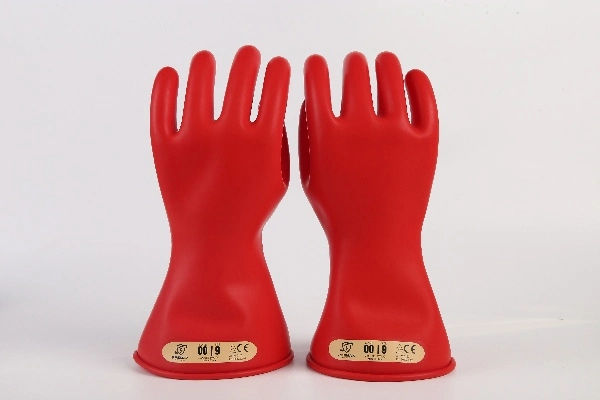
When buying electrical protective gloves for a big workforce, comfort and durability are not secondary considerations; they directly impact worker compliance and safety results. The best insulating gloves are a compromise between dielectric protection, tactile sensitivity, and structural durability. Gloves certified Class 00 for 500V AC according to international standards like ASTM D120 and IEC 60903 are an easy option for low-voltage applications. Made with high-grade natural rubber latex and ergonomically shaped for long shifts without compromising the quality of the protection.
|
Parameter |
Type I (Natural Rubber) |
Type II (Synthetic/EPDM) |
|
Maximum Use Voltage |
500V AC / 750V DC |
500V AC / 750V DC |
|
Proof Test Voltage |
2,500V AC / 10,000V DC |
2,500V AC / 10,000V DC |
|
Maximum Thickness |
0.75mm (30 mils) |
0.75mm (30 mils) |
|
Length Options |
11-14 inches |
11-14 inches |
|
Color Code |
Beige Label |
Beige Label |
|
Temperature Range |
Standard |
Extended (-25°C to +55°C) |
|
UV/Ozone Resistance |
Standard |
Enhanced |
Understanding Insulating Gloves: Materials and Safety Standards
What Are Insulating Gloves Made Of?
Most electrical-rated gloves are made from natural rubber latex, which is flexible and has a high dielectric strength. Some gloves employ synthetic mixes like EPDM for enhanced resistance to ozone and UV radiation. Leather gloves are commonly worn over rubber-insulated gloves for protection against mechanical injury; . The result is many levels of protection that protect you from the electrical and physical hazards you may encounter on the job.
How Voltage Ratings and Color Coding Work
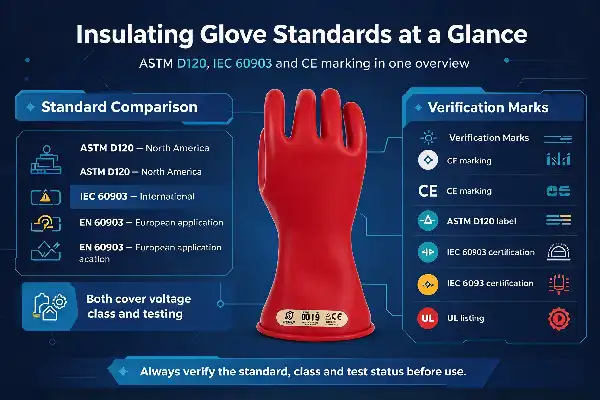
The voltage class of a glove is the basis for the safe range of its usage. Class 00 gloves are capable of handling up to 500V AC and 750V DC. Each class includes a consistent color label per IEC 60903 and ASTM D120 for easy identification on the work site. Most of the time, Class 00 has a beige label and Class 0 has a red label. These color codes allow supervisors and procurement officials to rapidly verify that the proper level of protection is being employed.
Why International Standards Matter for B2B Buyers
Compliance with ASTM D120, IEC 60903, and CE marking is necessary. You cannot ignore this. It is a question of purchasing risk management. Employers using non-certified gloves expose themselves to OSHA violations, liability lawsuits, and worker injuries. For bulk purchasers in many countries, buying gloves that are certified to both ASTM and IEC standards can save compliance costs and paperwork associated with cross-border sourcing.
Comparing Types of Insulating Gloves: Comfort and Durability Insights
Rubber vs. Leather vs. Composite Gloves
Natural rubber gloves are still the norm for electrical shielding since they are flexible and non-conductive. Leather insulating gloves are used as protection over rubber gloves. This makes the hands less sensitive to touch, but more wear-resistant. Composite gloves, comprised of rubber and other synthetic materials, strive to fill both demands. Thin rubber gloves like Class 00 kinds are the ideal option for low-voltage environments since they allow your movement without losing insulation.
How Insulating Gloves Differ from General-Purpose Work Gloves
There is a common misconception that home rubber gloves or general cut-resistant gloves are equivalent to authorized electrical protection gloves. Normal rubber gloves have no voltage rating; thus, they won't protect you from being electrocuted. Fire-resistant gloves guard against heat hazards, not dielectric hazards. Even if they seem quite similar, you should only use gloves that have been tested and authorized under ASTM D120 or IEC 60903 while dealing with live electricity.
Leading Brands and What They Offer
When we talk about electrical protection gloves, many people recognize the brands Ansell and Honeywell. The Ansell Electrotek line is characterized by flat dielectric strength and a comfortable cuff. Honeywell’s Salisbury line is trusted in utility applications because it’s tested to last. But for large-scale sourcing, procurement teams typically seek beyond brand familiarity. They also ranked certification consistency, delivery dependability, and unit cost as their top three. This is particularly the case if they are processing frequent orders across a number of locations.
If you're evaluating personal protective equipment suppliers and require batch-specific testing documents before placing an order, PPE MAX is able to provide official Certificates of Analysis, professional laboratory test reports, and product samples for your verification. Feel free to contact our team at marketing@ppemax.com to discuss your sourcing needs and obtain complete documentation for your quality assessment and procurement approval.
Key Factors Influencing Comfort and Durability in Insulating Gloves
Ergonomics: Fit, Flexibility, and Weight
If you are doing the same action over and again, comfort in gloves is all about how well the glove fits your hand. The thicker the glove, the harder it is to move your fingers. If it’s too loose, it’ll wear you out and make it tougher to get an appropriate hold. PPE MAX Class 00 glove is light enough to wear for extended periods of time yet durable enough to preserve its form, with an average width of 0.5 mm. They come in sizes 8-11, so they can accommodate a huge workforce with a wide variety of hand sizes.
Durability Factors: Ozone Resistance and Maintenance
Rubber degrades over time when exposed to UV radiation and chemicals such as ozone. Non-ozone-resistant gloves crack on the exterior, which makes them less insulated. PPE MAX Class 00 gloves are manufactured from natural rubber that does not break down in ozone, so they last longer. Proper storage away from direct sunshine, heat, and sharp objects will also considerably prolong the functional life of products. Gloves should be laid flat or wrapped up in their original package to prevent them from being squashed.
Testing Intervals and Glove Integrity
Electrical testing of protective gloves is required by ASTM D120 and IEC 60903 to be carried out every six months or before use if there is any cause to believe that they are not 100%. A simple field inflation test before each shift may detect holes or rips visible to the eye. Procurement teams should evaluate suppliers on the whole cost of ownership and not only the purchase price of the unit. This includes retest cost and timeline.
How to Choose the Best Insulating Gloves for Your Procurement Needs
Match Voltage Class to the Work Environment
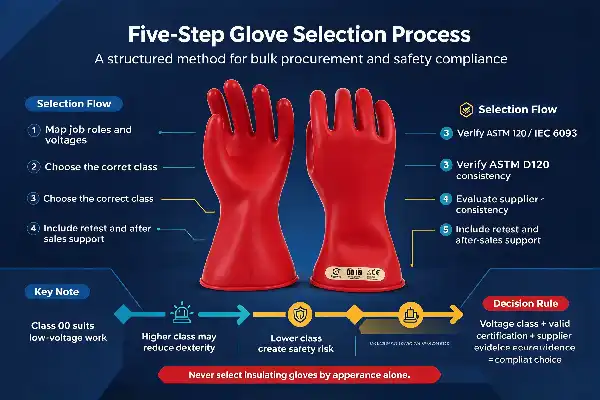
The first step is to figure out what the highest voltage is that workers will be exposed to. Class 00 gloves are the right choice for low-voltage electrical repair, telecommunications installations, HVAC service, and lab tests with voltages below 500V AC. If you choose a better class than you need, it costs more and makes you less flexible. If you choose a lower class, there is a clear safety risk. Before finalizing specifications, procurement officers should write down the voltage range for each job role.
Evaluate Certification and Supplier Credibility
Certification papers should be able to be checked. Ask sellers for up-to-date test papers that list the testing lab, the date of the test, and the voltage class. Check to see if the certification covers both ASTM D120 and IEC 60903 when buying globally. This will make sure that the gloves can be used in both North American and international settings. Don't buy from wholesalers who can't give you original test documents.
Bulk Purchasing and Cost Trade-Offs
Buying in bulk lowers the cost per unit, but only if the quality stays the same from batch to batch. Here are the most important things that procurement teams should look at when evaluating suppliers:
- Certification traceability: Can the supplier provide test records for each production batch?
- Customization support: Does the supplier offer OEM or private-label options for branded safety programs?
- Lead time and logistics: Can the supplier reliably fulfill recurring orders with consistent carton specifications?
- After-sales support: Does the supplier provide technical training, product documentation, and responsive issue resolution?
These factors help procurement teams keep the supply chain running smoothly and make sure that all operating areas follow safety rules.
Procurement Guide: Where and How to Buy High-Quality Insulating Gloves
Trusted Sourcing Channels for B2B Buyers
There are three main ways to get bulk insulating gloves: industrial safety wholesalers, wholesale PPE sites, and direct maker ties. Direct buying from the maker usually gives you the best price-to-quality ratio, especially for orders that come in more than 100 pairs per shipment. In addition, buyers can directly discuss the terms of shipping, labeling, and packaging.
PPE MAX Class 00 Insulating Gloves: Specifications at a Glance
Class 00 insulated gloves made by PPE MAX are approved by both IEC 60903 and ASTM D120. The following are the product specs:
- Maximum Use Voltage: 500V AC / 750V DC
- AC Proof Test Voltage: 2,500V
- Material: High-grade natural rubber latex
- Available Lengths: 11 inches (280mm) or 14 inches (360mm)
- Sizes: 8, 9, 10, 11
- Colors: Red / Black
- Reference Weight: 170g
- Packing: 1 pair/box, 20 pairs/carton (CTN: 54.5×35×42.5cm, 6.5kg)
500V AC or 750V DC is the highest voltage that can be used.
Each carton is sized for efficient freight consolidation, and individual box packaging protects glove integrity during transit and storage. Sample orders are available for quality verification before committing to bulk contracts.
Conclusion
The appropriate electrical glove selection influences the safety of the workers and the efficiency of the purchase process. For applications below 500V, Class 00 insulating gloves are the best option. The finest have proven dielectric performance, comfortable design, and materials that won’t break down in ozone. PPE MAX has been manufacturing certified safety gear since 1956 that fulfills the criteria of ASTM D120 and IEC 60903. They are sold in more than 134 countries. If your organization buys a lot of PPE, dealing directly with a manufacturer of this level reduces risk, saves money, and guarantees every order of the same quality.
FAQ
1. How often should insulating gloves be electrically retested?
Under ASTM D120 and IEC 60903, electrical protective gloves must be retested every six months from the date of last test. They should also be tested immediately if there is any visible damage, contamination, or reason to question their integrity before use.
2. Can Class 00 gloves protect against fire or arc flash?
No. Class 00 gloves are rated for dielectric protection only—they guard against electrical shock up to 500V AC. They do not provide arc flash or thermal protection. For arc flash hazards, additional arc-rated PPE must be worn in combination with the appropriate insulating gloves.
3. What does the color code on insulating gloves indicate?
Color codes identify the voltage class of the glove. Under IEC 60903 and ASTM D120, Class 00 gloves carry a beige label, Class 0 gloves carry a red label, and higher classes follow a defined sequence. These markings allow quick visual verification that the correct glove class is being used for the task voltage.
4. Are PPE MAX Class 00 gloves available in custom sizes or colors?
PPE MAX offers customization options including OEM labeling and custom packaging for bulk orders. Standard sizes available are 8, 9, 10, and 11, in red or black. Contact the team directly to discuss specific requirements.
Source Your Class 00 Insulating Gloves Through PPE MAX
With more than 60 years of proven production experience, PPE MAX is a reliable company that makes insulating gloves. Our Class 00 gloves are certified by both ASTM D120 and IEC 60903. They are shipped to more than 134 countries and are available through OEM and private-label programs for customers around the world. Ask for a sample or bulk quote right now to see for yourself how reliable the quality is. You can email our purchasing team at marketing@ppemax.com to see the whole product catalog.
References
1. ASTM International. ASTM D120: Standard Specification for Rubber Insulating Gloves. ASTM International, 2023.
2. International Electrotechnical Commission. IEC 60903: Live Working—Gloves of Insulating Material. IEC, 2022.
3. National Fire Protection Association. NFPA 70E: Standard for Electrical Safety in the Workplace. NFPA, 2024.
4. Occupational Safety and Health Administration. OSHA 29 CFR 1910.137: Electrical Protective Equipment. U.S. Department of Labor, 2023.
5. American National Standards Institute. ANSI/ISEA 105: Hand Protection Selection Criteria. ANSI, 2022.
6. Professional Safety Journal. "Evaluating Dielectric Glove Performance and Compliance in Industrial Environments." American Society of Safety Professionals, 2023.
Learn about our latest products and discounts through SMS or email