- English
- French
- German
- Portuguese
- Spanish
- Russian
- Japanese
- Korean
- Arabic
- Greek
- German
- Turkish
- Italian
- Danish
- Romanian
- Indonesian
- Czech
- Afrikaans
- Swedish
- Polish
- Basque
- Catalan
- Esperanto
- Hindi
- Lao
- Albanian
- Amharic
- Armenian
- Azerbaijani
- Belarusian
- Bengali
- Bosnian
- Bulgarian
- Cebuano
- Chichewa
- Corsican
- Croatian
- Dutch
- Estonian
- Filipino
- Finnish
- Frisian
- Galician
- Georgian
- Gujarati
- Haitian
- Hausa
- Hawaiian
- Hebrew
- Hmong
- Hungarian
- Icelandic
- Igbo
- Javanese
- Kannada
- Kazakh
- Khmer
- Kurdish
- Kyrgyz
- Latin
- Latvian
- Lithuanian
- Luxembou..
- Macedonian
- Malagasy
- Malay
- Malayalam
- Maltese
- Maori
- Marathi
- Mongolian
- Burmese
- Nepali
- Norwegian
- Pashto
- Persian
- Punjabi
- Serbian
- Sesotho
- Sinhala
- Slovak
- Slovenian
- Somali
- Samoan
- Scots Gaelic
- Shona
- Sindhi
- Sundanese
- Swahili
- Tajik
- Tamil
- Telugu
- Thai
- Ukrainian
- Urdu
- Uzbek
- Vietnamese
- Welsh
- Xhosa
- Yiddish
- Yoruba
- Zulu
Application of Class 1 Insulating Gloves in Utility & Industrial Fields
Class 1 Insulating Gloves represent a critical safety barrier for workers exposed to electrical hazards up to 7,500 volts in utility and industrial environments. These specialized protective devices combine advanced materials with rigorous engineering standards to deliver reliable protection against electrical shock incidents. Understanding their proper application across diverse industrial sectors enables safety managers and procurement professionals to make informed decisions that protect their workforce while maintaining operational efficiency and regulatory compliance.
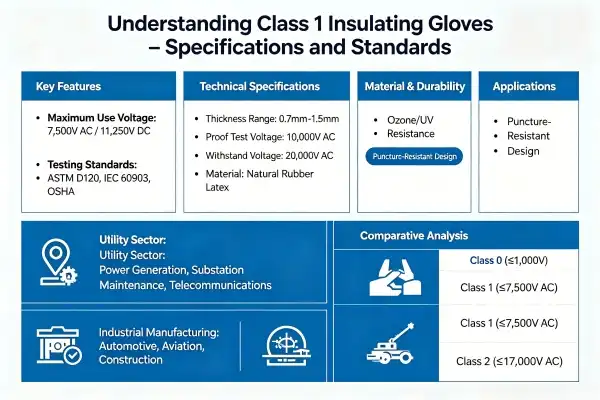
Understanding Class 1 Insulating Gloves – Specifications and Standards
Class 1 electrical safety gloves provide essential protection for workers operating in medium-voltage environments, with a maximum use voltage rating of 7,500V AC and 11,250V DC. These protective devices undergo extensive testing protocols to meet international safety standards, including ASTM D120, IEC 60903, and OSHA requirements.
Technical Specifications and Performance Parameters
The Class 1 Insulating Gloves these defensive gloves reflects decades of security advancement and fabric science headway. Our Lesson 1 electrical defensive gloves highlight a thickness range of 0.7mm to 1.5mm, giving ideal adjust between assurance and smoothness. The confirmation test voltage comes to 10,000V AC, whereas the withstand voltage amplifies to 20,000V AC, guaranteeing significant security edges past ordinary working conditions. Manufacturing forms utilize high-quality characteristic elastic latex that conveys predominant electrical separator properties, whereas keeping up adaptability basic for complex manual tasks. The ergonomic plan consolidates color-coded sleeves for simple, recognizable proof and classification, diminishing the chance of selecting improper security levels during basic operations.
Material Composition and Durability Features
Natural elastic development gives remarkable resistance to ozone and UV degradation, amplifying the benefits of life indeed beneath challenging natural conditions. The puncture-resistant plan withstands normal working environment risks whereas keeping up electrical judgment all through expanded utilize periods. Quality control forms guarantee steady divider thickness and kill fabrication errors that may compromise defensive capabilities.
Application of Class 1 Insulating Gloves in Utility and Industrial Sectors
Electrical safety gloves serve diverse applications across multiple industry segments, each presenting unique challenges and safety requirements. Understanding these specific use cases helps procurement professionals select appropriate protection levels and quantities for their operations.
Utility Sector Applications
Power era and dispersion offices depend intensely on Lesson 1 defensive gloves for schedule support and crisis reaction operations. Substation laborers performing exchange operations, meter installations, and transformer upkeep depend on solid electrical cover to anticipate genuine wounds. Line teams working on conveyance frameworks up to 7,500 volts require gloves that combine security with the adroitness required for exact device control and wire handling. Telecommunications framework upkeep presents comparable challenges where specialists experience different voltage levels while introducing or repairing communication systems. The adjusted security advertised by Lesson 1 gloves makes them perfect for these applications where both security and operational proficiency matter.
Industrial Manufacturing Applications
Manufacturing situations in the car, aviation, and common mechanical segments consolidate electrical frameworks that drop inside Lesson 1 voltage ranges. Generation line specialists, support professionals, and quality control staff benefit from the assurance these gloves give during gear overhauling and electrical investigation activities. Construction locales utilizing electrical hardware and brief control frameworks require dependable defensive gear that withstands demanding conditions, while providing steady security execution. The strength and adaptability of quality Course 1 gloves empower laborers to perform complex assignments without compromising security levels.
Comparative Analysis with Other Protection Classes
Class 1 gloves occupy a strategic position between Class 0 (maximum 1,000V) and Class 2 (maximum 17,000V) protection levels. This intermediate rating makes them particularly suitable for applications where Class 0 protection proves insufficient, while Class 2 gloves may be unnecessarily bulky or expensive. The balanced approach provides cost-effective protection for the majority of utility and industrial electrical work.
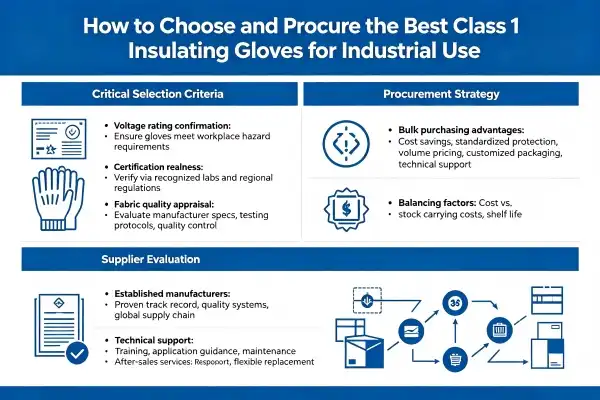
How to Choose and Procure the Best Class 1 Insulating Gloves for Industrial Use?
Successful procurement of electrical safety gloves requires careful evaluation of technical specifications, supplier capabilities, and total cost of ownership considerations. B2B buyers must balance immediate cost concerns with long-term safety performance and compliance requirements.
Critical Selection Criteria for B2B Procurement
Voltage rating confirmation stands as the essential choice basis, guaranteeing the chosen gloves give satisfactory security for particular work environment dangers. Certification realness requires confirmation through recognized testing research facilities and compliance with pertinent territorial guidelines. Fabric quality appraisal includes assessing producer determinations, testing conventions, and quality control processes. Class 1 Insulating Gloves are pivotal when overseeing large-scale acquisition operations over numerous offices. Setting up producers with demonstrated track records, comprehensive quality frameworks, and worldwide supply chain capabilities offers more prominent affirmation of reliable product accessibility and execution standards.
Procurement Strategy and Supplier Evaluation
Bulk obtaining methodologies can convey critical taken a toll focal points while guaranteeing standardized assurance levels over organizational operations. Volume commitments frequently open particular estimating, customized bundling alternatives, and improved specialized back-end administrations. Be that as it may, buyers must adjust taken a toll investment funds against stock carrying costs and item rack life considerations. Technical bolster accessibility impacts long-term obtainment esteem through training programs, application direction, and support proposals. Providers advertising comprehensive after-sales benefits, including responsive client support and adaptable substitution arrangements, give extra esteem past introductory item costs.
Xi'An PPE MAX Co., Ltd: Your Trusted Class 1 Insulating Gloves Manufacturer & Supplier
PPE MAX brings over 65 years of defensive gear fabrication ability to the worldwide electrical security showcase. Our Lesson 1 electrical protection gloves combine progressive materials innovation with thorough quality control forms to convey steady assurance for utility and mechanical applications worldwide.
Product Excellence and Manufacturing Capabilities
Class 1 Insulating Gloves offices in Xi'an, China, utilize state-of-the-art generation gear and comprehensive quality control frameworks to guarantee each pair of gloves meets or surpasses universal security measures. The generation process consolidates numerous testing stages, from crude material confirmation through final electrical testing, ensuring dependable execution in basic applications. Customization capabilities empower us to meet particular client prerequisites for measuring, bundling, and execution characteristics. Whether you require standard arrangements or specialized arrangements for one-of-a-kind applications, our building group works closely with clients to create ideal defensive solutions.
Global Supply Chain and Service Excellence
Our broad conveyance arrange ranges 134 nations, guaranteeing solid item accessibility and responsive client benefit over different markets. The worldwide supply chain joins vital stock situating and adaptable coordination capabilities to meet critical conveyance necessities while maintaining cost-effective shipping solutions. Technical bolster administrations incorporate application meeting, preparing program advancement, and progressive upkeep direction. Our group of security specialists works with clients to optimize glove choice, utilization conventions, and substitution plans, maximizing both security execution and cost efficiency.
Conclusion
Class 1 Insulating Gloves serve as crucial defensive hardware for utility and mechanical specialists exposed to medium-voltage electrical risks. Their adjusted plan gives fundamental security assurance while keeping up the ability required for complex specialized tasks. Legitimate determination, acquisition, and upkeep of these defensive gadgets specifically impacts workforce security, administrative compliance, and operational productivity. Organizations contributing to quality electrical security gloves from established producers like PPE MAX benefit from demonstrated security, solid supply chains, and comprehensive specialized support that improves overall security program effectiveness.
FAQ
What distinguishes Class 1 from other insulating glove classifications?
Class 1 gloves protect up to 7,500V AC, positioning them between Class 0 (1,000V) and Class 2 (17,000V) protection levels. This intermediate rating makes them ideal for most utility distribution work and industrial electrical applications without the bulk or expense of higher-class alternatives.
How frequently should Class 1 insulating gloves undergo electrical testing?
OSHA regulations require electrical testing every six months for rubber insulating gloves, with additional visual inspections before each use. Proper testing protocols ensure continued electrical integrity and identify potential damage that could compromise worker safety.
Can Class 1 gloves be used in wet conditions?
While Class 1 gloves maintain their electrical properties when wet, workers must exercise additional caution and follow enhanced safety protocols in damp environments. Proper inspection procedures become even more critical when moisture is present, as water can mask visible defects.
Safeguard Your Workforce with PPE MAX Class 1 Insulating Gloves
PPE MAX stands ready to support your electrical safety requirements with certified Class 1 Insulating Gloves manufactured to the highest international standards. Our comprehensive product line, competitive bulk pricing, and expert technical consultation ensure your organization receives optimal protective solutions tailored to your specific operational needs. Contact our team at marketing@ppemax.com to discuss your requirements and receive detailed specifications for our Class 1 insulating gloves supplier programs.
References
1. National Institute for Occupational Safety and Health. Criteria for a Recommended Standard: Working in Confined Spaces with Electrical Hazards. DHHS Publication No. 2019-106.
2. American Society for Testing and Materials. ASTM D120-14 Standard Specification for Rubber Insulating Gloves. West Conshohocken: ASTM International, 2014.
3. International Electrotechnical Commission. IEC 60903:2019 Live Working - Gloves of Insulating Material. Geneva: IEC Publications, 2019.
4. Occupational Safety and Health Administration. 29 CFR 1910.137 - Electrical Protective Equipment. Washington: Department of Labor, 2021.
5. Institute of Electrical and Electronics Engineers. IEEE Guide for In-Service Use, Care, Maintenance and Testing of Insulating Gloves and Sleeves. IEEE Standard 1048-2016.
6. Canadian Standards Association. CSA Z462-18 Workplace Electrical Safety Standard. Toronto: CSA Group, 2018.
Learn about our latest products and discounts through SMS or email