- English
- French
- German
- Portuguese
- Spanish
- Russian
- Japanese
- Korean
- Arabic
- Greek
- German
- Turkish
- Italian
- Danish
- Romanian
- Indonesian
- Czech
- Afrikaans
- Swedish
- Polish
- Basque
- Catalan
- Esperanto
- Hindi
- Lao
- Albanian
- Amharic
- Armenian
- Azerbaijani
- Belarusian
- Bengali
- Bosnian
- Bulgarian
- Cebuano
- Chichewa
- Corsican
- Croatian
- Dutch
- Estonian
- Filipino
- Finnish
- Frisian
- Galician
- Georgian
- Gujarati
- Haitian
- Hausa
- Hawaiian
- Hebrew
- Hmong
- Hungarian
- Icelandic
- Igbo
- Javanese
- Kannada
- Kazakh
- Khmer
- Kurdish
- Kyrgyz
- Latin
- Latvian
- Lithuanian
- Luxembou..
- Macedonian
- Malagasy
- Malay
- Malayalam
- Maltese
- Maori
- Marathi
- Mongolian
- Burmese
- Nepali
- Norwegian
- Pashto
- Persian
- Punjabi
- Serbian
- Sesotho
- Sinhala
- Slovak
- Slovenian
- Somali
- Samoan
- Scots Gaelic
- Shona
- Sindhi
- Sundanese
- Swahili
- Tajik
- Tamil
- Telugu
- Thai
- Ukrainian
- Urdu
- Uzbek
- Vietnamese
- Welsh
- Xhosa
- Yiddish
- Yoruba
- Zulu
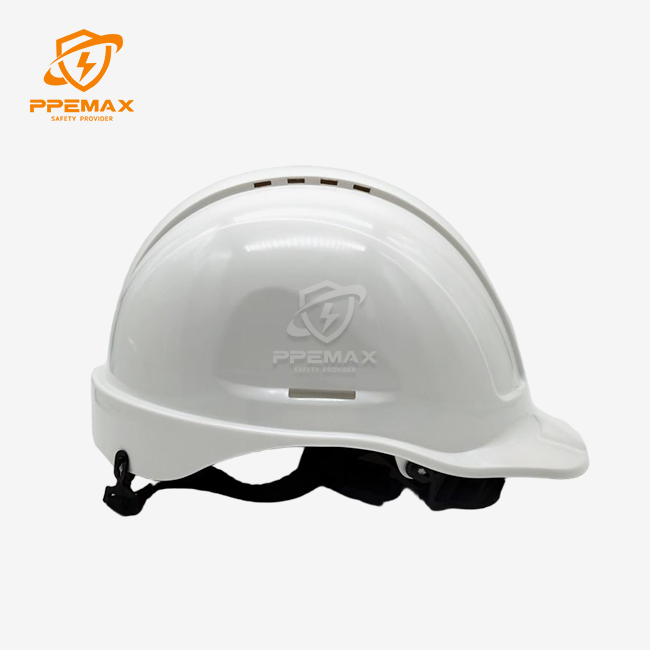
EN397 Safety Helmet
*Material: PE
*Headband: Six-point type
*Style: Knob type or button type
*Color: Red/Yellow/Green/Blue
*Weight: 385±10 gsm
*Certification: EN 397:2012+A1:2012
*Pakcing :25pcs/1ctn
EN397 Safety Helmet – Industrial Head Protection for High-Risk Environments
Xi'An PPE MAX Co., Ltd has been building industrial safety helmets since 1956. Construction crews wear them. So do metallurgy plants and utilities, across Europe and further out. Our Model M100 EN397 Safety Helmet holds certification to EN 397:2012+A1:2012. The shell is made of PE. On the scale it reads 385±10g. A six-point headband keeps it in place, set with a knob or a button. You can order red, yellow, green or blue. Each carton packs 25 pieces. Bulk buying stays simple for safety managers and procurement officers.

Xi'An PPE MAX Co., Ltd: This Product Manufacturer & Supplier
PPE MAX was founded in 1956 with one purpose: protect workers. Over six decades later, that purpose has not changed.
Industrial buyers around the world get certified head protection from us. Years of manufacturing experience sit behind every item we ship. So do quality processes we can document and show.
What Is This Product?
This product counts as Personal Protective Equipment (PPE). It is built to the European Standard EN 397:2012+A1:2012. That standard goes by the full title "Industrial Safety Helmets."
Physical performance requirements are what this standard lays out. Their job is to protect wearers from falling objects. Skull fractures and traumatic brain injuries from vertical impacts become less likely because of them. This is not generic headwear. Testing and certification stand behind it, and the pass/fail criteria are defined.
EU PPE Regulation (EU) 2016/425 applies to businesses. Under it, a compliant helmet counts as the baseline legal requirement. That covers general construction, forestry, and manufacturing sites across Europe. The same holds in regions that adopt EN standards.

Standard Specifications
| Parameter | Details |
|---|---|
| Model | M100 |
| Certification | EN 397:2012+A1:2012 |
| Material | PE (Polyethylene) |
| Headband | Six-point type |
| Adjustment Style | Knob type or button type |
| Weight | 385±10g |
| Available Colors | Red / Yellow / Green / Blue |
| Packing | 25 pcs / carton |
Key Features
PE Shell
Polyethylene forms the shell. Impact resistance and light weight are balanced well by this material, which is why it was picked. Weight comes in at 385±10g. Long shifts stay comfortable at that figure.
Six-Point Headband System
The internal six-point suspension maintains a clearance of 25mm–50mm between the shell and the skull. This gap absorbs kinetic energy during an impact — it is a structural safety function, not only a comfort feature.
Knob or Button Adjustment
Pick knob-type or button-type adjustment. Either choice gives a firm fit you can adjust. The setting then matches how your crew likes to work.
Flame Resistance
Under EN 397, the shell must not continue burning for more than 5 seconds after the removal of a flame source. This is a mandatory requirement of the standard.
Chin Strap Anchorage
The release mechanism is calibrated to fail between 150N and 250N. If the helmet, the EN397 Safety Helmet, is snagged on machinery, the strap releases rather than creating a strangulation risk — a mandatory safety design requirement under EN 397.
Technical Performance – Mandatory Requirements
| Test | Requirement |
|---|---|
| Shock Absorption | Force transmitted ≤ 5.0 kN (5 kg striker, dropped from 1 m) |
| Penetration Resistance | 3 kg conical striker dropped from 1 m must not contact headform |
| Flame Resistance | Shell must not burn > 5 seconds after flame removal |
| Chin Strap Anchorage | Must release between 150N and 250N |
Optional Performance Markings Available
| Marking | Meaning |
|---|---|
| -20°C / -30°C | Extremely low temperature performance |
| +150°C | Very high temperature resistance |
| 440V a.c. | Electrical insulation against live conductors |
| LD | Lateral deformation resistance |
| MM | Molten metal splash resistance |
Applications
General Construction & Infrastructure
Tools and masonry fall on building sites all the time. That is a constant hazard. Under EN 397, the M100 meets the mandatory vertical impact requirement. Color choices support ID systems set up for a specific site.
Heavy Industry & Metallurgy
Molten metal splash is one risk in foundries and steelworks. Lateral crushing is another. Helmets marked MM and LD address both. Shells without vents stop hot liquid from getting in. The PE structure resists deformation from radiant heat.
Utilities & Electrical Maintenance
Electricians and line workers often pick a helmet with the optional 440V a.c. marking. Shells on those helmets are unventilated and insulating. That cuts the chance of a shock if someone brushes low-voltage equipment by accident.


EN397 Safety Helmet Quality Control
Four stages make up the quality inspection of the M100. Each one follows EN 397:
Pre-Conditioning: before impact testing, helmets go through conditioning. Conditioning covers +50°C, -10°C (or lower for low-temperature variants), water immersion, and UV exposure. Such checks confirm the PE shell does not turn brittle in conditions that copy a real site.
Harness & Suspension Check: the six-point headband is inspected for secure attachment. The 25mm–50mm clearance between shell and skull is verified.
Chin Strap Release Calibration: QC checks that the strap lets go somewhere between 150N and 250N. Pull harder than 250N and it fails under EN 397.
Visual Shell Inspection: every helmet gets looked over for crazing. Discoloration and chalking are flagged too. All three point to UV degradation, and to a shell that has reached the end of its service life.
Certifications
- EN 397:2012+A1:2012: Industrial Safety Helmets

Packing
- 25 pcs / 1 carton
- Available colors: Red, Yellow, Green, Blue
- Suitable for bulk orders and container shipments
After-Sales Support
If you have compliance questions about your EN397 Safety Helmet, need replacement documentation, or require product guidance after your order, contact our team directly at bettybing@ppemax.com.
Exhibition & Factory Visits
You will find the PPE MAX team at safety and PPE trade shows around the world. Procurement managers, safety officers, and distributors can book a factory visit. Come and see how we produce and inspect our goods.
FAQ
Q: How long does This product usually last in service?
A: Once it is in use, expect 2 to 5 years. UV exposure and site conditions decide how long it really lasts. Stored in a dark, dry place, away from heat sources and chemicals, a helmet can sit on the shelf for 5–7 years from the manufacture date.
Q: Can I use an EN397 helmet for working at heights or rope access?
A: No. EN 397 chin straps are made to release at forces of 150N to 250N. That range helps prevent strangulation. Climbing or rope access work calls for EN 12492 helmets. They stay on during a fall. They also protect against side impacts, which EN 397 does not require.
Q: Is it okay to put stickers or paint on the helmet shell?
A: Only when the manufacturer approves. Lots of glues and paints have solvents in them. Those solvents can break down the PE shell. Tiny cracks may form. They lower the shell's ability to absorb shock. You may not see any damage on the outside.
Q: What does the "LD" marking mean?
A: LD means Lateral Deformation. A helmet that carries this optional marking has passed one more test, and that test puts pressure on the sides. It matters for tunneling, for trenching, and for confined-space work. In those settings, lateral crushing is a real hazard.
Q: What does the "440V a.c." marking mean?
A: The helmet gives electrical insulation if someone accidentally touches a live conductor for a short time, up to 440V. Shells on helmets with this marking have no vents. That way there are no conductive gaps.
Q: What is the right way to store a helmet so it keeps working?
A: Keep it out of direct sun. Stay clear of heat sources too, and away from chemicals. In PE shells, the main thing that breaks down the polymer is UV radiation. Protective service life drops a lot faster when helmets sit on a vehicle rear shelf or in the open sun.
Contact Us
To request product information, compliance documentation, or a sample for the EN397 Safety Helmet, contact us at bettybing@ppemax.com. We will respond to your inquiry directly.
Learn about our latest products and discounts through SMS or email